
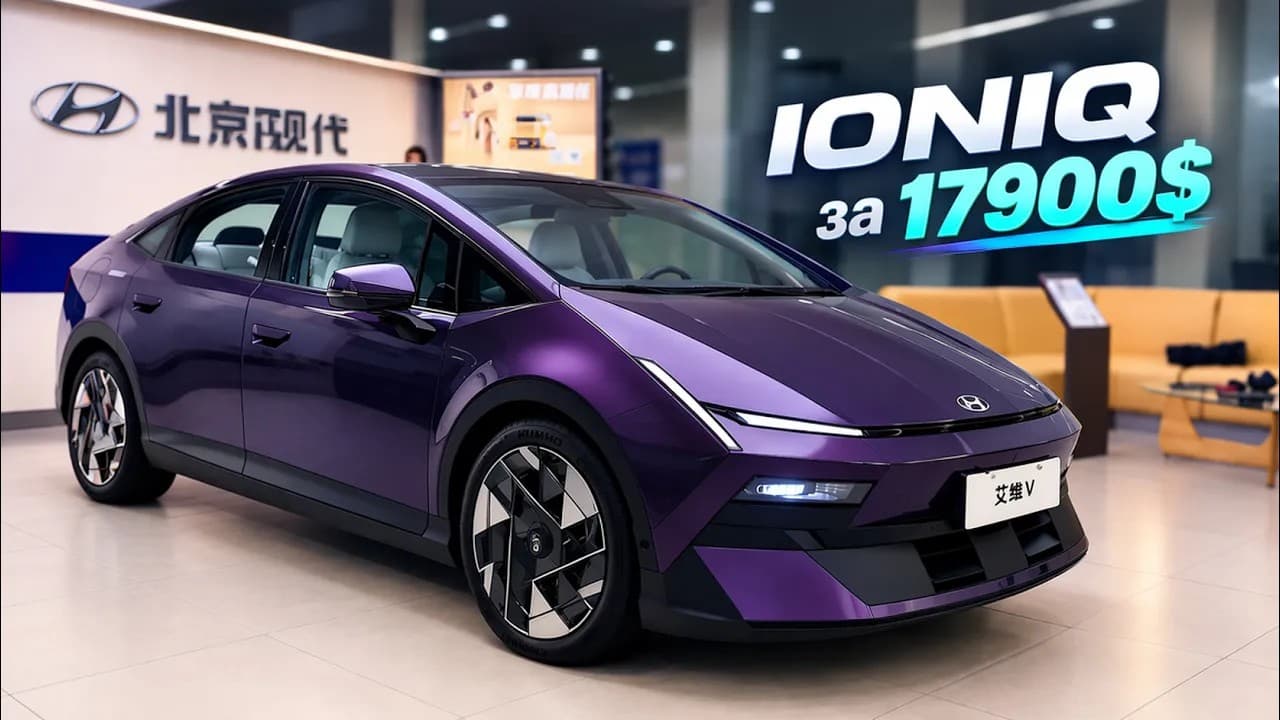
Hyundai has launched a car most of the world will never see: the Ioniq V, a China-exclusive electric fastback sedan built by the Beijing Hyundai joint venture specifically for the world's largest EV market. First previewed as the Venus concept in April 2026 and confirmed in production form the same month at the Beijing Auto Show, the Ioniq V opened pre-sales on August 21, 2026 at the Chengdu Auto Show. It rides on Hyundai's global E-GMP electric platform — the same underpinnings as the international Ioniq 5, 6 and 9 — but with pricing and a design language built to compete directly with domestic Chinese EVs rather than Hyundai's usual global lineup. Starting at just 119,900 yuan (about $17,600), it undercuts nearly every EV Hyundai sells anywhere else in the world.
Performance & Specs
The Ioniq V is offered as a single-motor BEV across all three trims, with output scaling by battery size. The entry 540 Max and mid-tier 540 Max+ trims use a 140 kW (188 hp) motor, while the range-topping 650 Max+ steps up to a 168 kW (225 hp) motor; both power levels share the same 250 Nm of torque, confirmed on-camera by a partner reviewer at a Beijing Hyundai showroom. Hyundai has not published an official 0-100 km/h or top-speed figure for any trim as of this writing — unusual for a car already in pre-sale, but not uncommon for a China-market launch where full technical disclosure often lands closer to first deliveries. The car follows Hyundai's E-GMP platform convention of a single motor mounted on one axle, though Beijing Hyundai has not explicitly confirmed whether the Ioniq V drives the front or rear wheels.

| Powertrain | Single-motor BEV |
|---|---|
| Power | 168 kW (225 hp) |
| Battery | 66.8 kWh LFP |
| Torque | 250 Nm |
| Range | Up to 650 km (CLTC) |
| POWERTRAIN TYPE | Battery-electric (BEV) |
|---|---|
| HORSEPOWER | 188 hp (540 Max / 540 Max+) or 225 hp (650 Max+) |
| TOP SPEED | Not yet published |
| DRIVETRAIN | Single motor (axle not confirmed) |
| BATTERY | 53.5 kWh LFP or 66.8 kWh LFP |
| ELECTRIC RANGE | Up to 540 km (53.5 kWh) or up to 650 km (66.8 kWh), CLTC |
Dimensions & Practicality

| Length | 4,900 mm |
|---|---|
| Width | 1,890 mm |
| Height | 1,470 mm |
| Wheelbase | 2,900 mm |
| Ground clearance | 165 mm |
At 4,900 mm long with a 2,900 mm wheelbase, the Ioniq V is a genuinely large four-door — closer in footprint to a mid-size sedan than a compact EV, despite its budget pricing; a partner reviewer at the launch showroom compared its scale directly to a Hyundai Sonata. Hyundai's design team frames the exterior as a "single-curve silhouette," a fastback roofline that runs in one unbroken arc from the windshield to the tail, paired with frameless door glass for a cleaner side profile. Curb weight ranges from 1,707 kg on the lighter 53.5 kWh trims to 1,808 kg on the larger-battery 650 Max+. Ground clearance is 165 mm, and wheel sizing steps up from 17-inch on the base trim to 19-inch (235/45R19) on the higher trims. The boot holds 460 litres, a genuinely large figure for a sedan this size, though the rear seatback doesn't fold — typical for this segment, but worth knowing if you need to carry long items. The front trunk area is largely occupied by the motor and electronics rather than open storage, so buyers should not expect a conventional frunk.
| LENGTH | 4,900 mm |
|---|---|
| WIDTH | 1,890 mm |
| HEIGHT | 1,470 mm |
| WHEELBASE | 2,900 mm |
| CURB WEIGHT | 1,707–1,808 kg |
| CARGO VOLUME | 460 L (rear seats fixed, do not fold) |
Charging & Battery
Both battery options use lithium-iron-phosphate (LFP) cells supplied by CATL, chosen for cost and long-term durability rather than outright energy density. The 53.5 kWh pack, fitted to the two entry trims, is rated for up to 540 km of CLTC range; the larger 66.8 kWh pack in the range-topping 650 Max+ stretches that to up to 650 km. There's a genuine discrepancy worth flagging on charging architecture: several English-language outlets reporting on the Ioniq V's China launch describe an 800V high-voltage system, but a partner reviewer who examined the actual showroom car stated on camera that it runs a 400V architecture, comparing it directly to the similarly-priced Volkswagen ID. Aura T6 and citing a roughly 40-minute full DC charge time — a figure more consistent with 400V than an ultra-fast 800V system. Hyundai has not published an official charging-power or 10-80% time figure to settle the discrepancy, so treat the exact voltage class as unconfirmed until the brand publishes a full spec sheet.
| BATTERY | 53.5 kWh LFP or 66.8 kWh LFP (CATL) |
|---|---|
| ARCHITECTURE | 400V or 800V (sources disagree; unconfirmed by Hyundai) |
| DC FAST CHARGE TIME | ~40 min to full, per a dealership walkaround (unofficial) |
| ELECTRIC RANGE | Up to 540 km / 650 km (CLTC) |
Design & Interior
Hyundai calls the Ioniq V's cabin theme "Nebula Wrap-around," and in person it's built around a single continuous dashboard sweep that runs from door to door, broken up by two-tone upholstery — the showroom car seen at launch wore a deep purple exterior over a black cabin with coral-orange accent panels on the doors and center console. Alcantara trim covers key touch points, and ambient lighting runs along the dash. The centerpiece is a 27-inch 4K display that spans the full width of the dashboard, replacing both the traditional gauge cluster and center touchscreen with one continuous panel — large enough that the driver's side alone comfortably runs a full-screen navigation map while the passenger side handles media. A separate head-up display, which Hyundai brands "Cyber Eye," projects core driving data onto the windshield, meaning the physical instrument binnacle behind the steering wheel is gone entirely. The wheel design carries a faceted, origami-style pattern on its center cap and spokes that echoes the fastback's sharp exterior creases.
Technology & Features
The Ioniq V's cockpit runs on a Qualcomm Snapdragon 8295 chip, the same processor found in flagship Chinese EVs well above this price bracket, handling both the infotainment stack and the car's AI voice assistant. That assistant is unusual for a global brand's China product: Hyundai has integrated both Baidu's Ernie Bot and ByteDance's Doubao AI directly into the cabin, giving owners a choice of China's two most widely used conversational AI systems rather than a proprietary Hyundai assistant alone. The 27-inch display runs a full China-market app ecosystem — navigation, streaming, and third-party apps accessible directly from the home screen — and the car supports over-the-air updates. Seat heating and ventilation, controlled through the main display, are fitted to the front row on higher trims.
Safety & ADAS
Driver assistance on the Ioniq V is built around an L2+ system co-developed with Momenta, the Chinese autonomous-driving specialist that also supplies ADAS stacks to several other China-market brands. Hyundai and Beijing Hyundai have not published a detailed breakdown of the Ioniq V's sensor suite (camera and radar count) or a specific list of supported ADAS functions, and the Momenta-based system is understood to be standard on the Smart Driving and Long-Range trims rather than the base 540 Max. The Cyber Eye head-up display doubles as part of the ADAS interface, surfacing lane and following-distance information directly in the driver's line of sight.
| ADAS LEVEL | L2+ (Momenta-developed system) |
|---|---|
| ADAS FEATURES | Head-up display integration; full sensor/feature list not yet published |
Available Versions
| VERSION | POWER | BATTERY | EV RANGE | PRICE | KEY DIFFERENCES |
|---|---|---|---|---|---|
| 540 Max | 188 hp | 53.5 kWh LFP | 540 km | $17,600 | Entry trim, 27-inch display, Cyber Eye HUD standard |
| 540 Max+ | 188 hp | 53.5 kWh LFP | 540 km | $19,100 | Adds Momenta L2+ ADAS suite ("Smart Driving Edition") |
| 650 Max+ | 225 hp | 66.8 kWh LFP | 650 km | $20,600 | Largest battery, longest range ("Long-Range Edition") |
Pricing & Availability
Beijing Hyundai opened Ioniq V pre-sales on August 21, 2026 at the Chengdu Auto Show, with three trims priced from 119,900 yuan to 139,900 yuan (about $17,600 to $20,600). Official on-sale pricing and first deliveries are expected to follow shortly after pre-sales, in line with how Beijing Hyundai has launched recent models. The Ioniq V is a China-exclusive product built specifically for the domestic market by the Beijing Hyundai joint venture; as of September 2026, Hyundai has not confirmed any export plan, and the car is not expected in Europe, North America, or any market outside China. CnEVPost has reported that Beijing Hyundai is also planning a future range-extender (EREV) variant of the Ioniq V, though no timeline or specifications for that version have been published.
How It Compares
The Ioniq V lands in the thick of China's cutthroat budget-EV sedan segment, and the numbers are close across the board: the XPENG Mona M03 undercuts it slightly on price with a touch more range, the Nissan N7 costs more for slightly less range, and the BYD Seal 06 GT splits the difference on both. What none of those three rivals offer is Hyundai's own E-GMP platform pedigree and a 27-inch 4K wraparound display at this price. For a global brand, the Ioniq V is also a genuinely unusual product: nothing this cheap wears a Hyundai badge anywhere else in the world.
- A genuinely large 460-litre boot and a 27-inch 4K wraparound display at a starting price under $18,000, both rare at this end of the market
- Up to 650 km CLTC range from the range-topping trim, competitive with the segment's best
- E-GMP platform pedigree shared with Hyundai's international Ioniq 5/6/9 lineup, at a fraction of their price
- China-exclusive with no confirmed export plan — international buyers have no path to this car
- Charging architecture is genuinely disputed between sources (400V vs 800V), and Hyundai hasn't published official 0-100 km/h, top speed, or charging-power figures even at pre-sale stage
The Ioniq V is one of the more surprising cars Hyundai has ever put its name on: a sub-$18,000 fastback EV with a 27-inch screen and a genuinely usable 460-litre boot, built purely to fight China's domestic budget-EV makers on their own turf. It's a smart, narrowly-targeted play rather than a global product, and the missing performance and charging figures at pre-sale stage are a reminder that Beijing Hyundai is still finalizing the full spec sheet. For Chinese buyers cross-shopping the Mona M03, N7, and Seal 06 GT, the Ioniq V's combination of platform tech and E-GMP pedigree makes it a genuine contender rather than a badge-engineering afterthought — but everyone else will simply have to watch from outside the market.