The Hyundai Staria Hybrid is a front-wheel-drive MPV with a full-hybrid (HEV) powertrain, which means a 1.6-litre turbocharged petrol engine and an electric motor that recharge from braking and the engine, with no plug and no charging port. In its home market of South Korea the facelifted model, sold as The New Staria, went on sale on 17 December 2025, about four years and eight months after the April 2021 launch, and the hybrid is now offered in cargo (2 or 5 seats), Tourer (9 or 11 seats) and Lounge (7 or 9 seats) versions. The Korean specification combines a 132 kW (180 PS) engine and a 54 kW (73 PS) motor into a system output of 180 kW (245 PS, about 242 hp) and 367 Nm (37.4 kgf·m), paired with a six-speed automatic. Hyundai's price list of 1 October 2026 starts at KRW 36,250,000 for the two-seat cargo van and KRW 38,700,000 for the cheapest passenger version, the 11-seat Tourer Smart, and it tops out at KRW 50,920,000 for the 7-seat Lounge Inspiration. The pre-facelift hybrid is sold in Germany and Israel with a lower 225 PS output, while Australia gets the facelift with the Korean 180 kW figure.
Performance & Specs
In the Korean and Australian specification the Staria Hybrid uses a 1.6-litre turbocharged four-cylinder (1,598 cc) rated at 132 kW (180 PS, about 178 hp) and 265 Nm (27.0 kgf·m), plus a 54 kW (73 PS) electric motor with 304 Nm. Together they make 180 kW (245 PS, about 242 hp) at the front wheels through a six-speed automatic, with a system torque of 367 Nm (37.4 kgf·m) in Korea (Israeli listings also show 37.4 kgf·m); Hyundai Australia does not publish a system torque figure, and the Australian press printed only the 304 Nm motor and 265 Nm engine figures. There is no all-wheel-drive version. (PS is the metric horsepower, about 1.4 percent smaller than the imperial hp used here.) Autoview, a Korean outlet that measures cars with its own instruments, recorded 0-100 km/h in 9.27 seconds for a 7-seat Lounge hybrid at a kerb weight of 2,320 kg, which is an independent measurement rather than a Hyundai claim.
The German and Israeli cars are pre-facelift and tuned differently. Hyundai Germany's press release of 7 November 2024 lists a 118 kW (160 PS, about 158 hp) 1.6 T-GDI engine and the same 54 kW (73 PS) motor for a system output of 165 kW (225 PS, about 222 hp), with 0-100 km/h in 10.2 seconds; Hyundai Germany’s data sheet (January 2025) adds a top speed of 167 km/h. Hyundai Germany publishes only the 265 Nm engine torque and no system torque; the 367 Nm (37.4 kgf·m) system figure is Hyundai Korea’s and also appears in Israeli listings, so it is likely, but not confirmed by Hyundai Germany, for the German car. Israeli price sites print the output as 225 “hp”, which is the same 225 PS figure, so it should not be read as 225 imperial horsepower or as the 245 PS Korean number.
Efficiency is quoted on different cycles in each market, so the numbers cannot be compared directly. In Korea, Hyundai's release cites up to 13.1 km/L combined (about 7.6 L/100 km) on the Cargo 2- and 5-seat with 17-inch wheels; Hyundai Korea's spec table lists 12.7 km/L for the Tourer 9- and 11-seat (12.5 with the built-in cam) and 12.7 for the Lounge 7- and 9-seat (12.5 with the cam), so the cheapest passenger Tourer, the 11-seat Smart, is rated 12.7 km/L; Autoview's spec sheet for the Lounge 7-seater with the built-in cam prints 12.5 km/L combined, 13.1 city and 11.7 highway. In Germany the WLTP figure is 7.6 L/100 km with 172 g/km of CO2 for every trim. In Australia, CarExpert lists the Lounge hybrid at 6.5 L/100 km combined with 147 g/km of CO2 and a tank of 65 litres, and measured 7.2 L/100 km over its own test. The Australian car has a braked and unbraked towing rating of 0 kg, unlike the diesel and petrol Staria, which tow 2,500 kg braked.

| Powertrain | Full hybrid (HEV, not plug-in), FWD |
|---|---|
| Power | 180 kW (245 PS / 242 hp), Korean spec |
| Torque | 367 Nm (37.4 kgf·m) |
| 0–100 km/h | 9.27 s (measured, Lounge 7-seat) |
| Battery | About 1.49 kWh (HEV) |
| Fuel economy | Up to 13.1 km/L (Korea, Cargo 17-inch) |
| POWERTRAIN TYPE | Full hybrid (HEV), not plug-in; 1.6 turbo petrol plus electric motor |
|---|---|
| HORSEPOWER | 180 kW (245 PS / 242 hp) Korea and Australia; 165 kW (225 PS / 222 hp) Germany and Israel |
| TORQUE | 367 Nm (37.4 kgf·m) system, Korea (Israeli listings also show 37.4 kgf·m); engine 265 Nm, motor 304 Nm |
| ACCELERATION | 0-100 km/h in 9.27 s (Autoview measurement, Lounge 7-seat); 10.2 s (Hyundai Germany, 225 PS) |
| TOP SPEED | 167 km/h (Hyundai Germany, 225 PS car) |
| DRIVETRAIN | FWD, six-speed automatic |
| BATTERY | About 1.49 kWh (Hyundai Germany data sheet and CarExpert Australia) |
| FUEL ECONOMY | Up to 13.1 km/L Korea combined (Cargo, 17-inch); 12.7 km/L Tourer 11-seat Smart; 7.6 L/100 km WLTP Germany; 6.5 L/100 km Australia combined |
Dimensions & Practicality

| Length | 5,255 mm |
|---|---|
| Width | 1,995 mm |
| Height | 1,990 mm |
| Wheelbase | 3,275 mm |
| Kerb weight | 2,320 kg (Lounge 7-seat) |
The Staria is a very large MPV, 5,255 mm long, 1,995 mm wide and 1,990 mm high on a 3,275 mm wheelbase, according to the Korean spec sheet published by Autoview; CarExpert gives 5,253 by 1,997 by 1,990 mm and 3,273 mm for the Australian car, with a kerb weight of 2,387 kg. Seating is the main variable: the 7-seat Lounge has a pair of captain’s chairs in the second row and a three-seat bench at the back, while the Tourer packs nine or eleven seats in three rows. CarExpert measured 117 L of boot space behind the third row of the 7-seat Lounge and 431 L with that row folded, while Auto Zeitung's German report quotes up to 1,303 L to the window line and about 5,000 L with the seats removed for the nine-seat car. The Australian Load hybrid van has a payload of 1,039 kg.
| LENGTH | 5,255 mm (5,253 mm Australia) |
|---|---|
| WIDTH | 1,995 mm (1,997 mm Australia) |
| HEIGHT | 1,990 mm |
| WHEELBASE | 3,275 mm (3,273 mm Australia) |
| KERB WEIGHT | 2,320 kg (Korea, Lounge 7-seat); 2,387 kg (Australia, Lounge) |
| CARGO VOLUME | 117 L behind the third row, 431 L with it folded (Australia, Lounge 7-seat) |
| TOWING | 0 kg braked and unbraked (Australia, hybrid) |
Charging & Battery
The Staria Hybrid has nothing to charge. It is a full hybrid, so its small traction battery, listed by the Hyundai Germany data sheet and CarExpert Australia as a lithium-ion polymer unit of about 1.49 kWh, is topped up by the engine and by regenerative braking, and the car cannot be plugged into a socket or a fast charger. German specification listings give the electric range as 0 km for this reason. A battery-electric Staria with an 84 kWh pack is a separate model that has been announced for Europe and Korea, and the hybrid described here should not be confused with it. For owners the hybrid’s benefit is the one shown in the consumption numbers above, a few litres per 100 km saved compared with the old 3.5-litre petrol or LPG engines, rather than any electric-only range.
| BATTERY | About 1.49 kWh lithium-ion polymer (HEV, Hyundai Germany data sheet and CarExpert Australia) |
|---|---|
| AC CHARGING | None (full hybrid, cannot be plugged in) |
| DC FAST CHARGING | None |
| ELECTRIC RANGE | 0 km (WLTP, German listings) |
Design & Interior
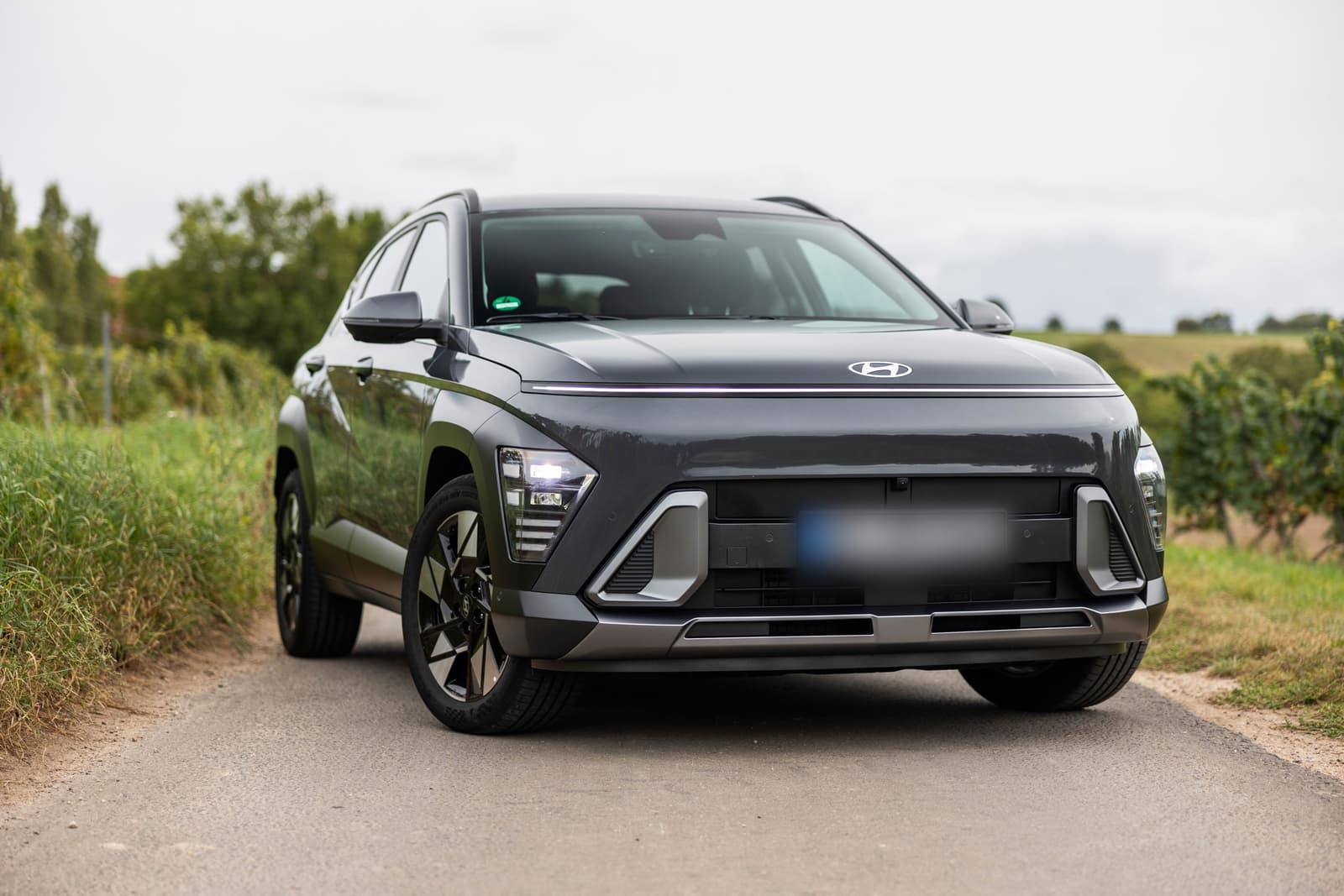
The Staria keeps the capsule-like van shape that Hyundai introduced in April 2021, with a one-piece front end, a full-width lighting strip across the nose and a large glasshouse. The Korean update replaced the daytime running lights that were split into three sections with a single long horizontal lamp, gave the black grille a geometric pattern and gave the Lounge a chrome block-pattern grille with a bumper garnish. The press images in this article show the pre-facelift European-market Staria Hybrid, with a German press plate, a bronze-toned grille, a rear spoiler and 18-inch wheels; it is the pre-facelift car, not the facelifted Korean one. Inside, the dashboard is laid out horizontally with a freestanding centre screen above a row of physical climate controls and a column-style gear selector, and the Lounge has captain’s chairs with an ambient-lit table between the front seats in the interior picture.
The Korean update also moved some climate and infotainment functions back to physical buttons, and Hyundai added more sound insulation and revised the front and rear suspension for high-speed stability. The Lounge uses hydraulic bushings to reduce road vibration. In Germany the top Signature trim has seven seats with electric relax seats in the second row, Nappa leather, a 12-speaker Bose system and a surround-view monitor, while the Trend and Prime have nine seats. In Australia the Lounge hybrid adds heated and ventilated front and second-row seats, a panoramic sunroof, power sliding doors and a power tailgate with auto-close.
Technology & Features
The Korean car moved to two 12.3-inch screens, one for the instrument cluster and one for infotainment, replacing 10.25-inch units, and runs Hyundai’s ccNC platform with over-the-air updates as standard. Other new items are the Bluelink Store for subscribing to extra functions, Walk Away Lock that locks the doors automatically when the driver leaves, Digital Key 2 for opening and starting the car with a smartphone, and Built-in Cam 2 Plus for video and audio recording. The Australian Lounge adds a 12-speaker Bose system, wireless Apple CarPlay and Android Auto and a five-year Bluelink subscription. The German car (10.3-inch screens) and the Israeli car (10.25-inch screens) are pre-facelift, with 225 PS; the Korean and Australian cars are the facelift, with 12.3-inch screens and model year 2027 in Australia.
Safety & ADAS
In Korea, Hyundai fits forward collision-avoidance assist and rear-side collision-avoidance assist as standard. The Australian Lounge hybrid carries seven airbags, autonomous emergency braking, blind-spot monitoring and lane-keep assist, with side parking sensors, a 360-degree camera and safe exit warning on top. The five-star ANCAP rating that Australia gave the petrol and diesel Staria in 2021 does not yet cover the hybrid, according to CarExpert, and Hyundai does not publish an SAE automation level for the Staria.
| ADAS LEVEL | Not stated by Hyundai; Level 2 driver assistance (SAE level not published) |
|---|---|
| ADAS FEATURES | Forward and rear-side collision-avoidance assist (Korea); AEB, blind-spot monitoring, lane-keep assist, 360-degree camera, safe exit warning (Australia, Lounge) |
Available Versions
| VERSION | POWER | TORQUE | 0-100 | TOP SPEED | DRIVETRAIN | BATTERY | EV RANGE | COMBINED RANGE | PRICE | KEY DIFFERENCES |
|---|---|---|---|---|---|---|---|---|---|---|
| Cargo 2-seat Smart | 242 hp | 367 Nm | — | — | FWD | 1.49 kWh | — | — | KRW 36,250,000 (~$27,043) | Two-seat van, up to 13.1 km/L on 17-inch wheels |
| Tourer 11-seat Smart | 242 hp | 367 Nm | — | — | FWD | 1.49 kWh | — | — | KRW 38,700,000 (~$28,870) | Cheapest passenger version, three rows, 12.7 km/L combined (Hyundai Korea) |
| Tourer 9-seat Modern | 242 hp | 367 Nm | — | — | FWD | 1.49 kWh | — | — | KRW 39,990,000 (~$29,833) | Nine seats, 12.7 km/L combined (Hyundai Korea) |
| Lounge 9-seat Prestige | 242 hp | 367 Nm | — | — | FWD | 1.49 kWh | — | — | KRW 44,990,000 (~$33,563) | Lounge trim with 18-inch wheels and hydraulic bushings |
| Lounge 9-seat Inspiration | 242 hp | 367 Nm | — | — | FWD | 1.49 kWh | — | — | KRW 48,760,000 (~$36,375) | Top nine-seat Lounge |
| Lounge 7-seat Inspiration | 242 hp | 367 Nm | 9.3s | — | FWD | 1.49 kWh | — | — | KRW 50,920,000 (~$37,987) | Captain’s chairs, 12.7 km/L combined (12.5 with built-in cam), 0-100 km/h measured by Autoview |
Pricing & Availability
In South Korea, Hyundai's price list of 1 October 2026 (for the facelift that went on sale on 17 December 2025) puts the hybrid cargo van at KRW 36,250,000 (two seats, Smart) to KRW 38,200,000 (five seats, Modern), the Tourer at KRW 38,700,000 (11 seats, Smart) to KRW 39,990,000 (nine or eleven seats, Modern), and the Lounge at KRW 44,990,000 (nine seats, Prestige), KRW 48,760,000 (nine seats, Inspiration) and KRW 50,920,000 (seven seats, Inspiration). The 3.5-litre LPI cars that remain on sale start at KRW 32,590,000, so the hybrid costs roughly KRW 3.2 to 3.7 million more in comparable trims (KRW 38,700,000 against KRW 35,020,000 for the 11-seat Tourer Smart). At 1,340.47 won to the US dollar (ECB reference rate of 28 October 2026), the entry passenger price of KRW 38,700,000 is about $28,870, the cargo van from KRW 36,250,000 is about $27,043 and the 7-seat Lounge at KRW 50,920,000 is about $37,987.
In Germany, Hyundai’s price list of February 2026 prices the Staria Hybrid at €49,500 (about $55,108) for the nine-seat Trend, €55,000 (about $61,232) for the nine-seat Prime and €58,950 (about $65,629) for the seven-seat Signature, which is the Prime plus €3,950, while the Prime costs the Trend plus €5,500. Australia lists the hybrid from AUD 53,490 (about $37,619) for the Load van and AUD 61,240 (about $43,069) for the Load Premium, and the seven-seat Lounge hybrid costs AUD 73,740 (about $51,860), all before on-road costs, with hybrid deliveries from June 2026 according to The Beep. The UK is not getting the hybrid and is expected to receive only the electric Staria, with What Car? estimating around £50,000 (about $66,440).
In Israel, Hyundai cars are sold by the importer Colmobil (Kalmobil), and the nine-seat Staria Hybrid is listed by the auto.co.il catalogue at NIS 315,990 (Premium, about $101,088) and NIS 339,990 (Luxury, about $108,765), the same figures that Carzone published at the December 2024 launch, along with a closed commercial van from NIS 289,900 (about $92,741). Kalmobil’s own current price list could not be found, so these Israeli prices may be out of date, and the Israeli listings show 225 PS rather than the 245 PS Korean output. The Staria Hybrid is sold in Korea, Germany, Australia and Israel according to the sources above, and a battery-electric Staria is a separate model with its own pricing.
How It Compares
For a buyer who needs seven to eleven seats, the Staria Hybrid sits in an unusual place. The Nissan Elgrand All New, a series-hybrid (e-POWER) minivan covered in our own Japan article, offers 202 hp and a 1,125 km total range from about $43,400, which is well above the Staria's $28,870 entry price, while the Staria's 242 hp is the higher output. The Forthing Xinghai V9 is a plug-in hybrid (PHEV) from China that lists 306 hp, a 1,300 km total range and $26,650, which undercuts the Staria on price and power, but it needs a charging habit to realise its range, and we did not check where it is sold. The Kia Carnival Hybrid, which uses a related 1.6 turbo hybrid system, is listed by CarExpert Australia at 5.8 L/100 km combined, against the Staria Lounge’s 6.5 L/100 km. The rival figures are each maker’s own home-market prices and cycles, so they are a guide to positioning rather than a like-for-like test.
- Full hybrid with 180 kW (245 PS, about 242 hp) in Korea and up to 13.1 km/L combined (Cargo, 17-inch), with nothing to plug in
- Seating for 7, 9 or 11 in a 5,255 mm body with three rows, and passenger prices from KRW 38,700,000
- Updated cabin with two 12.3-inch screens, ccNC over-the-air updates, Digital Key 2 and a long standard safety list
- The Australian hybrid has a 0 kg towing rating, and the 7-seat Lounge’s boot is only 117 L behind the third row
- The hybrid costs about KRW 3.2 to 3.7 million more than the LPI version in Korea, and the outputs and fuel numbers differ by market (225 PS in Germany, 245 PS in Korea)
The Staria Hybrid is the sensible version of one of the most distinctive people-carriers on sale, because it adds a full-hybrid system with 245 PS in Korea and fuel economy that the old petrol and LPG engines could not match, without asking owners to plug in. Its weaknesses are the price premium over the LPG car, a small third-row boot in the 7-seat Lounge and, in Australia, no towing. Buyers should check which output and which list price apply in their own market before comparing it with the Carnival or the Elgrand, and large families and shuttle operators will find it a strong, if unconventional, choice.