

Skoda has added a powertrain to the Octavia that the brand has never offered before: a full hybrid (HEV), which means a petrol engine, two electric motors and a small battery that is charged by the engine and by braking, never from a socket. Announced on 5 October 2026, the Octavia Hybrid is available as a liftback and as a Combi estate, in two power levels of 100 kW (136 PS, about 134 hp) and 125 kW (170 PS, about 168 hp) system output. It uses a 1.5 TSI evo2 petrol engine, a 1.6 kWh gross battery and a new single-speed automatic transmission, and it can move for roughly 2 km on electric power alone. Skoda says orders open in October 2026 and plans the first customer deliveries for December 2026. Skoda has not published a price, torque, acceleration or fuel consumption figures yet, so this article covers what the manufacturer has confirmed and says plainly what is still open.
Performance & Specs
The Octavia Hybrid is offered with two system outputs. The entry version makes 100 kW (136 PS, about 134 hp) and uses a 1.5 TSI evo2 engine rated at 96 kW (about 130 PS, 129 hp); the stronger version makes 125 kW (170 PS, about 168 hp) from the same engine family rated at up to 110 kW (about 150 PS, 148 hp). PS is the metric horsepower and is about 1.4 percent smaller than the imperial hp used here. Skoda says the two versions are otherwise technically identical, with the same motors and the same battery, and both are limited electronically to 180 km/h. The drive goes to the front wheels only: Skoda's release describes a traction motor that drives the front axle and mentions no all-wheel-drive version.
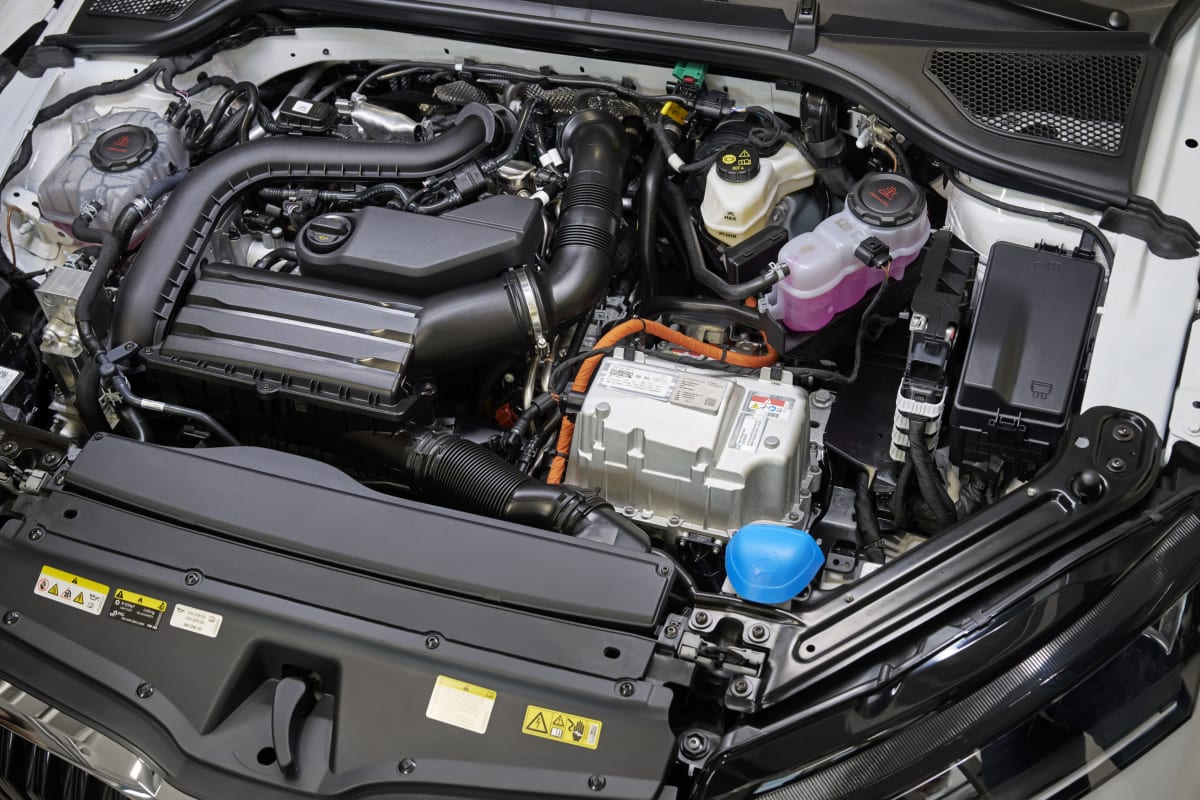
The layout is a series-parallel full hybrid. Skoda lists two electric machines: a 110 kW generator that mainly generates current and starts the engine, and a 125 kW traction motor that drives the front wheels and recovers energy when the driver lifts off or brakes. Because both outputs use the same motors, the difference between the 100 kW and 125 kW cars lies in the combustion engine. Between the engine and the front axle sits a new single-speed automatic transmission with an automatic clutch, which Skoda's storyboard names TQ250. There is no conventional gearbox with several ratios, so the car does not shift in the way the 7-speed DSG Octavia does.
The control unit chooses between three operating modes without any input from the driver. In electric mode the car moves without starting the engine. In series mode, which Skoda says is preferred up to about 60 km/h or when the battery is low or stronger acceleration is requested, the engine drives the generator and the traction motor alone turns the wheels. Above about 60 km/h and at steady speed the clutch closes and the car switches to parallel mode, where the engine drives the wheels directly and the motor can add its power when accelerating. Skoda adds that the Eco and Normal driving modes favour coasting with the engine off and very gradual deceleration, while the Sport mode pre-sets stronger regenerative braking, which is applied automatically and does not depend on pressing the brake pedal.
What Skoda has not said is as important as what it has. The press release gives no torque figure, no 0-100 km/h time, no fuel consumption and no CO2 figure. Trade coverage of the announcement says official consumption and emissions will only follow type approval. Volkswagen's Golf Hybrid, which carries the same 125 kW rating and the same 1.6 kWh battery, lists 309 Nm and 7.5 seconds for its 125 kW version, but Skoda has not confirmed that either number carries over to the Octavia, so neither appears in the tables below. For reference, the current mild-hybrid Octavia with the 110 kW 1.5 TSI is listed by Skoda at 8.5 seconds to 100 km/h and 4.9 to 5.4 L/100 km WLTP in the liftback.

| Powertrain | Full hybrid (HEV), series-parallel, no plug |
|---|---|
| Power | 125 kW (170 PS / 168 hp) system; 100 kW (136 PS / 134 hp) entry |
| Torque | Not published by Skoda |
| 0–100 km/h | Not published |
| Battery | 1.6 kWh gross (NMC), SoC kept at 40–90% |
| Electric-only | About 2 km, no external charging |
| POWERTRAIN TYPE | Full hybrid (HEV), not plug-in |
|---|---|
| HORSEPOWER | 100 kW (136 PS / 134 hp) or 125 kW (170 PS / 168 hp) system output |
| ENGINE | 1.5 TSI evo2 petrol, 96 kW (about 130 PS / 129 hp) or 110 kW (about 150 PS / 148 hp) |
| ELECTRIC MOTORS | 125 kW traction motor and 110 kW generator (both versions) |
| ACCELERATION | Not published |
| TOP SPEED | 180 km/h (electronically limited, both versions) |
| DRIVETRAIN | FWD, single-speed automatic with clutch (TQ250) |
| BATTERY | 1.6 kWh gross, NMC |
| ELECTRIC-ONLY RANGE | About 2 km |
| FUEL CONSUMPTION | Not published (available after type approval) |
Dimensions & Practicality

| Length | 4,698 mm |
|---|---|
| Width | 1,829 mm |
| Height | 1,468 mm (Combi) |
| Wheelbase | 2,686 mm |
| Boot | 485 L / 1,540 L seats folded (Combi) |
Skoda has not published exterior dimensions for the hybrid itself, so the figures above are those of the current Octavia Combi from Skoda's own technical data sheet, which gives 4,698 mm in length, 1,829 mm in width, 1,468 mm in height and a 2,686 mm wheelbase, with a ground clearance of 142 mm at kerb weight. The liftback in the same data sheet is also listed at 4,698 mm and 1,829 mm, with a height of 1,470 mm and a 143 mm clearance. Because the hybrid adds a battery and drops some equipment, the real numbers may differ slightly once Skoda publishes the data for the Hybrid.
Luggage space is where the hybrid pays for its battery. Skoda quotes 460 litres for the liftback, growing to 1,400 litres with the rear seats folded, and 485 litres for the Combi, growing to up to 1,540 litres. The mild-hybrid Octavia has 600 and 1,555 litres in the liftback and 640 and 1,700 litres in the Combi (CarExpert's figures for Skoda Australia; the Combi figure also appears in the autotijd.be database), so the hybrid gives up roughly 140 litres of boot in the liftback and 155 litres in the Combi. The variable boot floor and the spare wheel are not available on the hybrid, and the fuel tank holds 40 litres, against 45 litres in the combustion Octavia. Skoda's own pages disagree about where the battery sits: the press release says under the rear seats, while a second Skoda page refers to the area beneath the luggage floor.
| LENGTH | 4,698 mm (current Octavia range) |
|---|---|
| WIDTH | 1,829 mm |
| HEIGHT | 1,470 mm (liftback) / 1,468 mm (Combi) |
| WHEELBASE | 2,686 mm |
| CARGO VOLUME | Liftback 460 L (1,400 L seats folded); Combi 485 L (1,540 L) |
| FUEL TANK | 40 L |
Charging & Battery
The Octavia Hybrid has no charging port and Skoda says no external charging is needed. The 1.6 kWh battery, a nickel-manganese-cobalt (NMC) pack with 1.6 kWh of gross energy content, is filled by the engine through the generator and by regenerative braking, and the net capacity is not stated. The management system keeps the state of charge between 40 and 90 percent, which leaves roughly 0.8 kWh available for driving and suggests why the electric-only range is quoted as about 2 km. The battery's job is to let the engine run at efficient points, to allow short electric moves such as parking and creeping in traffic, and to add power when accelerating.
This is a different proposition from a plug-in hybrid (PHEV). Skoda positions the Octavia Hybrid as an intermediate step between the mild-hybrid models (Octavia, Superb, Kodiaq) and the plug-in hybrids (Superb, Kodiaq): it drives electrically for longer than a mild hybrid, and it does not require a wallbox the way a plug-in does. The cost of that simplicity is that none of the journey can be done on cheap mains electricity, so the saving over a combustion Octavia depends on the efficiency of the system, which Skoda has not yet published.
| BATTERY | 1.6 kWh gross, NMC; net capacity not stated |
|---|---|
| STATE-OF-CHARGE WINDOW | 40–90% |
| AC / DC CHARGING | None (HEV, no charging port) |
| ELECTRIC-ONLY RANGE | About 2 km |
Design & Interior
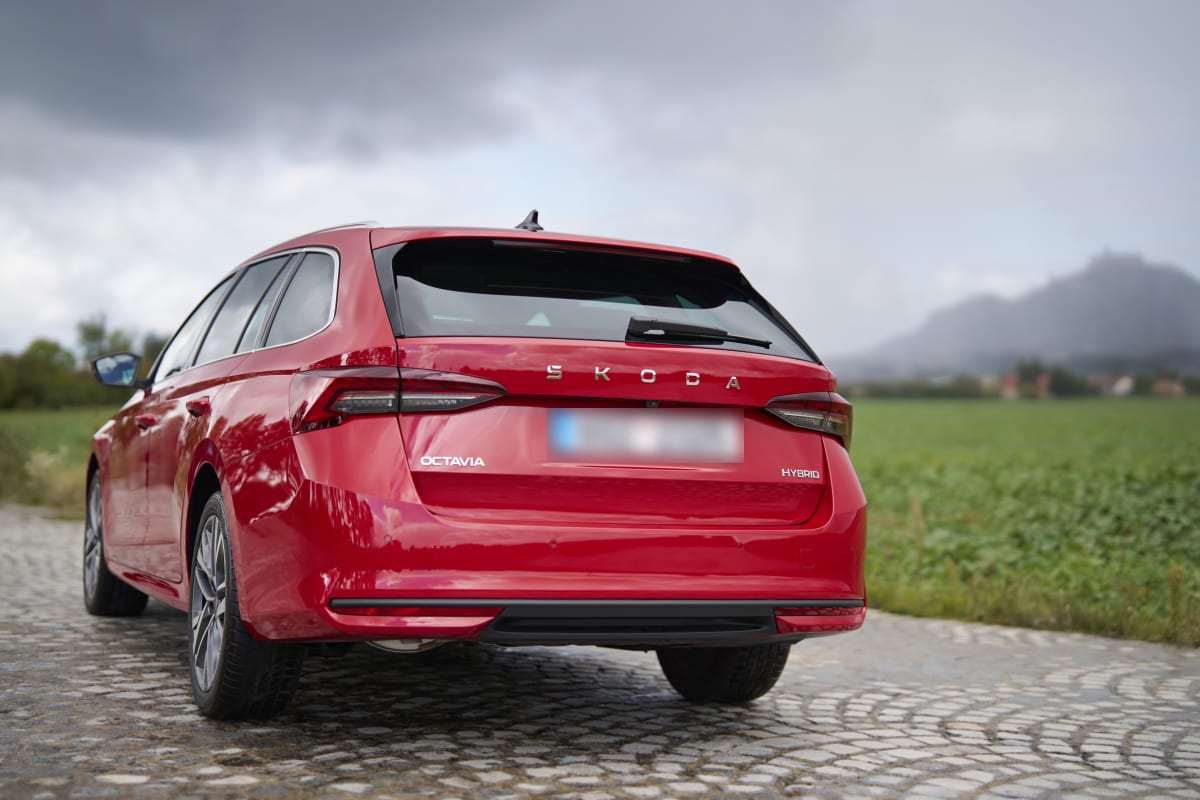
Visually the Octavia Hybrid is the current, updated Octavia with a small number of changes. The press photos show a red Combi with the familiar Skoda grille and slim LED headlights, and at the rear a HYBRID badge on the tailgate next to the Octavia lettering, which Skoda lists as standard on the hybrid. On the wheels, Skoda lists 17-inch Mensa alloys as standard equipment. Inside, the standard equipment includes a 13-inch infotainment display and a 10-inch Virtual Cockpit instrument display, both of which are fitted to the Selection and Sportline trims offered at launch.
Skoda has also removed a few options that exist on the combustion Octavia. The lowered sports suspension and the rough-road package cannot be ordered, and the variable boot floor and spare wheel are dropped. A buyer who wanted the sportier feel of the Sportline trim will still get the trim name and its equipment, but not the lowered chassis.
Technology & Features
The 13-inch central display and the 10-inch Virtual Cockpit are standard on the hybrid, and the driving-mode selection is the most visible hybrid-specific feature: Eco and Normal let the car coast with the engine off and decelerate very gradually after the accelerator is released, while Sport pre-sets stronger regeneration, so the car slows more strongly when the driver lifts off. The control unit decides when the engine runs based on speed, load, road gradient and the state of charge of the battery; the driver influences the behaviour through the driving modes rather than switching the engine on or off directly. Skoda has not detailed software features such as route-based energy management for the hybrid, so none are claimed here.
Safety & ADAS
Skoda has not published a separate safety specification for the hybrid. An Italian outlet lists driver assistance at level 2 on the Italian trims, but Skoda's international press release does not list assistance systems, and the content will depend on the market and trim. As the hybrid is built on the existing Octavia, which was updated in 2024, buyers can expect the standard equipment of the current Selection and Sportline trims, but that should be confirmed against the national price list once it appears. Euro NCAP results for the hybrid have not been published.
| ADAS LEVEL | Level 2 driver assistance listed for Italy (one Italian outlet); not stated in Skoda's international release |
|---|---|
| ADAS FEATURES | Not published for the hybrid; depends on market and trim |
Available Versions
| VERSION | POWER | TORQUE | 0-100 | TOP SPEED | DRIVETRAIN | BATTERY | EV RANGE | COMBINED RANGE | PRICE | KEY DIFFERENCES |
|---|---|---|---|---|---|---|---|---|---|---|
| Octavia Hybrid 100 kW | 134 hp | — | — | 180 km/h | FWD | 1.6 kWh | 2 km | — | — | 136 PS system, 96 kW engine, liftback and Combi, Selection and Sportline |
| Octavia Hybrid 125 kW | 168 hp | — | — | 180 km/h | FWD | 1.6 kWh | 2 km | — | — | 170 PS system, 110 kW engine, same motors and battery |
Pricing & Availability
Skoda has not announced prices for the Octavia Hybrid in any market as of 16 October 2026, so no starting price is quoted in this article. The manufacturer says orders open in October 2026 (not confirmed live on a configurator at the time of writing) and the first customer deliveries are planned for December 2026; Czech and German coverage repeats those dates. Italian outlets give a slightly different schedule for Italy, with orders from mid-October 2026 and first deliveries from January 2027, and the Italian lineup is described with the trim names Executive, Style and Sportline. In Australia, Skoda Australia says it is assessing both full-hybrid and plug-in Octavia options but cannot confirm a local launch or timing. Skoda also says the hybrid is added alongside the existing mild-hybrid Octavia, not in place of it, so buyers will have a choice between the two electrified versions.
How It Compares
The closest relative is the Volkswagen Golf Hybrid, which carries the same 125 kW rating, 168 hp and 1.6 kWh battery, and starts at €41,400 in Germany in R-Line trim. The standard Golf's boot is 381 litres (Volkswagen quotes no hybrid-specific figure), so the Octavia's 460 litres in the liftback and 485 litres in the Combi is the more practical answer for a family, although the Octavia's price is the missing piece of that comparison. The Kia Seltos Hybrid and the Honda ZR-V e:HEV are compact SUVs rather than liftbacks and estates, so they are listed as non-plug alternatives for a buyer who wants a self-charging hybrid, not as direct rivals: the Seltos has 152 hp, 5.4 L/100 km WLTP and starts at €37,490 in Germany, while the ZR-V has 181 hp, 5.7 L/100 km WLTP and starts at GBP 36,525 in the UK. Both already list their fuel consumption, which Skoda has not yet done. The rival figures are each maker's own German or UK list prices and WLTP data and are not on the same model-year or trim basis as the Octavia.
- First Skoda full hybrid (HEV) with no plug, 100 kW (134 hp) or 125 kW (168 hp) system output and a 1.6 kWh battery
- Still a big-boot Octavia: 460 L liftback and 485 L Combi, up to 1,400 L and 1,540 L with the rear seats folded
- Available in both liftback and Combi with a 13-inch display and 10-inch Virtual Cockpit as standard
- No price, torque, acceleration, fuel consumption or CO2 figures yet, so the case for the hybrid cannot be judged
- Boot is about 140 L (liftback) to 155 L (Combi) smaller than the mild-hybrid Octavia, the tank is 40 L and the variable boot floor and spare wheel are dropped
The Octavia Hybrid is a sensible step for Skoda: a self-charging full hybrid in the most practical body styles the brand sells, with two power levels and a familiar cabin. What it cannot yet answer is how efficient and how expensive it is, since Skoda has withheld the price, consumption and torque until later. It will suit buyers who want electric assistance without a wallbox and who value the boot, but wait for the national price lists and the WLTP figures before choosing it over the mild-hybrid Octavia or a Golf Hybrid.