
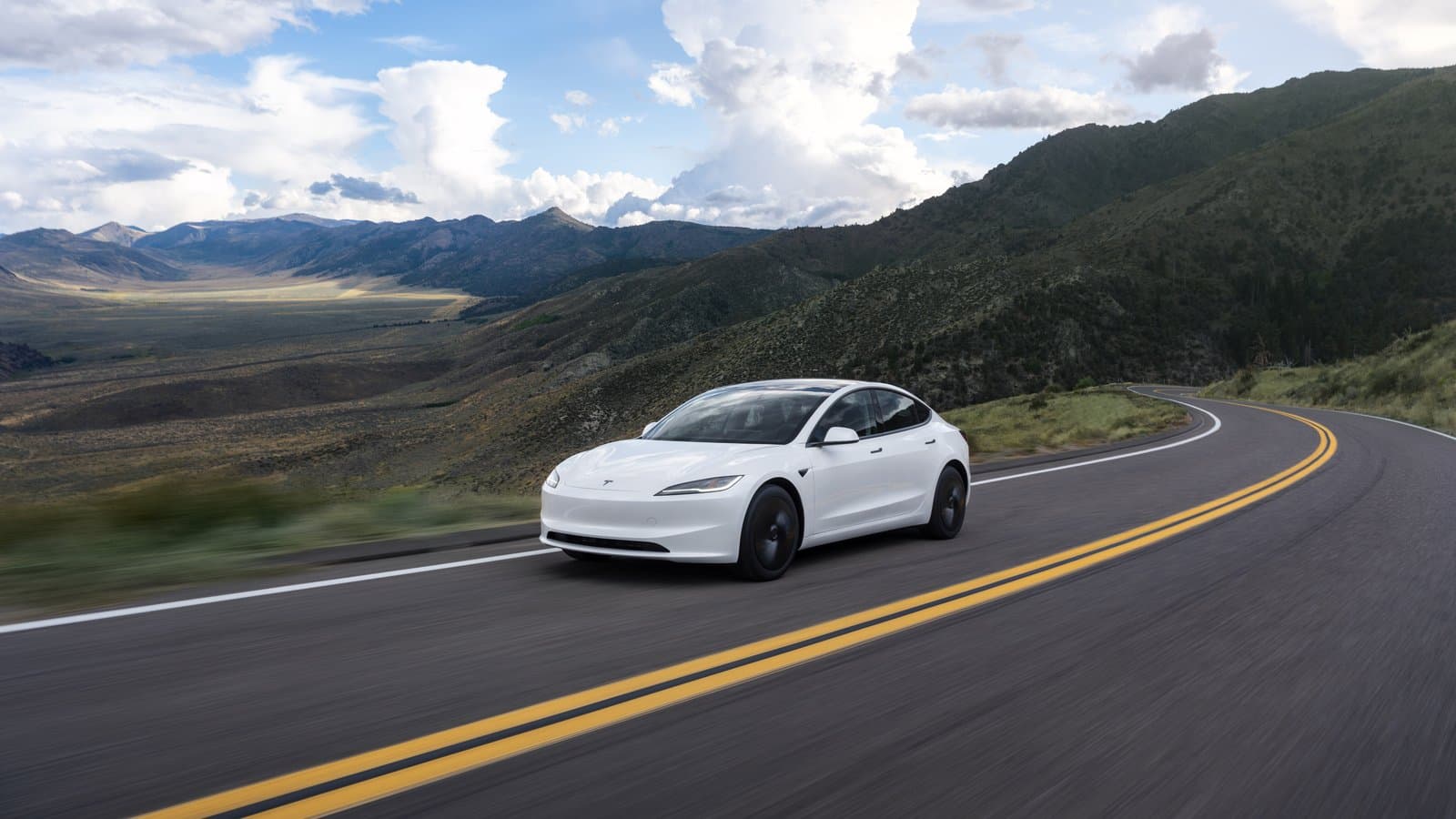
The 2026 Tesla Model 3 is now a four-trim lineup in the United States, and it is a very different proposition from the single expensive sedan of a few years ago. The Model 3 Standard opened the range in October 2025 at $36,990, the cheapest Model 3 Tesla has sold since 2019, while the Premium rear-wheel-drive, Premium all-wheel-drive and Performance trims climb to $54,990. EPA ratings run from 321 miles on the Standard to 363 miles on the Premium RWD, and the Performance flagship sprints from 0 to 60 mph in 2.9 seconds. Every trim uses Tesla's native NACS charging port and has access to the Supercharger network. Prices below are Tesla's list prices before a $1,640 destination and order fee, and there is no federal EV tax credit to subtract: it ended for vehicles acquired after September 30, 2025. This guide keeps the markets separate — US figures first, then a short, separately confirmed look at Europe and China.
Performance & Specs
Tesla does not publish horsepower or torque for the Model 3, so power figures depend on filings and independent testing, and they are not consistent from one database to the next. The one figure that is widely repeated is for the Performance: roughly 380 kW, or about 510 hp, from a dual-motor layout. For the other three trims we are deliberately not printing a horsepower number, because published estimates for the same trim disagree by tens of horsepower. What Tesla does publish are the acceleration times: 5.8 seconds to 60 mph for the Standard, 4.9 seconds for the Premium RWD, 4.2 seconds for the Premium AWD and 2.9 seconds for the Performance. Top speed is limited to about 125 mph on the non-Performance trims, and the Performance is rated at about 162 mph (261 km/h).
Efficiency is where the EPA gives the clearest picture. The Standard is rated at 24 kWh per 100 miles (139 MPGe combined), the Premium RWD at 25 kWh/100 mi (137 MPGe), the Premium AWD at 26 kWh/100 mi (128 MPGe) and the Performance at 30 kWh/100 mi. Those numbers line up with the range ratings and with the battery sizes independent outlets estimate, which is a useful sanity check when Tesla itself will not say how big the packs are. In Edmunds' own real-world range test, the Standard covered 339 miles against its 321-mile rating.

| Powertrain | Single rear motor BEV (Standard, Premium RWD) |
|---|---|
| Power | Not published by Tesla |
| 0–60 mph | 5.8 s (Standard) / 4.9 s (Premium RWD) |
| EPA range | 321 mi (Standard) / 363 mi (Premium RWD) |
| Efficiency | 24 / 25 kWh per 100 mi |
| DC fast charging | Up to 250 kW (Premium RWD) |
| POWERTRAIN TYPE | Battery electric (BEV) |
|---|---|
| HORSEPOWER | Not published by Tesla (Performance: about 510 hp / 380 kW) |
| ACCELERATION | 0-60 mph: 5.8 s Standard, 4.9 s Premium RWD, 4.2 s Premium AWD, 2.9 s Performance |
| TOP SPEED | About 125 mph (Performance about 162 mph / 261 km/h) |
| DRIVETRAIN | RWD (Standard, Premium RWD); AWD (Premium AWD, Performance) |
| BATTERY | Not published by Tesla; independent estimates: Standard under 70 kWh, other trims just under 80 kWh usable |
| EPA RANGE | 321 mi Standard; 363 mi Premium RWD; 346 mi Premium AWD; 309 mi Performance |
| EPA EFFICIENCY | 24 / 25 / 26 / 30 kWh per 100 mi |
Dimensions & Practicality

| Length | 4,720 mm (185.8 in) |
|---|---|
| Width | 1,850 mm (72.8 in), without mirrors |
| Height | 1,441 mm (56.7 in) |
| Wheelbase | 2,875 mm (113.2 in) |
| Ground clearance | 138 mm (5.4 in) |
The 2026 Model 3 keeps the compact-sedan footprint of the refreshed generation: about 4.72 metres long on a 2.875-metre wheelbase, seating five. Behind the rear seats the trunk holds 21.0 cubic feet (594 L), and a small front trunk adds another 3.1 cubic feet (about 88 L) for cables and groceries. Because the Model 3 is a sedan with a low roofline, its load height is modest, but the underfloor storage compartment makes it more practical than the silhouette suggests. Ground clearance is 138 mm, so this is a road car first; the Performance is aimed at pavement performance.
| LENGTH | 4,720 mm (185.8 in) |
|---|---|
| WIDTH | 1,850 mm (72.8 in) |
| HEIGHT | 1,441 mm (56.7 in) |
| WHEELBASE | 2,875 mm (113.2 in) |
| CARGO VOLUME | 594 L / 21.0 cu ft (trunk) |
| FRUNK | About 88 L / 3.1 cu ft |
Charging & Battery
Tesla does not disclose battery capacity, but independent estimates place the Standard's pack below 70 kWh and the other three trims just under 80 kWh usable. Premium and Performance trims charge at up to 250 kW on a DC fast charger, and the 10-to-80-percent stop typically takes roughly 25 to 30 minutes; the Premium RWD is quoted at up to 195 miles added in 15 minutes. The Standard charges more slowly, with a lower peak rate than the other trims — published figures for it range between 170 and 225 kW depending on the source, which is why we do not quote a single number. At home, Premium and Performance trims use an 11.5 kW onboard charger for a full charge in roughly eight hours or less, while the Standard's onboard charger is smaller at 7.7 kW. All trims use the NACS port that has become the North American standard.
| BATTERY | Not published; estimates below 70 kWh (Standard), just under 80 kWh (others) |
|---|---|
| AC CHARGING | 11.5 kW (Premium, Performance); 7.7 kW (Standard) |
| DC FAST CHARGING | Up to 250 kW (Premium, Performance); lower on Standard |
| DC 10-80% TIME | About 25-30 min |
| CHARGING PORT | NACS (native) |
Design & Interior
Outside, the Model 3 wears the Highland-era face: slim LED headlights, a smooth nose and a light bar at the rear, with 18-inch wheels on the Standard and larger, more aggressive wheels up the range. The Performance stands out with a rear spoiler, a more aggressive front fascia and larger black wheels. Inside, the cabin is minimalist by design, with a single 15.4-inch touchscreen handling climate, navigation and vehicle settings. The Premium trims add an 8-inch rear-seat display, ventilated front seats and heated rear seats, and the Performance adds upgraded hardware for braking and handling. The Standard is where Tesla saved money: it gets simpler interior materials, cloth-type seating in place of the vegan leather, fewer speakers and less acoustic glass, and it drops the ventilated front seats, heated rear seats and rear screen. It keeps heated front seats, a heated steering wheel and a hands-free power trunk.
Technology & Features
Every Model 3 is built around the central touchscreen, with route planning, phone-based access, over-the-air updates and access to Tesla's Supercharger network standard on all trims. Tesla's Full Self-Driving (Supervised) is no longer a one-time purchase: since February 14, 2026 it is subscription-only at $99 per month, and the old $8,000 purchase option has been discontinued for new orders. Tesla has said the monthly price will rise as the system's capabilities grow, though no date or figure has been announced. Independent testers note that the Model 3 leans hard on the touchscreen, which some drivers dislike, and that lane-centering assistance is not standard on the entry trim.
Safety & ADAS
Safety equipment includes surround-view cameras, collision warning with automatic emergency braking and blind-spot alerts, and adaptive cruise control is part of the standard package. Automated steering assistance is where trims and software packages diverge: the Standard does not include lane-centering as standard, and Tesla sells its more advanced driver-assist capability through the FSD (Supervised) subscription, which remains a supervised Level 2 system that requires the driver to pay attention at all times. Tesla backs the Model 3 with a 4-year/50,000-mile basic warranty and an 8-year battery and drive-unit warranty, covering 100,000 miles on the Standard and 120,000 miles on Premium and Performance.
| ADAS LEVEL | L2 (supervised; FSD (Supervised) subscription available) |
|---|---|
| ADAS FEATURES | Surround-view cameras, collision warning with AEB, blind-spot warning, adaptive cruise control |
Available Versions
| VERSION | POWER | 0-60 MPH | TOP SPEED | DRIVETRAIN | EV RANGE | PRICE | KEY DIFFERENCES |
|---|---|---|---|---|---|---|---|
| Standard | — | 5.8 s | 125 mph | RWD | 321 mi | $36,990 | Cheapest Model 3 since 2019; simpler interior, no rear screen, no ventilated front seats; 8-yr/100,000-mile battery warranty |
| Premium RWD | — | 4.9 s | 125 mph | RWD | 363 mi | $42,490 | Longest range in the lineup; 250 kW peak charging; rear screen, ventilated front seats |
| Premium AWD | — | 4.2 s | 125 mph | AWD | 346 mi | $47,490 | Dual-motor AWD; 250 kW peak charging |
| Performance | 510 hp | 2.9 s | 162 mph | AWD | 309 mi | $54,990 | Flagship; upgraded brakes and handling, rear spoiler |
Pricing & Availability
The US list prices are $36,990 for the Standard, $42,490 for the Premium RWD, $47,490 for the Premium AWD and $54,990 for the Performance. Tesla adds a $1,640 destination and order fee, so the Standard costs $38,630 and the Performance $56,630 before taxes and registration. The federal $7,500 clean vehicle credit expired for vehicles acquired after September 30, 2025, so no 2026 Model 3 qualifies. Availability has tightened: as of late September 2026, new orders for the base Standard show delivery estimates of January to March 2027, while the Premium RWD, Premium AWD and Performance show October to November 2026 delivery. Buyers who need a car sooner can look at existing inventory at Tesla delivery centers.
Outside the US, Tesla sells the Model 3 as separate, differently specified trims. In Germany, the Model 3 Standard has been listed from €36,990 (plus €980 in documentation fees) since December 2025, with a 534 km WLTP range, a 6.2 second 0-100 km/h time, a 201 km/h top speed and 175 kW peak charging. In China, Tesla launched the Model 3+ long-range rear-wheel-drive variant in August 2025 with an 830 km CLTC rating, a test cycle that is far more generous than the EPA and WLTP standards, so those figures should not be compared directly with the US numbers in this article.
How It Compares
The Model 3 competes with electric sedans that are not sold in America, so our own catalog offers a value snapshot rather than a real cross-shop. For roughly the price of a Model 3 Standard or Premium RWD, the ZEEKR 007, XIAOMI SU7 and BYD Da Han already list 295 to 496 hp in China at $30,974 to $37,300. Their ranges are quoted on the generous CLTC cycle, so 688 km and 1,008 km are not comparable to the Model 3's 363 EPA miles (about 584 km). What the comparison does show is how much power and equipment Chinese sedans offer at this price point, and why Tesla trimmed the Standard aggressively to protect its US margins. For a US buyer, the real appeal of the Model 3 is not raw specifications but the NACS Supercharger network, over-the-air software and a mature service footprint.
- Four clear trims from $36,990, with EPA range of 321 to 363 miles and efficiency of 24 to 30 kWh per 100 miles
- Native NACS Supercharger access with up to 250 kW peak charging on Premium and Performance trims
- The Performance's 2.9-second 0-60 mph time is among the quickest in the class for $54,990
- No federal tax credit since September 30, 2025, and the base Standard now shows January to March 2027 delivery
- Touchscreen-only controls, Standard trim cuts (no rear screen, no ventilated seats) and FSD (Supervised) now costs $99 per month
The 2026 Tesla Model 3 is still the benchmark for buyers who want a practical, efficient electric sedan with the best charging network in North America. The Premium RWD is the sweet spot at $42,490 for 363 miles of EPA range, the Standard is a genuine entry ticket if you can accept a plainer cabin and wait until 2027, and the Performance remains a quick, focused sleeper. The trade-offs are a touchscreen-heavy interior, the loss of the federal credit and a subscription-only FSD. Recommended for daily drivers who value range, charging convenience and software over cabin luxury.
Photos: Courtesy of Tesla, Inc.