

The Toyota C-HR+ is the electric coupe-SUV that Toyota developed for Europe, and it is also sold in the UK and Israel. Toyota Europe unveiled it in March 2025, opened orders in Germany in December 2025 and in the UK in January 2026, and began customer deliveries in March 2026. It sits on Toyota's dedicated e-TNGA battery-electric platform, shares its electric axles with the bZ4X, and is built in Japan. Buyers choose between a 57.7 kWh pack with 123 kW (167 PS, about 165 hp) and up to 458 km of WLTP range, or a 77 kWh pack with 165 kW (224 PS, about 221 hp) and up to 607 km, which Toyota calls the longest range of any Toyota battery-electric vehicle. A dual-motor all-wheel-drive version combines the 77 kWh battery with 252 kW (343 PS, about 338 hp) and a 0-100 km/h time of 5.2 seconds. Prices start at GBP 32,995 in the UK including the government grant, EUR 41,990 in Germany and NIS 179,990 in Israel.
Performance & Specs
Toyota uses "DIN hp" for what is really the metric horsepower, the PS, which is about 1.4 percent smaller than the imperial hp used in the US and UK. The three power levels therefore convert as follows: 123 kW is 167 PS or about 165 hp, 165 kW is 224 PS or about 221 hp, and 252 kW is 343 PS or about 338 hp. The 167 PS base car is front-wheel drive and covers 0-100 km/h in 8.4 seconds with a top speed of 140 km/h, according to Toyota Germany's price list and the Israeli importer. The 224 PS front-drive car takes 7.3 seconds to 100 km/h and tops out at 160 km/h. Toyota Germany lists 268.6 Nm at the front axle for every version.
The all-wheel-drive car is the one that changes the character of the C-HR+. A second electric axle at the rear gives a system output of 252 kW (343 PS, about 338 hp), made up of 165 kW (224 PS) at the front and 88 kW (119 PS) at the rear. Toyota Germany lists 268.6 Nm at the front axle and 169.8 Nm at the rear, about 438 Nm combined, with 0-100 km/h in 5.2 seconds and a top speed of 180 km/h. Toyota says this makes it one of the most powerful cars in its European line-up outside the GR performance models. A torque-distribution system predicts the line the driver wants through a bend, using speed and steering angle, and shifts torque between the axles accordingly. The all-wheel-drive car can tow braked trailers of up to 1,500 kg, the 77 kWh front-wheel-drive car in Mid+ grade is rated for 750 kg, and the 57.7 kWh car has no towing rating beyond a 75 kg bicycle carrier.
The chassis gets as much attention as the motors. Fixing the battery to the underfloor frame raised torsional rigidity by 30 percent and lowered the centre of gravity by 65 mm compared with the hybrid C-HR, while ground clearance is 182-185 mm depending on version. Dedicated damper, stabiliser-bar and bush settings, and a low-rate coil spring, are meant to deliver a more agile feel, and the electric steering is mapped to be light at low speed and more direct at higher speed. Four levels of regenerative braking are selected with paddles behind the wheel and can slow the car by up to 0.15 g without touching the brake pedal. The drag coefficient is a claimed 0.262, helped by active grille shutters, hidden rear door handles, a roof spoiler and a ducktail rear end.

| Powertrain | Dual-motor AWD BEV (front and rear eAxle) |
|---|---|
| Power | 252 kW (343 PS / 338 hp) |
| Torque | About 438 Nm combined (269 Nm front, 170 Nm rear) |
| 0–100 km/h | 5.2 s |
| Battery | 77 kWh gross (72 kWh net) |
| Range | 507-548 km WLTP, depending on grade and wheels |
| POWERTRAIN TYPE | Battery electric, permanent-magnet motors, silicon-carbide inverters |
|---|---|
| HORSEPOWER | 123 kW (167 PS / 165 hp); 165 kW (224 PS / 221 hp); 252 kW (343 PS / 338 hp) |
| TORQUE | 269 Nm at the front axle (all versions); about 438 Nm combined (AWD, 269 Nm front + 170 Nm rear) |
| ACCELERATION | 0-100 km/h in 8.4 s (57.7 kWh); 7.3 s (77 kWh FWD); 5.2 s (AWD) |
| TOP SPEED | 140 km/h (57.7 kWh); 160 km/h (77 kWh FWD); 180 km/h (AWD) |
| DRIVETRAIN | FWD (57.7 and 77 kWh); AWD (77 kWh) |
| BATTERY | 57.7 kWh or 77 kWh gross; 54 kWh or 72 kWh net (Toyota Germany) |
| ELECTRIC RANGE | 458 km; up to 607 km; up to 548 km WLTP (507 km in High grade) |
Dimensions & Practicality

| Length | 4,530 mm (4,520 mm in some listings) |
|---|---|
| Width | 1,870 mm |
| Height | 1,595 mm |
| Wheelbase | 2,750 mm |
| Ground clearance | 182-185 mm (Toyota Germany) |
At 4,530 mm long, the C-HR+ is 170 mm longer than the hybrid C-HR and its 2,750 mm wheelbase is 110 mm longer, which Toyota says gives rear passengers a 900 mm front-to-rear seat distance, 35 mm more than the latest C-HR. Some earlier Toyota material and several databases list the length as 4,520 mm; the March 2026 Toyota Europe press release uses 4,530 mm. Width is 1,870 mm and height 1,595 mm, and Toyota says the coupe roofline was shaped so that rear headroom is not sacrificed.
Luggage space is up to 416 litres by the VDA method, with the rear overhang 50 mm longer than the hybrid C-HR. A two-level deck board and an underfloor compartment let owners raise the load floor by 74 mm, and Toyota says two 82-litre suitcases fit with the rear seats up. The 60:40 split rear seat folds to a maximum of about 1,207 litres according to EV Database, and there is no front trunk. A powered tailgate is standard on Mid+ and High grades. That is well below the 545 litres of the Renault Scenic E-Tech Electric, and the boot is the C-HR+'s main practical compromise.
| LENGTH | 4,530 mm (Toyota Europe, March 2026) |
|---|---|
| WIDTH | 1,870 mm |
| HEIGHT | 1,595 mm |
| WHEELBASE | 2,750 mm |
| CARGO VOLUME | 416 L VDA (about 1,207 L seats folded, EV Database) |
| FRUNK | None |
| TOWING | 1,500 kg braked (AWD); 750 kg braked (77 kWh FWD, Mid+); none (57.7 kWh, 75 kg bike carrier) |
Charging & Battery
Both packs are lithium-ion units from Prime Planet Energy & Solutions, the Toyota-Panasonic joint venture, with 78 cells in the 57.7 kWh pack and 104 cells in the 77 kWh pack, the same configuration as the bZ4X. Toyota's press material publishes gross capacity, and Toyota Germany lists net capacities of 54 kWh and 72 kWh. The 72 kWh figure is consistent with the official WLTP numbers: 72 kWh over 607 km works out at roughly 11.9 kWh/100 km battery to wheel, against Toyota's WLTP consumption of 13.4 kWh/100 km for the same car, which includes charging losses.
DC charging peaks at 150 kW on every version. Toyota Europe claims 10-80% in 28 minutes at 20 °C (Toyota Germany quotes about 28 minutes at 25 °C), and Toyota UK quotes about 28 minutes as well. That works out at an average of roughly 107 kW over the 10-80% window (about 50 kWh of the 72 kWh net pack in 28 minutes), so the 150 kW figure is a peak and not a sustained rate. With pre-conditioning, the target is below 30 minutes even at -10 °C, 20 minutes faster than charging without it. At home, an 11 kW AC charger is standard and takes 4 hours 48 minutes for 10-80%; High grade has a 22 kW charger that cuts this to 2 hours 12 minutes. Toyota UK lists about six hours for 10-80% from a 7 kW wallbox with the small battery. The battery state of health is shown in the instrument cluster, and Toyota guarantees at least 70% of battery capacity for up to 10 years (Toyota Germany adds a 250,000 km limit, whichever comes first), provided the car is serviced on schedule with an annual battery check; Toyota Europe's release describes its Battery Care Program as running up to 1 million kilometres, and Toyota UK says 1 million miles.
| BATTERY | 57.7 kWh or 77 kWh gross; 54 kWh or 72 kWh net (Toyota Germany) |
|---|---|
| AC CHARGING | 11 kW standard; 22 kW on High grade |
| DC FAST CHARGING | 150 kW peak |
| DC 10-80% TIME | 28 min at 20 °C; under 30 min from -10 °C with pre-conditioning |
| WLTP CONSUMPTION | 13.4 kWh/100 km (57.7 kWh); 13.4-14.6 (77 kWh FWD); 14.4-15.7 (AWD) |

Design & Interior
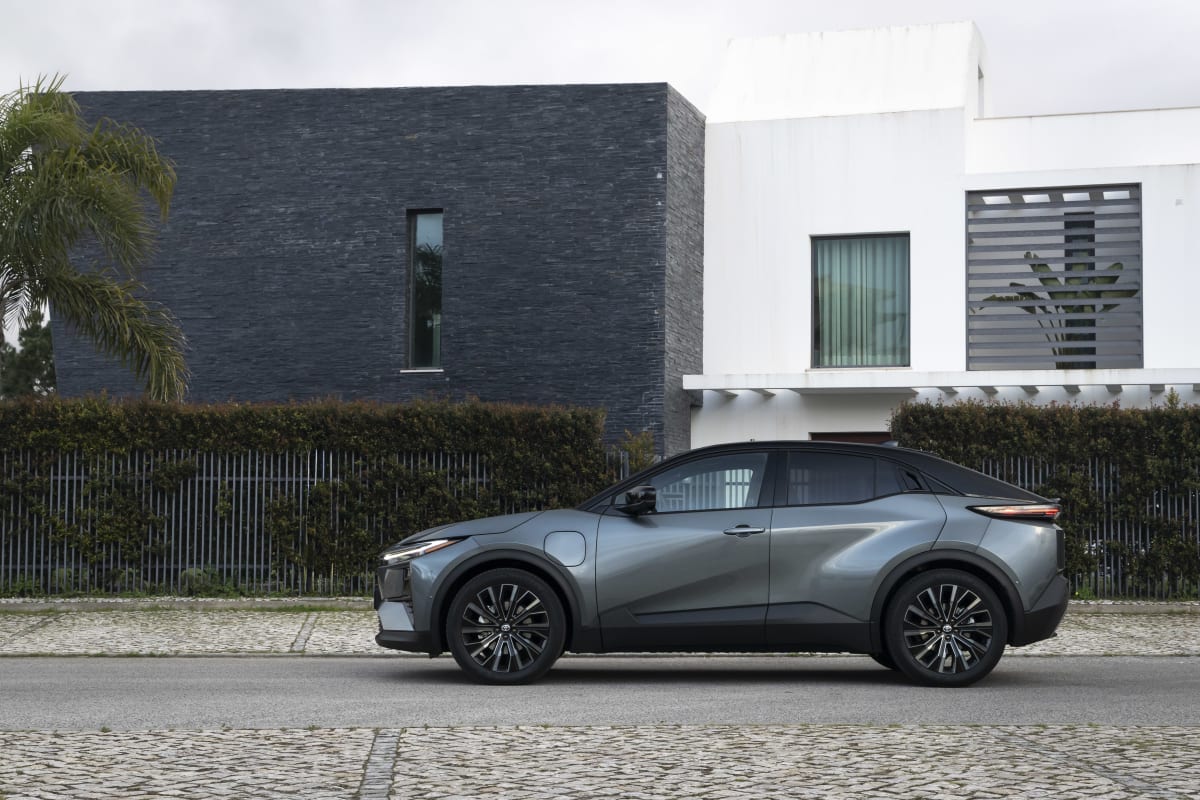
The C-HR+ drops the old C-HR's chunky shoulders for a smooth, grille-less face with Toyota's hammerhead light signature, a low roofline that falls into a ducktail and a light bar that links the tail lamps. Five colours are offered on every grade: Platinum Pearl White, Cement Grey, Attitude Black, Metal Oxide and a newly developed Mineral. High grade adds a contrasting black roof as standard. Mid grade rides on 18-inch wheels, which also give the longest range, while Mid+ and High use 20-inch wheels as an option or as standard.
Inside, the front of the cabin is shared with the bZ4X, but the C-HR+ has its own dashboard finish and seat trims. A 7-inch digital combimeter sits above the steering wheel and a 14-inch centrally mounted multimedia display handles navigation and the media system. Seat covers are synthetic leather, suede-like material or fabric, all made with recycled PET. Ambient lighting offers 64 colours, there are two wireless phone chargers, two rear USB-C ports with a combined 60 W, and rear passengers get their own climate controls. High grade adds a powered driver's seat with memory, a digital key and, as an option, a panoramic glass roof and a nine-speaker JBL system with an 800 W amplifier and a 9-inch subwoofer. Mid and Mid+ use a six-speaker system.
Technology & Features
The multimedia system runs Toyota Smart Connect+ with cloud navigation and real-time traffic, wireless Apple CarPlay and Android Auto, and a voice agent that answers to "Hey Toyota". A dedicated EV routing function proposes charging stops based on state of charge and updates the plan in real time from actual consumption. The MyToyota app lets owners pre-heat or pre-cool the cabin, view state of charge, send destinations to the car and manage the Toyota HomeCharge wallbox, and a coaching tool reviews past journeys with efficiency advice. The instrument cluster shows live charging power and the time left to reach 80%. Toyota's safety software can be updated over the air.
Safety & ADAS
Every C-HR+ comes with Toyota T-Mate and Toyota Safety Sense. Standard equipment includes a pre-collision system with pedestrian detection day and night, cyclist and motorcyclist detection in daylight, intersection detection, intelligent adaptive cruise control, Lane Departure Alert with steering control, Lane Trace Assist, road sign assist, a blind spot monitor, rear cross-traffic alert with automatic braking, an adaptive high-beam system and a parking support brake. Safe Exit Assist warns if a door could be opened into traffic from behind, and the interior door handles light up red. High grade adds lane change assist, front cross-traffic alert, park assist and a panoramic view monitor. Euro NCAP awarded the C-HR+ five stars in May 2026, a result it carried over from the closely related bZ4X after comparing the two cars. The Israeli specification lists eight airbags.
| ADAS LEVEL | Driver-supervised assistance (no SAE level stated by Toyota) |
|---|---|
| ADAS FEATURES | Pre-collision with intersection detection, adaptive cruise, lane trace assist, blind spot monitor, rear cross-traffic alert with braking, Safe Exit Assist, road sign assist; High adds lane change assist, front cross-traffic alert, park assist, panoramic view monitor |
Available Versions
| VERSION | POWER | TORQUE | 0-100 | TOP SPEED | DRIVETRAIN | BATTERY | EV RANGE | COMBINED RANGE | PRICE | KEY DIFFERENCES |
|---|---|---|---|---|---|---|---|---|---|---|
| 57.7 kWh FWD (Mid; UK Icon, Germany Active, Israel Motion) | 165 hp | 269 Nm | 8.4s | 140 km/h | FWD | 57.7 kWh | 458 km | — | £32,995 (UK, incl. grant) | 123 kW (167 PS), 18-inch wheels, 11 kW AC; EUR 41,990 in Germany, NIS 179,990 in Israel |
| 77 kWh FWD (Mid+; UK Design, Germany Teamplayer, Israel Vision) | 221 hp | 269 Nm | 7.3s | 160 km/h | FWD | 77 kWh | 607 km | — | £35,495 (UK, incl. grant) | 165 kW (224 PS), 607 km on 18-inch and 560 km on 20-inch wheels; EUR 45,990 in Germany, NIS 199,990 in Israel |
| 77 kWh AWD (Mid+ and High; Germany Lounge, Israel Exclusive) | 338 hp | 438 Nm | 5.2s | 180 km/h | AWD | 77 kWh | 548 km | — | €53,990 (Germany) | 252 kW (343 PS), 548 km (Mid+, 18-inch) to 507 km (High, 20-inch); 1,500 kg braked towing; not offered in the UK; NIS 229,990 in Israel (502 km per the importer) |
Pricing & Availability
In the UK, Toyota lists the Icon (57.7 kWh) at GBP 32,995 on the road including the GBP 1,500 Band 2 Electric Car Grant, and the Design (77 kWh) at GBP 35,495 including the grant. The Excel was announced at GBP 40,995 before the grant, about GBP 39,500 after it; listings with optional paint show roughly GBP 40,150 to 40,245, so check Toyota UK for the exact figure. All UK cars are front-wheel drive. In Germany, Toyota's price list (recommended retail prices including VAT, before delivery costs) puts the Active at EUR 41,990, the 77 kWh Teamplayer at EUR 45,990 and the all-wheel-drive Lounge at EUR 53,990; a EUR 38,990 introductory price for the Active ran to the end of March 2026. Toyota Germany also advertises an action price from EUR 34,966.72 for private buyers, which includes Toyota's E-Auto Bonus (advertised at EUR 7,000) and is valid to 31 December 2026; the separate state subsidy of up to EUR 6,000 is not included in it. Prices and offers can change, so check Toyota Germany.
Israel's importer Union Motors announced the C-HR+ in early May 2026, and official sales began on 10 May 2026 at Toyota dealers and on the Toyota Israel website. The Motion with the 57.7 kWh battery costs NIS 179,990, the Vision with 77 kWh and 607 km costs NIS 199,990, and the dual-motor Exclusive with 343 PS costs NIS 229,990, before licence fees of NIS 2,450 for the Motion and NIS 2,786 for the Vision and Exclusive shown on Toyota Israel's site. Israeli launch coverage based on the importer's release quotes up to 502 km for the Exclusive, compared with 507 km for the equivalent High grade in Toyota Europe's WLTP table, and also offers a Mobility EasyWay monthly plan from NIS 2,499. The Toyota C-HR sold in the United States is a separate car with its own North American battery, drivetrain and EPA ratings, so the European figures in this article do not apply to it. In Spain, Spanish outlets reported the C-HR+ as the top-selling battery-electric car in April 2026, based on DGT registration data for private buyers.
How It Compares
The two most useful UK reference points are on sale at similar money. The Renault Scenic E-Tech Electric qualifies for the full GBP 3,750 grant, so its Techno costs GBP 33,245, GBP 2,250 less than the C-HR+ Design, and it offers 215 hp and a claimed 631 km (392 miles) with a 545-litre boot, against the Toyota's 416 litres and its UK rating of 605 km (376 miles). The Toyota matches the Renault's 150 kW peak charging rate, offers a sportier coupe shape, and is available with all-wheel drive in markets such as Germany and Israel, while the Scenic is front-wheel drive. The MG4 EV Premium Extended Range is the performance-per-pound pick at GBP 32,995 with 241 hp, but its 544 km WLTP is about 60 km short of the Toyota and its 10-80% charge averages about 80 kW according to EV Database, against about 107 kW for the C-HR+ implied by Toyota's own 28-minute claim. All three figures are UK-rated WLTP and UK prices on the same basis; the Renault is the 2027 model-year update on sale in the UK since 1 October 2026.
- Up to 607 km WLTP from a 77 kWh battery, with a 28-minute 10-80% charge on a 150 kW charger and a standard heat pump
- Real performance choice: 167 PS, 224 PS or a 343 PS (about 338 hp) AWD that reaches 100 km/h in 5.2 seconds and tows up to 1,500 kg
- Strong ownership terms: battery guarantee of at least 70% capacity for 10 years, five-star Euro NCAP, and prices from GBP 32,995 in the UK
- Boot is 416 litres and the coupe roofline limits it, below the 545 litres of the Renault Scenic E-Tech
- AWD is not sold in the UK, costs EUR 53,990 in Germany, and its WLTP range drops to 507 km in High grade on 20-inch wheels, 100 km below the 77 kWh front-drive car
The C-HR+ is Toyota's most convincing electric car so far: a 77 kWh battery with up to 607 km of WLTP range, a 28-minute fast charge and, in the UK, a price within about GBP 2,500 of the Renault Scenic E-Tech and the MG4 once grants are applied. The 77 kWh front-drive version is the sensible buy in Britain, Germany and Israel, while the 343 PS all-wheel-drive car is a genuine performance option in markets that offer it. The trade-offs are a modest boot and 150 kW peak charging that is sustained at only about 107 kW on average. A good family EV for buyers who value Toyota's reliability and battery guarantee.