

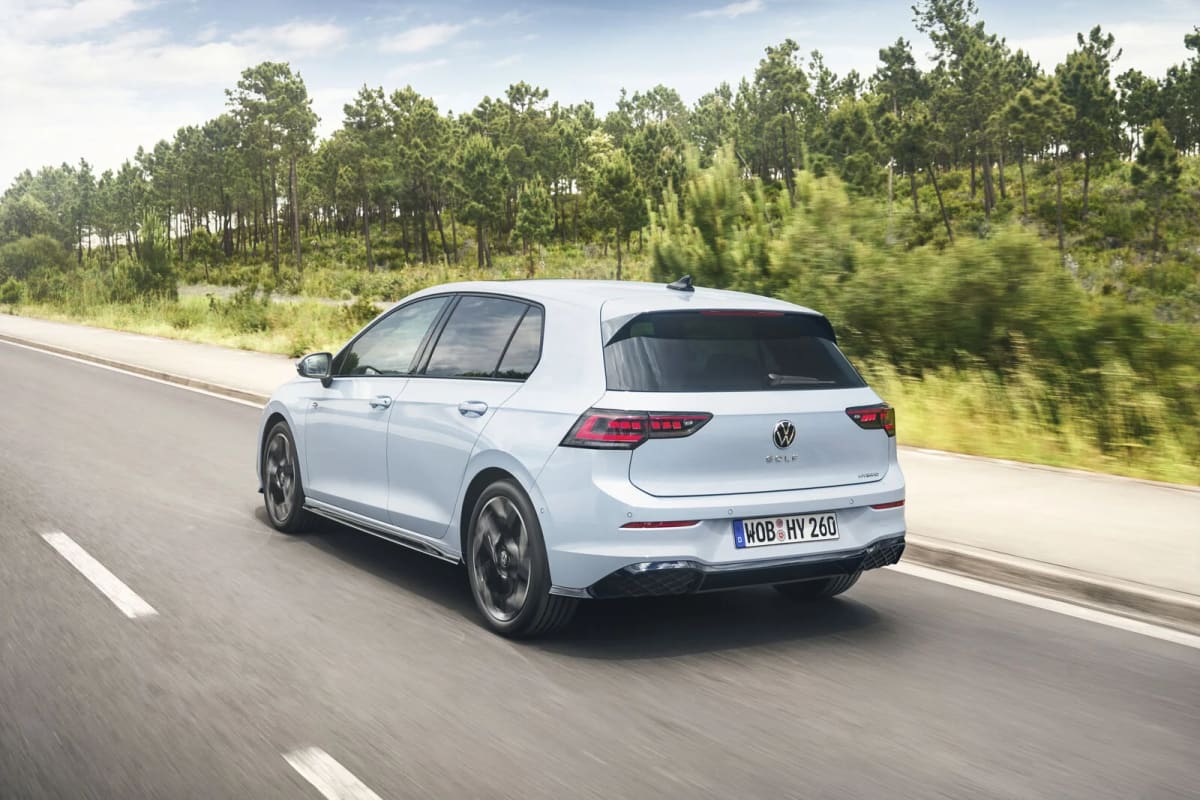
Volkswagen has opened pre-sales in Germany for a genuinely new powertrain option on two of its best-selling models: a 125 kW (170 PS / 168 hp) full hybrid for the Golf and the T-Roc. Unlike the existing Golf eHybrid plug-in, this system carries no plug, no charging cable, and no wallbox requirement — it recharges its small battery entirely through regenerative braking and an onboard generator motor while driving, the same basic principle Toyota has used in its hybrids for decades. Volkswagen is badging it simply "Hybrid," dropping the "e" prefix reserved for its plug-in cars, and the tailgate script on cars photographed for the launch confirms it. The system pairs a 1.5 TSI evo2 turbo petrol engine with two electric motors and a compact 1.6 kWh battery, and Volkswagen says it can frequently run on electric power alone in everyday, low-speed driving. Pre-sales opened on July 21, 2026, with the Golf Hybrid R-Line starting at €41,400 (about $48,200) and the T-Roc Style Hybrid at €44,470 (about $51,800), ahead of deliveries expected from the fourth quarter of 2026.
Performance & Specs
The heart of the new system is a 1.5 TSI evo2 turbocharged four-cylinder combined with two electric motors — one drive motor and one motor-generator — plus a 1.6 kWh (gross) lithium-ion NMC battery mounted low in the floor at the rear axle. Combined system output is 125 kW (170 PS, or 168 hp using the standard 1 kW ≈ 1.341 hp conversion) with 309 Nm (228 lb-ft) of torque, sent to the front wheels through a single-speed gearbox with an electronically controlled multiplate clutch instead of a conventional automatic. Volkswagen quotes a 0-100 km/h time of 7.5 seconds for the Golf Hybrid. The car automatically shifts between three operating modes: pure electric propulsion at low speeds with the TSI engine switched off, a serial mode where the engine runs purely as a generator to feed the drive motor, and a parallel mode above roughly 60 km/h (37 mph) where the petrol engine becomes the primary source with the electric motor stepping in to boost. Drivers can also pick between three profiles — Eco caps system output at 70% and disables the boost function, Comfort removes the limiter and enables boost, and Sport switches into serial mode earlier so full power is always on tap.

| Powertrain | 1.5 TSI evo2 full hybrid (HEV, no plug) |
|---|---|
| Power | 125 kW (170 PS / 168 hp) |
| Torque | 309 Nm |
| 0–100 km/h | 7.5 s |
| Battery | 1.6 kWh (gross), Li-ion NMC |
| Drivetrain | FWD, 1-speed gearbox |
| POWERTRAIN TYPE | Full hybrid (HEV), no plug-in charging |
|---|---|
| HORSEPOWER | 168 hp (125 kW / 170 PS) |
| ACCELERATION | 7.5 s (0–100 km/h, Golf Hybrid) |
| TOP SPEED | Not yet disclosed by Volkswagen |
| DRIVETRAIN | FWD, 1-speed gearbox with electronically controlled multiplate clutch |
| BATTERY | 1.6 kWh (gross), lithium-ion NMC |
| ELECTRIC RANGE | No plug-in EV range; electric-only driving available up to roughly 60 km/h (37 mph) in city traffic |
| COMBINED RANGE | Not published — self-charging hybrid, refuels at any gas station like a conventional car |
Dimensions & Practicality

| Length | 4,282 mm |
|---|---|
| Width | 1,789 mm |
| Height | 1,483 mm |
| Wheelbase | 2,620 mm |
| Ground clearance | approx. 115 mm |
Because the hybrid hardware adds a compact 1.6 kWh battery rather than the much larger 19.7 kWh pack in the plug-in Golf eHybrid, cabin and cargo space are expected to stay close to the standard Golf's figures rather than taking the roughly 108-litre boot penalty that the plug-in variant pays. Volkswagen quotes 381 litres of boot space with the rear bench up and 1,237 litres with it folded flat for the regular Golf hatchback, though the brand has not yet published a hybrid-specific cargo figure separately. The T-Roc, riding on a longer 2,631 mm wheelbase and measuring 4,373 mm nose to tail, carries a deeper 475-litre boot thanks to its taller SUV body, making it the practical pick of the pair for buyers who need more room without stepping up to a plug-in hybrid. Both cars keep their five-door, five-seat layouts unchanged from the standard lineup; nothing about the hybrid hardware forces a reduction in seating.
| LENGTH | 4,282 mm (Golf) / 4,373 mm (T-Roc) |
|---|---|
| WIDTH | 1,789 mm (Golf) |
| HEIGHT | 1,483 mm (Golf) |
| WHEELBASE | 2,620 mm (Golf) / 2,631 mm (T-Roc) |
| CARGO VOLUME | approx. 381 L Golf / 475 L T-Roc (seats up) |
| FRUNK | Not applicable — engine bay houses the TSI engine |
Charging & Battery
This is the detail that separates a true full hybrid from a rebadged mild hybrid, and it's worth stating plainly: the Golf Hybrid and T-Roc Hybrid never plug in. There is no charge port, no cable in the trunk, and no need for a home wallbox or public charging network. The 1.6 kWh lithium-ion NMC battery is topped up exclusively through regenerative braking and by the onboard generator motor while the petrol engine is running, then discharged again during electric-only driving, serial mode, or boost. That is a fundamentally different architecture from Volkswagen's own Golf eHybrid, which uses a roughly 19.7 kWh pack that does require external charging for its much longer electric-only range. The trade-off is exactly what you'd expect: no plug-in EV range, but also no dependence on charging infrastructure, no home installation cost, and no change to how owners already refuel a conventional car.
| BATTERY | 1.6 kWh (gross), Li-ion NMC, floor-mounted at the rear axle |
|---|---|
| EXTERNAL CHARGING | None — no plug, no cable, no wallbox required |
| AC CHARGING | Not applicable |
| DC FAST CHARGING | Not applicable |
| RECHARGE METHOD | Regenerative braking + onboard generator motor while driving |
Design & Interior
Exterior changes are deliberately subtle. Both cars carry over the current Golf and T-Roc styling essentially unchanged, including the option of IQ.Light LED matrix headlights, and the only visual giveaway is a plain "HYBRID" script badge on the tailgate — no lightning-bolt icon, no charge-port flap, and no "e" prefix, since Volkswagen reserves that naming for its plug-in models. Inside, the Golf keeps its column-mounted gear selector and the returning physical rotary knob for volume and drive-mode selection, a response to owner complaints about the previous generation's touch-only controls. The T-Roc goes further on materials and comfort, offering a perforated leatherette dashboard with ambient lighting, optional 14-way ergoActive seats with a massage function, and around 40 kg of recycled plastics worked into the cabin trim. Both cars are available with Volkswagen's latest digital cockpit and a large central touchscreen, continuing the brand's push to modernize its interiors after years of criticism over sluggish, unintuitive software.
Technology & Features
The centerpiece of the hybrid-specific software is a new Energy Flow screen, visible on the central touchscreen, that animates the car's power sources in real time — showing whether the wheels are being driven by the battery, the engine, or a blend of both, alongside a live electric-range readout for the current trip. The Golf's infotainment display and the T-Roc's screen, offered in 10.4-inch or 12.9-inch sizes depending on trim, both run Volkswagen's latest software with an upgraded voice assistant and over-the-air update capability. A 10-inch digital instrument cluster is standard across the range, and both models retain smartphone mirroring alongside Volkswagen's own connected-car app for remote functions like climate pre-conditioning.
Safety & ADAS
Both cars ship with Volkswagen's IQ.Drive suite of driver-assistance systems as standard equipment for 2026. Front Assist, the automatic emergency braking system, has been updated to better detect pedestrians and cyclists in low-light conditions and to recognize cross-traffic during unprotected left turns. Lane Assist adds a new road-edge detection function to keep the car from drifting off unmarked rural roads, not just marked lanes. Travel Assist, now at version 2.5, bundles adaptive cruise control with lane centering and automatic motorway lane changes, and on the T-Roc an enhanced version of Travel Assist is bundled with the optional IQ.DRIVE package alongside Park Assist Pro, which can steer the car into a space automatically over distances of up to 50 meters.
| ADAS LEVEL | SAE Level 2 driver assistance |
|---|---|
| ADAS FEATURES | Front Assist AEB, Lane Assist with road-edge detection, Travel Assist 2.5 (adaptive cruise + lane centering + automatic lane change), Park Assist Pro (T-Roc, optional) |

Available Versions
| VERSION | POWER | TORQUE | 0-100 | TOP SPEED | DRIVETRAIN | BATTERY | EV RANGE | COMBINED RANGE | PRICE | KEY DIFFERENCES |
|---|---|---|---|---|---|---|---|---|---|---|
| Golf Hybrid R-Line | 168 hp | 309 Nm | 7.5s | — | FWD | 1.6 kWh | — | — | $48,200 | Entry point for the new full hybrid; R-Line trim standard, pre-sales open now |
| T-Roc Style Hybrid | 168 hp | 309 Nm | — | — | FWD | 1.6 kWh | — | — | $51,800 | Same 125 kW hybrid system in the taller T-Roc SUV body; Style trim standard, 475 L boot |
Pricing & Availability
Volkswagen opened pre-sales for the new full hybrid in Germany on July 21, 2026. The Golf Hybrid R-Line starts at €41,400 (about $48,200), while the T-Roc Style Hybrid starts at €44,470 (about $51,800), with both figures reflecting the German market at launch. Deliveries are expected to begin in the fourth quarter of 2026. Volkswagen has also confirmed a second, lower-output 100 kW (136 PS / 134 hp) version of the full hybrid for the T-Roc lineup, aimed at a lower price point, though pricing for that variant has not yet been disclosed. Volkswagen has not announced pricing or timing for this specific full-hybrid powertrain in other European markets or beyond, so buyers outside Germany should expect local pricing and availability to follow in subsequent phases of the rollout.
How It Compares
The closest philosophical match on the market is the Subaru Forester Hybrid, another self-charging system with no plug and no external charging dependency — it undercuts the Golf Hybrid on price while offering more power, though it comes in a larger SUV body rather than a compact hatchback. Freshmotors doesn't yet cover a direct same-segment non-plug hybrid hatchback rival to the Golf, so it's worth noting what similar money buys elsewhere in our own catalog, even outside this segment: for roughly the price of a Golf Hybrid, a BYD Tang DM-i plug-in hybrid SUV offers nearly triple the horsepower and over 1,000 km of combined range on a charge-and-fuel basis, while an AVATR 11 range-extender EV delivers a broadly similar "engine as generator" concept to VW's serial mode, just scaled up with a genuine plug-in electric range on top. None of these are direct cross-shop rivals — body style, market, and intended buyer all differ — but they illustrate how much more electrified performance and range a similar budget buys once a plug enters the equation, which is precisely the trade-off VW's engineers made in keeping this system plug-free.
- Genuine electric-only driving at low speed with zero dependence on charging cables, wallboxes, or public infrastructure
- Up to 35% better fuel economy in city driving versus a comparable 1.5 eTSI mild hybrid, per Volkswagen's own figures
- Proven three-mode hybrid architecture (electric, serial, parallel) brought to two of VW's highest-volume nameplates
- No official top speed or electric-only range figures published yet, and no EV range in the plug-in sense at all
- Pricing sits well above a comparable mild-hybrid Golf or T-Roc for buyers who don't specifically want electric-only crawling
This is Volkswagen finally building the kind of hybrid Toyota has sold by the million for two decades — a genuine electric-assist system that needs nothing more than a gas station to keep running. For buyers who like the idea of electric driving but can't or won't install a home charger, that's a meaningfully different pitch than the existing plug-in Golf eHybrid, and the claimed 10-15% fuel savings (up to 35% in the city) should show up in real-world running costs. It's not a thrilling car on paper — no headline EV range, no eye-catching top speed, and a price premium over the mild-hybrid versions it replaces at the top of the non-plug lineup — but it's a sensible, well-engineered option for exactly the buyer who wants a familiar Golf or T-Roc without rethinking how they refuel. Recommended for commuters and city drivers who want lower running costs without any change to their routine.