
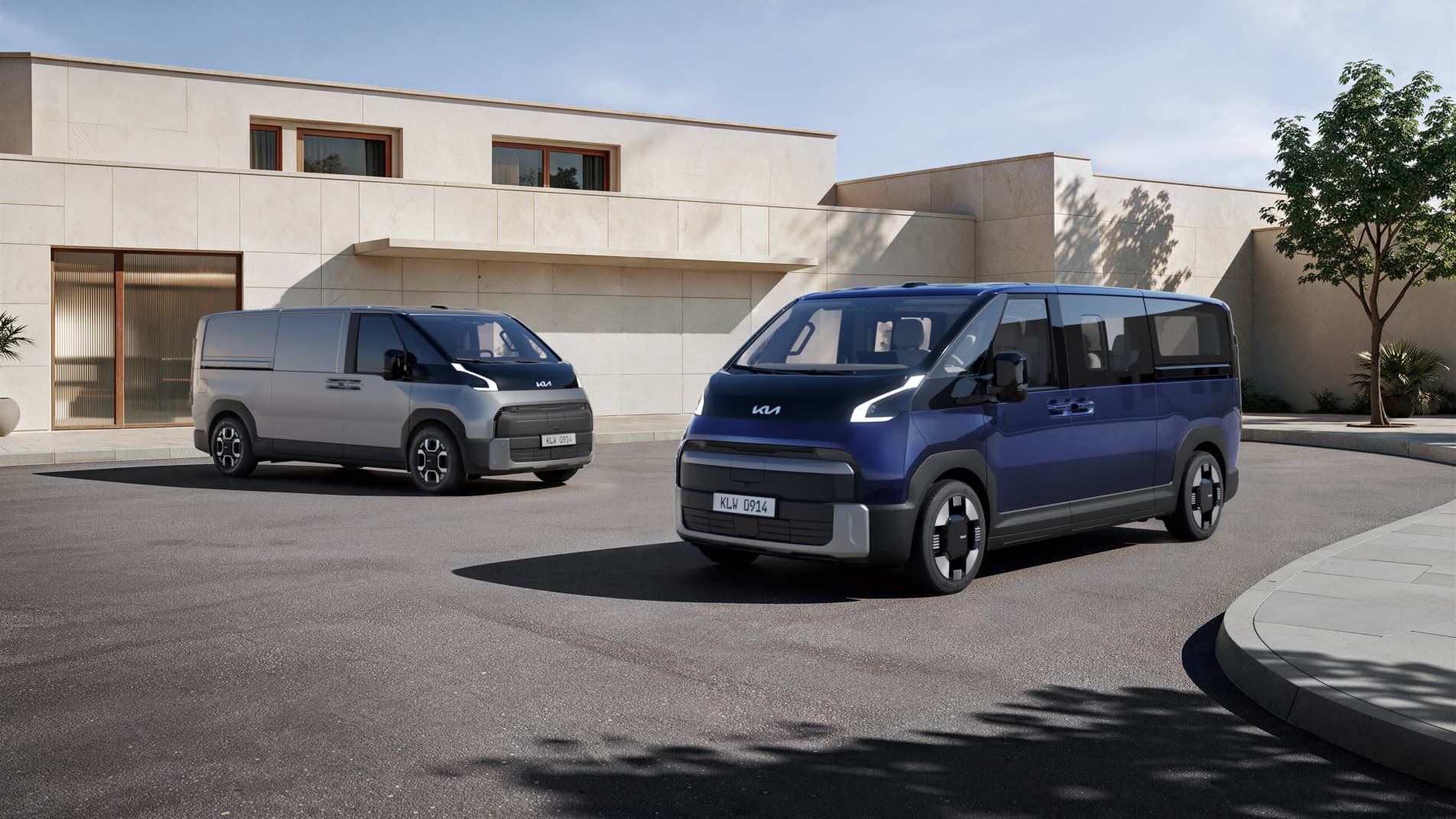
Kia has unveiled the PV7, the second model in its dedicated all-electric Platform Beyond Vehicle (PBV) lineup, at IAA Transportation 2026 in Hannover. Where the smaller PV5 targeted urban flexibility, the PV7 is a genuinely large, 800V commercial EV built to compete for logistics, shuttle, and fleet business -- offered in Cargo and Passenger body styles, with up to 460 km of WLTP range and a scalable body architecture Kia plans to expand into 23 total variants by the time it goes on sale in Korea and Europe in the second half of 2027.
Kia's Second PBV, Built for Bigger Jobs
The PV7 sits on Kia's PBV-dedicated E-GMP.S architecture and follows the same basic template as the PV5 -- a flat-floor, flexible-body platform meant to spawn multiple derivatives from one base structure -- but scaled up for heavier-duty use. Kia frames the PV5's "Open Box" concept (urban flexibility) against the PV7's "Tool Box" concept, which prioritizes greater payload and cargo capacity for larger-scale commercial operators, fleets, and logistics businesses rather than last-mile city delivery alone. Both Cargo and Passenger versions were shown at the car's Hannover debut, with Kia CEO Ho Sung Song describing the PV7 as going "beyond the vehicle itself to deliver a complete business solution" combining hardware, fleet-management software, and dedicated PBV services. Kia's broader PBV roadmap continues from here: the larger PV9 is confirmed for 2029, and Kia says the PV7 lineup itself will grow to 23 variants -- including a dedicated chassis cab and third-party conversion models -- after this initial launch.
Tech Highlights
- 800V E-GMP.S architecture with 71.5 kWh or 96.2 kWh NCM battery options, enabling 10-80% DC fast charging in the mid-20-minute range at up to 350 kW.
- Dual charging ports -- a front AC/DC port plus an optional rear-side AC port -- a first for Kia, giving fleet operators more flexibility around depot and street-side charging layouts.
- Pleos Connect infotainment on Android Automotive OS, paired with the Gleo AI voice assistant, 12.9-inch and 14.6-inch displays, and an open third-party business-app marketplace.
- Vehicle-to-Load (V2L) power output and a dedicated heavy-load driving mode that adapts the Cargo variant's dynamics to varying payload conditions.
Design and Dimensions
At 5,350 mm long, 1,995 mm wide (2,030 mm including mirrors), 1,990 mm tall, and riding a 3,500 mm wheelbase, the PV7 is a substantially bigger vehicle than the PV5 -- closer in footprint to a mid-size panel van than a city delivery vehicle. Designed under Kia's "Opposites United" philosophy, it carries over the PV5's black-hood treatment and one-box silhouette, with hidden headlamps, a floating-roof graphic on the Passenger model, and a lowered front beltline for better outward visibility. A visible skid plate below the front bumper and replaceable bumper corners, wheel-arch sections, and door cladding are aimed squarely at fleet operators who need cheap, fast collision repairs rather than showroom aesthetics. Kia is launching the PV7 in three new colors -- Fjord Blue, Solid Moonrock Gray, and Lush Green -- with matte finishes available across the body-color range.

| Layout | Single motor, front axle |
| Drive | Front-wheel drive |
| Power | 200 kW (268 hp) |
| Torque | 420 Nm |

| Length | 5,350 mm (210.6 in) |
| Width | 1,995 mm (78.5 in) / 2,030 mm w/ mirrors |
| Height | 1,990 mm (78.3 in) |
| Wheelbase | 3,500 mm (137.8 in) |
Performance and Specs
Every PV7 variant shares the same 200 kW (268 hp), 420 Nm front motor and front-wheel-drive layout at launch, with Kia stating an all-wheel-drive version will follow later in the model's life. What varies is battery size: a 71.5 kWh pack for shorter-range, typically lighter-duty configurations, and a 96.2 kWh pack for the Long Range Cargo variant, which Kia rates at "over 460 km" of WLTP range -- a figure the company explicitly flags as based on internal testing and still subject to final WLTP homologation. The 800V architecture supports DC fast charging at up to 350 kW, with a 10-80% top-up taking roughly 20-25 minutes. A dedicated heavy-load driving mode adjusts the Cargo variant's throttle and stability behavior depending on how much weight is on board, and Kia's Pedal Misapplication Safety Assist 2.0 is standard across the range, alongside a seven-airbag system that includes a roof-mounted front-passenger airbag.
| Spec | Kia PV7 |
|---|---|
| Motor | 200 kW (268 hp) front-mounted |
| Torque | 420 Nm |
| Battery Options | 71.5 kWh / 96.2 kWh NCM |
| Range (WLTP, Long Range Cargo) | 460+ km |
| DC Fast Charging | Up to 350 kW; 10-80% in ~20-25 min |
| Drive | FWD standard; AWD planned later |
| Max Payload | 1,165 kg (Long) / 1,200 kg (Compact) |
| Cargo Volume | 6.1 m³ (Long) / 8.0 m³ (High Roof) |
Interior and Technology
The PV7 Cargo and Passenger interiors are built around genuinely different priorities, sharing an underlying platform but differing sharply in finish. The Cargo variant uses a "Mobile Workspace" layout with a layered dashboard, open storage cubbies within easy reach, and -- on three-seat models -- a center seatback that folds down into a flat open tray. Standard interior trim is Onyx Black One-Tone, with a speckled open tray finish designed to resist dirt and scratches rather than look premium. The Passenger cabin takes the opposite approach: two-tone finishes, optional ambient lighting, a center console that doubles as a table, roof-integrated rear climate controls, and newly developed seats, including 7-seat models with Long-Rail Easy Remove Seats for reconfiguring the cabin between shuttle and cargo-hauling duty. Both variants run Kia's Pleos Connect infotainment system on Android Automotive OS across 12.9-inch and 14.6-inch displays, with the Gleo AI voice assistant handling natural-language navigation, messaging, and vehicle-function requests, plus an open app marketplace for both first- and third-party business software. An A-pillar grab handle and reworked step geometry specifically target drivers who get in and out of the vehicle dozens of times a shift.
Pricing and Availability
Kia has not announced official pricing for the PV7 -- the specifications shared at its Hannover unveiling are explicitly labeled preliminary, with final figures, features, and market availability confirmed closer to launch. The PV7 Passenger and Cargo variants are scheduled to go on sale in Korea and Europe in the second half of 2027, with additional markets, derivatives, and conversion models -- including a dedicated chassis cab -- following afterward as part of Kia's plan to grow the lineup to 23 total variants. For context, Kia's smaller PV5 currently starts in the low-to-mid €30,000s in Europe; given the PV7's larger dimensions, higher-capacity battery options, and 800V architecture, most outlets covering the unveiling expect a starting price somewhere in the roughly $45,000-$55,000 range once official figures land, though this is an estimate rather than a confirmed number.
How It Compares
XPENG X9
$53,094 | 315 hp | MPV
A passenger-focused electric MPV rather than a commercial PBV, but a useful price-and-power reference point in the same rough bracket as where the PV7 is expected to land -- illustrating how much interior flexibility and family-oriented tech that budget already buys elsewhere.
ArcFox Wendao V9
$61,962 | 530 hp | 550 km range
Considerably more powerful and slightly longer-range than the PV7's single 268 hp motor, though again a passenger-first MPV rather than a payload-focused commercial van -- the contrast underlines that the PV7 is optimized for cargo and fleet duty, not outright performance.
Pros and Cons
Pros
- 800V architecture with up to 350 kW DC fast charging is genuinely advanced for a commercial-focused EV van, not just a passenger-car halo feature
- 1,200 kg max payload and up to 8.0 m³ of cargo volume (High Roof) make it a serious tool for logistics and delivery fleets, not a converted passenger van
- Dual charging ports and a dedicated heavy-load driving mode show genuine engineering attention to real fleet-operator needs
- Shared platform with the PV5 and a planned 23-variant lineup gives Kia a credible, scalable PBV strategy rather than a one-off niche vehicle
Cons
- No official pricing yet -- all figures, including range, are explicitly preliminary and subject to change before the 2027 launch
- All-wheel drive isn't available at launch; FWD is the only configuration until an AWD variant arrives later
- Launch is nearly a year and a half away (second half of 2027), with the full 23-variant lineup arriving even later
- Korea and Europe only at launch -- no confirmed timeline for other markets including North America
FAQs
Verdict
The PV7 is a credible, well-engineered step up from the PV5 rather than a rushed follow-up -- Kia has clearly built real fleet-operator thinking into details like the dual charging ports, heavy-load driving mode, and repair-friendly replaceable body panels, not just scaled up the smaller van's numbers. The 800V architecture and up to 460 km of WLTP range are genuinely competitive for a commercial EV, even if the lack of confirmed pricing and the still-distant 2027 launch mean this is a promise more than a purchase decision today. For fleet buyers already sold on the PV5 concept but needing more payload and cargo volume, the PV7 looks like exactly the right next chapter in Kia's PBV strategy.