

Porsche's electric Cayenne is no longer a single launch model but a complete family. The SUV was revealed on 19 November 2025 in two versions, the mid-range Cayenne S Electric followed on 10 March 2026, and the Coupe body style, unveiled at Auto China in Beijing in April 2026, completed a line-up of six variants: Cayenne Electric, Cayenne S Electric and Cayenne Turbo Electric, each as an SUV and as a Coupe. All six share a 113 kWh gross battery, an 800-volt architecture and dual-motor all-wheel drive, with 300 kW (408 PS, 402 hp) at the entry point and up to 850 kW (1,156 PS, about 1,140 hp) at the top with Launch Control. The latest model-year update adds optional electrically operated doors, a new massage-and-sound seat system and a 105-shade paint palette. US pricing starts at $109,000 before a $2,350 delivery fee, Germany at €105,200 including VAT and the UK at £83,200 including VAT.
Performance & Specs
Every electric Cayenne carries a permanent-magnet synchronous motor on each axle and electronic Porsche Traction Management, so all variants are all-wheel drive. The entry-level Cayenne Electric makes 300 kW (408 PS, about 402 hp) in normal driving and 325 kW (442 PS, about 436 hp) with Launch Control, with 835 Nm of torque, a 0-100 km/h time of 4.8 seconds and a top speed of 230 km/h. The Cayenne S Electric sits in the middle with 400 kW (544 PS, about 536 hp) and up to 490 kW (666 PS, about 657 hp) with Launch Control, 1,080 Nm, 3.8 seconds to 100 km/h and 250 km/h. Like the Turbo, the S uses direct oil cooling for the rear-axle motor, and its rear pulse inverter uses silicon carbide and handles up to 620 amps.
The Cayenne Turbo Electric is the headline act. In normal driving it delivers up to 630 kW (857 PS, about 845 hp), and the Push-to-Pass function adds a further 130 kW (176 PS) for 10 seconds. With Launch Control the peak is 850 kW (1,156 PS) and 1,500 Nm, which takes it from 0 to 100 km/h in 2.5 seconds, 0 to 200 km/h in 7.4 seconds and on to 260 km/h. A note on units: Porsche quotes PS, the metric horsepower, which is about 1.4 percent smaller than the imperial hp. 1,156 PS therefore works out at about 1,140 hp (850 kW x 1.341), and Porsche's US newsroom prints 1,139 hp; some coverage prints 1,156 as hp, which overstates it. In the US, Porsche quotes 0-60 mph in 4.5 seconds for the Cayenne Electric, 3.6 seconds for the S and 2.4 seconds for the Turbo, the same figures for the Coupe versions, all with Launch Control. Porsche describes the Turbo as the most powerful production Porsche of all time.
The chassis is as important as the motors. Adaptive air suspension with Porsche Active Suspension Management is standard, rear-axle steering of up to five degrees is optional on every model, and Porsche Active Ride, the active suspension known from Porsche's sports sedans, is optional on the S and the Turbo, a first for the Cayenne. The Turbo comes with a Porsche Torque Vectoring Plus rear differential as standard, and the S can add it as an option. Recuperation reaches up to 600 kW, a level Porsche compares with Formula E, and the company says about 97 percent of braking events can be handled by the electric motors alone.

| Powertrain | Dual-motor AWD BEV (one motor per axle) |
|---|---|
| Power | 630 kW (857 PS / 845 hp); 850 kW (1,156 PS / 1,140 hp) with Launch Control |
| Torque | 1,500 Nm with Launch Control |
| 0–100 km/h | 2.5 s |
| Battery | 113 kWh gross |
| Range | Up to 623 km WLTP |
| POWERTRAIN TYPE | Dual-motor BEV, permanent-magnet synchronous motors on both axles |
|---|---|
| HORSEPOWER | Cayenne Electric 300 kW (408 PS / 402 hp); S Electric 400 kW (544 PS / 536 hp); Turbo Electric 630 kW (857 PS / 845 hp) |
| LAUNCH CONTROL POWER | 325 kW (442 PS / 436 hp); 490 kW (666 PS / 657 hp); 850 kW (1,156 PS / 1,140 hp) |
| TORQUE | 835 Nm; 1,080 Nm; 1,500 Nm (with Launch Control) |
| ACCELERATION | 0-100 km/h in 4.8 s; 3.8 s; 2.5 s (with Launch Control) |
| TOP SPEED | 230 km/h; 250 km/h; 260 km/h |
| DRIVETRAIN | AWD with electronic Porsche Traction Management |
| BATTERY | 113 kWh gross, 800 V |
| ELECTRIC RANGE | Up to 642 km; 653 km; 623 km WLTP (SUV) |
Dimensions & Practicality

| Length | 4,985 mm (S Electric: 4,991 mm) |
|---|---|
| Width | 1,980 mm (without mirrors) |
| Height | 1,674 mm (Coupe: 1,650 mm) |
| Wheelbase | 3,023 mm |
| Luggage | 781-1,588 L plus 90 L front |
The electric Cayenne SUV is 4,985 mm long, 1,980 mm wide and 1,674 mm tall. That is 55 mm longer than the combustion Cayenne, and almost all of the growth is between the axles: the 3,023 mm wheelbase is nearly 13 cm longer, which Porsche says translates into more rear legroom than in any previous Cayenne. The rear seat system is electrically adjustable as standard. Luggage space is 781 litres up to the top of the rear seats and 1,588 litres with the seats folded, plus a 90-litre front compartment. The Turbo Electric lists slightly less, 747 to 1,554 litres according to Porsche Germany's technical data, and Porsche Germany lists a braked towing capacity of 3.0 tonnes with the optional tow hitch, rising to 3.5 tonnes with the Off-Road package.
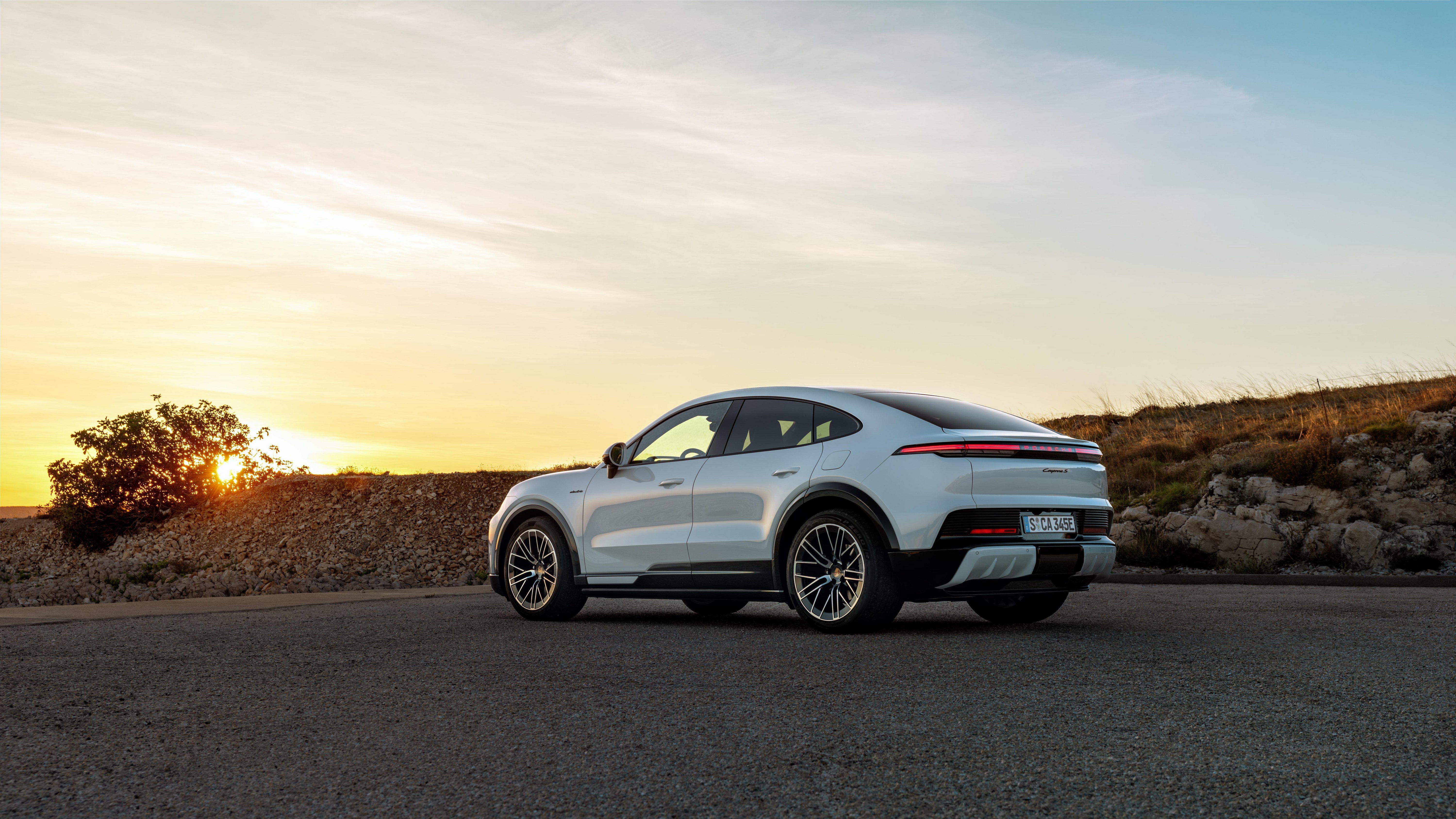
The Coupe keeps the same length, width and wheelbase but is 24 mm lower at 1,650 mm, with a sloping roofline Porsche calls the flyline, borrowed from the 911, and a lower drag coefficient of 0.23 against 0.25 for the SUV. Porsche credits the shape with adding up to 18 km of WLTP range. Cargo volume falls to 534 to 1,347 litres (500 to 1,313 litres in the Turbo Coupe), with the same 90-litre front compartment and the same 3.0 to 3.5-tonne towing ratings. Rear seating is a two-seat or 2+1 layout, both electrically adjustable. Porsche Germany lists kerb weights (DIN) of 2,525 kg for the Cayenne Electric, 2,555 kg for the S and 2,645 kg for the Turbo, and 5 kg more for each Coupe.
| LENGTH | 4,985 mm (S Electric 4,991 mm) |
|---|---|
| WIDTH | 1,980 mm (without mirrors) |
| HEIGHT | 1,674 mm SUV; 1,650 mm Coupe |
| WHEELBASE | 3,023 mm |
| CARGO VOLUME | 781 L / 1,588 L seats up / folded (SUV, Turbo 747 / 1,554 L); Coupe 534 / 1,347 L (Turbo 500 / 1,313 L) |
| FRUNK | 90 L |
| KERB WEIGHT (DIN) | 2,525 kg / 2,555 kg / 2,645 kg (SUV); 2,530 kg / 2,560 kg / 2,650 kg (Coupe) |
| TOWING | 3.0 t braked with optional tow hitch; 3.5 t with Off-Road package |
Charging & Battery
All six variants use the same newly developed 113 kWh high-voltage battery with double-sided cooling. Porsche's own pages list the 113 kWh as gross capacity and do not publish a net figure; the German outlet electrive and the Israeli site auto.co.il both cite about 108 kWh usable, so treat that as unofficial. The 800-volt system charges at up to 390 kW and, under specific conditions with a 400 kW charger, up to 400 kW. Porsche's headline claim is 10-80% in less than 16 minutes, which applies to optimal conditions: a charger that delivers more than 390 kW at more than 850 V, a battery temperature around 15 °C and a very low starting state of charge. On a 400-volt charging network Porsche Germany lists 26 minutes for the same 10-80% window. In 10 minutes the SUV can add about 325 km (Cayenne) or 315 km (Turbo) of WLTP range under those ideal conditions.
At home, an 11 kW AC charger is standard and a 22 kW one is optional, with Porsche Germany listing 11 hours and 5.75 hours for a full charge. The 2027 model year adds Porsche Wireless Charging, an optional inductive pad that transfers up to 11 kW at about 90 percent efficiency; it is on sale in Germany and other European markets first and is being rolled out worldwide in stages, and it is not offered in China. US cars have a NACS port on the driver-side rear fender for DC and a separate J1772 port for AC, plus a CCS adapter as standard. Official WLTP consumption ranges from 18.9 to 22.5 kWh/100 km depending on the variant. Those figures are measured at the socket, which is why they sit above what 113 kWh divided by the range would suggest. AutoScout24 Austria reported 27 to 40 kWh/100 km in its own driving with the Turbo, so real-world range can fall well below the WLTP number.
| BATTERY | 113 kWh gross, 800 V |
|---|---|
| AC CHARGING | 11 kW standard, 22 kW optional; US J1772 port |
| DC FAST CHARGING | Up to 390 kW (400 kW under specific conditions); US NACS port |
| DC 10-80% TIME | Under 16 min in optimal conditions; 26 min on 400 V charger (Porsche Germany) |
| WIRELESS CHARGING | Optional, up to 11 kW, about 90% efficiency |
| WLTP CONSUMPTION | 18.9-22.5 kWh/100 km depending on variant |
Design & Interior
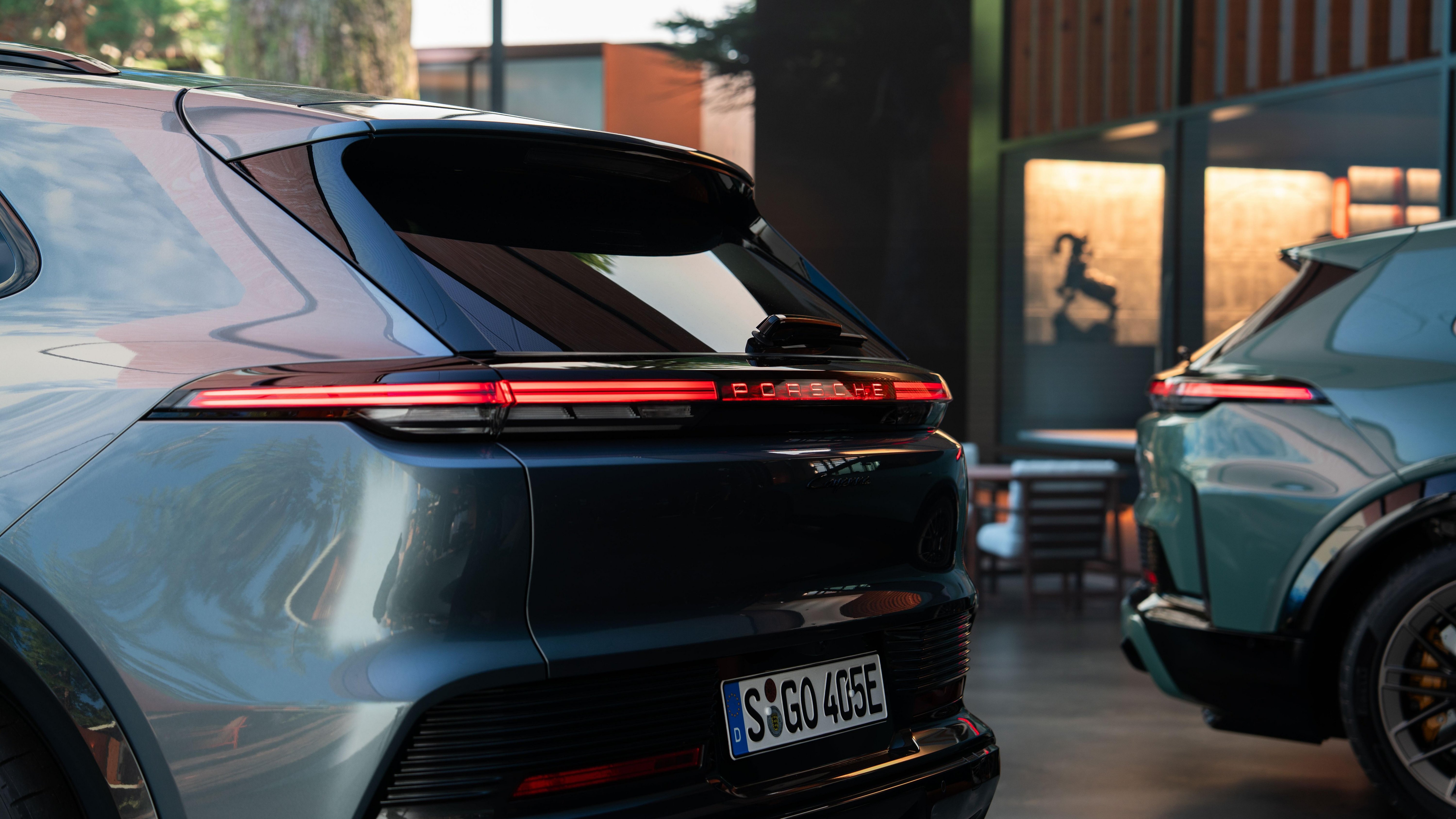
The electric Cayenne keeps the proportions of the combustion model but with its own face: a low bonnet, slim Matrix LED headlights that carry all lighting functions in one module, strongly contoured wings and frameless doors with a pronounced crease. At the rear a light strip with animated graphics and illuminated Porsche lettering takes the place of a conventional bar. The Turbo adds contrasting Turbonite accents on the crests, wheel faces and window trims, and an Off-Road package changes the front geometry for a better approach angle. The Coupe is different from the A-pillar back, with a Coupe-specific windscreen, a flush-mounted rear window, an adaptive rear spoiler and a panoramic glass roof as standard. An optional Lightweight Sport package for the Coupe adds a carbon roof, 22-inch wheels and open-pore carbon trim and saves up to 17.6 kg.
Inside, the focus is the Flow Display, a curved OLED panel that blends into the centre console, together with a 14.25-inch OLED instrument cluster and an optional 14.9-inch passenger display. An optional head-up display uses augmented reality to project an 87-inch image 10 metres ahead of the car. Porsche kept analogue controls for the most-used functions such as climate and volume. Mood Modes change seating position, lighting, climate, sound and display themes together, and panel heating warms armrests and door panels as well as the seats. The model-year update adds optional electrically operated doors for all four doors, controlled from the handles, the cabin, the display or the Digital Key, and a new massage system with 16 air cushions and six sound actuators per front seat, five programmes and 4D audio, plus three Wellness Mood Modes. Customers can choose from 13 standard colours, and with Paint to Sample the palette reaches 105 shades.
Technology & Features
The new Porsche Digital Interaction concept lets drivers place widgets on the displays and recolour every screen with the Themes app. Third-party apps arrive through the Porsche App Centre, and in April 2026 Porsche added Disney+ streaming to the Cayenne Electric and Macan Electric. Voice Pilot is an AI-based assistant that understands context and chained requests and can control navigation, and the Porsche Digital Key turns a smartphone or smartwatch into a key that can be shared with up to seven other users. Porsche Active Aerodynamics adjusts the cooling flaps and roof spoiler to speed and driving situation, and the Turbo has active aeroblades at the rear that extend the lateral tear-off edges to help range at higher speeds.
Safety & ADAS
Porsche Germany's standard equipment list for the Cayenne Electric includes adaptive cruise control, lane keeping assist with an emergency stop function, lane change assist, an intersection assistant, a warning and brake assist, an evasion and turn assistant, traffic sign recognition, an active speed limit assistant, attention detection, automated parking with 2D Surround View and eCall. Airbags include front and rear side airbags and a front centre airbag, with roll-over sensing for the curtain airbags. Equipment varies by market, so US and other buyers should check the local specification. Porsche does not state an SAE automation level for these systems, which are driver-supervised. Euro NCAP tested the Cayenne Electric SUV and awarded five stars in December 2025, with 91% for adult occupants, 89% for child occupants, 81% for vulnerable road users and 79% for safety assist; no NHTSA rating had been published at the time of writing.
| ADAS LEVEL | Driver-supervised assistance (no SAE level stated by Porsche) |
|---|---|
| ADAS FEATURES | Adaptive cruise control, lane keeping with emergency stop, lane change assist, intersection assistant, warning and brake assist, evasion and turn assistant, traffic sign recognition, 2D Surround View with automated parking, attention detection, eCall (German specification) |
Available Versions
| VERSION | POWER | TORQUE | 0-100 | TOP SPEED | DRIVETRAIN | BATTERY | EV RANGE | COMBINED RANGE | PRICE | KEY DIFFERENCES |
|---|---|---|---|---|---|---|---|---|---|---|
| Cayenne Electric (SUV) | 402 hp | 835 Nm | 4.8s | 230 km/h | AWD | 113 kWh | 642 km | — | $109,000 | 300 kW (408 PS), 325 kW (442 PS / 436 hp) with Launch Control; EUR 105,200 in Germany |
| Cayenne S Electric (SUV) | 536 hp | 1,080 Nm | 3.8s | 250 km/h | AWD | 113 kWh | 653 km | — | $126,300 | 400 kW (544 PS), 490 kW (666 PS / 657 hp) with Launch Control; EUR 126,400 in Germany |
| Cayenne Turbo Electric (SUV) | 845 hp | 1,500 Nm | 2.5s | 260 km/h | AWD | 113 kWh | 623 km | — | $163,000 | 630 kW (857 PS), 850 kW (1,156 PS / 1,140 hp) with Launch Control; EUR 165,500 in Germany |
| Cayenne Coupe Electric | 402 hp | 835 Nm | 4.8s | 230 km/h | AWD | 113 kWh | 661 km | — | $113,800 | Cd 0.23, 24 mm lower, 534-1,347 L; EUR 109,000 in Germany |
| Cayenne S Coupe Electric | 536 hp | 1,080 Nm | 3.8s | 250 km/h | AWD | 113 kWh | 669 km | — | $131,200 | Longest WLTP range in the line-up; EUR 130,300 in Germany |
| Cayenne Turbo Coupe Electric | 845 hp | 1,500 Nm | 2.5s | 260 km/h | AWD | 113 kWh | 637 km | — | $168,000 | 850 kW (1,156 PS / 1,140 hp) with Launch Control, 500-1,313 L; EUR 168,500 in Germany |
Pricing & Availability
All prices below are the manufacturer's list prices as published on Porsche's own sites and newsrooms in early October 2026. In the US, Porsche lists the Cayenne Electric at $109,000, the S Electric at $126,300 and the Turbo Electric at $163,000, with the Coupe versions at $113,800, $131,200 and $168,000. A $2,350 delivery, processing and handling fee is extra. The 2027 model year is open for orders in the US with deliveries from the first quarter of 2027 and prices unchanged from 2026. In Germany Porsche lists the SUV at €105,200, €126,400 and €165,500, and the Coupe at €109,000, €130,300 and €168,500, all including VAT. In the UK the SUV starts at £83,200 for the Cayenne Electric, £99,900 for the S and £130,900 for the Turbo, and the Coupe at £86,200, £103,100 and £133,300, including VAT.
In China, Porsche's local configurator lists the Cayenne Turbo Electric at CNY 1,118,000 and the Cayenne Turbo Coupe Electric at CNY 1,158,000, including VAT; those are the only Chinese variants and prices we found, so the availability of the S and base models there is not confirmed. In Israel the importer Orchid Sports Cars opened orders in November 2025 and has since cut its prices. In July 2026 the Cayenne Electric SUV started at NIS 737,000 and the Coupe at NIS 747,000, with the Turbo Coupe at NIS 1,277,000, according to the Israeli outlet auto.co.il. Listings for the S and Turbo SUV differ between outlets, from NIS 947,000 to 957,000 for the S and from NIS 1,237,000 to 1,267,000 for the Turbo, so check the importer's current price list.
How It Compares
Two electric luxury SUVs sold in the US at similar prices make useful reference points. The Range Rover Electric makes 542 hp and starts at $138,000 before destination, so it lands between the Cayenne S Electric at $126,300 (536 hp) and the Turbo at $163,000, and its EPA rating of 333 miles (536 km) is a different test cycle from Porsche's WLTP figures, so the two cannot be compared directly. The Mercedes-Benz G 580 Electric has 579 hp, an EPA range of 249 miles (401 km) and a $163,750 starting price, within $750 of the Cayenne Turbo Electric before destination, yet its 579 hp is roughly two-thirds of the Turbo's 845 hp in normal driving and about half of the 1,140 hp Launch Control peak. With three power levels from 402 hp to 845 hp in normal driving, plus the Coupe body, the Cayenne covers a wider slice of the price ladder than either rival.
- Six variants on one 113 kWh, 800-volt platform, from 300 kW (402 hp) to 630 kW (845 hp) in normal driving, with two body styles
- 390 kW peak DC charging and 10-80% in under 16 minutes in optimal conditions, with up to 669 km WLTP
- Large and practical for the segment: 3,023 mm wheelbase, 781-1,588 L plus a 90 L frunk, and up to 3.5 t towing with the Off-Road package
- Heavy and expensive: 2,525 to 2,650 kg kerb weight and $109,000 to $168,000 before a $2,350 US delivery fee
- Headline numbers depend on conditions: Launch Control for the 0-100 times and peak power, a charger above 390 kW at over 850 V for the 16-minute claim, and a spirited-driving test of the Turbo by AutoScout24 Austria recorded 27 to 40 kWh/100 km against the Turbo's official WLTP rating of 20.4-22.5 kWh/100 km
The electric Cayenne is now a complete range, and the numbers are strong where it matters: a 113 kWh, 800-volt battery that Porsche says charges 10-80% in under 16 minutes, up to 669 km WLTP, and power from 402 hp to about 1,140 hp across two body styles. The S Electric looks like the sensible centre of the line-up at $126,300 in the US, while the Turbo is a flagship that costs $163,000 plus delivery and weighs over 2.6 tonnes. Buyers should treat the peak figures as best-case and expect real-world range well below the WLTP numbers. It is a convincing electric performance SUV for those who can afford it.