
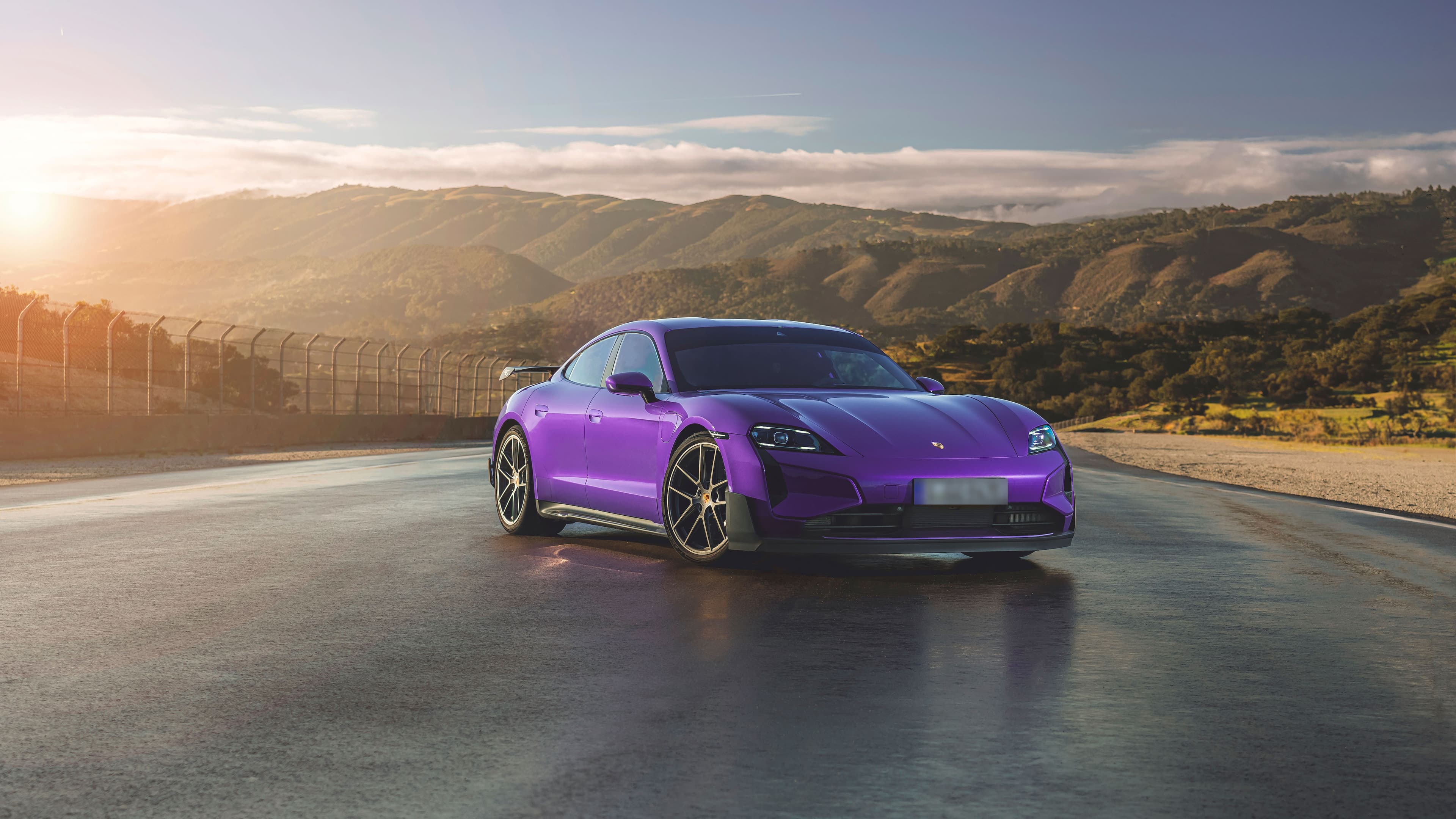
The 2027 Porsche Taycan is the latest model-year update of the brand's all-electric sports sedan. Every trim is built around an 800-volt architecture, and the larger 105 kWh Performance Battery Plus (97 kWh usable), which charges at up to 320 kW, is now standard on every US-market Taycan. Power runs from 300 kW (408 PS, about 402 hp) in the entry-level rear-wheel-drive Taycan up to 760 kW (1,034 PS, about 1,019 hp) in the Turbo GT, both measured with Launch Control. Porsche says the rear-wheel-drive Taycan with the larger battery and the optional low-rolling-resistance "Summer tyres range plus" (offered in Europe) can now reach up to 700 km on the WLTP cycle, the longest rating the model has had. In the United States the 2027 Taycan starts at $111,900 before a $2,350 delivery fee, in Germany at €102,600, in the UK at £88,465 on the road, and in Israel at NIS 757,000. The new E-Shift option adds eight simulated gears, and the whole range is available to order now.
Performance & Specs
Porsche quotes Taycan power as overboost output with Launch Control, and the ladder is wide. The Taycan and Taycan 4 make 300 kW (408 PS / 402 hp) with the standard battery or 320 kW (435 PS / 429 hp) with the Performance Battery Plus. The Taycan 4S makes 400 kW (544 PS / 536 hp), or 440 kW (598 PS / 590 hp) with the larger battery. The GTS reaches 515 kW (700 PS / 690 hp), the Turbo 650 kW (884 PS / 872 hp) and the Turbo S 700 kW (952 PS / 939 hp). At the top, the Turbo GT and the Turbo GT with Weissach Package both reach 760 kW (1,034 PS / 1,019 hp). Without Launch Control the Turbo GT is rated at 580 kW (789 PS / 778 hp), and Porsche's own peak-power method puts it at up to 815 kW (1,092 hp) for two seconds. A push-to-pass function in the Sport Chrono package (with the Performance Battery Plus, not on the rear-wheel-drive Taycan) adds up to 70 kW for 10 seconds, while the Turbo GT's Attack Mode adds up to 120 kW.
Acceleration with Launch Control, from Porsche's technical data, runs from 4.8 seconds to 100 km/h for the Taycan and 4.6 seconds for the Taycan 4, through 3.7 seconds for the 4S and 3.3 seconds for the GTS, to 2.7 seconds for the Turbo and 2.4 seconds for the Turbo S. The Turbo GT needs 2.3 seconds and the Weissach version 2.2 seconds. Top speed climbs from 230 km/h for the Taycan and Taycan 4 to 250 km/h for the 4S and GTS, 260 km/h for the Turbo and Turbo S, 290 km/h for the Turbo GT and 305 km/h for the Weissach car. Maximum torque with Launch Control is 410 Nm for the base car on the standard battery, 790 Nm for the GTS, 890 Nm for the Turbo, 1,110 Nm for the Turbo S and 1,240 Nm for the Turbo GT. The technical gains over the first Taycan come from a new rear-axle motor that delivers up to 80 kW more than before and weighs about 10 kg less, a revised pulse inverter, a next-generation heat pump and a retuned all-wheel-drive strategy that decouples the front motor more often to save energy. The Turbo GT adds a 900-amp silicon-carbide pulse inverter on the rear axle.
The chassis is as important as the motors. Adaptive two-chamber air suspension with self-levelling is standard on every Taycan, including the base car, which previously used steel springs. Porsche Active Ride, a fully active damper system that cancels pitch and roll, is an option on all-wheel-drive models and standard on the Turbo GT. Rear-axle steering with up to 2.8 degrees of angle is standard on the Turbo S, and Porsche Torque Vectoring Plus is standard on the Turbo and Turbo S. The Turbo S and Turbo GT use Porsche Ceramic Composite Brakes with 420 mm front and 410 mm rear discs. Maximum recuperation has risen from 290 kW to up to 400 kW.
The top of the range has also been busy in 2026. Porsche says a Taycan Turbo GT with the Manthey kit, a performance package for the Weissach car, offered as a retrofit and, from the 2027 model year, directly from the factory, that lifts output to 600 kW and adds a much larger aero package, lapped the Nordschleife in 6:55.533, a time Porsche announced on May 7, 2026, as a record for electric executive cars. Earlier, in February 2024, the Turbo GT with Weissach Package set a 1:27.87 lap at WeatherTech Raceway Laguna Seca, which Porsche described as the fastest lap by a series-production electric car there at the time.

| Powertrain | Dual-motor AWD BEV, 1-speed front and 2-speed rear gearbox |
|---|---|
| Power | 760 kW (1,034 PS / 1,019 hp) with Launch Control |
| Torque | 1,240 Nm with Launch Control |
| 0–100 km/h | 2.3 s (2.2 s with Weissach Package) |
| Battery | 105 kWh gross / 97 kWh net |
| Range | Up to 559 km (WLTP) |
| POWERTRAIN TYPE | Battery electric: RWD (Taycan), dual-motor AWD (all other trims) |
|---|---|
| HORSEPOWER | 402 hp (Taycan, standard battery) to 1,019 hp (Turbo GT), Launch Control overboost |
| ACCELERATION | 0–100 km/h in 4.8 s (Taycan) to 2.2 s (Turbo GT with Weissach Package) |
| TOP SPEED | 230 km/h (Taycan) to 305 km/h (Turbo GT with Weissach Package) |
| DRIVETRAIN | RWD or AWD; 2-speed gearbox on the rear axle |
| BATTERY | 105 kWh gross / 97 kWh net (89 / 82.3 kWh standard pack in Europe) |
| ELECTRIC RANGE | Up to 700 km (WLTP, Taycan with Performance Battery Plus) |
| COMBINED RANGE | Not applicable (battery electric) |
Dimensions & Practicality

| Length | 4,963 mm |
|---|---|
| Width | 1,966 mm (2,144 mm with mirrors) |
| Height | 1,379 mm |
| Wheelbase | 2,900 mm |
| Unladen weight (DIN) | 2,090 kg (Taycan) to 2,295 kg (Turbo S) |
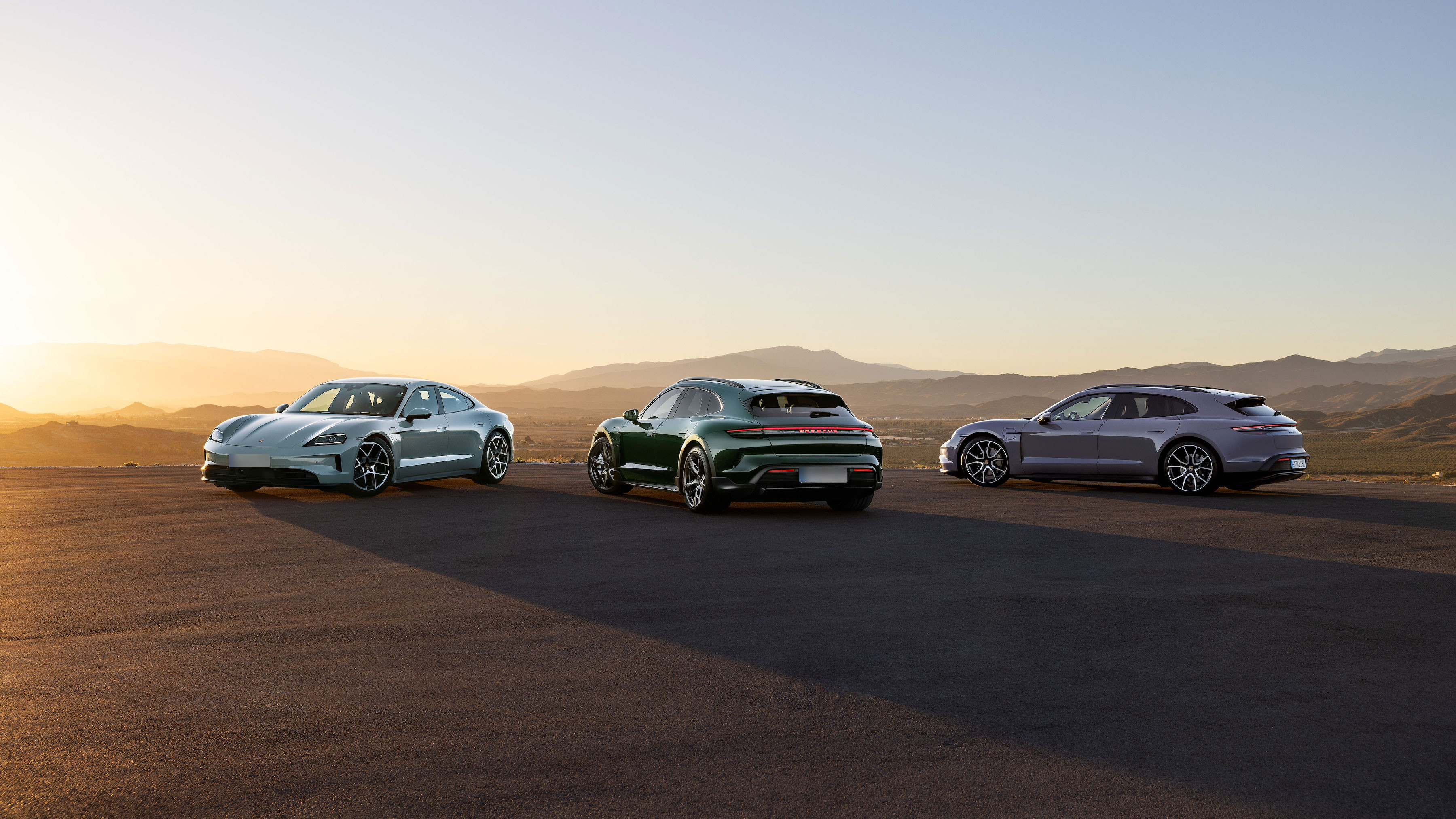
The sedan keeps the four-door sports-car proportions of the original: 4,963 mm long, 1,966 mm wide without mirrors and about 1,379 mm tall on a 2,900 mm wheelbase, with length and height shifting by a few millimetres between trims. Luggage space is 407 litres behind the rear seats in the Taycan and 4S and 366 litres in the Turbo and Turbo S, plus an 84-litre front trunk in all of them. Unladen weight, to the German DIN standard, ranges from 2,090 kg for the Taycan to 2,295 kg for the Turbo S, and 2,220 kg for the Turbo GT with Weissach Package. Porsche also builds the Taycan as the Sport Turismo and the raised, off-road-styled Cross Turismo, both with a large tailgate and more than 1,200 litres of maximum luggage space. Those body styles are still on sale in Germany, the UK and Israel, but Porsche has dropped them from the US range for the 2027 model year, where only the sedan remains.
| LENGTH | 4,963 mm |
|---|---|
| WIDTH | 1,966 mm (2,144 mm with mirrors) |
| HEIGHT | 1,379 mm |
| WHEELBASE | 2,900 mm |
| CARGO VOLUME | 407 L rear (Taycan, 4S); 366 L rear (Turbo, Turbo S) |
| FRUNK | 84 L |
Charging & Battery
Charging is where the update made the biggest difference. The Performance Battery Plus stores 105 kWh gross and 97 kWh net, up from 93 kWh gross in the first generation, and it accepts up to 320 kW at 800-volt DC stations, 50 kW more than before. Porsche says charging power above 300 kW can be held for up to five minutes, and that the 10–80% charge now takes 18 minutes under optimal conditions, compared with 37 minutes for the first-generation car at a battery temperature of 15 degrees Celsius. On 400-volt chargers the car can take up to 150 kW, which Porsche puts at about 35 minutes for the same window. The standard on-board AC charger is 11 kW in Europe (a US-market listing gives 9.6 kW). In Europe the smaller 89 kWh gross (82.3 kWh net) battery is still offered on the Taycan, Taycan 4 and 4S, with DC charging limited to 270 kW, but in the United States the larger pack is now the only choice. Porsche's WLTP consumption figures, for example 16.7–19.7 kWh/100 km for the 2024 launch Taycan, are measured at the charger, so they include charging losses.
| BATTERY | 105 kWh gross / 97 kWh net (Performance Battery Plus); 89 / 82.3 kWh standard pack in Europe |
|---|---|
| AC CHARGING | 11 kW (Europe); 9.6 kW reported for US cars |
| DC FAST CHARGING | Up to 320 kW (270 kW with the standard 89 kWh pack) |
| DC 10-80% TIME | 18 min (Porsche, optimal conditions) |
Design & Interior
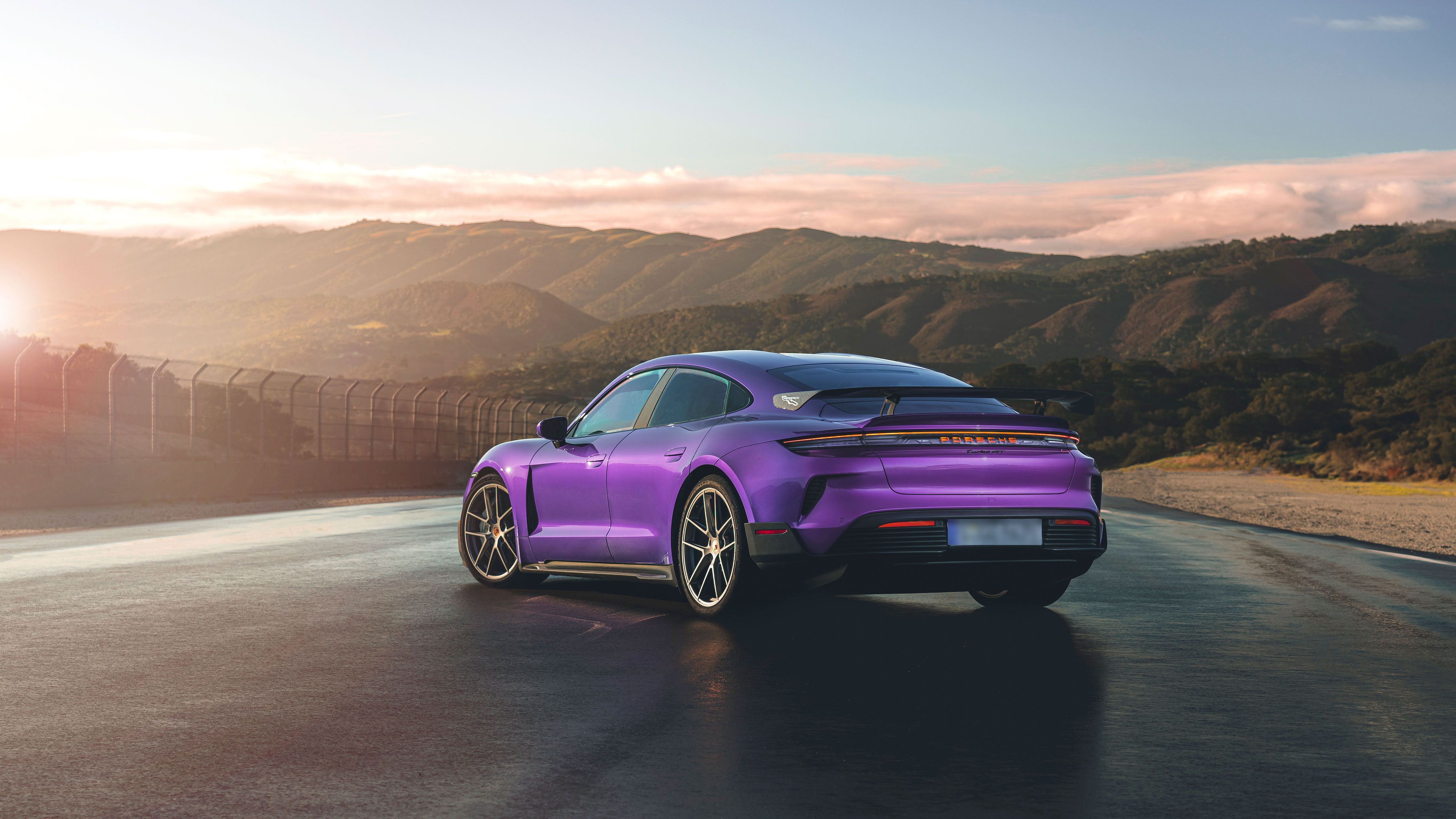
The 2024 redesign sharpened the look rather than reinventing it. The front air intakes were reshaped, the headlights are flatter and now show Porsche's four-point light graphic at night, and the Porsche logo in the rear light strip is a three-dimensional glass-look element that can be illuminated with greeting animations. The Turbo and Turbo S carry an exclusive Turbonite accent colour on the badge, window surrounds, side-sill inlays and wheel spokes, while the Turbo GT is styled more like a racing car, with a front spoiler with aeroblades, carbon-fibre B-pillars and mirror caps, and an adaptive rear wing. Inside, new leather-free packages in black and slate grey use Race-Tex microfibre and a wool-blend Pepita houndstooth textile, and a new Aluminium Prisma trim is optional. The Turbo GT with Weissach Package drops the rear seats in favour of carbon cladding and storage, and Porsche says it saves about 70 kg compared with the standard Turbo GT. Black Edition versions of the Taycan, Taycan 4 and 4S add gloss-black exterior details, 21-inch wheels and the larger battery as standard, and are listed in Germany, the UK and Israel.
Technology & Features
The Porsche Driver Experience combines a curved digital instrument cluster, a central display and an optional passenger display, and since the update it has a configurable battery view, a 3D driver-assistance view and deeper Apple CarPlay integration, plus Android Auto. A separate In-Car Video function can stream to the central and passenger displays through a third-party subscription. For the 2027 model year Porsche added E-Shift, an option on every variant that simulates eight gears with paddle shifts, drag-torque simulation, a virtual rev limiter and a reworked Electric Sport Sound. It needs the Sport Chrono package and a Bose or Burmester sound system, and it is standard on the Turbo GT. The same update raised wireless phone charging to 25 W and, in the US, brought native NACS charging on the passenger-side port (except on the Turbo GT with Weissach Package), with J1772 AC kept on the driver's side. The Porsche Charging Planner now calculates routes online and, with Plug and Charge, handles authentication and payment at compatible stations.
Safety & ADAS
Driver assistance is built around adaptive cruise control with a Swerve Assist function that steers around an obstacle in a critical situation, part of the optional ACC Premium package. Driver fatigue detection and a reversing camera are standard. An optional Surround View package adds a top-view camera, Intelligent Park Assist and Manoeuvring Assist, and the optional HD Matrix LED headlights use more than 32,000 individually controllable micro-LEDs in each unit. Porsche does not publish an automation level or a Euro NCAP rating for the updated car, so neither is listed here.
| ADAS LEVEL | Not published by Porsche |
|---|---|
| ADAS FEATURES | Adaptive cruise control with Swerve Assist (ACC Premium), fatigue detection, reversing camera, optional Surround View and Park Assist |
Available Versions
| VERSION | POWER | TORQUE | 0-100 | TOP SPEED | DRIVETRAIN | BATTERY | EV RANGE | COMBINED RANGE | PRICE | KEY DIFFERENCES |
|---|---|---|---|---|---|---|---|---|---|---|
| Taycan | 429 hp | — | 4.8s | 230 km/h | RWD | 105 kWh | up to 700 km | — | $111,900 | Only RWD trim; 320 kW (435 PS) with Performance Battery Plus (4.8 s is the 300 kW figure); 700 km needs the Europe-only "Summer tyres range plus" option |
| Taycan 4 | 429 hp | — | 4.6s | 230 km/h | AWD | 105 kWh | up to 644 km | — | $116,000 | Entry AWD, same power as the Taycan |
| Taycan 4S | 590 hp | — | 3.7s | 250 km/h | AWD | 105 kWh | up to 645 km | — | $131,800 | 440 kW (598 PS) with the larger battery; Porsche's 3.7 s is for the 400 kW version |
| Taycan GTS | 690 hp | 790 Nm | 3.3s | 250 km/h | AWD | 105 kWh | up to 637 km | — | $157,000 | Sport Chrono and GT steering wheel standard |
| Taycan Turbo | 872 hp | 890 Nm | 2.7s | 260 km/h | AWD | 105 kWh | up to 637 km | — | $184,600 | Turbonite accents, PTV Plus standard |
| Taycan Turbo S | 939 hp | 1,110 Nm | 2.4s | 260 km/h | AWD | 105 kWh | up to 634 km | — | $221,400 | Rear-axle steering and ceramic brakes standard |
| Taycan Turbo GT | 1,019 hp | 1,240 Nm | 2.3s | 290 km/h | AWD | 105 kWh | up to 559 km | — | $243,700 | Active Ride, E-Shift and Attack Mode standard |
| Taycan Turbo GT with Weissach Package | 1,019 hp | 1,240 Nm | 2.2s | 305 km/h | AWD | 105 kWh | up to 555 km | — | $243,700 | Rear seats removed, fixed carbon wing, track focus |
Pricing & Availability
Porsche opened orders for the 2027 model year in June 2026 and says it can be ordered from all its centres. In the United States the starting prices, before the $2,350 delivery, processing and handling fee, are $111,900 for the Taycan, $116,000 for the Taycan 4, $131,800 for the 4S, $157,000 for the GTS, $184,600 for the Turbo, $221,400 for the Turbo S and $243,700 for the Turbo GT, with the Weissach version listed at the same price. US deliveries begin in the fall of 2026. In Germany Porsche's configurator lists the Taycan at €102,600, the Taycan 4 at €107,300, the 4S at €122,000, the GTS at €148,800, the Turbo at €177,200, the Turbo S at €211,000 and the Turbo GT at €241,100 including 19% VAT. In the UK Porsche's model pages list the Taycan from £88,400 and the Turbo GT at £189,200 including VAT, while the configurator's on-the-road prices, which add the first registration fee and first-year road tax, run from £88,465 to £189,265, with the 4S at £96,465. In Israel the importer, Orchid Sports Cars Israel, lists the Taycan from NIS 757,000, the Taycan 4 from NIS 797,000, the 4S from NIS 937,000, the GTS from NIS 1,117,000, the Turbo from NIS 1,337,000, the Turbo S from NIS 1,597,000 and the Turbo GT from NIS 1,897,000, all including VAT, with the Weissach version at NIS 1,877,000. Sport Turismo and Cross Turismo versions are also listed there, from NIS 767,000 and NIS 877,000.
How It Compares
The Tesla Model S was the Taycan's obvious American rival, but Tesla ended production in May 2026, so it is no longer a current-production rival. In its final form the Model S AWD offered 670 hp and a 410-mile EPA rating at a last published price of $109,990, close to the $111,900 entry Taycan, while the Plaid made 1,020 hp. The Taycan Turbo S, at 939 hp, trails the Plaid on paper, but the Porsche counters with a four-door cabin built around driving feel, a Turbo GT that reaches 305 km/h with the Weissach Package and a chassis that Porsche has optimised for track use. Range ratings are not directly comparable: the Taycan's 700 km is WLTP, the Model S figure is EPA, and EPA ratings typically come in lower than WLTP for the same car. The NIO ET9 is the Chinese flagship counterpart: 697 hp, up to 650 km on the more generous CLTC cycle and about $113,600 in China, with steer-by-wire and 900-volt architecture. It is a much larger car at more than 5.3 metres long, aimed at chauffeured comfort rather than the Taycan's driver focus.
- Up to 700 km WLTP range on the rear-wheel-drive Taycan and 18-minute 10–80% charging at up to 320 kW
- A very wide power ladder, from 402 hp to 1,019 hp, with a standard air suspension and optional Porsche Active Ride
- Strong standard equipment and real driver-focused options such as E-Shift, push-to-pass and Sport Chrono
- Prices rise steeply, from $111,900 to $243,700 in the US, and the 2027 base car costs roughly $6,000 more than the 2026 one because the larger battery is now standard
- Unladen weights of 2,090–2,295 kg and modest 366–407 litre sedan boot space; wagon versions are gone from the US
The 2027 Taycan is the most convincing version of Porsche's electric sports sedan yet: faster charging, much better range and a range of trims that covers 402 to 1,019 hp. The trade-off is price, since even the entry car costs $111,900 in the US, and the larger battery and added equipment push every trim upward. For buyers who want an electric four-door that rewards driving, it is a strong recommendation, and the 4S or GTS look like the sweet spot. Those who mainly want range and space should also look at the Sport Turismo in markets where it is still sold.