
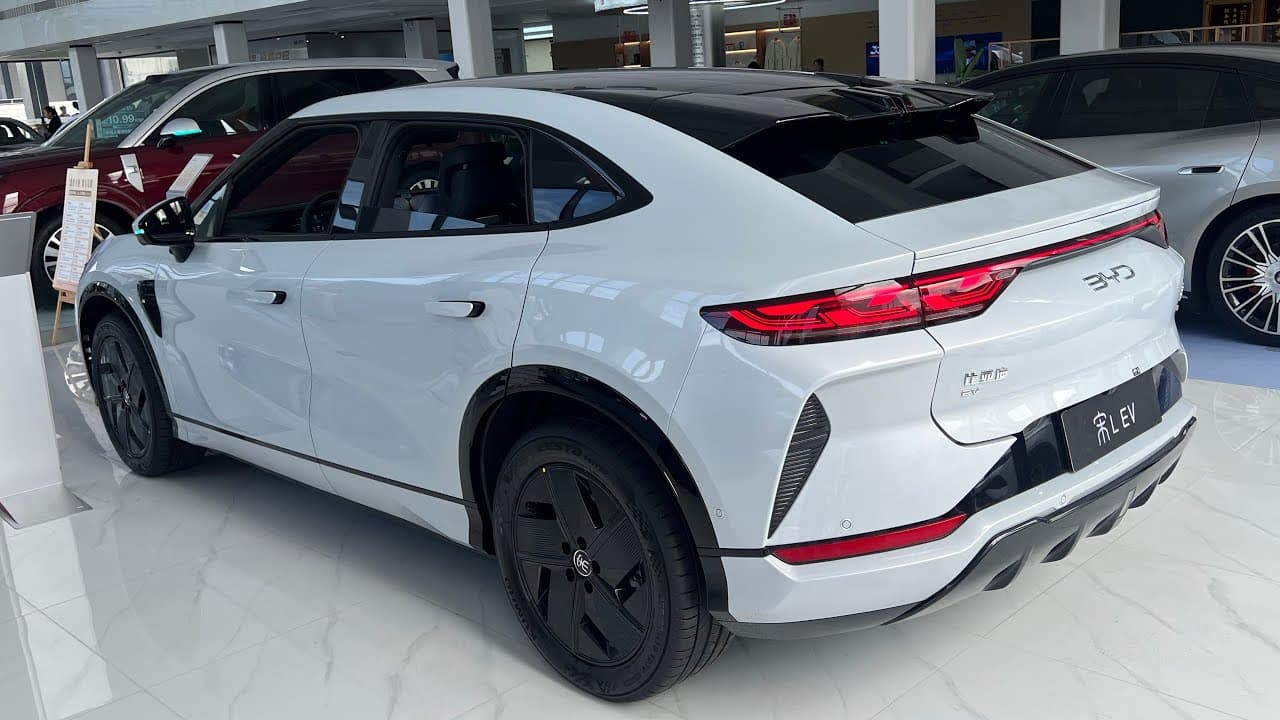
The 2025 BYD Song L EV is a coupe-style, battery-electric mid-size SUV that BYD has sold in China since December 2023, and its 2025 model-year update, now on dealer floors, added the DiPilot 100 driver-assistance suite. It rides on BYD's e-Platform 3.0, uses in-house Blade LFP batteries of 71.8 kWh or 87.04 kWh, and claims 550, 602 or 662 km of CLTC range depending on the version. Power runs from a single 150 kW (204 PS / 201 hp) rear motor up to a 380 kW (517 PS / 510 hp) dual-motor all-wheel-drive setup that reaches 100 km/h in 4.3 seconds. In China the four versions list at RMB 189,800 to RMB 249,800, roughly $26,700 to $35,200. The car in the partner walkaround is a white 2025 unit on a Chinese dealer floor, offered for export at a quoted $28,000 to $37,000. Despite the shared badge this is not the Song L DM-i plug-in hybrid, not the newer Song Ultra EV and not the Ocean-series Sealion 07 EV — it is a separate car with its own body.
Performance & Specs
The Song L EV is offered with three powertrain layouts. The entry 550 km version has a single 150 kW (204 PS / 201 hp) rear motor with 310 Nm of torque, a 0–100 km/h time of 8.5 seconds and a 199 km/h top speed. The 662 km versions step up to a 230 kW (313 PS / 308 hp) rear motor with 360 Nm, rated at 6.9 seconds to 100 km/h and 201 km/h flat out — the same power, torque and sprint figures the reviewer reads out on camera. The 602 km flagship keeps the 230 kW rear motor and adds a 150 kW front motor, for 380 kW (517 PS / 510 hp) and 670 Nm combined, which cuts the sprint to 4.3 seconds. Curb weight climbs with the hardware, from 2,158 kg on the entry car to 2,265 kg for the 662 km versions and 2,385 kg for the AWD. BYD's official consumption figure for the 662 km version is 14.8 kWh/100 km, a plug-to-wheel number that includes charging losses; at the battery it works out to roughly 13 kWh/100 km on the CLTC cycle. The underlying architecture is e-Platform 3.0 with cell-to-body battery integration.

| Powertrain | Single-motor RWD BEV |
|---|---|
| Power | 230 kW (313 PS / 308 hp) |
| Torque | 360 Nm |
| 0–100 km/h | 6.9 s |
| Battery | 87.04 kWh LFP |
| Range | 662 km (CLTC) |
| POWERTRAIN TYPE | Battery electric (BEV), e-Platform 3.0 |
|---|---|
| HORSEPOWER | 201 hp (150 kW) / 308 hp (230 kW) / 510 hp (380 kW) |
| ACCELERATION | 8.5 s / 6.9 s / 4.3 s (0-100 km/h) |
| TOP SPEED | 199 km/h (entry) / 201 km/h (others) |
| DRIVETRAIN | RWD (single motor) or AWD (dual motor) |
| BATTERY | 71.8 kWh or 87.04 kWh Blade LFP |
| ELECTRIC RANGE | 550 / 602 / 662 km (CLTC) |
| COMBINED RANGE | — (pure BEV) |
Dimensions & Practicality

| Length | 4,840 mm |
|---|---|
| Width | 1,950 mm |
| Height | 1,560 mm |
| Wheelbase | 2,930 mm |
| Curb weight | 2,158–2,385 kg |
At 4,840 mm long, 1,950 mm wide and 1,560 mm tall on a 2,930 mm wheelbase, the five-seat Song L EV is a wide, low car by mid-size SUV standards, and its wheelbase is 90 mm longer than the 2,840 mm of the newer Song Ultra EV. The reviewer quotes 410 litres of boot space behind the rear seats, growing to about 1,000 litres with the second row folded; spec sheets list 410 litres and roughly 1,050 to 1,100 litres depending on the source. A separate 48-litre front trunk sits under the bonnet, and the video shows a shallow, rubber-sealed tub that suits charging cables and small bags rather than luggage. The tailgate opens onto a wide load area with a flat floor, and the three-across rear bench has split-folding backrests released by levers in the boot, plus a fold-down centre armrest with cup holders.
| LENGTH | 4,840 mm |
|---|---|
| WIDTH | 1,950 mm |
| HEIGHT | 1,560 mm |
| WHEELBASE | 2,930 mm |
| CARGO VOLUME | 410 L (about 1,050–1,100 L seats folded) |
| FRUNK | 48 L |
Charging & Battery
Both packs use BYD's Blade LFP cells: 71.8 kWh on the 550 km version and 87.04 kWh on the 602 and 662 km versions. Spec sheets quote a 30–80% DC charge in about 25 minutes (0.42 hours) for every version, which is respectable but no longer class-leading now that BYD sells the Song Ultra EV with 1,500 kW Flash Charging rated at 10–70% in five minutes. The reviewer says the car has two charging ports, one for DC fast charging and one for AC, and puts a home AC charge at 8 to 10 hours. He also quotes 15 minutes on a fast charger, which does not line up with the 25-minute 30–80% figure on the spec sheets, so the spec-sheet number is the one to plan around. The demo car's trip meter reads just 7 km, so this is a fresh showroom unit.
| BATTERY | 71.8 kWh (550 km) / 87.04 kWh (602 and 662 km), Blade LFP |
|---|---|
| AC CHARGING | Overnight (8–10 hours per the reviewer) |
| DC FAST CHARGING | Separate DC port, 30–80% in about 25 minutes |
| DC 30-80% TIME | About 25 min (0.42 h) |
Design & Interior
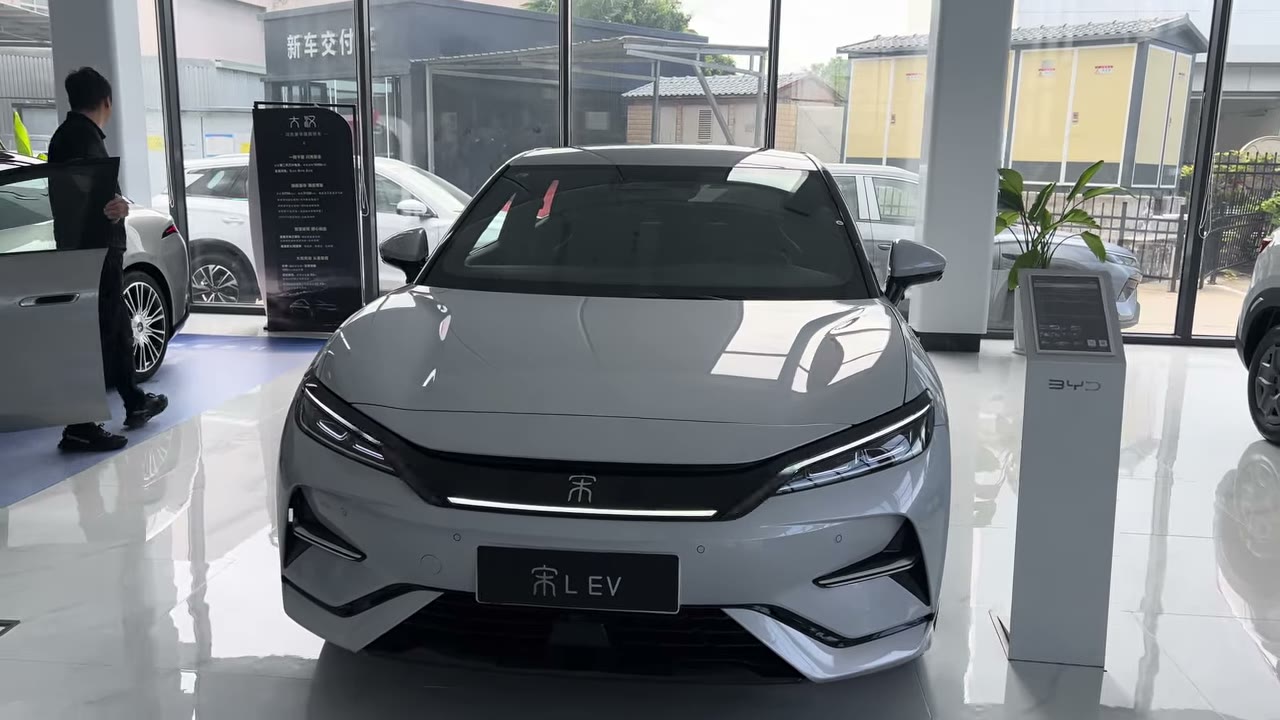
The Song L EV wears BYD's Dragon Face design language: a full-width light bar with the Song character in the middle of the nose, slim LED headlights and a low, wide fascia. The rear is the more dramatic end, with a black roof and glass area, an electric rear wing that the reviewer confirms is functional, a wide red light bar carrying BYD lettering and vertical vents at the corners of the bumper. Frameless doors and hidden-style door handles complete the coupe-SUV look, and the demo car rides on aero-style 19-inch wheels wearing 255/50 R19 103V tyres. Inside, the driver faces a 10.25-inch digital cluster and a 15.6-inch central touchscreen, with a leather-wrapped steering wheel carrying the Song logo. A crystal-style gear selector sits on the console next to a wireless charging pad and a deep cup-holder well. The front seats are sculpted with integrated headrests, the rear bench has a fold-down centre armrest, and the reviewer points out a glass roof with a sunshade.
Technology & Features
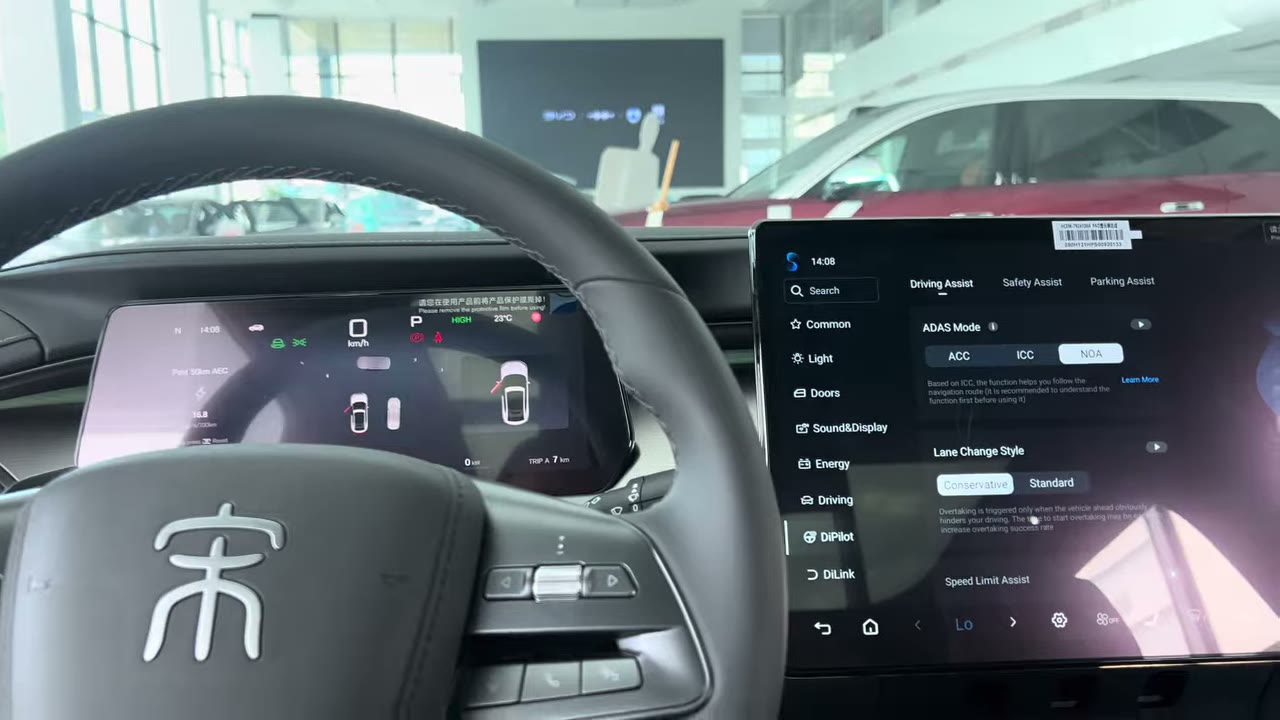
The 15.6-inch screen runs BYD's DiLink software and, on this export unit, an English interface that the reviewer scrolls through on camera. Launch coverage listed a 12-speaker Dynaudio system and dual wireless charging pads on the higher versions, while CarNewsChina's spec database gives the flagship AWD a 50-inch AR head-up display. The DiPilot menu on the demo car offers ACC, ICC and NOA driver-assistance modes plus a lane-change style setting with conservative and standard options, which makes the navigation-assisted driving mode easy to find. Buyers who care about audio and cabin tech should check the exact version, because speaker counts and the head-up display vary between the entry car and the flagship.
Safety & ADAS
The 2025 model-year update introduced DiPilot 100, which BYD describes as a suite of 29 sensors covering more than 30 driver-assistance and parking functions, with highway navigation-assisted driving available from launch. The 662 km Excellence Smart Driving version (RMB 225,800) and the 602 km AWD (RMB 249,800) add a LiDAR sensor, according to the Sohu and Autohome trim lists, while the white demo car in the video shows a clean windscreen header with no LiDAR housing, consistent with a non-LiDAR version. If you want the most capable assist package, budget for one of the two LiDAR versions rather than the 550 km or 662 km Superior cars.
| ADAS LEVEL | L2 (DiPilot 100); LiDAR on the two upper versions |
|---|---|
| ADAS FEATURES | ACC, ICC, NOA (highway navigation), parking assist, 29 sensors |
Available Versions
| VERSION | POWER | TORQUE | 0-100 | TOP SPEED | DRIVETRAIN | BATTERY | EV RANGE | COMBINED RANGE | PRICE | KEY DIFFERENCES |
|---|---|---|---|---|---|---|---|---|---|---|
| 550 km Excellence | 201 hp | 310 Nm | 8.5s | 199 km/h | RWD | 71.8 kWh | 550 km | — | $26,700 | Entry version, single 150 kW motor, 2,158 kg |
| 662 km Superior | 308 hp | 360 Nm | 6.9s | 201 km/h | RWD | 87.04 kWh | 662 km | — | $28,100 | Bigger pack and 230 kW motor, 2,265 kg |
| 662 km Excellence Smart Driving (LiDAR) | 308 hp | 360 Nm | 6.9s | 201 km/h | RWD | 87.04 kWh | 662 km | — | $31,800 | Adds LiDAR and the fuller equipment list |
| 602 km AWD Smart Driving (LiDAR) | 510 hp | 670 Nm | 4.3s | 201 km/h | AWD | 87.04 kWh | 602 km | — | $35,200 | Dual motor, LiDAR, 50-inch AR HUD, 2,385 kg |
Pricing & Availability
BYD launched the Song L EV in China on 15 December 2023 at RMB 189,800 (about $26,700), RMB 30,200 below its pre-sale starting price, after more than 28,000 pre-orders. The 2025 model-year update was unveiled at the Chengdu Auto Show on 30 August 2024 with the same RMB 189,800 entry price and DiPilot 100 added. The four versions on sale now list at RMB 189,800, RMB 199,800, RMB 225,800 and RMB 249,800, or about $26,700, $28,100, $31,800 and $35,200, and Sina Auto's price database shows a real-world starting price below guide for the 662 km Superior at RMB 174,800. The dealer in the video quotes $28,000 to $37,000 for export, broadly in line with the converted guide prices at the low end and about $1,800 above the AWD's at the top; that is a dealer quote, not an official BYD export price. He also notes the car carries a 2025 VIN year because BYD has not updated the model since. As of September 2026 we found no official BYD announcement of an overseas launch, so the Song L EV should be treated as a China-market model.
How It Compares
The closest rival is BYD's own newer Song Ultra EV, which starts at RMB 151,900 (about $21,400), is rear-drive only and claims up to 710 km of CLTC range with five-minute Flash Charging. That makes it the cheaper, quicker-charging choice, but the Song L EV still answers with a 2,930 mm wheelbase that is 90 mm longer, a 510 hp AWD version with a 4.3-second sprint, against the Song Ultra EV's 362 hp rear-drive maximum. Against the Xiaomi YU7, which starts at RMB 253,500 (about $35,700) with a 315 hp rear motor and 835 km of CLTC range, the Song L EV's AWD flagship costs about the same but delivers far more power, while the YU7 wins on range and size at 4,999 mm long. Read it as a value contrast: for roughly the price of a base YU7 you get a 510 hp AWD car, but for the money of a Song Ultra EV you get a newer car with faster charging.
- Up to 662 km of CLTC range from an 87.04 kWh Blade battery, with a 25-minute 30–80% fast charge
- A 510 hp dual-motor AWD version with a 4.3-second 0–100 km/h time, rare at $35,200
- Long 2,930 mm wheelbase, 410 L boot plus a 48 L front trunk, and the DiPilot 100 driver-assistance suite introduced with the 2025 update
- Charging speed and price have been overtaken by the newer Song Ultra EV, which starts around $21,400
- No confirmed official overseas launch, so export units are dealer-sourced, carry a markup and need their warranty terms checked
The Song L EV is a handsome, well-equipped mid-size electric SUV that has been overtaken on price and charging speed by its own newer sibling, yet it keeps two clear advantages: a longer wheelbase and a genuine 510 hp AWD option. The 662 km Superior at RMB 199,800 is the sensible pick for most buyers, and the AWD is the one to choose if performance matters. It suits buyers in China who want more space and power than a Song Ultra EV offers; anyone considering an export unit should factor in the dealer markup and check the warranty terms. Recommended with those caveats.