
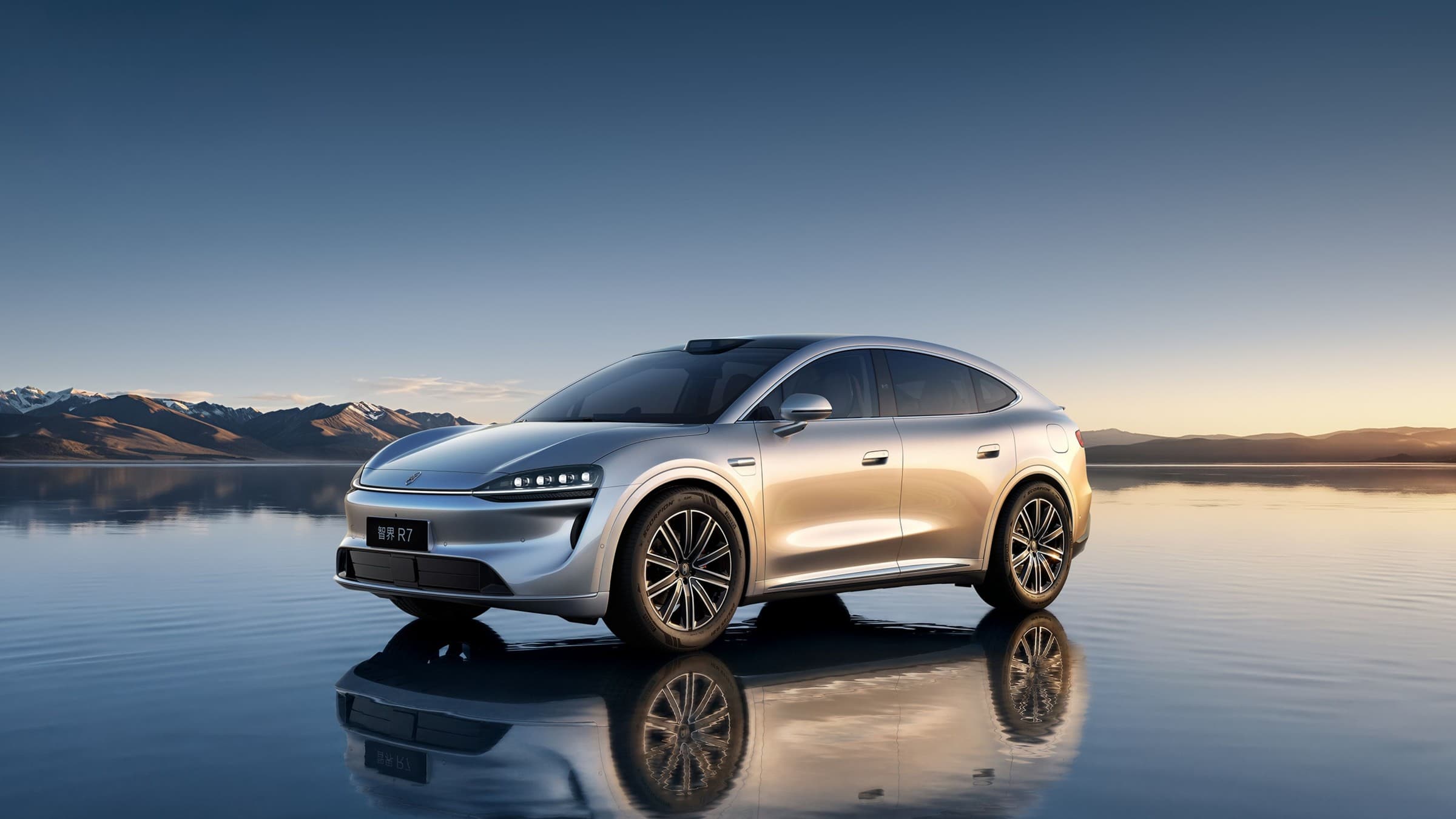
Luxeed, the electric-car brand built by Chery with Huawei's Harmony Intelligent Mobility Alliance (sold in China as Zhijie), has refreshed its R7 coupe SUV for the 2027 model year. The update went on sale on September 28, 2026, backed by what Luxeed describes as a RMB 500 million investment spread across eight upgrades: a dual 17.2-inch “butterfly-wing” display, a 26-inch head-up display, Huawei's ADS 5 driver-assist system with an 896-line lidar, a stronger 227 kW rear motor, new zero-gravity seats with a “singing bowl” vibration mode, a chilled fridge, a retuned chassis and a health-focused cabin. The battery-electric R7 now starts at RMB 239,800 (about $35,580 at CnEVPost's rate of roughly RMB 6.74 per US dollar) and tops out at RMB 319,800 ($47,450), while the CLTC range rating climbs to as much as 855 km, up from the 802 km of the previous top version. This is a mid-cycle update rather than a new car: the R7 first launched in China in September 2024, and Luxeed says it has passed 120,000 cumulative deliveries since then.
Performance & Specs
Every R7 in the new line-up is a battery-electric coupe SUV. Three of the four trims are rear-wheel drive with a single permanent-magnet motor at the back rated at 227 kW (309 PS / 304 hp), a step up from the 215 kW motor used when the car launched in 2024. Huawei quotes 0-100 km/h in 7.2 seconds for the two 81 kWh trims and 7.0 seconds for the 100 kWh Max+ Long Range. The top Ultra trim adds a 150 kW (201 hp) induction motor on the front axle for dual-motor all-wheel drive, and Huawei's own page lists 0-100 km/h in 4.4 seconds for it, together with a 34.7 m braking distance and an 82.3 km/h moose-test result. Huawei publishes the two motor ratings for the Ultra but no combined system figure, so we do not add them together; one independent test write-up cites a 365 kW (about 489 hp) system peak. Peak torque and top speed have not been published for this update, so both are left out. The underpinnings are Huawei's Tuling chassis platform: an all-aluminium front virtual-pivot double-wishbone suspension, a five-link rear axle and continuously variable damping on every trim, with air suspension standard on the Ultra and optional on the Max+ and Max+ Long Range. The Huawei DATS torque-control and xMotion body-control systems tie the chassis together.

| Powertrain | Single rear-motor RWD BEV (Max, Max+, Max+ Long Range) |
|---|---|
| Power | 227 kW (309 PS / 304 hp) |
| Torque | Not published |
| 0–100 km/h | 7.2 s (Max, Max+) / 7.0 s (Max+ Long Range) |
| Battery | 81 kWh LFP / 100 kWh ternary lithium |
| Range | 705 km / 855 km (CLTC) |
| POWERTRAIN TYPE | Battery electric (BEV); RWD single motor or AWD dual motor |
|---|---|
| HORSEPOWER | 227 kW (309 PS / 304 hp) rear motor; Ultra adds a 150 kW (201 hp) front motor |
| TORQUE | Not published |
| ACCELERATION | 0-100 km/h in 7.2 s (Max, Max+), 7.0 s (Max+ Long Range), 4.4 s (Ultra) |
| TOP SPEED | Not published |
| DRIVETRAIN | RWD (Max, Max+, Max+ Long Range) / AWD (Ultra) |
| BATTERY | 81 kWh LFP or 100 kWh ternary lithium, 800V |
| ELECTRIC RANGE | 705 km / 855 km / 785 km (CLTC) |
| DRAG COEFFICIENT | 0.217 Cd |
Dimensions & Practicality

| Length | 4,982 mm |
|---|---|
| Width | 1,981 mm |
| Height | 1,650 mm (1,634 mm Ultra) |
| Wheelbase | 2,950 mm |
| Rear legroom | 956 mm |
The R7 is a near-five-metre car: 4,982 mm long, 1,981 mm wide and 1,650 mm tall on a 2,950 mm wheelbase, with the Ultra sitting 16 mm lower at 1,634 mm on its air suspension. It seats five. Luxeed quotes 956 mm of rear legroom and 1,034 mm of rear headroom despite the sloping roofline, and the rear backrest angle is electrically adjustable on every trim. The rear seats fold flat, and Luxeed pitches this as a bed for road trips. Luggage space is a three-layer 852-litre boot on the battery-electric car, a figure that includes roughly 80 litres of hidden under-floor storage according to launch coverage, opened by a kick sensor. Up front, a 106-litre powered front trunk opens with a double knock on the bonnet's lower edge and closes with an electric suction latch; it is offered only on the battery-electric version. Curb weight is 2,275 kg for the Max and Max+, 2,220 kg for the Max+ Long Range and 2,340 kg for the Ultra.
| LENGTH | 4,982 mm |
|---|---|
| WIDTH | 1,981 mm |
| HEIGHT | 1,650 mm (1,634 mm Ultra) |
| WHEELBASE | 2,950 mm |
| SEATS | 5 |
| CURB WEIGHT | 2,220-2,340 kg depending on trim |
| CARGO VOLUME | 852 L (BEV) |
| FRUNK | 106 L (BEV only) |
| WHEELS | 20-inch 255/50 R20 standard; 21-inch 255/45 front, 275/45 rear optional |
Charging & Battery
Two battery packs are on offer. The two cheaper trims use an 81 kWh lithium iron phosphate pack rated at 705 km on the CLTC cycle. The Max+ Long Range and the Ultra use a 100 kWh ternary lithium pack, rated at 855 km for the rear-drive car and 785 km for the dual-motor Ultra. Some Chinese outlets round the smaller pack to 82 kWh; Huawei's own configuration table says 81 kWh, and that is the figure used here. All four trims sit on Huawei's 800V “Giant Whale” battery platform and Huawei lists a 30-80% DC charge in 15 minutes for each of them. On the 100 kWh pack, the company's product page also states that five minutes on a 480 kW charger adds up to 200 km of CLTC range and 15 minutes adds up to 400 km. As a sanity check, 81 kWh over 705 km works out to about 11.5 kWh per 100 km, 100 kWh over 855 km is about 11.7 kWh per 100 km and the Ultra's 785 km implies roughly 12.7 kWh per 100 km, all on the CLTC cycle, which is consistent across the range. The car also offers 6 kW vehicle-to-load output through a 220 V connection, and the pack is pre-heated for cold-weather fast charging.
| BATTERY | 81 kWh LFP (Max, Max+) / 100 kWh ternary lithium (Max+ Long Range, Ultra) |
|---|---|
| PLATFORM | 800V Giant Whale |
| DC FAST CHARGING | 30-80% in 15 min (all trims) |
| 100 KWH PACK, 480 KW CHARGER | +200 km CLTC in 5 min; +400 km in 15 min |
| V2L OUTPUT | 6 kW (220 V) |
Design & Interior
The R7 keeps its fastback silhouette, which Luxeed calls a “coupe SUV”: a low bonnet line, a sloping roof, half-hidden door handles, frameless doors, a full-width light bar with a starlight-style headlamp cluster, and an active grille shutter that helps deliver a 0.217 drag coefficient on the electric version. Two new paint colours, Titanium Silver and Star Rose Pink, join Ceramic White, Gilded Black, Deep Space Grey, Night Purple and Aurora Green for seven in total. The optional black-out package darkens the badges, window frames, wheel arches and lower trim, and comes as standard on the Night Purple and Aurora Green cars. Inside there are four upholstery choices: White Sand Apricot, Feather Sand Purple, Nebula Red and Truffle Brown, all in Nappa-textured leatherette with a D-shaped steering wheel. The headline change is the seat. Luxeed calls its new front seats “singing bowl” zero-gravity seats: 16-way power adjustment, heating, ventilation, massage and eight low-frequency vibration motors that recreate a singing-bowl effect alongside dedicated music. They are standard on the Max+ Long Range and Ultra and optional on the Max and Max+, whose standard driver seat is a 12-way unit on the Max. The rear bench is heated and ventilated on every trim. A 2.1 square-metre panoramic roof, double-glazed side windows and 100-plus wind-noise measures target cabin quiet, and the seven-litre fridge is standard on the two top trims.
Technology & Features
The dashboard now carries a pair of 17.2-inch 3.4K screens in a 21:10 format, one in front of the driver and one for the passenger, with an 8.88-inch instrument display in between. They run Huawei's HarmonyOS cockpit with voice control that also works from outside the car through the exterior microphones. The 26-inch head-up display puts speed, navigation and driver-assist prompts on the windscreen, and a streaming rear-view mirror is standard on the Ultra and optional on the Max+ and Max+ Long Range. Huawei Sound is fitted to every car: a 7.1.4-channel system with 21 speakers (19 in the cabin plus two shoulder-pillow speakers), a 2,080 W amplifier and a turbine sub-bass unit. Practical details include two 50 W wireless chargers, 100 W and 66 W USB-C ports, Huawei MagLink for the front passenger, seven magnetic mounting points around the cabin, a dash-cam, a driver-monitoring camera and a star-flash physical key alongside phone and watch digital keys.
Safety & ADAS
Every R7 now carries Huawei's ADS 5, in an “enhanced” form on the Max and an “advanced” form on the other three trims. The Max relies on a single shared-optical-path lidar mounted in the cabin, while the Max+, Max+ Long Range and Ultra add a forward 896-line dual-optical-path imaging lidar and a rear-facing solid-state lidar. The sensor suite on those trims also includes five 4D millimetre-wave radars, 12 ultrasonic sensors and 11 cameras, with three radars on the Max. Standard functions include highway navigation assist, lane keeping, automatic emergency braking from 4 to 150 km/h, cross-traffic braking front and rear, remote parking and a transparent-chassis view. Urban navigation assist, park-to-park navigation and several extra protective functions are separate paid upgrades bought through the app after delivery. The body uses a high share of high-strength steel, hot-formed steel and aluminium, and seven airbags are fitted. The battery pack has liquid cooling and over-temperature protection, and the car cuts the battery circuit after a collision.
| ADAS LEVEL | L2+ (Huawei ADS 5, driver must supervise) |
|---|---|
| ADAS FEATURES | Highway NCA, AEB (4-150 km/h), cross-traffic braking, lane keeping, remote parking, transparent chassis, 360° camera, 7 airbags |
| SENSORS (MAX+ AND ABOVE) | 1 forward 896-line lidar, 1 rear solid-state lidar, 5 4D radars, 12 ultrasonic, 11 cameras |
Available Versions
| VERSION | POWER | TORQUE | 0-100 | TOP SPEED | DRIVETRAIN | BATTERY | EV RANGE | COMBINED RANGE | PRICE | KEY DIFFERENCES |
|---|---|---|---|---|---|---|---|---|---|---|
| Max | 304 hp | — | 7.2s | — | RWD | 81 kWh | 705 km | — | $35,580 | RMB 239,800; LFP pack, single cabin lidar, ADS 5 enhanced, 12-way driver seat, 2,275 kg |
| Max+ | 304 hp | — | 7.2s | — | RWD | 81 kWh | 705 km | — | $38,550 | RMB 259,800; 896-line forward lidar plus rear lidar, ADS 5 advanced, optional air suspension |
| Max+ Long Range | 304 hp | — | 7.0s | — | RWD | 100 kWh | 855 km | — | $43,000 | RMB 289,800; ternary 100 kWh pack, standard 26-inch HUD, zero-gravity seats and fridge, 2,220 kg |
| Ultra | — | — | 4.4s | — | AWD | 100 kWh | 785 km | — | $47,450 | RMB 319,800; 150 kW front plus 227 kW rear motors, standard air suspension and Brembo brakes, 2,340 kg |
Pricing & Availability
The updated R7 went on sale in China on September 28, 2026 in four battery-electric trims: the Max at RMB 239,800 ($35,580), the Max+ at RMB 259,800 ($38,550), the Max+ Long Range at RMB 289,800 ($43,000) and the Ultra at RMB 319,800 ($47,450). The dollar figures use CnEVPost's conversion of about RMB 6.74 per dollar. The entry price is RMB 20,000 below the RMB 259,800 starting price of the March 2026 update, according to CnEVPost, but that comparison is not like-for-like: the Max makes do with a single cabin lidar, while the Max+ at RMB 259,800 carries the 896-line lidar and rear lidar. Launch incentives include limited-time benefits worth up to RMB 44,500 through November 2, 2026, and a five-year loan with two years at 0% interest. The range-extender R7, with its 53.4 kWh pack and 360 km of pure-electric range, was not part of the price list announced on launch day; CnEVPost reports it keeps its existing powertrain hardware with minor chassis and calibration changes.
How It Compares
The closest price match in our own catalog is the Xiaomi YU7 835 km, listed at $35,700 against $35,580 for the R7 Max. The Xiaomi makes slightly more power at 315 hp and lists 835 km, while the R7 Max is rated at 705 km; to match the Xiaomi's range you step up to the Max+ Long Range at $43,000 and 855 km, which also buys the head-up display and zero-gravity seats. The ZEEKR 7X is stronger on paper, with 470 hp for $41,318, but its 550 km rating trails every R7 trim, and the Onvo L80 605 offers 456 hp and 605 km at $35,650. Where the R7 pulls ahead of all three is in equipment at the price: Huawei ADS 5, a lidar, a 26-inch HUD and a fridge are all within reach, and the entry car's 304 hp is the lowest figure here. The R7 is the value-and-comfort pick, not the power pick, unless you spend up to the dual-motor Ultra. It also sits alongside Luxeed's other models on our site, such as the Luxeed RX and Luxeed V9, which share the brand's Huawei driver-assist and cabin technology.
- Up to 855 km CLTC range on the 100 kWh Max+ Long Range, with 30-80% fast charging in 15 minutes on every trim
- Huawei ADS 5 with an 896-line lidar, a 26-inch HUD and dual 17.2-inch screens for RMB 259,800 ($38,550) and up
- Comfort-first cabin: singing-bowl zero-gravity seats, fridge, 852 L boot and a 106 L front trunk
- The 855 km rating needs the RMB 289,800 ($43,000) trim; the entry Max is rated at 705 km and has only a single cabin lidar
- Torque and top speed are unpublished, and urban navigation assist is a paid post-purchase upgrade
The 2027 Luxeed R7 is a well-judged mid-cycle update: it keeps the coupe-SUV shape, adds Huawei's newest driver-assist hardware, dual 17.2-inch screens and a genuinely comfort-led cabin, and pushes CLTC range to 855 km. The RMB 239,800 ($35,580) entry price is competitive, but the car really shines from the RMB 259,800 Max+ upward. Buyers who want the long-range pack or the quick 4.4-second Ultra pay noticeably more, and the missing torque and top-speed figures leave some questions open. Recommended for family buyers in China who value technology and comfort over raw power.