
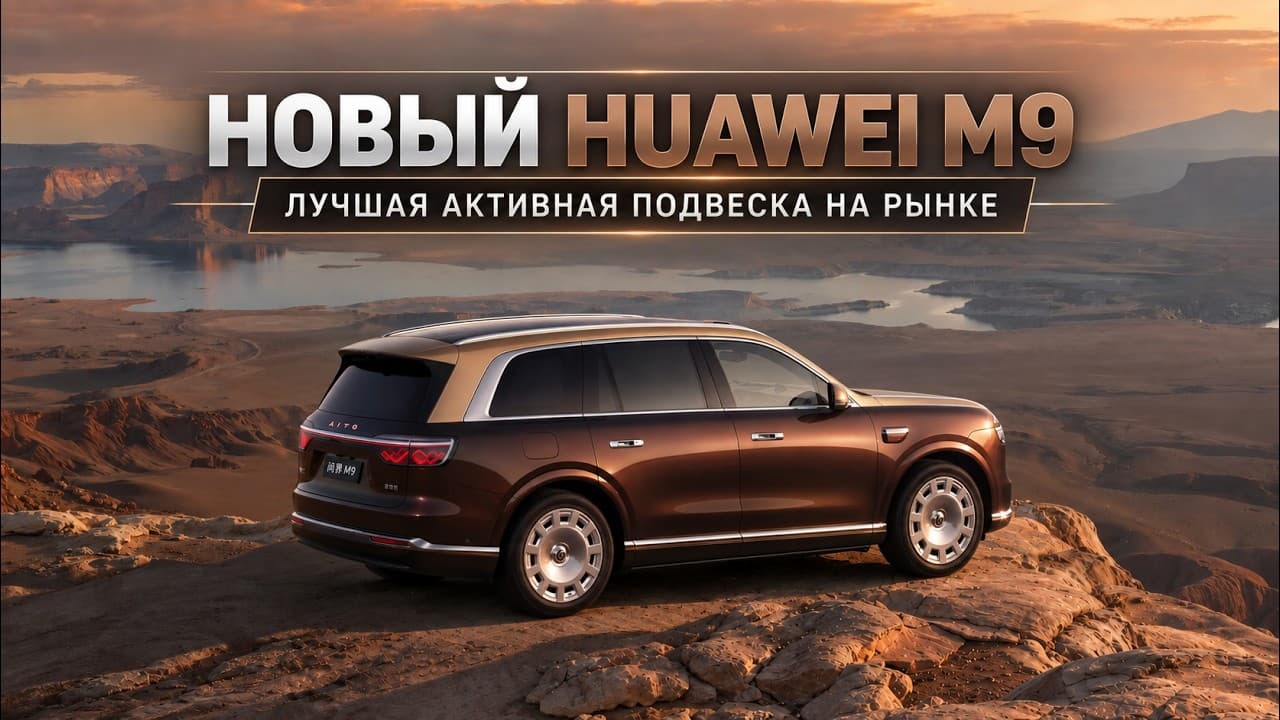
The AITO M9 Ultimate is the long-wheelbase flagship of Huawei's best-known SUV, and it is the trim that carries the 800V fully active suspension as standard. AITO launched the new-generation M9 on 27 May 2026, and the Ultimate costs CNY 649,800 for the five-seat layout and CNY 659,800 for the six-seat one, the same price for the range-extender and the pure-electric version. It stretches the body to 5,402 mm with a 3,236 mm wheelbase, adds a 2.0-litre range extender with three electric motors for 664 kW (890 hp), and pairs the active suspension with rear-wheel steering and steer-by-wire. Deliveries began on 12 September 2026 at the Seres factory in Chongqing. Sergey Gilevich, a Russian-language car reviewer, published a hands-on test of a five-seat Ultimate on 6 October 2026 and concluded that the suspension is tuned for softness first; his impressions are quoted below as his own opinion, while every number in this article comes from AITO's own pages or from launch coverage.
Performance & Specs
The Ultimate comes in two powertrains. The range-extender version uses a 2.0-litre turbocharged four-cylinder that acts as a 133 kW (178 hp) generator, feeding a 75.4 kWh battery and three motors: 220 kW at the front and two 222 kW motors at the rear, for a system output of 664 kW. That is about 890 hp (664 kW x 1.341); Chinese coverage often prints 903 PS, which is the metric horsepower for the same output. AITO quotes 0-100 km/h in 3.99 seconds and a top speed of 251 km/h for this version, and a curb weight of 3,200 kg. CLTC pure-electric range is 375 km (310 km on the stricter WLTC cycle), and the combined CLTC range with a full tank is 1,260 km (1,100 km WLTC).
The pure-electric Ultimate has a 120 kWh battery and two motors, 220 kW at the front and 277 kW at the rear, for 497 kW (about 666 hp). AITO lists 700 km of CLTC range (690 km with some option combinations), 0-100 km/h in 4.9 seconds, a 220 km/h top speed and a 3,105 kg curb weight. Both versions sit on Huawei's 800V platform with silicon-carbide drive units, and AITO lists a 93.5% electric-drive efficiency for the new M9 family. The reviewer noted that the range extender's output looks modest next to the motors; he said AITO told him it was sized to be light, quiet and economical, and to hold 160 km/h cruising, which is his account of a company statement rather than a published specification.

| Powertrain | Tri-motor AWD range-extender (2.0T generator, 133 kW) |
|---|---|
| Power | 664 kW (890 hp / 903 PS) system output |
| Motors | 220 kW front + 2 x 222 kW rear |
| 0–100 km/h | 3.99 s |
| Battery | 75.4 kWh, 800V platform |
| Range | 375 km CLTC electric, 1,260 km CLTC combined |
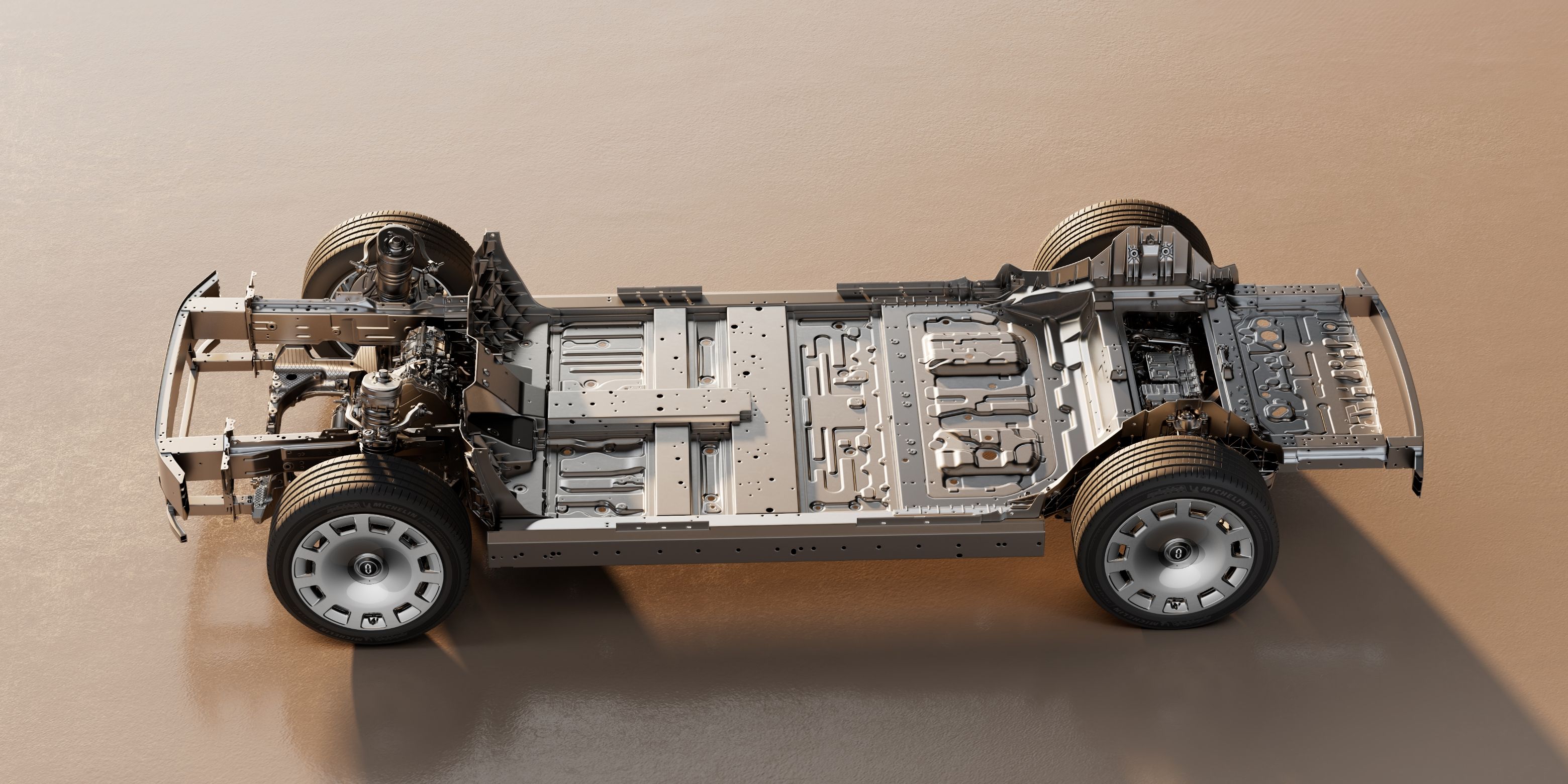
The chassis is the point of this trim. AITO calls the platform Tuling Longxing: front four-ball-joint double wishbones, a rear five-link axle, closed dual-chamber air springs and dual-valve continuously variable dampers. The 800V fully active suspension is standard on all four Ultimate variants and, according to AITO, delivers up to 11,451 N of lift force per wheel, a response speed of 400 mm per second and 180 mm of height adjustment, with five ride-height settings from lowest to highest. A second-generation road-preview system uses the Huawei ADS sensors to spot potholes, speed bumps and kerbs ahead and adjusts the dampers before the wheel arrives. The Ultimate also has rear-wheel steering of up to 8 degrees and a crab mode, and it is the only M9 with steer-by-wire. AITO's product page quotes a 5.1 m minimum turning radius, while its configuration table lists 5.2 m for the Ultimate.
| POWERTRAIN TYPE | Range-extender (EREV) tri-motor AWD, or pure electric (BEV) dual-motor AWD |
|---|---|
| HORSEPOWER | EREV 664 kW (890 hp / 903 PS); BEV 497 kW (666 hp) |
| ACCELERATION | 0-100 km/h in 3.99 s (EREV); 4.9 s (BEV) |
| TOP SPEED | 251 km/h (EREV); 220 km/h (BEV) |
| DRIVETRAIN | AWD |
| BATTERY | 75.4 kWh (EREV); 120 kWh (BEV), 800V |
| ELECTRIC RANGE | 375 km CLTC / 310 km WLTC (EREV); 700 km CLTC (BEV) |
| COMBINED RANGE | 1,260 km CLTC / 1,100 km WLTC (EREV) |
Dimensions & Practicality

| Length | 5,402 mm |
|---|---|
| Width | 2,026 mm |
| Height | 1,845 mm |
| Wheelbase | 3,236 mm |
| Wading depth | 820 mm |
The Ultimate is 117 mm longer than the standard M9 (5,285 mm) and has a 111 mm longer wheelbase (3,236 mm against 3,125 mm); width and height are unchanged. Seres test-centre data puts the effective cabin length at 3,785 mm, against 3,685 mm for the standard M9, and the flat floor area at 3.2 square metres against 3.04. The six-seat layout has a 155 mm sliding rail for the third row and, as an option, rotating second-row seats that turn 180 degrees for a face-to-face 1.7 m seating space. In the five-seat car the reviewer showed, the rear is a lounge with a removable tablet, ventilated and heated seats, a cooler, a roller blind and a projector.
The pure-electric Ultimate has a 217 L front trunk with electric opening; the range-extender version has none, because the engine sits under the bonnet, and the reviewer noted this on camera. The test car rode on 22-inch wheels with 275/45 R22 tyres at the front and 295/45 R22 at the rear, which matches AITO's configuration table. The reviewer said the steering-wheel reach is now good, with about four fingers of space in front of his knee, which he felt earlier M9s lacked.
| LENGTH | 5,402 mm |
|---|---|
| WIDTH | 2,026 mm |
| HEIGHT | 1,845 mm |
| WHEELBASE | 3,236 mm |
| CARGO VOLUME | Not published for the Ultimate |
| FRUNK | 217 L (BEV only) |
| CURB WEIGHT | 3,200 kg (EREV); 3,105 kg (BEV) |
| TYRES | 275/45 R22 front, 295/45 R22 rear |
Charging & Battery
Both Ultimate versions use Huawei's Whale 800V battery platform with ternary lithium cells. The range-extender car has a 75.4 kWh pack and AITO quotes 15 minutes for 20-80% on a 600 A / 1,000 V DC charger at a 25 °C cell temperature; the pure-electric car has a 120 kWh pack and 15 minutes for 30-80% under the same conditions. On a roughly 7 kW AC charger, 20-90% takes about 9 hours for the 75.4 kWh car and about 14 hours for the 120 kWh car. The cars can also power external loads: AITO lists a vehicle-to-load mode of up to 6 kW at 220 V, and range-extender versions can charge another electric car over DC at up to 13 kW. Because the 375 km figure is CLTC, which is a lenient cycle, the WLTC electric range of 310 km is the more cautious number for buyers who want to compare it with rivals tested on other standards.
| BATTERY | 75.4 kWh (EREV); 120 kWh (BEV), 800V platform |
|---|---|
| AC CHARGING | About 7 kW test charger: 20-90% in 9 h (EREV) / 14 h (BEV) |
| DC FAST CHARGING | Peak power not published; 600 A / 1,000 V charger used for the quoted times |
| DC 10-80% TIME | 20-80% in 15 min (EREV); 30-80% in 15 min (BEV) |
Design & Interior
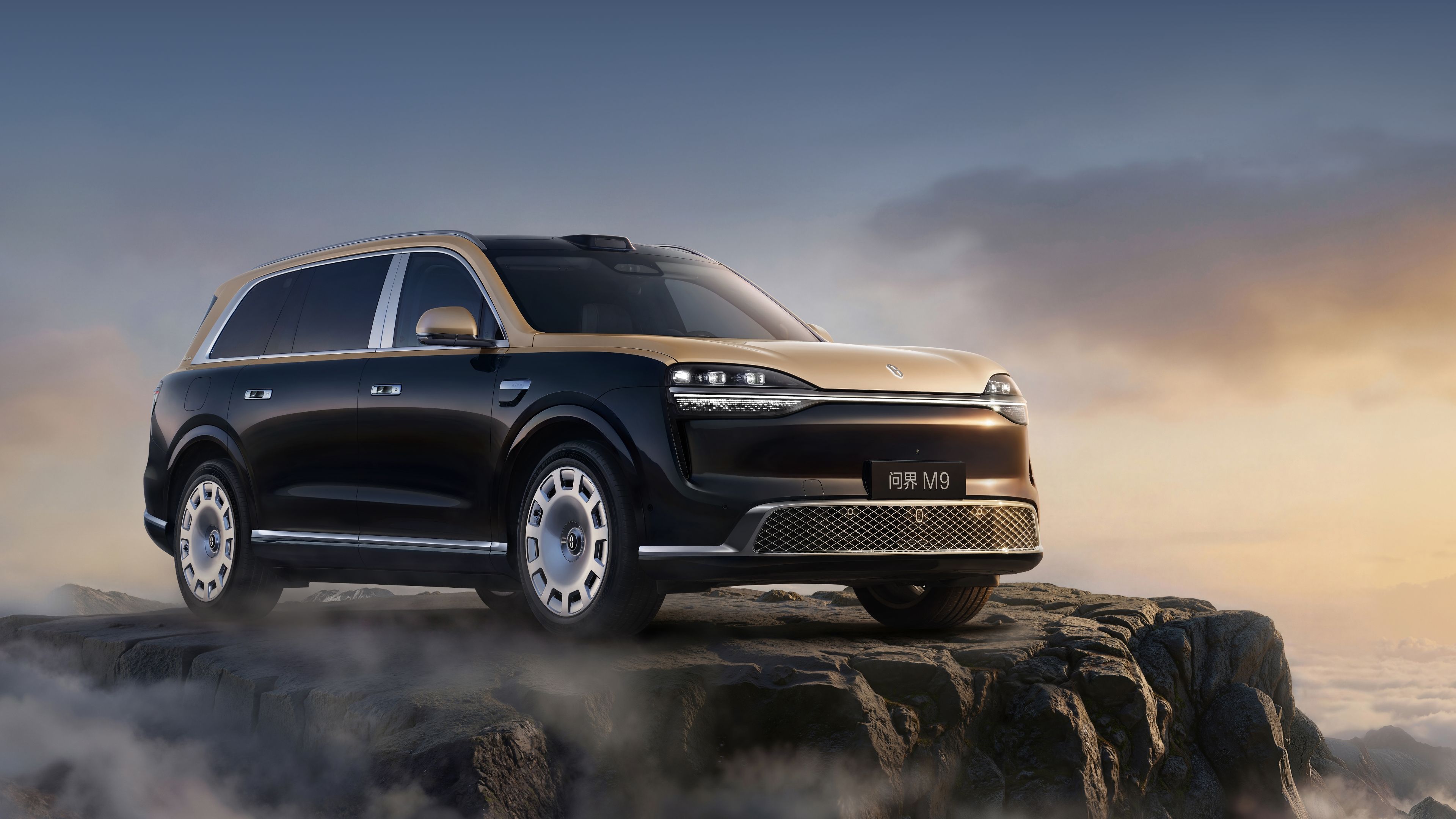
The Ultimate keeps the M9's flat Kunpeng-wing nose but adds chrome window trim, Ultimate badging on the pedals, pillar and tail, an illuminated floating front logo and a black-and-gold paint scheme using a new six-coat, three-bake process. The reviewer called the cabin ultra-luxury and said the materials run to the bottom of the third row, with leather-wrapped door cards, wood trim and Nappa leather on the seats that he judged better than the door-card leather. All seats have ventilation, heating and massage, and the four zero-gravity seats have one-touch zero-gravity presets.
He also pointed to details such as the large step bearing the Ultimate name, motorised doors with an emergency release next to the button, and a camera and display in place of the interior mirror. A star-sky roof and a forest-grade oxygen-supply system are options; the reviewer said the test car felt very fresh inside and that its ultra-soft seat option did not feel especially soft to him. He also showed the optional projector headlights, which he put at roughly CNY 30,000 and described as a gimmick he would not buy. These option prices are his figures, not an AITO price list.
Technology & Features
The cockpit uses Huawei's HarmonyOS system with a 12.3-inch instrument cluster and two 17.2-inch 3.4K screens, a dual-focal-plane AR head-up display and an optional 32-inch retractable laser projection screen. The Ultimate has a 43-speaker, 2,920 W Huawei Sound system with a 9.5.8 acoustic layout and eight sky speakers, against 39 speakers in the standard M9. The reviewer, who said he is not an audio expert, found the sound good, and called the central puck, which selects the driving modes, the way to pick the M9 mode he considered the smoothest. He added that the displays, including the instrument cluster, ran quickly with no lag on the test car.
Safety & ADAS
Every M9 comes with Huawei's Qiankun ADS 5 driver-assistance system, built around six LiDARs: one 896-line dual-light-path main unit, four solid-state units and one in-cabin unit. AITO's product page lists five 4D millimetre-wave radars, 12 ultrasonic radars, 11 high-definition cameras and six exterior microphones; the configuration table counts 15 ultrasonic units, three of them wading sensors. AITO states that the system is driver assistance and not self-driving. The body uses 91% high-strength steel and aluminium, a cage of 13 transverse and 11 longitudinal members, and 2,200 MPa hot-formed steel at ten locations. The six-seat Ultimate has 13 airbags, including second-row far-side airbags and zero-gravity cushion airbags; the five-seat Ultimate, as the reviewer's car, has 11 because it lacks the far-side pair.
| ADAS LEVEL | Driver-assistance system (Huawei ADS 5); AITO says it is not self-driving |
|---|---|
| ADAS FEATURES | Six LiDARs, five 4D mmWave radars, 12 ultrasonic radars, 11 cameras, highway and city navigation assist, remote parking, emergency steering |
| AIRBAGS | 13 (six-seat) / 11 (five-seat) |
Available Versions
| VERSION | POWER | TORQUE | 0-100 | TOP SPEED | DRIVETRAIN | BATTERY | EV RANGE | COMBINED RANGE | PRICE | KEY DIFFERENCES |
|---|---|---|---|---|---|---|---|---|---|---|
| Ultimate EREV 5-seat (Kuowu) | 890 hp | — | 3.99s | 251 km/h | AWD | 75.4 kWh | 375 km | 1,260 km | CNY 649,800 | 664 kW tri-motor, 2.0T range extender, 11 airbags |
| Ultimate EREV 6-seat (Xiangliu) | 890 hp | — | 3.99s | 251 km/h | AWD | 75.4 kWh | 375 km | 1,260 km | CNY 659,800 | Same powertrain, 13 airbags, third row with 155 mm slide |
| Ultimate BEV 5-seat (Kuowu) | 666 hp | — | 4.9s | 220 km/h | AWD | 120 kWh | 700 km | — | CNY 649,800 | 497 kW dual-motor, 217 L front trunk |
| Ultimate BEV 6-seat (Xiangliu) | 666 hp | — | 4.9s | 220 km/h | AWD | 120 kWh | 700 km | — | CNY 659,800 | Same powertrain, 13 airbags, six-seat layout |
Pricing & Availability
AITO's official list prices for the Ultimate are CNY 649,800 for the five-seat (Kuowu) layout and CNY 659,800 for the six-seat (Xiangliu) layout, in both the range-extender and the pure-electric version. At the launch-day rate quoted by CnEVPost (about CNY 6.78 to the dollar) that is roughly USD 95,800 to USD 97,300, a conversion rather than a US price. The standard-wheelbase M9 range runs from CNY 479,800 to CNY 549,800 in the same configuration table, so the Ultimate adds about CNY 100,000 over the top standard trim. The reviewer separately said the active suspension is a roughly CNY 50,000 component; that is his estimate and is not an AITO figure.
The new M9 launched on 27 May 2026, standard-size deliveries began in mid-June, and the Ultimate followed on 12 September 2026 with a hand-over ceremony at the Seres Super Factory in Chongqing. It is sold in China; the active suspension is also a paid option on some standard M9 Ultra trims, but steer-by-wire and the long wheelbase are Ultimate-only.
How It Compares
Two Chinese six-seat flagships also offer fully active suspension, and the reviewer describes the M9 Ultimate as the third Chinese crossover with the technology, after the Li Auto L9 Livis and the NIO ES9. The Livis costs CNY 509,800 and pairs a 420 kW (563 hp) range-extender system with a 72.7 kWh battery, giving 420 km of CLTC electric range and 1,650 km combined; it also has steer-by-wire. The NIO ES9 is pure electric with a 520 kW (697 hp) dual-motor system and a 102 kWh battery; the SkyRide fully active suspension is standard only on the Signature (CNY 558,000) and Horizon (CNY 628,000) editions, which include the battery. On paper the M9 Ultimate has the most power in the group, the longest combined range and the highest price. The reviewer found the M9's tune the softest of the three on deep bumps but less able than the Livis and ES9 at smoothing small, fast irregularities, and said the Livis tune gives better body control.
- 800V fully active suspension, rear steering and steer-by-wire all standard, on a long 3,236 mm wheelbase, with a third-row seat that slides 155 mm in the six-seat layout
- Choice of 890 hp tri-motor range-extender (1,260 km CLTC combined) or 700 km CLTC pure electric, both with 15-minute 800V charging claims
- Reviewer found it very soft on deep bumps and still controlled in corners, comparing the ride with a Mercedes EQS SUV
- Heavy and expensive: 3,105-3,200 kg and CNY 649,800-659,800, with deliveries and sales confined to China
- Reviewer felt it rocks on small bumps where the Livis and ES9 stay flat, and found the short steering ratio available only in Sport mode
The M9 Ultimate is Huawei's most complete luxury SUV: a 5.4-metre body, an 890 hp range-extender or a 700 km pure-electric option, and a chassis with 800V active suspension, rear steering and steer-by-wire. The reviewer's impression is that AITO tuned it for soft comfort rather than the tightest body control, which will suit buyers who want a limousine ride and less so those who want a sharper rival to the L9 Livis. At CNY 649,800 it asks about CNY 100,000 more than the top standard M9 and about CNY 140,000 to 150,000 more than the Livis, so the extra length, seats and chassis hardware have to justify it. For Chinese buyers who want the most comfortable M9, it is a strong, well-equipped choice.