
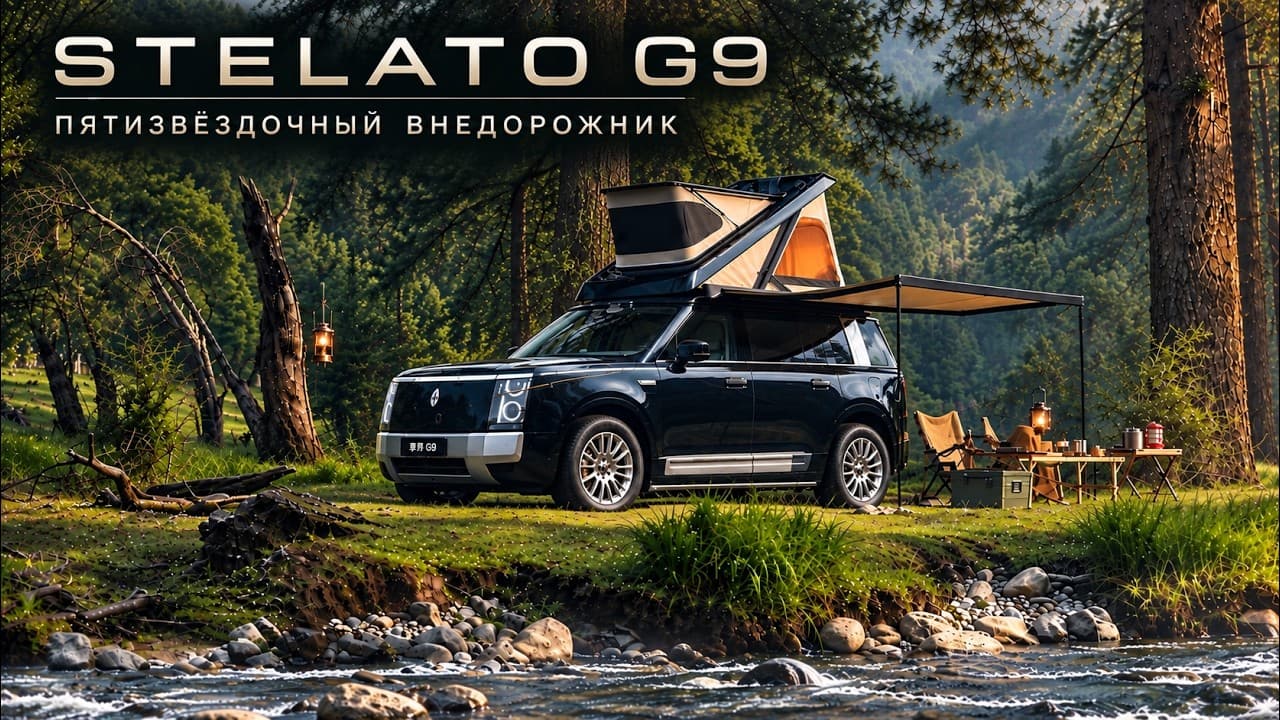
The Stelato G9 is the first off-road SUV from Stelato, the luxury brand that Huawei's Harmony Intelligent Mobility Alliance (HIMA) builds together with BAIC. It went on sale in China on August 20, 2026, in 10 versions priced from CNY 429,800 (about $64,150) to CNY 549,800 (about $82,060), with a choice of five or six seats and of a range-extender or a pure-electric powertrain. Every version shares one dual-motor all-wheel-drive system that produces 437 kW (586 hp), an 800-volt architecture and Huawei's ADS 5 driver-assistance hardware. The body is a boxy, Defender-like monocoque on air suspension, but the cabin and the equipment list read more like a three-row luxury SUV than a utility vehicle. This article follows Russian-language reviewer Sergey Gilevich, who was lent a six-seat range-extender car for two hours in China and drove it on a broken road, on a highway and through the city before going over the cabin, and it adds the official launch data for every trim.
Performance & Specs
All ten versions use the same layout: a 160 kW (215 hp) asynchronous (induction) motor on the front axle and a 277 kW (371 hp) permanent-magnet motor on the rear axle, for a combined 437 kW (586 hp). Torque is 658 Nm on the range-extender cars (208 Nm front, 450 Nm rear) and 727 Nm on the battery-electric ones, which get a stronger 277 Nm front motor. Huawei's own 0-100 km/h times, measured with the media method, run from 4.6 s for the five-seat BEV to 5.4 s for the six-seat Max+ range-extender, and top speed is 220 km/h. On the range-extender versions a 1.5-litre turbocharged four-cylinder built by BAIC and rated at 118 kW (160 PS / 158 hp) works only as a generator, so the wheels are always turned by the electric motors. Curb weight is high, from 2,848 kg to 3,062 kg depending on the version. Underneath sit double wishbones at the front, a five-link rear axle, dual-chamber air springs with continuously variable dampers and an adaptive mechanical differential lock on the rear axle.
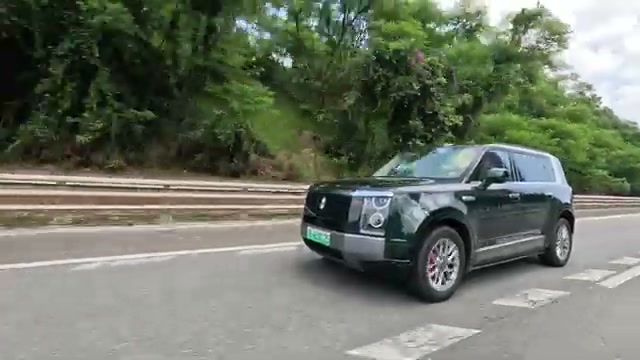
Gilevich's route covered a stretch of badly broken road, a highway run and a slow city section. He rates the ride as average: small ripples feel close to a Li Auto L9, mid-size bumps register like a Toyota RAV4, and a pothole taken at speed is properly harsh, although the suspension stays quiet and the cabin does not shake. In town the rear-wheel steering, which turns the rear wheels by up to 12 degrees, lets the big SUV drive like a small sedan, and he gave the U-turn test top marks. On the highway he puts straight-line stability at about 4+ out of 5, but says that at 140 km/h, when he deliberately saws the wheel left and right, the car feels loose because of its mass and tall body. Acceleration is smooth and, by Chinese standards, unremarkable at roughly 5 s to 100 km/h, and the engine is almost inaudible while it tops up the battery. His main complaint is that the small engine is too weak for a car this heavy: above 140 km/h the G9 can still surge towards 200 km/h to overtake, but it cannot hold that pace and has to settle back to a 140 km/h cruise. He also praises the strong energy recuperation.

| Powertrain | Dual-motor AWD range extender (1.5T generator) |
|---|---|
| Power | 437 kW (586 hp) |
| Torque | 658 Nm |
| 0–100 km/h | 5.3 s |
| Battery | 75.4 kWh |
| Range | 400 km EV / 1,356 km combined (CLTC) |
| POWERTRAIN TYPE | Dual-motor AWD, range extender (EREV) or battery-electric (BEV) |
|---|---|
| HORSEPOWER | 437 kW (586 hp) on every version |
| TORQUE | 658 Nm (EREV) / 727 Nm (BEV) |
| ACCELERATION | 0-100 km/h in 5.1-5.4 s (EREV) / 4.6-4.7 s (BEV) |
| TOP SPEED | 220 km/h |
| DRIVETRAIN | AWD (160 kW front asynchronous + 277 kW rear permanent-magnet) |
| BATTERY | 56 kWh LFP or 75.4 kWh NMC (EREV); 120 kWh NMC (BEV) |
| ELECTRIC RANGE | 310-405 km (EREV, CLTC) / 701-728 km (BEV, CLTC) |
| COMBINED RANGE | 1,271-1,366 km (EREV, CLTC) |
Dimensions & Practicality

| Length | 5,206 mm (5,377 mm with rear box) |
|---|---|
| Width | 2,050 mm |
| Height | 1,897 mm |
| Wheelbase | 3,160 mm |
| Ground clearance | 202 mm (up to 282 mm) |
The G9 is 5,206 mm long without the optional rear-mounted storage box, 2,050 mm wide and 1,897 mm tall, so it is taller and wider than the Li Auto L9 (2,000 mm wide, 1,810 mm tall) even though it is slightly shorter. Gilevich says the driving position is about 10 cm higher than in the Li L9, AITO M9, Denza N9 or a Mercedes-Benz GLS. The off-road numbers are respectable: 202 mm of standard ground clearance that rises to 282 mm on the air suspension (80 mm up and 50 mm down), a 23-degree approach angle and a 26-degree departure angle. Huawei's configuration sheet lists a wading depth of 800 mm, measured in still water in electric mode at 5-8 km/h with the air suspension at its highest setting; pre-sale reports and some launch-day coverage quoted a 900 mm maximum instead.
Luggage space depends on the seat layout. The six-seat cars hold 370 L behind the third row and 1,198 L with it folded, and the five-seat cars hold 978 L and 2,058 L. A 128 L front trunk is listed only for the battery-electric versions. The optional tailgate-mounted case looks like a spare-wheel cover and adds 171 mm of length, taking the car to 5,377 mm. The body itself is a monocoque with no separate frame. Huawei describes it as a hot-formed steel safety cage with a roof that can bear up to 16.5 tonnes (the reviewer rounds this to 16), and it lists a drag coefficient of 0.279, measured on the battery-electric version, a strong figure for a boxy SUV.
| LENGTH | 5,206 mm (5,377 mm with rear-mounted box) |
|---|---|
| WIDTH | 2,050 mm |
| HEIGHT | 1,897 mm |
| WHEELBASE | 3,160 mm |
| GROUND CLEARANCE | 202 mm standard, up to 282 mm |
| APPROACH / DEPARTURE | 23° / 26° |
| CURB WEIGHT | 2,848-3,062 kg |
| CARGO VOLUME | 370 L (1,198 L seats folded) 6-seat / 978 L (2,058 L) 5-seat |
| FRUNK | 128 L (BEV only) |
Charging & Battery
The G9 uses Huawei's 800-volt Giant Whale 3.0 battery platform with three pack options. The range-extender cars carry a 56 kWh lithium iron phosphate pack on the Max+ trim (310 km of electric range on the CLTC cycle) or a 75.4 kWh NMC pack on Ultra and Ultra+ (400 km on the six-seat cars, 405 km on the five-seat cars). The battery-electric versions carry a 120 kWh NMC pack rated at up to 728 km, but that figure applies only to the five-seat Ultra without options or the rear box; the other BEVs are rated at 701 km. Huawei claims a 20-80% DC charge in 15 minutes for the range-extender versions and 30-80% in 15 minutes for the BEV on a 600 A / 1,000 V charger, but neither its configuration sheet nor its product page gives a peak charging power in kW. On a roughly 7 kW home charger the 20-90% top-up takes about 6.5 h for the 56 kWh pack, 9 h for the 75.4 kWh pack and 14 h for the 120 kWh pack. Optional all-terrain tyres raise rolling resistance and cut CLTC electric range by 34-45 km on the range-extender versions.
The big battery also powers the camping side of the G9. The car can output up to 6 kW of 220 V power through a V2L cable, and the reviewer showed two 220 V sockets in the cargo area. Huawei lists the roof tent, tailgate kitchen, roof platform with searchlights, side ladder and side box as factory accessories, and the reviewer says the tent is wired into the car's climate control.
| BATTERY | 56 kWh LFP / 75.4 kWh NMC (EREV); 120 kWh NMC (BEV) |
|---|---|
| AC CHARGING | About 7 kW test charger: 6.5 h (56 kWh), 9 h (75.4 kWh), 14 h (120 kWh), 20-90% |
| DC FAST CHARGING | No peak power in kW listed by Huawei; times measured on a 600 A / 1,000 V charger |
| DC FAST-CHARGE TIME | 15 min for 20-80% (EREV) or 30-80% (BEV) |
| V2L OUTPUT | Up to 6 kW |
Design & Interior
The exterior copies the recipe of classic square-cut SUVs: a flat bonnet, upright pillars, roof rails, semi-concealed door handles and a side-hinged tailgate that opens electrically. The standard wheels are 20 inches with 275/55 R20 tyres (all-terrain tyres are optional), and 22-inch wheels with 285/45 R22 tyres are available; power side steps are also optional, and the test car had them. Two body colours are standard and three are optional, and the test car was a dark green. The cabin is where the G9 leans hardest towards luxury. Gilevich calls the materials a step below the flagship trims of the German executive sedans but still clearly premium: leather on the seats and doors, real wood on the trim and cup-holder lids, and Alcantara trim on the pillars, some of it attached with magnets. The steering wheel is smooth nappa leather rather than top-grade hide, the doors are very heavy, and the side glass is double-glazed.
The seats are the standout. Both front seats and the second-row seats have heating, ventilation and massage, and the reviewer says he prefers the massage to the one in the ZEEKR 9X, and it works the back, the buttocks and, on the ottoman, the calves. The six-seat car he drove has two second-row captain seats, each with a leg rest, that can slide together towards the centre, and two zero-gravity recline modes; he still prefers a bench, but notes that Chinese buyers favour captain seats because multi-generation families travel together. There is a fridge and a rear screen but no folding tables, and he finds the screen on the small side for 2026. Side bolsters inflate only in the front row, and the second-row side support is moderate. The third row is for children: the backrest reclines electrically, it is heated and trimmed in wood and Alcantara, and there are two cup holders, a curtain and a 25 kg hook, but Gilevich could not fit and says knee room is short. In the second row he measured about four fingers of space in front of his knees while sitting upright and says a taller passenger would also fit.
Technology & Features
The cockpit is one wide glass panel made up of a 12.3-inch cluster, a 17.2-inch centre screen and a 17.2-inch passenger screen, with an AR head-up display on top; the reviewer, who says he has spent five years asking for modern screens built into the dashboard, praises both the quality and the widget-based layout. The test car showed an English interface. Voice control is Huawei's own assistant, which failed to answer his question about tyre pressure; the screen showed 2.9 bar, and he would run 2.6. Physical controls survive in three groups, for chassis, cabin and outdoor functions, plus a variable-damping central knob and a puck-style controller that cycles the drive modes. One programmable button opens the tailgate in the test car, another lets the driver talk to someone outside the car, and the door-exit button shows a camera view before the door opens; there are also two 50 W wireless charging pads in the front console.
Every G9 carries a 25-speaker, 7.1.4 Huawei Sound system with 2,080 W of amplification (the reviewer counted 29 speakers), and the car offers driver-facing camera monitoring, gesture control, a 360-degree view with a transparent-chassis mode and a sentry mode. The factory accessory range is unusually deep: a powered roof tent with an awning, a tailgate kitchen, a roof platform and a side box, all sold through Huawei's shop. The tent enters through a hatch above the second row, is controlled from the tablet, phone or main screen, and carries up to 260 kg; the reviewer's car did not have it, and Huawei's configuration sheet marks the tent as optional without giving a price.
Safety & ADAS
Every G9 carries Huawei's Qiankun ADS 5 hardware, which Huawei's configuration sheet lists as four LiDARs (one 896-line dual-path unit and three solid-state units), five 4D millimetre-wave radars, 14 ultrasonic sensors (two of them for wading) and 11 cameras, with self-cleaning for the LiDAR and rear camera. Highway navigation assist, city lane-centering, forward, rear and cross-traffic emergency braking, remote parking and a transparent-chassis view are standard. Functions such as city navigation assist, park-to-park driving, roaming cruise and enhanced emergency steering are paid software packs bought after delivery. In July 2026, Beijing authorities granted the G9 an L3-level road-testing permit for expressways at up to 120 km/h; that is a permit for testing, not a level-3 feature that owners can switch on today.
Passive safety is built around a hot-formed steel cage, front, front-side and second-row side airbags, full-length curtain airbags and a centre airbag between the front seats. On the six-seat cars the second-row zero-gravity seats add cushion airbags and pre-crash seat-back retraction, standard from Ultra and optional on Max+.
| ADAS LEVEL | L2+ (Huawei ADS 5); L3 road-test permit in Beijing |
|---|---|
| ADAS FEATURES | Highway NCA, city LCC, AEB, blind-spot monitoring, door-open warning, cross-traffic braking, 360° view, transparent chassis, remote parking |
| SENSORS | 4 LiDARs, 5 4D radars, 14 ultrasonic sensors, 11 cameras |

Available Versions
| VERSION | POWER | TORQUE | 0-100 | TOP SPEED | DRIVETRAIN | BATTERY | EV RANGE | COMBINED RANGE | PRICE | KEY DIFFERENCES |
|---|---|---|---|---|---|---|---|---|---|---|
| Max+ EREV 5-seat | 586 hp | 658 Nm | 5.3s | 220 km/h | AWD | 56 kWh | 310 km | 1,271 km | $64,150 | Entry price, LFP pack, four-piston front brakes, no active anti-roll bar |
| Max+ EREV 6-seat | 586 hp | 658 Nm | 5.4s | 220 km/h | AWD | 56 kWh | 310 km | 1,271 km | $65,640 | Third row; standard second-row seats, captain seats optional |
| Ultra EREV 5-seat | 586 hp | 658 Nm | 5.1s | 220 km/h | AWD | 75.4 kWh | 405 km | 1,366 km | $71,610 | NMC pack, active anti-roll bar, six-piston front brakes |
| Ultra EREV 6-seat | 586 hp | 658 Nm | 5.3s | 220 km/h | AWD | 75.4 kWh | 400 km | 1,356 km | $74,600 | Standard zero-gravity captain seats and third row |
| Ultra BEV 5-seat | 586 hp | 727 Nm | 4.6s | 220 km/h | AWD | 120 kWh | 728 km | — | $71,610 | 128 L front trunk; 728 km applies without options or rear box |
| Ultra BEV 6-seat | 586 hp | 727 Nm | 4.7s | 220 km/h | AWD | 120 kWh | 701 km | — | $74,600 | Same price as the range-extender Ultra |
| Ultra+ EREV 5-seat | 586 hp | 658 Nm | 5.1s | 220 km/h | AWD | 75.4 kWh | 405 km | 1,366 km | $79,070 | Adds projection headlamps, satellite link and an onboard oxygen system |
| Ultra+ EREV 6-seat | 586 hp | 658 Nm | 5.3s | 220 km/h | AWD | 75.4 kWh | 400 km | 1,356 km | $82,060 | Top range-extender trim |
| Ultra+ BEV 5-seat | 586 hp | 727 Nm | 4.6s | 220 km/h | AWD | 120 kWh | 701 km | — | $79,070 | Fully loaded five-seat BEV |
| Ultra+ BEV 6-seat | 586 hp | 727 Nm | 4.7s | 220 km/h | AWD | 120 kWh | 701 km | — | $82,060 | Top BEV trim |
Pricing & Availability
Pre-sales opened on August 5, 2026 at CNY 439,800, and Chinese media reported more than 10,000 pre-orders within 24 hours and more than 15,000 within 72 hours. Official pricing was set at the launch event on August 20 at CNY 429,800 to CNY 549,800 (about $64,150 to $82,060 at 6.70 yuan per dollar), and on September 7 Stelato said nationwide deliveries would start in mid-September, with early reservation holders served first; as of September 20, 2026 no first-delivery event or delivery figures had been reported, so the start of deliveries is unconfirmed. At Ultra and Ultra+ the range-extender and battery-electric versions cost the same, and the six-seat cars cost CNY 10,000 to 20,000 more than the five-seat ones. Gilevich puts the top version at about $80,000 and stresses that the electric and hybrid versions cost the same money. The G9 is sold through Huawei's HIMA retail network in China, and as of September 2026 neither Huawei nor BAIC has announced an export market.
How It Compares
The G9 has the lowest entry price of the group, at CNY 429,800 against CNY 459,800 for the Li Auto L9, CNY 479,800 for the AITO M9 and CNY 465,900 for the six-seat ZEEKR 9X (its new five-seat version lists at CNY 471,900, or CNY 451,900 with a limited-time incentive). Its 586 hp sits between the L9's 563 hp and the M9's 667 hp, and it is well short of the ZEEKR 9X, whose entry dual-motor car makes 660 kW (885 hp). On combined range the G9's 1,366 km beats the ZEEKR 9X but trails the AITO M9 and, by a wide margin, the L9's 1,650 km. Where the G9 stands out is height: at 1,897 mm it is 87 mm taller than the L9 and 78 mm taller than the ZEEKR 9X, which fits its off-road pitch. It also offers a 120 kWh battery-electric version at the same price as the range-extender, which the Li Auto L9 does not.
- Real off-road hardware for the money: air suspension with 202-282 mm of clearance, rear-wheel steering, a rear differential lock and, from Ultra, an active disconnecting anti-roll bar
- Luxury-grade cabin with heated, ventilated, massaging seats in two rows, a three-screen cockpit and a fridge, and camping extras such as 220 V sockets and 6 kW V2L
- Lowest entry price of the four SUVs compared here at about $64,150, with 586 hp, an 800V platform and full ADS 5 hardware, and BEV and EREV cost the same at Ultra and Ultra+
- The 118 kW range extender is small for a car of up to 3,062 kg, and the reviewer says it cannot sustain much more than 140 km/h once the battery is drained
- Ride is average rather than plush, big potholes at speed are harsh, and the steering feels loose at 140 km/h
- Third-row knee room is short for adults, and the front trunk exists only on the BEV; city navigation and park-to-park driving cost extra
The Stelato G9 is a family luxury SUV with off-road hardware rather than a rock-crawler. It is aimed at buyers who want a tall, heavy-duty three-row cabin with massaging captain seats, a big screen, a fridge and the option of a roof tent, and who trust Huawei's software and BAIC's factories to deliver it. The 586 hp dual-motor drive, the 800V platform and up to 1,366 km of combined range on the range-extender are competitive at about $64,150 to $82,060, and there is a true 120 kWh BEV at the same price. The trade-offs are a small engine for a car this heavy, an ordinary ride, and a third row for children only. Recommended as a comfortable, well-equipped family flagship if the ride and top-speed limits fit how you drive.