
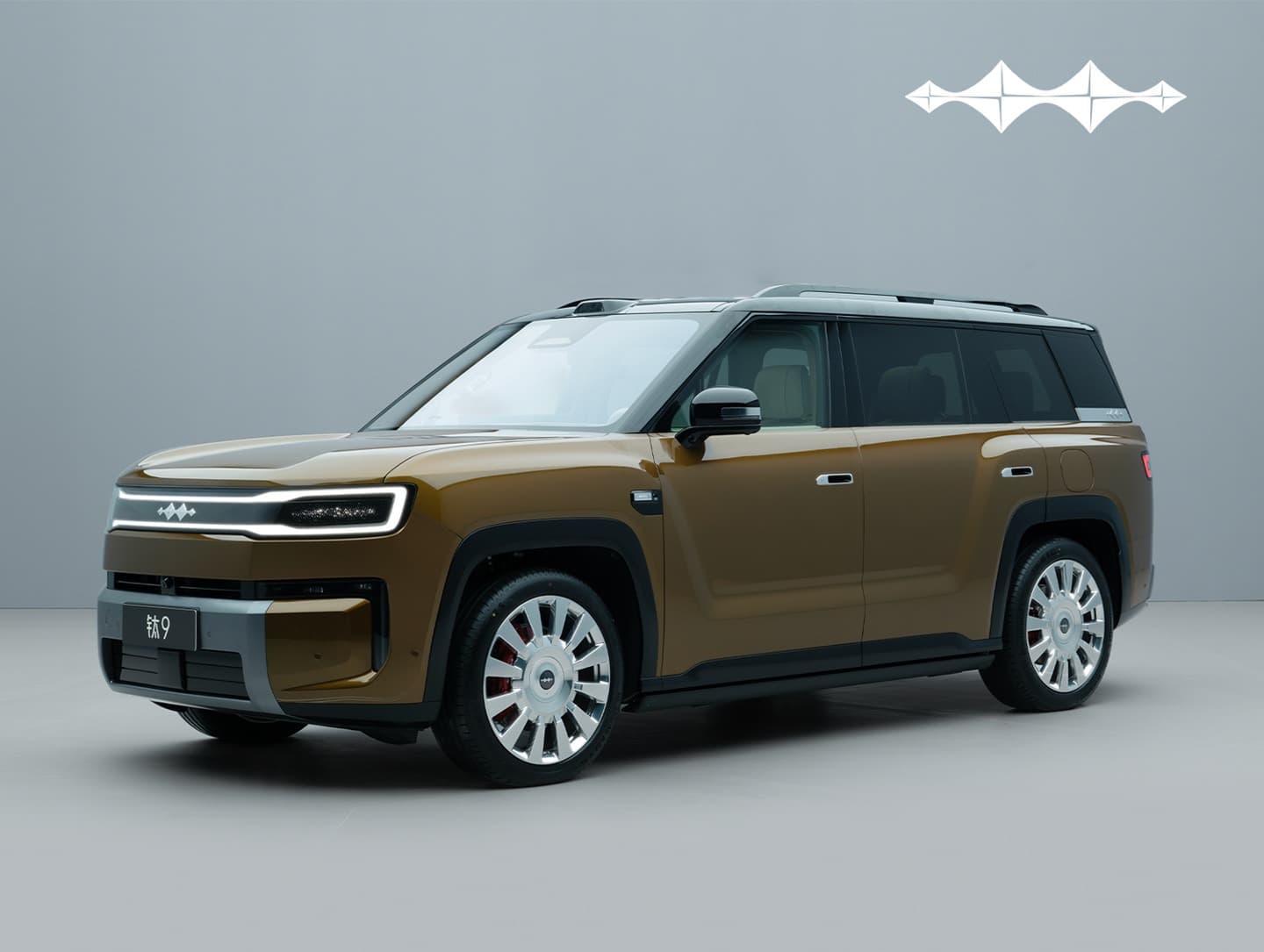
The 2026 BYD Fangchengbao Tai 9, badged Ti 9 in BYD's English-language material, is the largest model yet from BYD's Fangchengbao sub-brand. It is a 5,270 mm plug-in hybrid SUV with a 2+2+2 six-seat cabin, built on a load-bearing unibody rather than a ladder frame, and it is the first car on BYD's new DMS hybrid platform. Two 200 kW electric motors, one per axle, add up to 400 kW (544 PS, about 536 hp) and drive all four wheels, backed by a 1.5-litre turbocharged petrol engine. BYD says the 66.48 kWh LFP battery is good for 310 km of pure-electric driving on the WLTC cycle and the tank-plus-battery total exceeds 1,600 km. Production cars reached showrooms across China on September 28, 2026, nationwide registration of interest opened on September 29, and BYD has not yet announced a price. The company says the car will launch in the fourth quarter of 2026, and this article will be updated once the official price list is published.
Performance & Specs
The powertrain is a plug-in hybrid with front and rear electric motors and a 1.5-litre turbocharged petrol engine. The two motors are each rated at 200 kW peak, which BYD states as 400 kW combined (544 PS, about 536 hp, using 1 kW as roughly 1.341 hp). The engine is rated at 115 kW gross (about 154 hp) and 110 kW net according to the ministry type-approval filing. The front and rear motors are rated at 90 kW and 70 kW nominal, according to CarNewsChina's reading of the filing. BYD has not published a peak system output, a torque figure or a 0–100 km/h time, so none of those are quoted here; the only published top speed is 220 km/h from the filing. At 2,865 to 2,965 kg, the Tai 9 is a heavy car, so acceleration will depend on the system tune that BYD has yet to disclose. What BYD does say is that the new DMS platform allows independent left-right torque distribution for off-road driving, torque-based body stabilization, and a switch from four-wheel drive to two-wheel drive to save energy in daily driving.

| Powertrain | Dual-motor AWD plug-in hybrid (DMS platform) |
|---|---|
| Motors | 2 × 200 kW peak (400 kW / 536 hp combined) |
| Engine | 1.5 L turbo, 115 kW (154 hp) |
| Torque | Not published |
| 0–100 km/h | Not published |
| Battery | 66.48 kWh LFP |
| Range | 310 km WLTC EV / 1,600+ km total |
| POWERTRAIN TYPE | Plug-in hybrid (PHEV), 1.5T engine with front and rear electric motors |
|---|---|
| HORSEPOWER | Motors: 400 kW (544 PS / 536 hp) combined · Engine: 115 kW (154 hp) |
| ACCELERATION | Not published |
| TOP SPEED | 220 km/h (ministry filing) |
| DRIVETRAIN | AWD (front 200 kW + rear 200 kW motors) |
| BATTERY | 66.48 kWh LFP, second-generation Blade Battery |
| ELECTRIC RANGE | 310 km (WLTC) |
| COMBINED RANGE | More than 1,600 km (full tank and full battery) |
Dimensions & Practicality

| Length | 5,270 mm |
|---|---|
| Width | 1,999 mm |
| Height | 1,850 mm (1,880 mm with roof rails) |
| Wheelbase | 3,130 mm |
| Curb weight | 2,865–2,965 kg |
At 5,270 mm long, 1,999 mm wide and 1,850 mm tall on a 3,130 mm wheelbase, the Tai 9 is the longest Fangchengbao yet, ahead of the 5,195 mm Bao 8. Height rises to 1,880 mm on cars with roof rails. CarExpert notes it is 75 mm longer than the Denza B8, with a wheelbase 210 mm longer. The cabin is a 2+2+2 layout with three separate seat designs: comfort seats up front, zero-gravity seats in the second row and comfort seats in the third row, and every seat has ventilation, heating and massage. The filing also lists 21-inch or 22-inch wheels, 19 degrees approach angle, 22 degrees departure angle, and an optional retractable tow hook for a 2,000 kg braked trailer. Boot volume, ground clearance and the load limit have not been published by BYD.
| LENGTH | 5,270 mm |
|---|---|
| WIDTH | 1,999 mm |
| HEIGHT | 1,850 mm (1,880 mm with roof rails) |
| WHEELBASE | 3,130 mm |
| CURB WEIGHT | 2,865–2,965 kg |
| SEATS | 6 (2+2+2) |
| TOWING | 2,000 kg (braked, optional retractable hook) |
| CARGO VOLUME | Not published |
Charging & Battery
The Tai 9 uses a 66.48 kWh lithium iron phosphate pack built from second-generation Blade Battery cells supplied by BYD's FinDreams unit. According to the ministry filing, the pack weighs 487 kg for an energy density of 136.5 Wh/kg. BYD says the car is good for 310 km of pure-electric range on the WLTC cycle, which works out to about 21.4 kWh per 100 km, a believable figure for a 2.9-tonne SUV. The combined figure quoted in BYD's September 29 release is more than 1,600 km on a full tank and a full battery; some earlier coverage of the August reveal repeated a figure of about 2,300 km, but the newer official number is the one used here. The car supports BYD's flash-charging technology, but BYD has not yet released a peak charging power, a 10–80% time, an AC charging rate or a fuel-tank size, and ChinaEVHome reports that a pure-electric variant is also planned. Treat any specific charging time you see quoted for this model as unconfirmed until BYD publishes its own.
| BATTERY | 66.48 kWh LFP, second-generation Blade Battery (FinDreams cells) |
|---|---|
| AC CHARGING | Not published |
| DC FAST CHARGING | BYD flash-charging support, peak power not published |
| DC 10-80% TIME | Not published |
Design & Interior
The Tai 9 keeps the boxy silhouette of the Fangchengbao family but adds a more upmarket face. A continuous light bar runs across the full width of the nose and wraps around the brand logo, split headlamps sit below it, and the bumper has a wide lower intake with an active grille. The tailgate is a horizontally split design that BYD calls the heaven-and-earth gate, with an upper hatch and a lower flap. BYD offers six colours: three solid finishes (roughly translated as Liquid Gold, Meteorite Black and Universe Silver) and three two-tone finishes (Star Radiance Gold, Red Cloud Red and Deep Space Blue), all with a nano-ceramic clear coat. The pictures released so far show 21-inch and 22-inch wheels with red front calipers, and BYD lists front six-piston brake calipers.
Inside, BYD calls the cabin a "5D cockpit" and pushes it as a technology-luxury space. A 30-inch panoramic screen dominates the dashboard, with a separate instrument display and a head-up display in front of the driver, and a 21.4-inch screen is mounted in the ceiling for rear passengers. There are three interior colour schemes, white-brown, grey-black and red-black, all in Nappa leather, and the gear selector sits on the steering column. CarNewsChina's photos of the September 25 interior reveal show a wireless charging pad, physical controls under the screen and a refrigerator in the armrest for rear passengers. BYD also lists a debut rocking-chair comfort seat in the front row.
Technology & Features
The Tai 9 is the first model to carry BYD's new DMS hybrid platform, and BYD lists it together with the second-generation Blade Battery and flash charging as headline technologies. The suspension is the DiSus-A body-control system, which reads the road ahead and adjusts the dampers before the wheels reach a bump. iATS, the intelligent all-terrain recognition system, identifies the terrain for off-road driving, and rear-wheel steering cuts the turning circle. An electrically operated horizontally split tailgate, satellite communication, a 30-inch dash display and a ceiling-mounted rear screen round out the equipment that has been shown. BYD has not yet published the infotainment chip, the audio system or the smartphone integration, and the software experience is still unknown until journalists get behind the wheel.
Safety & ADAS
The Tai 9 carries a roof-mounted LiDAR and BYD's DiPilot 300 driver-assistance system, which is known as God's Eye B in China and supports navigation-on-autopilot functions on highways and urban roads. BYD also lists TSC tyre-blowout stabilization control, an ultra-high-strength steel cage body structure and front six-piston calipers. The body is a unibody monocoque, which BYD positions as a more car-like and more refined alternative to a body-on-frame SUV. No crash-test rating exists yet, so the safety claims are BYD's own until independent tests are published.
| ADAS LEVEL | L2+ (DiPilot 300 / God's Eye B with roof LiDAR) |
|---|---|
| ADAS FEATURES | Roof LiDAR, navigation-assisted driving, TSC tyre-blowout stability control, iATS all-terrain recognition, rear-wheel steering |
Available Versions
| VERSION | POWER | TORQUE | 0-100 | TOP SPEED | DRIVETRAIN | BATTERY | EV RANGE | COMBINED RANGE | PRICE | KEY DIFFERENCES |
|---|---|---|---|---|---|---|---|---|---|---|
| Tai 9 PHEV AWD (launch spec) | 536 hp | — | — | 220 km/h | AWD | 66.48 kWh | 310 km | 1,600+ km | TBA | Trim structure not announced; 536 hp is the two-motor rating, engine adds 115 kW |
Pricing & Availability
BYD has not announced a price for the Tai 9. Production units began arriving at Fangchengbao showrooms on September 28, 2026, nationwide registration of interest opened on September 29, and BYD says the car will launch in the fourth quarter of 2026, with the first deliveries expected in the same quarter. The car will also appear at auto shows in nine Chinese cities during the National Day holiday: Xi'an, Tianjin, Shenzhen, Hangzhou, Hefei, Suzhou, Changsha, Shenyang and Chongqing. Unofficial estimates vary widely, with ChinaEVHome quoting CNY 250,000–300,000 (about $37,000–45,000) and Sina Auto citing about CNY 400,000, but these are media guesses rather than BYD figures and none is used in the specifications above. The Tai 9 was first revealed through a ministry type-approval filing on August 7, 2026, and made its public debut at the Chengdu Auto Show in August. Sales outside China are not confirmed. BYD Australia has told CarExpert only that Denza is young in that market and that lineup decisions need a careful approach, so a European or Australian launch remains unconfirmed.
How It Compares
The obvious rival is the Xiaomi Sky Nomad N90, an extended-range SUV of 5,285 mm that sold from CNY 269,900 (about $40,300) with 416 hp and a 76 kWh battery. The Tai 9 is 15 mm shorter but has a longer 3,130 mm wheelbase against 3,080 mm, and its dual motors are rated at 536 hp against 416 hp, although the Xiaomi carries seven seats in a 2+2+3 layout and quotes CLTC ranges of 464 km electric and 1,705 km total. Those CLTC numbers are more generous than the WLTC rating BYD uses for the Tai 9, so the 310 km figure and the Xiaomi's 464 km are not a like-for-like comparison. The sister brand Denza already sells a six-seat plug-in hybrid at this size in the N9, a 5,258 mm SUV with three motors, 912 hp and 202 km of CLTC electric range, priced from CNY 389,800 (about $54,200). The Li Auto L9 Livis sits above both at 5,255 mm, 563 hp, 1,650 km of CLTC range and from CNY 459,800 (about $67,600). If the Tai 9 lands in the CNY 250,000–300,000 range that some outlets expect, which BYD has not confirmed, it would undercut the Denza and Li Auto flagships by a wide margin while matching the Xiaomi's bracket, and that is the value contrast worth watching.
- Six seats in a 2+2+2 layout with ventilation, heating and massage on every seat
- Two 200 kW motors for 400 kW (536 hp) combined and all-wheel drive, plus a 2,000 kg towing rating
- Over 1,600 km of combined range from a 66.48 kWh battery and a 1.5T engine
- Roof LiDAR with DiPilot 300, rear-wheel steering and adaptive DiSus-A body control
- Price, 0–100 km/h time, torque, cargo volume and peak charging power are all unpublished
- Only 310 km of WLTC electric range, and a curb weight of 2,865–2,965 kg
- Sales outside China are unconfirmed
The Tai 9 is BYD's answer to the large six-seat plug-in hybrid SUV, and on paper it is a serious one: 536 hp from two motors, a flagship-grade cabin with a 30-inch screen and zero-gravity seats, LiDAR-based assisted driving and more than 1,600 km of total range. What it lacks for now are the numbers that decide a purchase, chiefly the price, acceleration time and charging speed. It looks best suited to large families and buyers who tow or take long trips and want a cabin closer to a Denza than a traditional off-roader. We would treat it as a strong candidate until BYD publishes its price list in the fourth quarter.