
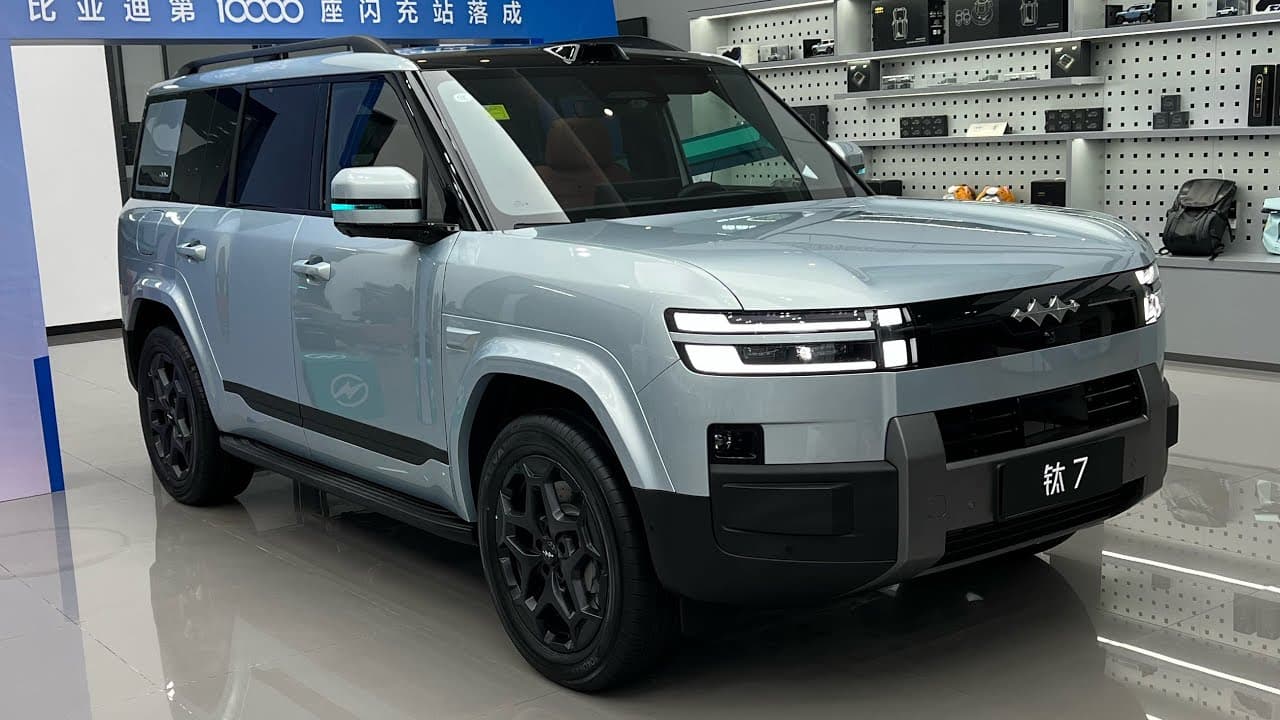
BYD's Fangchengbao brand has launched a Long-Range Edition of the Titanium 7 plug-in hybrid, and the headline change is the battery, which grows from 35.6 kWh to 50 kWh. That lifts CLTC electric-only range to 315 km on the rear-drive Max and 300 km on the dual-motor Ultra, against a previous ceiling of 200 km, while the Max reaches 1,470 km of total range. The China launch took place on August 18, 2026, at 195,800 yuan (about $28,800) for the Max and 225,800 yuan (about $33,200) for the Ultra. Each new trim costs 6,000 yuan more than the equivalent 35.6 kWh trim, so the extra 14.4 kWh works out to roughly $61 per kWh. The car is called the Fangchengbao Tai 7 in China, Titanium 7 in English-language coverage and BYD Ti7 as the export badge, and some dealers and importers sell it as the Leopard 7. It is the brand's best seller, with 20,320 deliveries in July 2026 alone.
Performance & Specs
The Long-Range Edition keeps the familiar hybrid hardware: a 1.5-liter turbocharged four-cylinder rated at 115 kW (156 PS, about 154 hp) and 225 Nm. The rear-drive Max adds a single 200 kW motor (272 PS, about 268 hp) with 315 Nm and needs roughly 7.9 seconds for 0-100 km/h. The Ultra adds a 160 kW front motor for a combined 360 kW (489 PS, about 483 hp) and 620 Nm of torque, which BYD says is good for 4.5 seconds to 100 km/h; the reviewer quoted both the 7.9-second and 4.5-second figures on camera. Top speed is about 190 km/h on both trims. Suspension is a double-wishbone front axle with a five-link rear, and BYD's launch material also lists its DiSus-C intelligent damping.

| Powertrain | 1.5T plug-in hybrid, 1 or 2 motors |
|---|---|
| Engine | 115 kW (156 PS / 154 hp), 225 Nm |
| Motors (Max) | 200 kW (272 PS / 268 hp), 315 Nm |
| Motors (Ultra) | 360 kW (489 PS / 483 hp), 620 Nm |
| 0–100 km/h | 7.9 s (Max) / 4.5 s (Ultra) |
| Battery | 50 kWh LFP Blade |
| POWERTRAIN TYPE | Plug-in hybrid (1.5T engine + 1 or 2 electric motors) |
|---|---|
| HORSEPOWER | 268 hp (Max, 200 kW) / 483 hp (Ultra, 360 kW) |
| ACCELERATION | 7.9 s (Max) / 4.5 s (Ultra) |
| TOP SPEED | ~190 km/h |
| DRIVETRAIN | RWD (Max) / AWD (Ultra) |
| BATTERY | 50 kWh LFP Blade |
| ELECTRIC RANGE | 315 km (Max) / 300 km (Ultra), CLTC |
| COMBINED RANGE | 1,470 km (Max) / 1,310 km (Ultra), CLTC |
Dimensions & Practicality

| Length | 4,999 mm |
|---|---|
| Width | 1,995 mm |
| Height | 1,865 mm |
| Wheelbase | 2,920 mm |
| Approach / departure angle | 24° / 25° |
At almost exactly five meters long with a 2,920 mm wheelbase, the Titanium 7 is a full-size five-seater rather than a compact crossover. The reviewer opened the tailgate to show a flat load floor and quoted about 970 liters with the rear seats up, while press coverage rounds the figure to 1,000 liters; folding the second row opens up to 1,880 liters. Off-road geometry is respectable at 24 degrees of approach angle and 25 degrees of departure angle. The reviewer was candid that this is not the car for serious off-roading, and pointed buyers who want that toward the Leopard 5 instead.
| LENGTH | 4,999 mm |
|---|---|
| WIDTH | 1,995 mm |
| HEIGHT | 1,865 mm |
| WHEELBASE | 2,920 mm |
| CARGO VOLUME | ~970–1,000 L (1,880 L seats folded) |
| SEATS | 5 |
Charging & Battery
The 50 kWh BYD Blade pack is the real story here. It is 40% larger than the 35.6 kWh pack it sits above, and BYD has also raised peak DC charging power to 158 kW from 73 kW, cutting the 30-80% stop to 13.9 minutes, about 20% faster than the earlier versions. Spread over 315 km of CLTC range, 50 kWh works out to roughly 15.9 kWh/100 km battery-to-wheel, a sensible figure for a 5-meter SUV. Once the battery is depleted, the 60-liter tank does the rest: the official combined figures imply about 5.9 L/100 km for the Ultra, the number the reviewer quoted on camera, and about 5.2 L/100 km for the Max by the same arithmetic. On the reviewer's car the central screen has a dedicated energy page with an AI charge mode, a save mode, a smart-charging option and a long-range toggle.
| BATTERY | 50 kWh LFP Blade (previously 26.6 / 35.6 kWh) |
|---|---|
| DC FAST CHARGING | 158 kW peak (previously 73 kW) |
| DC 30-80% TIME | 13.9 min |
| FUEL TANK | 60 L |
Design & Interior
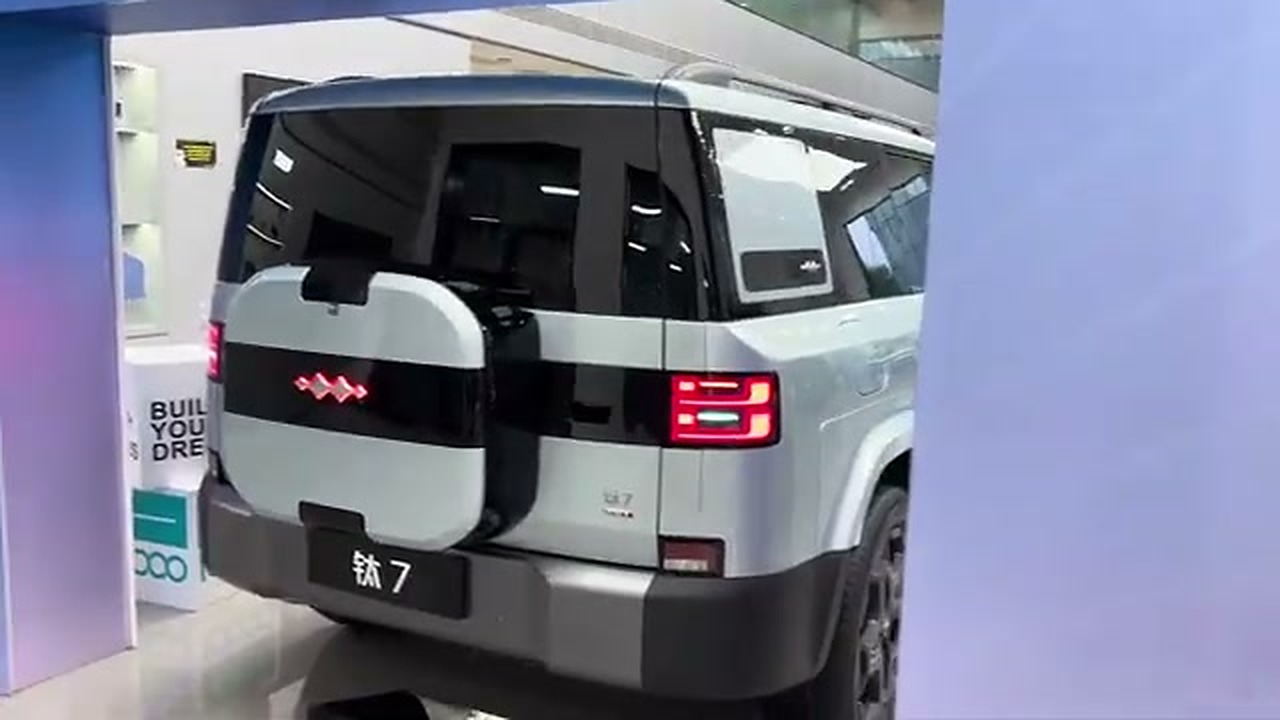
Nothing about the styling has changed, and that is no bad thing. The Titanium 7 is a slab-sided, upright wagon with horizontal LED headlight units on either side of a black grille band, roof rails, black alloy wheels and chunky gray lower cladding. At the rear, a body-color spare-wheel-style cover carries a lit Fangchengbao emblem between two vertical LED taillights. Inside, the showroom car wore a black-and-burnt-orange leather scheme across the dashboard, door cards and seats, with a rear bench that has a center armrest with two cup holders. The reviewer also pointed out a sunroof with a proper sunshade and a lit mirror on the sun visor. BYD's launch material lists a new purple paint option, a 26-inch head-up display, a 20-speaker Devialet sound system, dual 50 W wireless charging pads and a 4.5-liter onboard refrigerator.
Technology & Features
A large 15.6-inch central touchscreen dominates the dash, and the reviewer's car showed an English interface with menus for vehicle, light, energy, drive, ADAS, display, audio, voice and system settings. A 10.25-inch digital cluster sits behind a steering wheel that carries the Fangchengbao emblem and button clusters on both spokes. BYD says the new car gets a next-generation AI cockpit and a multi-screen linkage feature. The English interface is a useful signal for export buyers, although the reviewer noted that the newest version is not yet cleared for export.
Safety & ADAS
Every Long-Range trim ships with standard L2 driver assistance, built on BYD's base God's Eye C suite, which covers automatic emergency braking and lane keeping. The 4WD Ultra adds the LiDAR-based God's Eye B system as standard, which brings highway and city navigation-assist functions. Buyers of the Max can add the same hardware for 12,000 yuan, about $1,800.
| ADAS LEVEL | L2 (God's Eye C) / L2+ with LiDAR (God's Eye B) |
|---|---|
| ADAS FEATURES | AEB, lane keeping (standard); highway and city NOA on God's Eye B (Ultra standard, Max +12,000 yuan) |

Available Versions
| VERSION | POWER | TORQUE | 0-100 | TOP SPEED | DRIVETRAIN | BATTERY | EV RANGE | COMBINED RANGE | PRICE | KEY DIFFERENCES |
|---|---|---|---|---|---|---|---|---|---|---|
| 315KM 2WD Max | 268 hp | 315 Nm | 7.9s | 190 km/h | RWD | 50 kWh | 315 km | 1,470 km | $28,800 | Longest EV range; LiDAR pack optional (+12,000 yuan) |
| 300KM 4WD Ultra | 483 hp | 620 Nm | 4.5s | 190 km/h | AWD | 50 kWh | 300 km | 1,310 km | $33,200 | Dual motors, LiDAR God's Eye B standard |
Pricing & Availability
The Long-Range Edition went on sale in China on August 18, 2026, at 195,800 yuan for the 315KM 2WD Max and 225,800 yuan for the 300KM 4WD Ultra, or about $28,800 and $33,200 at roughly 6.8 yuan to the dollar. The original Titanium 7 plug-in hybrid launched on September 9, 2025 from 179,800 yuan (about $26,500), and the 26.6 and 35.6 kWh trims at 179,800 to 219,800 yuan remain in the lineup alongside the new pair. Chinese listings designate the new car a 2026 model, although at least one export dealer already markets it as a 2027 model. Demand is strong: the brand delivered 20,320 units in July 2026 out of 41,213 for all Fangchengbao models, and cumulative sales passed 200,000 within about ten months of launch. A separate all-electric Titanium 7 with up to 755 km of CLTC range sits above the plug-in hybrid in the range.
How It Compares
The Titanium 7 sits between two very different cars from the freshmotors catalog. The Deepal S07 EREV starts about $7,800 lower at $21,000 and makes the same 268 hp, but it is a smaller 4,750 mm SUV with a 1,384 km total range, so the Titanium 7 adds roughly 250 mm of length, the longest electric-only range of the three and 86 km more total range for the extra money. The sibling Leopard 5 costs about $9,000 more at $37,800 and brings 671 hp and genuine off-road hardware on a shorter 4,890 mm body, yet it manages 210 km of electric range and 1,300 km in total, both below the Titanium 7's 315 km and 1,470 km. For a family that wants a big, rugged-looking five-seater and plans to do most daily driving on electricity, the Titanium 7 is now the value pick of the three.
- 315 km of CLTC electric range from a 50 kWh pack, far beyond the previous 200 km ceiling
- 158 kW peak DC charging with a 13.9-minute 30-80% stop, and 1,470 km total range
- Full-size five-seat body with about 970–1,000 L of boot space and 1,880 L folded
- Only 6,000 yuan (about $880) more than the equivalent 35.6 kWh trim for 14.4 kWh extra battery
- The Max needs about 7.9 seconds to reach 100 km/h, and the quick 4.5-second Ultra costs $33,200
- Rugged looks outrun its off-road ability, as the reviewer pointed out, and the newest version is China-only for now
The 50 kWh Long-Range Edition fixes the Titanium 7's one weak spot, its modest electric range, for a price bump of just 6,000 yuan. A 315 km CLTC range means most daily driving can be done without the engine, while the 1,470 km total range and 13.9-minute fast-charge stop keep road trips painless. The Max is the smart buy for almost everyone, and the Ultra is worth it only if you want the LiDAR pack and 483 hp. Recommended for families who want a big, boxy PHEV and can buy in China.