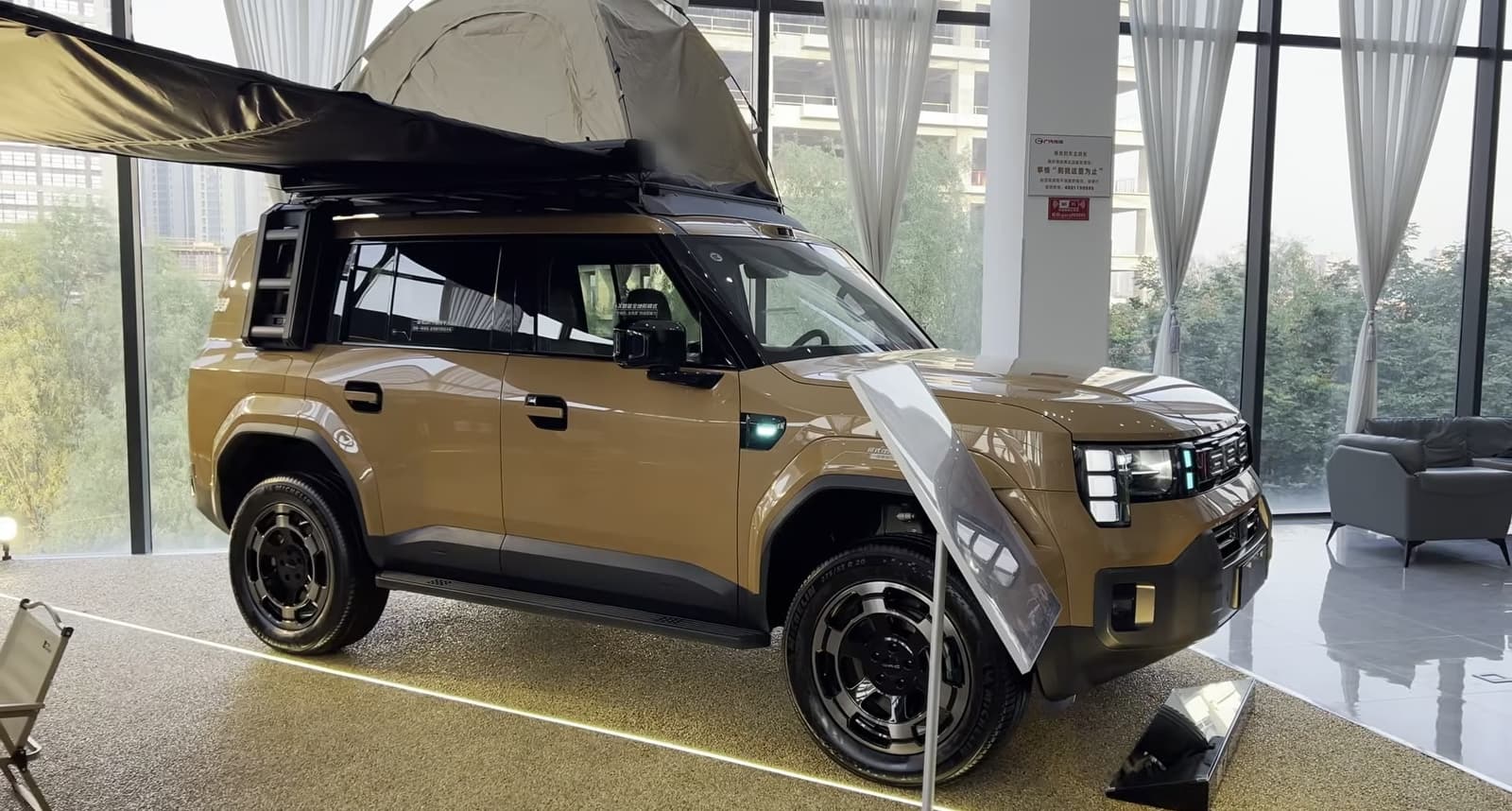
The 2026 BYD Fangchengbao Tai 7, sold in English-language coverage as the Titanium 7 and listed by some exporters, including the reviewer’s channel, as the Leopard 7, is a five-seat, 4,999 mm plug-in hybrid SUV that pairs a 1.5-liter turbo engine with one or two electric motors. It launched on September 9, 2025 at CNY 179,800 (~$26,971 at 6.6664 yuan to the dollar) for a 26.6 kWh version with 135 km of electric range, and the lineup now tops out at CNY 225,800 (~$33,871) for a 50 kWh dual-motor version with 300 km of electric range. BYD quoted a maximum total range of more than 1,300 km at launch and gives up to 1,470 km for the 50 kWh Long-Range Edition launched on August 18, 2026. It is built as a well-equipped daily driver and family hauler rather than a hardcore off-roader, with a unibody structure, a 2,920 mm wheelbase and about 1,000 liters of boot space.
Performance & Specs
Every version pairs a 1.5-liter turbocharged four-cylinder rated at 115 kW (156 PS / about 154 hp) and 225 Nm with electric motors. The rear-drive versions have a single 200 kW (272 PS / 268 hp) motor with 315 Nm and take 7.5 to 7.9 seconds to reach 100 km/h. The dual-motor all-wheel-drive versions add a 160 kW front motor for 360 kW combined (489 PS / 483 hp) and 620 Nm, which cuts the 0-100 km/h time to 4.5 seconds. The reviewer quoted a top speed of about 190 km/h. Battery options are 26.6 kWh, 35.6 kWh and, since August 2026, 50 kWh, all LFP; together with the 60-liter fuel tank they give a maximum total range that BYD put at more than 1,300 km at launch.

| Powertrain | 1.5T plug-in hybrid, 1 or 2 motors |
|---|---|
| Engine | 115 kW (156 PS / 154 hp), 225 Nm |
| Motors (RWD) | 200 kW (272 PS / 268 hp), 315 Nm |
| Motors (AWD) | 360 kW (489 PS / 483 hp), 620 Nm |
| 0–100 km/h | 7.5–7.9 s RWD / 4.5 s AWD |
| Battery | 26.6 / 35.6 / 50 kWh LFP |
| POWERTRAIN TYPE | PHEV |
|---|---|
| HORSEPOWER | 268 hp (200 kW motor) RWD / 483 hp (360 kW motors) AWD |
| TORQUE | 315 Nm RWD / 620 Nm AWD |
| ACCELERATION | 7.5–7.9 s (RWD) / 4.5 s (AWD) |
| TOP SPEED | about 190 km/h |
| BATTERY | 26.6 kWh, 35.6 kWh or 50 kWh LFP |
| ELECTRIC RANGE | 135–315 km (CLTC) |
| COMBINED RANGE | More than 1,300 km at launch; 1,470 km (50 kWh RWD) / 1,310 km (50 kWh AWD) |
| FUEL TANK | 60 L |
Available Versions
The Tai 7 PHEV is sold in six versions across three battery sizes. The two rear-drive 2025 versions and the two all-wheel-drive versions launched together in September 2025, and the two 50 kWh Long-Range versions followed on August 18, 2026, each priced 6,000 yuan (~$900) above the equivalent 35.6 kWh version.
| VERSION | POWER | TORQUE | 0-100 | TOP SPEED | DRIVETRAIN | BATTERY | EV RANGE | COMBINED RANGE | PRICE | KEY DIFFERENCES |
|---|---|---|---|---|---|---|---|---|---|---|
| 135KM RWD Pro | 268 hp | 315 Nm | 7.5-7.9s | 190 km/h | RWD | 26.6 kWh | 135 km | — | CNY 179,800 (~$26,971) | Entry price, 179,800 yuan |
| 200KM RWD Max | 268 hp | 315 Nm | 7.5-7.9s | 190 km/h | RWD | 35.6 kWh | 200 km | — | CNY 189,800 (~$28,471) | Larger battery, 189,800 yuan |
| 315KM RWD Max (Long-Range) | 268 hp | 315 Nm | 7.9s | 190 km/h | RWD | 50 kWh | 315 km | 1,470 km | CNY 195,800 (~$29,371) | 195,800 yuan; 158 kW peak DC charging; LiDAR +12,000 yuan |
| 190KM AWD Max | 483 hp | 620 Nm | 4.5s | 190 km/h | AWD | 35.6 kWh | 190 km | — | CNY 206,800 (~$31,021) | Dual motor, 206,800 yuan |
| 190KM AWD Ultra | 483 hp | 620 Nm | 4.5s | 190 km/h | AWD | 35.6 kWh | 190 km | — | CNY 219,800 (~$32,971) | 219,800 yuan; God’s Eye B LiDAR standard |
| 300KM AWD Ultra (Long-Range) | 483 hp | 620 Nm | 4.5s | 190 km/h | AWD | 50 kWh | 300 km | 1,310 km | CNY 225,800 (~$33,871) | 225,800 yuan; 158 kW peak DC charging; LiDAR standard |
Dimensions & Practicality

| Length | 4,999 mm |
|---|---|
| Width | 1,995 mm |
| Height | 1,865 mm |
| Wheelbase | 2,920 mm |
| Ground clearance | about 210 mm |
The Tai 7 offers a highly practical and cavernous interior within a large SUV footprint. At 4,999 mm long, 1,995 mm wide and 1,865 mm tall, it is a full-size five-seater, and its 2,920 mm wheelbase gives generous leg room front and rear; the reviewer found enough leg and head room in the second row. Cargo space is about 1,000 L behind the rear bench and about 1,880 L with the second row folded. Off-road geometry is respectable rather than extreme, with a 24-degree approach angle, a 25-degree departure angle and a 600 mm wading depth. A small storage box on the tailgate holds up to 3 kg, according to the reviewer.
| LENGTH | 4,999 mm |
|---|---|
| WIDTH | 1,995 mm |
| HEIGHT | 1,865 mm |
| WHEELBASE | 2,920 mm |
| GROUND CLEARANCE | about 210 mm |
| APPROACH / DEPARTURE | 24° / 25° |
| CARGO VOLUME | about 1,000 L (1,880 L seats folded) |
| SEAT LAYOUT | 5 (2+3) |
Charging & Battery
As a plug-in hybrid, the Tai 7 offers silent electric driving for daily commutes and hybrid operation for long journeys. The 26.6 and 35.6 kWh packs peak at 73 kW on a DC fast charger, and the reviewer quotes about 25 to 30 minutes to reach roughly 80%. The 50 kWh Long-Range packs raise peak DC power to 158 kW and cut the 30-80% stop to 13.9 minutes, about 20% faster, according to BYD. The car has separate slow and fast charging ports on the exterior. On a standard AC charger a full charge takes about 5 hours, again according to the reviewer.
| BATTERY | 26.6 kWh, 35.6 kWh or 50 kWh LFP |
|---|---|
| AC CHARGING (SLOW) | about 5 hours |
| DC PEAK POWER | 73 kW (26.6 / 35.6 kWh) / 158 kW (50 kWh) |
| DC 30-80% TIME | 13.9 min (50 kWh); about 25–30 min to ~80% (35.6 kWh, reviewer) |
Design & Interior
The Tai 7 has a commanding, boxy SUV design language. It is equipped with LED daytime running lights, a functional grille and two exhaust outlets at the rear, which the reviewer says are both functional, signaling its hybrid nature. Inside, the cabin is packed with comfort features: a panoramic sunroof with a physical sunshade, an adjustable steering column, a wireless charging pad and a refrigerator in the center console box. A large central infotainment screen carries an official English interface, and the front passenger gets a separate entertainment display.
Safety & ADAS
Safety and driving convenience are high priorities. The RWD Pro, RWD Max and AWD Max versions use BYD’s God’s Eye C driver-assistance suite, which has no LiDAR, and the all-wheel-drive Ultra versions add the LiDAR-based God’s Eye B system; on the 315KM RWD Max it is a 12,000-yuan (~$1,800) option. The reviewer also pointed to a comprehensive 360-degree surround-view camera system, a head-up display and an automatic parking system that guides the nearly 5-meter-long SUV into tight urban spaces.
Driving Experience
While the Tai 7 shares design cues with BYD’s hardcore off-roaders, its driving experience is tuned for on-road comfort and daily usability. If buyers want a dedicated rock-crawling machine, the reviewer says the Leopard 5 (Bao 5) is the better choice, but for highway cruising and city driving the Tai 7 is the calmer, more practical car. The reviewer’s car rides on 19-inch wheels wrapped in 255/60 R19 GT tires, which provide good shock absorption and stability. The 268 hp rear-drive powertrain gives smooth, effortless acceleration, and the 60-liter fuel tank lets you drive past gas stations for a long way, with BYD quoting a maximum total range of more than 1,300 kilometers at launch.
Pricing & Availability
The Tai 7 PHEV launched in China on September 9, 2025 at CNY 179,800 (~$26,971) for the 135KM RWD Pro, and prices climb to CNY 189,800 (~$28,471) for the 200KM RWD Max, CNY 206,800 (~$31,021) for the 190KM AWD Max and CNY 219,800 (~$32,971) for the 190KM AWD Ultra. The 50 kWh Long-Range Edition added on August 18, 2026 costs CNY 195,800 (~$29,371) for the 315KM RWD Max and CNY 225,800 (~$33,871) for the 300KM AWD Ultra; all conversions use 6.6664 yuan to the dollar. Demand is strong: the Tai 7 passed 200,000 cumulative sales about ten months after launch and delivered 27,320 units in July 2026 across its PHEV and EV versions. Outside China the plug-in hybrid is sold as the BYD Ti7, with the UK and the Middle East reported as markets and a seven-seat layout offered there. A wider European or North American launch has not been confirmed as of September 2026.
How It Compares
The Tai 7 PHEV competes in a highly aggressive PHEV SUV market, prioritizing family comfort and range over extreme off-road geometry. Its battery-electric sibling shares the body but starts about $3,000 higher at roughly $29,971, with 402 hp, 675 to 755 km of electric range and 10-70% flash charging in 5 minutes; the plug-in hybrid answers with a petrol engine and total range above 1,300 km. GWM’s Tank 300 Hi4-T, refreshed in July 2026, starts at CNY 249,800 (~$37,471), around $10,500 above the entry Tai 7. It offers 105 km of WLTC electric range and 913 km in total from a 2.0-liter turbo plus a 174 hp motor, against the Tai 7’s 135 to 315 km of electric range and up to 1,470 km in total. For buyers who spend most of their time on paved roads, the Tai 7 is the cheaper and roomier answer.
Where It Fits in the Range
The Tai 7 sits between the Leopard 5 and Leopard 8 in size, but it is built differently: the Tai 7 is a unibody SUV, while the Leopard 5 and 8 are body-on-frame off-roaders. That makes it the family-oriented member of Fangchengbao’s lineup, with the rugged styling and large footprint of the off-road division and a powertrain and chassis tuned for daily comfort. Since April 29, 2026 it has also been available as a battery-electric version with flash charging.
- Entry price of about $26,971 for a 4,999 mm five-seater with a plug-in hybrid drivetrain
- More than 1,300 km of total range, and up to 1,470 km on the 50 kWh Long-Range Edition
- Premium features included: head-up display, refrigerator, automatic parking and a 360-degree camera
- Long-Range Edition adds 14.4 kWh of battery for only about $900 more than the 35.6 kWh trims
- Not designed for heavy or technical off-roading; unibody, not body-on-frame
- The 26.6 and 35.6 kWh versions peak at only 73 kW on DC and need about 5 hours on AC
The 2026 BYD Titanium 7 PHEV is a masterclass in market positioning. Many buyers love the imposing, boxy look of an off-roader but use their vehicles for school runs and highway road trips, and BYD answered with a large, well-equipped family SUV on a road-biased unibody chassis that starts at about $26,971. With an onboard fridge, a passenger screen and a total range above 1,300 km, and now up to 1,470 km with the 50 kWh Long-Range Edition, it removes range anxiety for practical families. The Long-Range Max at about $29,371 is the smart buy for most people, and the dual-motor Ultra is for those who want LiDAR and 483 hp. Recommended for families who want a big, boxy PHEV and can buy in China or in a market that gets the BYD Ti7.