
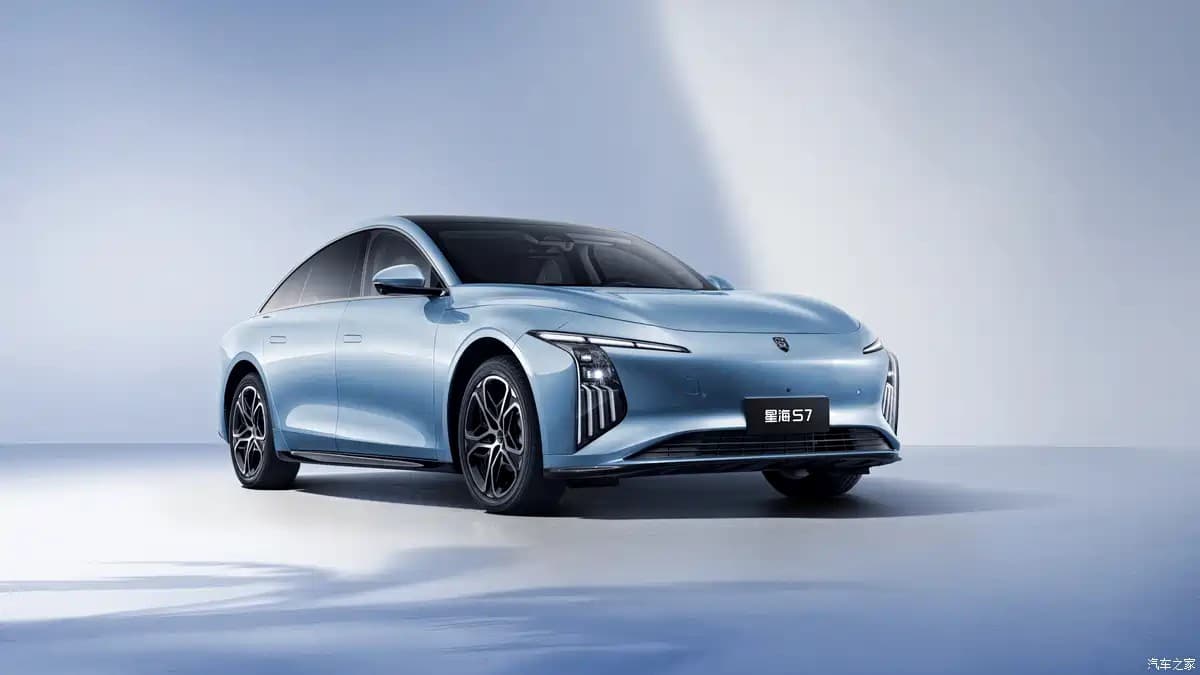
The 2026 Forthing Xinghai S7 is a full-size liftback sedan from Xinghai, the electrified sub-brand of Dongfeng Forthing, and it is unusual in offering buyers a genuine choice between two very different powertrains under one nameplate. The lineup opens with a pure-electric "565" trim priced from CNY 119,900 (about $16,900), runs through an 800V "650 Ultra-Fast Charging" flagship BEV, and tops out with a range-extended (EREV) version that pairs a small battery with a 1.5-liter generator engine for a combined range of up to 1,250 km. Styling leans into a low, coupe-like roofline and a drag coefficient of just 0.191 Cd, while the cabin gets a 15.6-inch center touchscreen, an 8.8-inch driver display and a Qualcomm Snapdragon 8155 chip as standard across the range. It is aimed squarely at China's crowded $17,000-$24,000 electrified-sedan segment, competing on space, range flexibility and price rather than outright badge prestige.
Performance & Specs
Every Xinghai S7 trim uses a single motor driving the rear wheels, so the differences between versions come down to battery size and, for the EREV, whether a small combustion engine is on board to recharge it. The entry-level BEV "565" trims and the range-extended version share the same 160 kW (215 hp) rear motor and 310 Nm of torque, good for a 0-100 km/h time of 6.67 seconds in the pure-EV car and roughly 7.2 seconds in the heavier EREV. Stepping up to the "650 Ultra-Fast Charging" BEV swaps in a stronger 230 kW (308 hp) motor and cuts the 0-100 km/h sprint to 5.9 seconds, riding on an 800V electrical architecture that also unlocks much faster DC charging. Top speed on the base cars is electronically limited to 165 km/h. The EREV's range extender is a 1.5-liter DFMC15DE four-cylinder producing 77 kW (105 PS, about 104 hp) that acts purely as a generator — it never drives the wheels directly — feeding the same rear-mounted electric motor used in the BEV.

| Powertrain | Range-extended EV (EREV) |
|---|---|
| Drive Motor | 160 kW (215 hp), 310 Nm |
| Range Extender | 1.5L DFMC15DE, 77 kW (105 PS / ~104 hp) |
| 0–100 km/h | ~7.2 s |
| Battery | 28.4 kWh LFP |
| Range | 235 km EV / 1,250 km combined (CLTC) |
| POWERTRAIN TYPE | BEV or EREV (trim-dependent) |
|---|---|
| HORSEPOWER | 215 hp (565 / EREV) or 308 hp (650 Ultra-Fast Charging) |
| ACCELERATION | 5.9–7.2 s (0–100 km/h, trim-dependent) |
| TOP SPEED | 165 km/h (565 / EREV) |
| DRIVETRAIN | RWD, single rear motor |
| BATTERY | 28.4 kWh (EREV) to 68.2 kWh (650 BEV), LFP |
| ELECTRIC RANGE | 235–650 km CLTC (trim-dependent) |
| COMBINED RANGE | Up to 1,250 km (EREV only) |
Dimensions & Practicality

| Length | 4,935 mm |
|---|---|
| Width | 1,915 mm |
| Height | 1,495 mm |
| Wheelbase | 2,915 mm |
| Curb weight | 1,730–2,105 kg |
At 4,935 mm long with a 2,915 mm wheelbase, the Xinghai S7 sits in the full-size sedan class, closer in footprint to a Toyota Camry-plus than a compact EV, and the long wheelbase translates into generous rear legroom for a car this size. The liftback tailgate (a hatch rather than a conventional trunk lid) opens onto a 513-liter boot that expands to roughly 1,303 liters with the rear seats folded, plus a hidden 115-liter sub-floor storage well beneath the boot floor. A 50-liter front trunk under the hood adds further everyday storage that a conventional sedan simply doesn't have. Curb weight ranges from about 1,730 kg on the lightest BEV trim up to roughly 2,105 kg on the heavier EREV, which carries both a battery and a combustion range-extender engine.
| LENGTH | 4,935 mm |
|---|---|
| WIDTH | 1,915 mm |
| HEIGHT | 1,495 mm |
| WHEELBASE | 2,915 mm |
| CARGO VOLUME | 513 L (1,303 L seats folded) |
| FRUNK | 50 L |
Charging & Battery
Battery capacity varies sharply by trim. The entry BEV "565" cars use a 59.4 kWh LFP pack for 565 km of CLTC range on conventional charging hardware — an earlier version of this same trim was originally quoted at 56.8 kWh and 555 km before a 2026 model-year update revised the pack slightly upward alongside the new flagship. That flagship, the "650 Ultra-Fast Charging" BEV, jumps to a 68.2 kWh LFP pack and adds an 800V electrical architecture exclusive to that trim, cutting a 10-80% DC fast charge down to around 15 minutes and adding roughly 320 km of range in about 14 minutes under ideal conditions. The EREV carries a much smaller 28.4 kWh LFP pack, enough for 235 km of CLTC pure-electric range before the 1.5-liter range extender kicks in to keep the battery topped up, for a combined 1,250 km between fuel and charging stops. All packs use cobalt-free lithium iron phosphate cells, which Forthing favors for cost and longevity over energy density.
| BATTERY | 28.4 kWh (EREV) / 59.4 kWh (565 BEV) / 68.2 kWh (650 BEV), LFP |
|---|---|
| AC CHARGING | 11 kW (approx., typical for the segment) |
| DC FAST CHARGING | Up to 800V (650 trim); standard-voltage DC on other trims |
| DC 10-80% TIME | ~14 min for 320 km added (650 Ultra-Fast Charging trim) |
Design & Interior
Forthing calls the Xinghai S7 a sedan, but the sloping rear glass and hatch-style tailgate make it a liftback in the mold of cars like the Audi A7 or a Tesla Model 3 — a shape chosen specifically to help the 0.191 Cd drag figure and to open up that generous cargo hatch. The nose carries slim, layered LED headlights either side of a closed-off front fascia (there's no need for a large radiator grille on the BEV trims), with a full-width light bar and a body-colored badge plate spanning the tail. Inside, the cabin is built around a light, minimalist theme with a two-spoke steering wheel, a floating center console with dual wireless phone chargers, and heated and cooled cupholders — a small but distinctive touch above the segment's typical fare. A panoramic glass roof is standard, and seat trims range from cloth on entry cars up to synthetic leather on the higher Star and Supreme editions. The overall presentation looks and feels closer to a car a full price bracket up, which is a deliberate part of Forthing's pitch against better-known Chinese EV brands.
Technology & Features
Every trim gets the same Qualcomm Snapdragon 8155 chip running Forthing's in-house Xinghai OS across a 15.6-inch center touchscreen and an 8.8-inch digital instrument cluster, with voice control, gesture recognition and app-based remote functions (climate pre-conditioning, remote lock/unlock) available through a companion smartphone app. A six-speaker audio system is standard, and over-the-air software updates keep the infotainment and driver-assist software current after purchase. Wheel sizes range from 18 to 20 inches depending on trim, wrapped around low-rolling-resistance rubber chosen to protect range rather than outright grip.
Safety & ADAS
Higher Xinghai S7 trims add "Xinghai Pilot," Forthing's L2 driver-assistance suite, bundling adaptive cruise control, lane-keeping assist and a 360-degree camera system for parking. There is no LiDAR sensor on any confirmed trim, so this stays a camera-and-radar L2 system rather than the LiDAR-based L2+ hardware now common on flagship Chinese EVs from brands like NIO or XPeng — a reasonable trade-off at this price point, but worth knowing if hands-off highway driving is a priority. Entry trims ship with a more basic suite of active safety features (forward AEB, basic cruise control) without the full Xinghai Pilot package.
| ADAS LEVEL | L2 (Xinghai Pilot on upper trims) |
|---|---|
| ADAS FEATURES | AEB, adaptive cruise control, lane-keeping assist, 360° camera, parking assist |
Available Versions
| VERSION | POWER | TORQUE | 0-100 | TOP SPEED | DRIVETRAIN | BATTERY | EV RANGE | COMBINED RANGE | PRICE | KEY DIFFERENCES |
|---|---|---|---|---|---|---|---|---|---|---|
| 565 Light Plus | 215 hp | 310 Nm | 6.67s | 165 km/h | RWD | 59.4 kWh | 565 km | — | $16,900 | Entry BEV trim, cloth seats, base ADAS |
| 565 Star Edition | 215 hp | 310 Nm | 6.67s | 165 km/h | RWD | 59.4 kWh | 565 km | — | $19,300 | Adds Xinghai Pilot L2 ADAS, upgraded trim |
| 650 Ultra-Fast Charging Luxury | 308 hp | — | 5.9s | — | RWD | 68.2 kWh | 650 km | — | $19,700 | 800V architecture, stronger motor, ultra-fast DC charging |
| 650 Ultra-Fast Charging Supreme | 308 hp | — | 5.9s | — | RWD | 68.2 kWh | 650 km | — | $21,100 | Top BEV trim, full ADAS and interior package |
| 235 EREV | 215 hp | 310 Nm | ~7.2s | 165 km/h | RWD | 28.4 kWh | 235 km | 1,250 km | $18,300 | 1.5L DFMC15DE range extender, FSD adaptive suspension |
| 235 EREV Star Xiang | 215 hp | 310 Nm | ~7.2s | 165 km/h | RWD | 28.4 kWh | 235 km | 1,250 km | $23,900 | Flagship EREV trim, full luxury and ADAS package |
Pricing & Availability
The Xinghai S7 lineup spans CNY 119,900 to CNY 169,900 (roughly $16,900 to $23,900) depending on powertrain and trim, making it one of the more affordable ways into an 800V-capable BEV or a 1,250 km-range EREV on the Chinese market. The pure-electric "565" trims launched first, with the 800V "650 Ultra-Fast Charging" flagship following as part of the car's 2026 model-year update, and the range-extended EREV version added to the lineup in spring 2025 as a lower-cost, longer-legroom alternative for buyers who aren't ready to commit to pure EV charging habits. As of September 2026, the Xinghai S7 is sold exclusively in mainland China through Dongfeng Forthing's dealer network, with no announced export program.
How It Compares
The XPeng Mona M03 and Nissan N7 EV are the Xinghai S7's most direct pure-EV rivals: both are similarly sized electric sedans with matching 215 hp output and cheaper starting prices, but neither offers a combustion-backed range-extender option for buyers without reliable home charging. The BYD Seal 06 DM-i is the closer match for the Xinghai S7 EREV specifically — it's a plug-in hybrid sedan in the same price band with an even longer claimed combined range, though its 120 km EV-only range is roughly half of the Xinghai S7's 235 km, meaning Forthing's car can cover far more daily driving on electricity alone before its range extender needs to switch on. Against all three, the Xinghai S7's trump card is flexibility: no other car in this comparison lets a buyer choose between pure BEV and EREV versions of the exact same body and interior.
- Rare BEV-or-EREV choice on one platform, so range anxiety isn't a dealbreaker either way
- 800V flagship trim charges 320 km of range in about 14 minutes, matching pricier rivals
- Liftback practicality (513-1,303 L boot plus a 50 L frunk) most sedans in this price range can't match
- No LiDAR or L2+ hands-off driver assistance, even on the top trims
- 800V ultra-fast charging is locked to the priciest "650" BEV trim, not available lineup-wide
The 2026 Forthing Xinghai S7 is a smart pick for a buyer who wants a spacious, well-equipped electrified sedan but isn't sure yet whether they want to commit fully to a BEV. Its two extremes — a genuinely quick 800V flagship BEV and a 1,250 km-range EREV — cover very different use cases without forcing a compromise on space or features, and the pricing undercuts better-known EV-only rivals with similar output. It loses ground on driver-assistance hardware, where LiDAR-equipped rivals are pulling ahead, and the base 565 trim's 6.67-second 0-100 time is unremarkable rather than exciting. For buyers prioritizing range flexibility and interior space over outright performance or cutting-edge autonomy, the Xinghai S7 is a genuinely compelling value.