
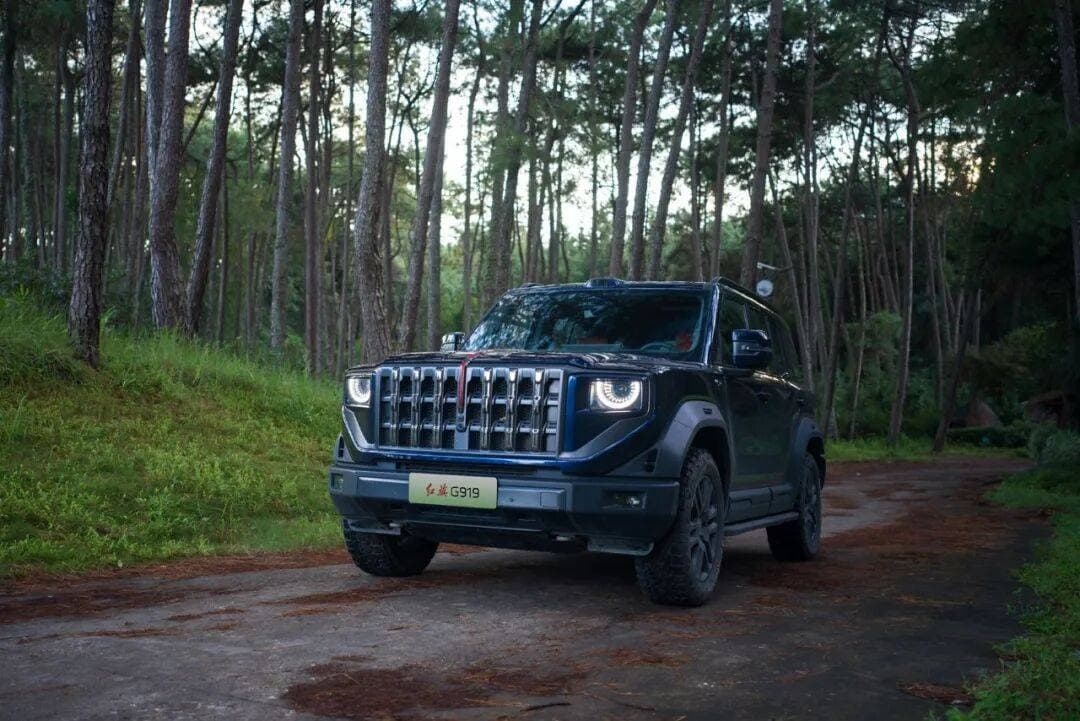
Hongqi, the premium brand of state-owned FAW Group, has opened pre-sales for the G919, its first genuinely hardcore off-road SUV, on September 22, 2026. The pitch is unmistakable: a 5,135 mm body-on-frame box with a 2.0-liter turbo range extender feeding four electric motors, a combined 620 kW (843 PS / 831 hp) and 1,320 Nm, a claimed 4.5-second 0-100 km/h time and up to three locking differentials. Pre-sale pricing starts at ¥359,800, roughly $52,500 at 6.85 yuan to the dollar, and climbs to ¥439,800 for a limited edition. Hongqi rates the 62.9 kWh battery at 280 km of CLTC electric range and the full tank-plus-battery figure at 1,350 km. The G919 grew out of the P567 project and an off-road concept shown at Auto Shanghai in April 2025, and the production name was confirmed in early June 2026. Final launch pricing and delivery dates have not been announced, so every price below is a pre-sale figure.
Performance & Specs
The G919 is an extended-range electric vehicle, so the 2.0-liter turbo engine (a 160 kW unit built by FAW's powertrain arm) acts as a generator and the four motors do all the driving, one at each wheel. Hongqi quotes 620 kW of combined motor power and 1,320 Nm of torque. Converting properly, 620 kW is about 831 hp; the 843 figure that appears in some Chinese-language coverage is metric horsepower (PS), which is roughly 1.4% larger than the imperial horsepower most English readers expect. Torque at the wheels is quoted at 18,500 Nm after gearing, and Hongqi says the car reaches 100 km/h in 4.5 seconds despite a curb weight of 3,150 to 3,175 kg. A top speed has not been confirmed by the maker, so it is left out here. Because the wheels are driven electrically and independently, the software can vary torque between all four corners in milliseconds, and the off-road pitch leans heavily on that torque vectoring. The engine also works while the vehicle is parked and can feed the battery at up to 30 kW according to Chinese launch coverage, which is useful for camping or recovering charge far from a socket.

| Powertrain | 2.0T range extender + four electric motors (EREV) |
|---|---|
| Power | 620 kW (843 PS / 831 hp) |
| Torque | 1,320 Nm |
| 0–100 km/h | 4.5 s |
| Battery | 62.9 kWh (EVE cylindrical cells) |
| Range | 280 km EV (CLTC) / 1,350 km combined |
| POWERTRAIN TYPE | EREV (2.0T range extender, 160 kW, four electric motors) |
|---|---|
| HORSEPOWER | 620 kW (843 PS / 831 hp) |
| TORQUE | 1,320 Nm (18,500 Nm at the wheels) |
| ACCELERATION | 4.5 s (0-100 km/h, claimed) |
| TOP SPEED | Not confirmed |
| DRIVETRAIN | Four-motor AWD, front and rear mechanical locks plus electronic center lock |
| BATTERY | 62.9 kWh |
| ELECTRIC RANGE | 280 km (CLTC) |
| COMBINED RANGE | 1,350 km (CLTC, full battery and 80 L tank) |
Dimensions & Practicality

| Length | 5,135 mm |
|---|---|
| Width | 2,050 mm |
| Height | 1,950 mm |
| Wheelbase | 2,900 mm |
| Ground clearance | 210 mm (entry) / 220 mm (mid trim) |
The G919 is a large five-seat SUV: 5,135 mm long, 2,050 mm wide and 1,950 mm tall on a 2,900 mm wheelbase, which puts it in the same size class as the biggest boxy off-roaders on sale. It rides on a ladder frame with a claimed torsional rigidity of 9,500 Nm per degree, built with 84.4% high-strength steel, and it wears 275/60R20 all-terrain tires with a full-size spare mounted on the rear door. Ground clearance is 210 mm on the entry trim and 220 mm on the air-suspension trims, and Chinese outlets report that the air suspension can raise the body to 235 mm, lifting the approach and departure angles from 30 and 29 degrees to 33 and 31 degrees. Rated wading depth is 800 mm on the entry trim and 900 mm on the mid and top trims. Chinese launch coverage lists a 950 liter boot, expanding to 2,120 liters with the second row folded, and a rear backrest that reclines to 131 degrees. Pre-sale gifts include a roof platform and side-tent accessories.
| LENGTH | 5,135 mm |
|---|---|
| WIDTH | 2,050 mm |
| HEIGHT | 1,950 mm |
| WHEELBASE | 2,900 mm |
| GROUND CLEARANCE | 210 mm (entry) / 220 mm (mid trim; up to 235 mm raised) |
| WADING DEPTH | 800 mm (entry) / 900 mm (mid trim) |
| CURB WEIGHT | 3,150 / 3,175 kg |
| TIRES | 275/60R20 all-terrain |
| CARGO VOLUME | 950 L (2,120 L seats folded) |
| SEATS | 5 |
Charging & Battery
The G919 carries a 62.9 kWh battery built from EVE large cylindrical cells and sits on an 800V silicon-carbide architecture. Hongqi claims a 30-80% charge in 12 minutes. That is a maker claim rather than a tested result, and the peak DC charging power has not been published, so this article does not quote one; the claim does imply an average of about 157 kW over those 12 minutes, our own arithmetic from 31.5 kWh added. Pure-electric range is rated at 280 km on the CLTC cycle, an optimistic test cycle that real-world figures will undercut on a 3.2-tonne brick, and the 80-liter fuel tank stretches the combined range to 1,350 km. The car takes 92-octane gasoline. Hongqi will supply a home charger and installation with pre-sale orders, and a stationary generation mode of up to 30 kW allows the engine to top up the battery in camp. AC charging speed has not been published.
| BATTERY | 62.9 kWh (EVE cylindrical cells) |
|---|---|
| EV RANGE (CLTC) | 280 km |
| COMBINED RANGE | 1,350 km (80 L fuel tank) |
| DC FAST CHARGING | 800V; 30-80% in 12 min (Hongqi claim); peak power not published |
| STATIONARY ENGINE CHARGING | Up to 30 kW |
Design & Interior
The exterior is deliberately blunt: a vertical windshield, flat roof, squared-off fenders and a tall grille with vertical chrome slats and a red center line that nods to the Hongqi flag emblem. Round LED headlamps sit in blocky housings, the spare wheel hangs on the side-hinged tailgate, and the roof carries a rack with the LiDAR module mounted at its leading edge. Recovery hooks and an all-terrain tire package reinforce the overlander look. Inside, the pictured cabin uses quilted orange leather over dark trim, a large center screen and a row of physical switches, and a mechanical shift lever flanked by chunky rocker controls on the console. Wang Shunan of Hongqi summed up the philosophy at launch: a real off-roader needs a frame, a round steering wheel, mechanical door handles and physical buttons, and the G919 follows that recipe. The front seats offer heating, ventilation and eight-point massage, and the rear backrest reclines to 131 degrees. Options and trim differences include a fridge, a rear ceiling screen, rear seat heating and ventilation, and a powered passenger leg rest, which are optional on the entry trim and standard higher up.
Technology & Features
The cockpit centers on a 17.3-inch 3K central display, with a second 17.3-inch 3K screen for rear passengers, and both run on a Snapdragon 8295P chip. Hongqi's Lingxi 5.0 cockpit software integrates the Doubao and Qwen AI models for voice control, and an 18-speaker Dynaudio system is fitted. The off-road menu shows six terrain modes, including grass, gravel, snow, mud, wading and sand, according to Chinese launch coverage, according to Chinese launch coverage. A software-defined torque-vectoring system distributes power between the four motors, and the three locks cover the front axle, rear axle and center. Hongqi also lists path-memory and terrain-perception functions in the assisted-driving suite. Pre-sale buyers get three years of free in-car data at 20 GB per month, and Hongqi offers lifetime warranty coverage on the vehicle and battery for the first private owner.
Safety & ADAS
Hongqi's assisted-driving system is called SinoPilot 5.0 Max, and the launch material describes it as offering park-to-park navigation assistance. The hardware set listed by Chinese outlets includes a roof LiDAR that combines laser, visible-light and infrared sensing, eleven high-definition cameras, millimeter-wave radar and twelve ultrasonic sensors. The city navigation-assist function is included as a pre-sale gift, so it is not part of the base price during pre-sale. Structural safety centers on the frame, and Hongqi cites 1,500 joules of underbody impact resistance and a drive-shaft breaking torque of 11,500 Nm. Like every Chinese system in this class, it is a Level 2+ driver-assistance suite: the driver remains responsible at all times.
| ADAS LEVEL | L2+ (SinoPilot 5.0 Max) |
|---|---|
| ADAS FEATURES | Roof LiDAR, 11 cameras, millimeter-wave radar, 12 ultrasonic sensors, park-to-park navigation assist, infrared night vision (Yujing and Limited) |
Available Versions
| VERSION | POWER | TORQUE | 0-100 | TOP SPEED | DRIVETRAIN | BATTERY | EV RANGE | COMBINED RANGE | PRICE | KEY DIFFERENCES |
|---|---|---|---|---|---|---|---|---|---|---|
| Four-Motor Tujing | 831 hp | 1,320 Nm | 4.5 s | — | AWD | 62.9 kWh | 280 km | 1,350 km | $52,500 | ¥359,800 pre-sale; front mechanical lock optional, no air suspension, 210 mm clearance, 800 mm wading |
| Four-Motor Yujing | 831 hp | 1,320 Nm | 4.5 s | — | AWD | 62.9 kWh | 280 km | 1,350 km | $58,400 | ¥399,800 pre-sale; standard front lock, air suspension, infrared night vision, 220 mm clearance, 900 mm wading |
| Limited Edition | 831 hp | 1,320 Nm | 4.5 s | — | AWD | 62.9 kWh | 280 km | 1,350 km | $64,200 | ¥439,800 pre-sale; bookings expected to open in December 2026, white bespoke interior and red brake calipers |
Pricing & Availability
All three prices are pre-sale guidance in Chinese yuan, converted at 6.85 yuan per dollar: ¥359,800 ($52,500) for the Tujing, ¥399,800 ($58,400) for the Yujing and ¥439,800 ($64,200) for the Limited Edition, whose bookings are expected to open in December 2026. Hongqi has not given a date for the official launch beyond the second half of 2026, and final prices could differ. The pre-sale package includes a deposit-multiplier offer, a trade-in subsidy of ¥20,000 for Hongqi owners and ¥15,000 for other brands (about $2,920 and $2,190), a three-year zero-interest financing option and a free home charger, all valid until launch. The entry Tujing deserves a caution: the “three differential locks” headline is complete only on the Yujing, because the front mechanical lock is an option on the Tujing. Hongqi has not announced any export markets for the G919.
How It Compares
All three rivals come from our own catalog and are plug-in hybrids in the same boxy off-road segment. The Jetour G700 lists 892 hp and up to 1,400 km for about $46,000, so it undercuts the G919 by roughly $6,500 and out-powers it on paper, but it uses two electric motors rather than four. The BYD Leopard 8 is almost exactly the G919's price at $53,500 with 738 hp and 1,200 km, which leaves the Hongqi about 93 hp ahead on paper. The GWM TANK 700 Hi4-Z is the established flagship at about $63,500 with 864 hp and 1,191 km; the G919 Limited Edition costs about the same at $64,200, while the base Tujing is around $11,000 cheaper. The honest reading is that the G919 does not win on peak power or on price, and its selling points are the four-motor layout with 18,500 Nm of wheel torque, the complete lock set on the Yujing, the 280 km CLTC electric range (rival ranges use different test cycles) and the Hongqi badge. Rival prices are approximate launch-era figures from our own coverage.
- Four independent motors deliver 620 kW (831 hp), 1,320 Nm and a claimed 4.5 s to 100 km/h on a real body-on-frame chassis
- 280 km of CLTC electric range and 1,350 km combined, with a claimed 30-80% charge in 12 minutes on an 800V system
- Serious off-road hardware on the Yujing: front and rear mechanical locks, electronic center lock, air suspension, 900 mm wading and infrared night vision
- The entry Tujing has no air suspension and only an optional front mechanical lock, with 210 mm clearance and 800 mm wading
- Curb weight is 3,150 to 3,175 kg, and towing capacity, top speed and peak charging power have not been published
The Hongqi G919 is a credible first attempt at a hardcore off-roader from a brand better known for limousines. It pairs a proper frame and mechanical locks with a four-motor range-extender powertrain, an unusually long 280 km electric range and a fast-charging claim that few rivals match. The catch is the trim ladder: the full three-lock story lives on the roughly $58,400 Yujing, and with final prices, launch date, towing rating and export plans still unannounced, some of the hardware promises remain untested. For buyers in China who want a G-Class-style silhouette with plug-in flexibility, the Yujing looks like the sweet spot, while rivals such as the Jetour G700 offer more power for less money. Recommended once final pricing and real-world tests confirm the claims.