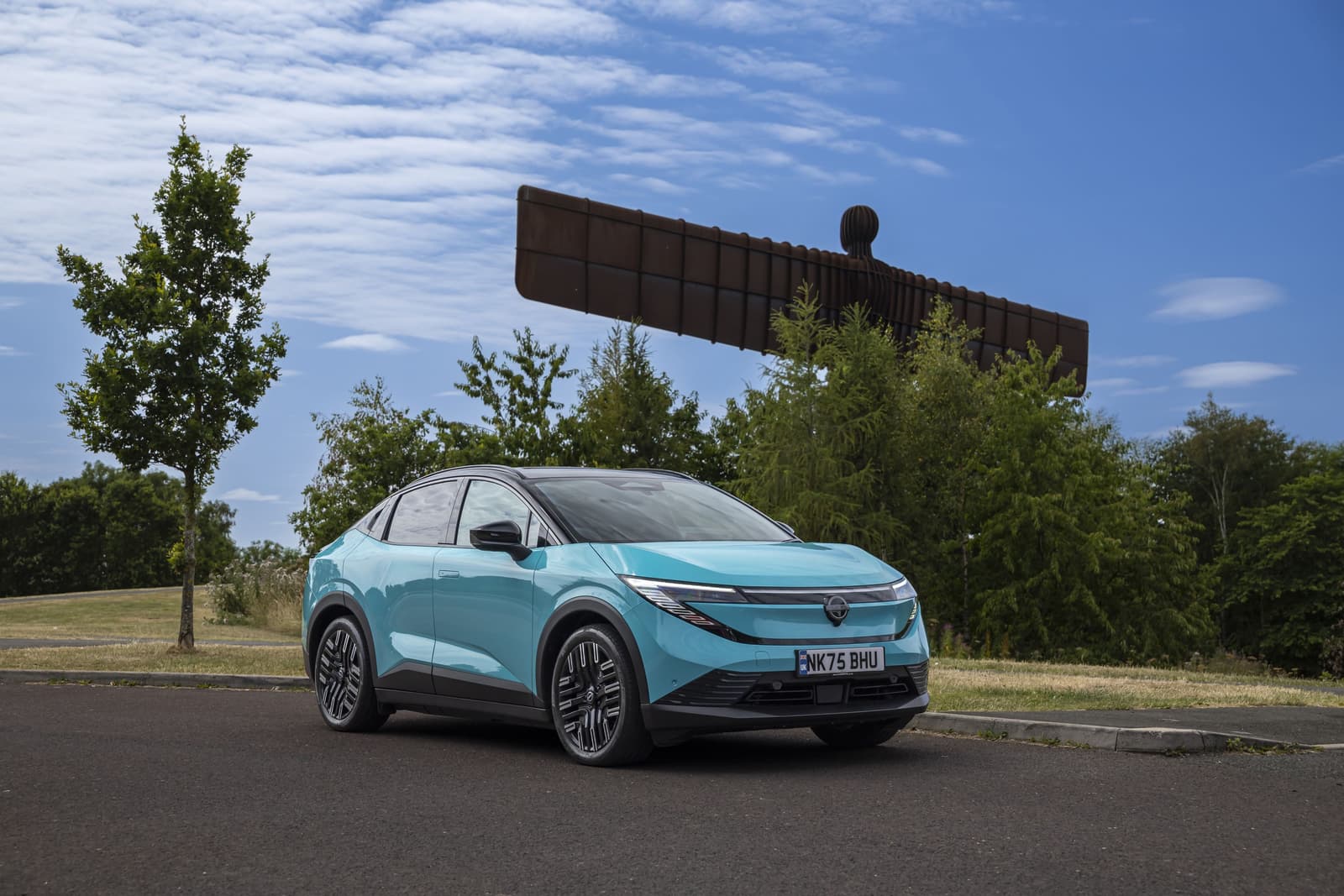
The third-generation Nissan LEAF is a front-wheel-drive battery-electric (BEV) five-seat crossover that replaces the old hatchback with a fastback profile, a full-width front light bar and a choice of two batteries, 52 kWh and 75 kWh usable. The motor is rated at 130 kW (177 PS, about 174 hp) with the small battery and 160 kW (218 PS, about 215 hp) with the large one, and Nissan UK quotes up to 280 miles (about 451 km) and up to 387 miles (about 623 km) on the UK WLTP cycle. It is built at Nissan's Sunderland plant in England, and the UK is the market whose official price data can be read in full today: Nissan UK lists the LEAF from GBP 28,849 (~$38,300) on the road after the GBP 3,750 Electric Car Grant, which is GBP 32,599 before the grant. The 75 kWh car costs GBP 32,249 to GBP 36,249 after the grant in four trims, the 52 kWh car is offered in two. The LEAF is also on sale in Germany, the United States, Japan and Canada, and its Israeli importer, Freesbe, has not announced the car.
Performance & Specs
A single electric motor drives the front wheels through a single-speed reduction gear. Nissan UK's specification tables give 160 kW (218 PS) and 355 Nm with the 75 kWh battery and 130 kW (177 PS) and 345 Nm with the 52 kWh battery. The PS figures are metric horsepower; converted to imperial horsepower they are about 215 hp and 174 hp, which are the numbers used in this article. Acceleration from 0 to 62 mph, which is roughly 0 to 100 km/h, takes 7.6 seconds with the 75 kWh car and 8.3 seconds with the 52 kWh car, and both are limited to 100 mph (160 km/h). Outlets such as electrive have printed 213 bhp for the large motor, but Nissan's own table gives 218 PS, so that is the figure used here.
The bigger battery adds roughly 90 kg. Nissan UK lists a kerb weight of 1,791 to 1,840 kg for the 52 kWh car and 1,883 to 1,946 kg for the 75 kWh car, with gross vehicle weights of 2,305 kg and 2,400 kg. Both are rated to tow 750 kg unbraked and braked with five passengers, and 975 kg braked with two passengers. WLTP combined consumption on the Engage grade is 4.60 miles per kWh for the 52 kWh car and 4.50 miles per kWh for the 75 kWh car, or about 13.5 and 13.8 kWh per 100 km. These consumption figures include charging losses, which is why they do not match a simple battery-size divided by range calculation. In practice the range falls with the richer trims, which sit on bigger wheels and carry more equipment: the 75 kWh car is rated at 387 miles in Engage, 374 in Engage+, 368 in Advance and 361 in Evolve, and the 52 kWh car at 280 miles in Engage and 268 in Advance.

| Powertrain | Single-motor FWD BEV |
|---|---|
| Power | 160 kW (218 PS / 215 hp) or 130 kW (177 PS / 174 hp) |
| Torque | 355 Nm or 345 Nm |
| 0–100 km/h | 7.6 s (75 kWh) / 8.3 s (52 kWh), 0-62 mph |
| Battery | 75 kWh or 52 kWh usable (NMC) |
| Range | Up to 387 miles / 280 miles WLTP (UK) |
| POWERTRAIN TYPE | Battery electric (BEV), single motor |
|---|---|
| HORSEPOWER | 160 kW (218 PS / 215 hp) with 75 kWh; 130 kW (177 PS / 174 hp) with 52 kWh |
| TORQUE | 355 Nm (75 kWh); 345 Nm (52 kWh) |
| ACCELERATION | 0-62 mph in 7.6 s (75 kWh); 8.3 s (52 kWh) |
| TOP SPEED | 100 mph (160 km/h) |
| DRIVETRAIN | FWD |
| BATTERY | 75 kWh or 52 kWh usable, NMC (Japan lists 78 and 55 kWh total energy) |
| WLTP RANGE (UK) | Up to 387 miles (75 kWh Engage); up to 280 miles (52 kWh Engage) |
| WLTP CONSUMPTION (UK) | 4.50 miles/kWh (75 kWh Engage); 4.60 miles/kWh (52 kWh Engage) |
Dimensions & Practicality

| Length | 4,350 mm |
|---|---|
| Width | 1,810 mm (2,098 mm with mirrors) |
| Height | 1,555 mm (with roof rails) |
| Wheelbase | 2,690 mm |
| Boot | 437 L / 1,052 L seats folded |
The LEAF is a compact crossover, 4,350 mm long on a 2,690 mm wheelbase, 1,555 mm high with roof rails and 2,098 mm wide with the mirrors. The body width of 1,810 mm without mirrors is taken from the US specification of 71.3 inches and from independent data, because Nissan UK prints only the mirror width. Nissan UK quotes a boot of up to 437 litres behind the rear seats and up to 1,052 litres to the roof with the 60:40 split rear bench folded, with a maximum load length of 1,585 mm and a width of 1,100 mm. The US figures are given in cubic feet, 20 with the second row up and 55.5 folded, and use a different measuring method, so they are not directly comparable. The turning circle is 11.2 metres wall to wall, and the US press kit lists a ground clearance of 5.3 inches, about 135 mm. The LEAF has five seats, and the car sits on 18-inch alloy wheels with 215/55 R18 tyres in Engage, with 19-inch wheels in Evolve.
| LENGTH | 4,350 mm |
|---|---|
| WIDTH | 1,810 mm (2,098 mm with mirrors) |
| HEIGHT | 1,555 mm (with roof rails) |
| WHEELBASE | 2,690 mm |
| CARGO VOLUME | 437 L (1,052 L seats folded), UK figures |
| SEATS | 5 |
| KERB WEIGHT (UK) | 1,791-1,840 kg (52 kWh); 1,883-1,946 kg (75 kWh) |
Charging & Battery
Both batteries use nickel manganese cobalt chemistry according to Nissan UK, and both connect to public chargers through a CCS socket. The 75 kWh pack accepts up to 150 kW on a DC charger and the 52 kWh pack up to 105 kW, but Nissan UK estimates 35 minutes for a 10 to 80 percent charge with either. An 11 kW onboard AC charger is standard in the UK: on a 7.4 kW home wallbox a 10 to 100 percent charge takes about 12 hours for the 75 kWh car and 9 hours for the 52 kWh car, and on an 11 kW three-phase supply about 7 hours and 6 hours. Independent EV Database data lists 52.9 kWh usable and 55.0 kWh nominal for the small pack, and Nissan Japan states 55 kWh and 78 kWh of total energy for the two batteries, so the 52 and 75 kWh figures are usable capacities.
Bidirectional charging is where the LEAF differs most from its rivals on paper. Nissan UK lists every trim as vehicle-to-grid (V2G) enabled, but the feature requires a compatible Nissan Home Charger that Nissan says is available later in 2026; independent reports from 2025 said Nissan developed the charger with the Belgian company Dreev. Every trim is also vehicle-to-load (V2L) compatible, which powers appliances from the car, and the V2L connector is included only on the top Evolve trim. Nissan UK does not list vehicle-to-home (V2H) for the new car, and neither does Nissan USA, which lists 1.5 kW V2L through an adapter on the J1772 port and no V2G. The previous-generation LEAF used a CHAdeMO socket for bidirectional charging, and the new car has switched to CCS in the UK and to NACS in the United States. Nissan USA quotes the same 35 minutes for 10 to 80 percent with the 150 kW charger, a 7.2 kW onboard charger and access to Tesla Superchargers through the built-in NACS port.
| BATTERY | 75 kWh or 52 kWh usable, NMC |
|---|---|
| AC CHARGING | 11 kW onboard (UK); 10-100% in about 7 h (75 kWh) or 6 h (52 kWh) at 11 kW |
| DC FAST CHARGING | Up to 150 kW (75 kWh); up to 105 kW (52 kWh); CCS |
| DC 10-80% TIME | About 35 min (Nissan UK estimate, both batteries) |
| V2L / V2G | V2L compatible on all trims (connector included on Evolve); V2G enabled, home charger later in 2026 |
Design & Interior
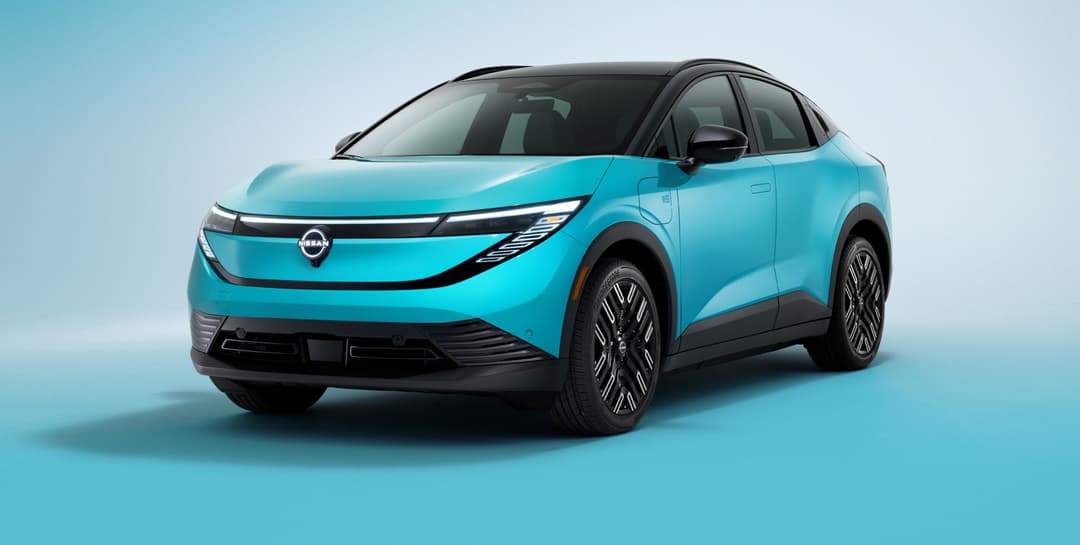
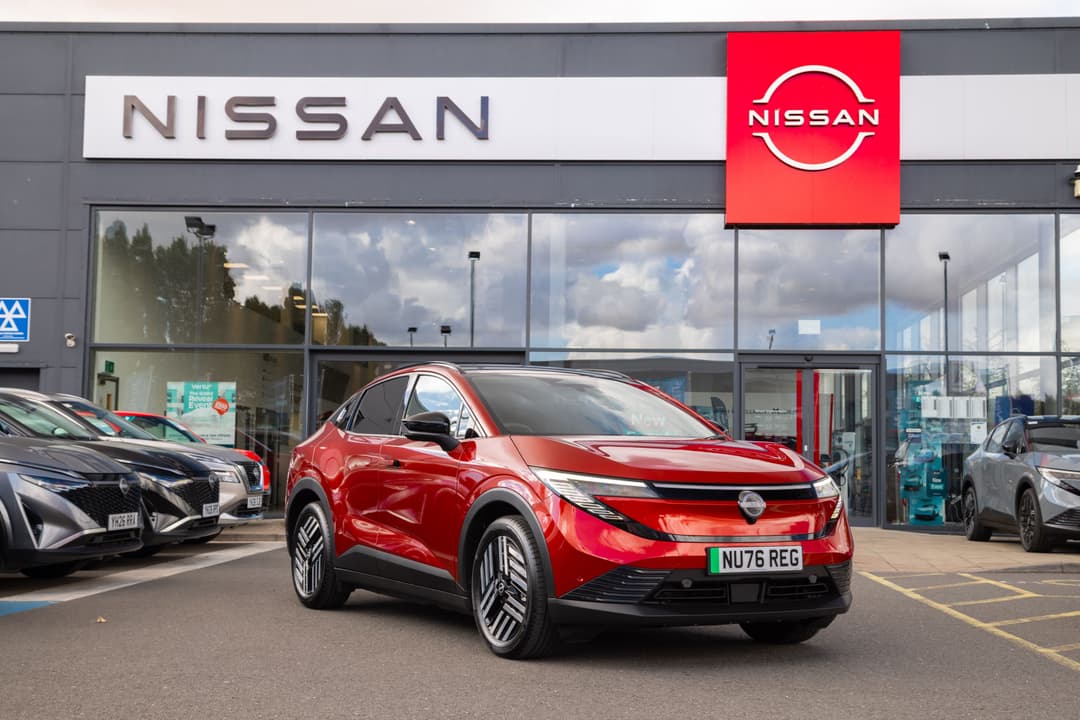
The LEAF has moved from a hatchback to a crossover with a sloping fastback roofline, flush door handles, black roof rails and an aerodynamic body. The front carries a full-length signature light bar with an illuminated Nissan logo, and the rear has 3D tail lamps with the LEAF script on the tailgate. Engage rides on 18-inch alloy wheels, Evolve on 19-inch wheels, and Advance and above add a dimming panoramic glass roof, rear privacy glass and an electric tailgate. The official press photos show the car in a bright aqua and in red, and the interior photos show a pale cabin with a wide curved display, a pale and blue-grey dashboard and Bose speakers built into the front headrests.
Inside, Engage has two 12.3-inch screens, and Engage+ and above have two 14.3-inch screens, one for the driver and one for infotainment, with Google built-in. Advance adds a head-up display and synthetic leather with fabric inserts, and Evolve has an eight-way powered driver seat with a massage function, synthetic leather upholstery and a nine-speaker Bose audio system. Heated front seats and a heated steering wheel are standard from Engage+, and they are available on Engage in a GBP 338 Cold Pack.
Technology & Features
The infotainment system runs Google built-in with Google Maps and a built-in route planner, Google Assistant and Google Play from Engage+ upwards, with wireless Apple CarPlay and Android Auto, and Nissan UK lists firmware-over-the-air update capability for the car. NissanConnect services add a route planner in the app, remote control services, battery management and vehicle health reports. A 15 W wireless phone charger, voice control that includes seat heating and a digital driver display are fitted to the higher trims, and, on trims from Advance up, a heat pump keeps cabin heating from draining the battery as quickly as a resistive heater. The e-Pedal Step system and steering-wheel paddles select regeneration levels, and the car has Normal, Eco, Sport and Custom drive modes.
Safety & ADAS
Every UK trim has Nissan's ProPILOT Assist with navigation link, which combines intelligent cruise control with stop and go, lane assist and distance control on motorways. Nissan's own wording is that the driver must keep eyes on the road and hands on the wheel, which makes it a Level 2 system. The standard list also includes front emergency braking with pedestrian, cyclist and junction recognition, rear automatic braking with rear cross-traffic alert, blind-spot warning and intervention, emergency lane keeping, a multi-collision brake, an intelligent driver alertness system, traffic sign recognition with speed adjustment and an Intelligent Around View Monitor with a 360-degree 3D camera. Nissan lists front, side, far-side and curtain airbags and two rear ISOFIX anchor points. No Euro NCAP result for the third-generation LEAF was available at the time of writing.
| ADAS LEVEL | Level 2 (ProPILOT Assist with Navi Link, eyes-on and hands-on, motorway) |
|---|---|
| ADAS FEATURES | Intelligent cruise control with stop and go, lane keep assist, emergency lane keep, front emergency braking with pedestrian and cyclist recognition, rear automatic braking, blind-spot intervention, traffic jam pilot, 360° 3D camera, traffic sign recognition |
Available Versions
| VERSION | POWER | TORQUE | 0-100 | TOP SPEED | DRIVETRAIN | BATTERY | EV RANGE | COMBINED RANGE | PRICE | KEY DIFFERENCES |
|---|---|---|---|---|---|---|---|---|---|---|
| LEAF Engage 52 kWh | 174 hp | 345 Nm | 8.3s | 160 km/h | FWD | 52 kWh | 451 km | — | GBP 28,849 (~$38,300) | 280 miles WLTP, 105 kW DC; £32,599 before the grant; 18-inch alloys, two 12.3-inch screens, ProPILOT Assist |
| LEAF Advance 52 kWh | 174 hp | 345 Nm | 8.3s | 160 km/h | FWD | 52 kWh | 431 km | — | GBP 30,849 (~$41,000) | 268 miles WLTP; £34,599 before the grant; 14.3-inch screens with Google, head-up display, panoramic roof, electric tailgate |
| LEAF Engage 75 kWh | 215 hp | 355 Nm | 7.6s | 160 km/h | FWD | 75 kWh | 623 km | — | GBP 32,249 (~$42,900) | 387 miles WLTP, 150 kW DC; £35,999 before the grant |
| LEAF Engage+ 75 kWh | 215 hp | 355 Nm | 7.6s | 160 km/h | FWD | 75 kWh | 602 km | — | GBP 33,149 (~$44,000) | 374 miles WLTP; £36,899 before the grant; 14.3-inch screens with Google, heated seats and wheel, wireless charger |
| LEAF Advance 75 kWh | 215 hp | 355 Nm | 7.6s | 160 km/h | FWD | 75 kWh | 592 km | — | GBP 34,249 (~$45,500) | 368 miles WLTP; £37,999 before the grant; head-up display, panoramic roof, electric tailgate |
| LEAF Evolve 75 kWh | 215 hp | 355 Nm | 7.6s | 160 km/h | FWD | 75 kWh | 581 km | — | GBP 36,249 (~$48,200) | 361 miles WLTP; £39,999 before the grant; 19-inch wheels, Bose audio, massage seat, V2L connector included |
Pricing & Availability
Nissan UK's price data, read on 19 October 2026, shows a total retail price including VAT and a government-grant line of GBP 3,750 that is deducted from every trim to give the on-the-road price, which Nissan says includes VAT, vehicle excise duty and the first registration fee. With the 52 kWh battery the LEAF costs GBP 28,849 (~$38,300) in Engage and GBP 30,849 in Advance after the grant, and GBP 32,599 and GBP 34,599 before it. With the 75 kWh battery it costs GBP 32,249 in Engage, GBP 33,149 in Engage+, GBP 34,249 in Advance and GBP 36,249 in Evolve after the grant, and GBP 36,899, GBP 37,999 and GBP 39,999 before it for the last three; the Engage retail price is GBP 35,999, confirmed by the Nissan UK newsroom release on the 75 kWh pricing. The 75 kWh car was priced in November 2025 and the 52 kWh car went on sale in July 2026, and right-hand-drive production started at Sunderland. The grant is a government scheme with its own eligibility rules, so buyers should confirm with a dealer. Nissan UK also launched a Service Activated Warranty programme for its electric cars in July 2026, advertised as up to six years.
Outside the UK, Nissan Germany's legal notes imply a recommended price of EUR 35,950 (~$40,000) for the 52 kWh Engage (130 kW, 13.5 kWh/100 km), and InsideEVs Germany lists the 75 kWh from EUR 41,200 (~$45,900). In the United States the 2026 LEAF has only the 75 kWh battery and costs USD 29,990 for the S+, USD 34,230 for the SV+ and USD 38,990 for the Platinum+ before a USD 1,575 destination charge, with Nissan estimating 303, 288 and 259 miles. In Japan the B5 with the 55 kWh battery costs JPY 4,389,000 to JPY 5,648,500 and the B7 with 78 kWh starts at JPY 5,188,700, and a Japan-only NISMO version is covered in a separate article. In Canada the 2027 LEAF starts at CAD 34,998 for a new 53 kWh S. In Israel, importer Freesbe has not announced the third-generation LEAF; Israeli outlet auto.co.il reported in June 2025 that the importer was considering it, and the previous-generation LEAF was withdrawn there in 2021.
How It Compares
On German list prices the LEAF sits in the middle of this group. The 52 kWh LEAF Engage at EUR 35,950 is EUR 240 below the Kia EV3, which starts at EUR 36,190 with 201 hp and 438 km WLTP, so the Nissan gives up 27 hp for almost the same range, as electrive.net reports a German rating of 440 km WLTP for the 52 kWh LEAF, 2 km more than the EV3 (438 km). The Hyundai Kona Electric starts at EUR 38,340 with 133 hp and 380 km WLTP in its 49 kWh version, which is EUR 2,390 more than the LEAF Engage for 41 hp less and a shorter rating on its own WLTP cycle. The Skoda Elroq 60, at EUR 37,890 with 140 kW (190 PS, about 188 hp) and up to 453 km, is EUR 1,940 more than the LEAF Engage for 14 hp more and about the same range. The LEAF's real differentiator against all three is bidirectional charging, with V2G enabled on every trim and V2L on all of them, plus 150 kW charging on the 75 kWh car. All prices and WLTP ranges in this comparison are German figures, taken from the German LEAF data (440 km for the 52 kWh and 622 km for the 75 kWh) and from our own articles on each rival, so the basis is like-for-like.
- Nissan UK lists the LEAF from GBP 28,849 (~$38,300) after the grant with 4.60 miles per kWh and up to 280 miles WLTP from 52 kWh, and a heat pump from Advance up
- 75 kWh version reaches up to 387 miles WLTP, accepts 150 kW DC and rates 215 hp with 0-62 mph in 7.6 s
- V2G enabled and V2L compatible on every UK trim, with ProPILOT Assist, a 360-degree camera and emergency braking with cyclist and junction recognition as standard
- Top Evolve costs GBP 36,249 after the grant (GBP 39,999 before) and its range drops to 361 miles from 387, while the 52 kWh car is limited to 105 kW on a DC charger
- The V2G home charger is only due later in 2026, there is no V2H, the boot is 437 L and Nissan UK's standard warranty page lists 3 years or 60,000 miles
The third-generation LEAF is a well-judged electric family crossover: it is efficient, built in Britain, priced from GBP 28,849 after the UK grant, and it carries V2G, V2L and a full set of driver aids on every trim, with a heat pump listed from Advance up. The compromises are charging speed that is competitive rather than class-leading, a 437-litre boot and a bidirectional-charging story that depends on a home charger not yet on sale. For most buyers the 75 kWh Engage or Engage+ at GBP 32,249 to GBP 33,149 is the sweet spot, while the 52 kWh Engage at GBP 28,849 suits city and commuter use. We would skip Evolve unless the Bose system and massage seat matter.