
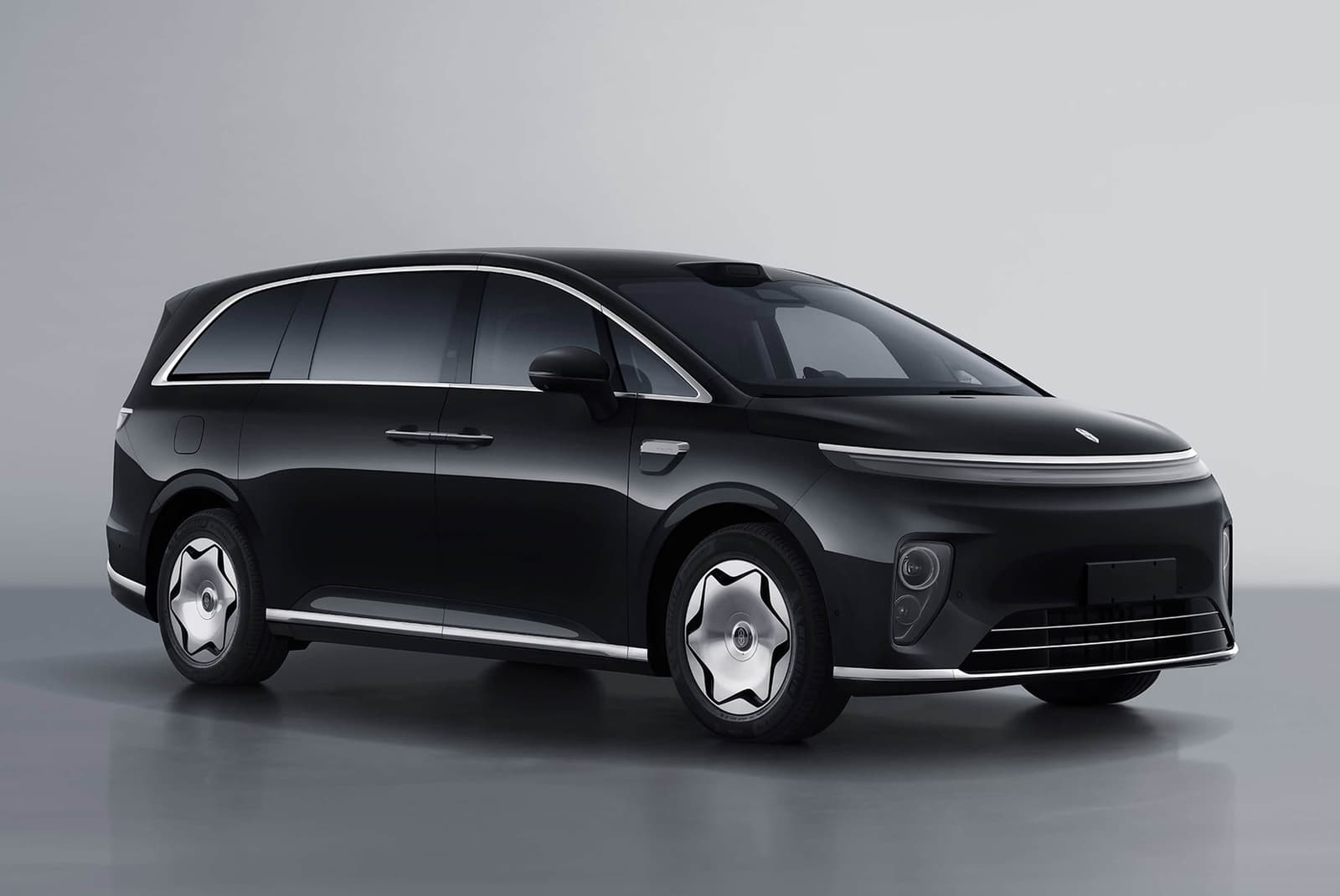
Stelato, the electric brand that Huawei and BAIC build together inside Huawei's HIMA alliance, has launched the V8, its first MPV, in China on November 20, 2026. Known locally as the Xiangjie V8, the seven-seater is sold in seven trims, starting at CNY 319,800 (~$47,972 at 6.6664 yuan per US dollar) for the cheapest extended-range trim, which is CNY 10,000 below the CNY 329,800 pre-sale price announced on September 28. The battery-electric versions start at CNY 349,800 (~$52,472), and the range tops out at CNY 429,800 (~$64,473). The V8 is 5,335 mm long, rides on an 800V platform and carries Huawei's ADS 5 driver-assistance system, backed by a four-LiDAR sensor suite on the four Ultra and Ultra+ trims. It comes as a 120 kWh battery-electric car rated at up to 830 km on the CLTC cycle, or as a range-extender model rated at 1,445 km combined on the CLTC cycle in rear-wheel-drive form, 1,365 km in all-wheel-drive form, and up to 1,465 km with the optional 75.4 kWh pack on the Ultra+. Trim-by-trim figures come from HIMA's official configuration sheet. It joins the S9 sedan, S9T wagon and G9 off-road SUV in the Stelato line-up and aims at the Denza D9, the XPeng X9 and the Luxeed V9. All prices here are launch prices for China; per CnEVPost, initial deliveries began in Beijing on November 20 and large-scale deliveries in 18 cities followed on November 21.
Performance & Specs
Stelato sells the V8 with two kinds of powertrain. According to HIMA's official configuration sheet, the rear-wheel-drive versions use a single 227 kW (309 PS / 304 hp) rear motor with 320 N·m of torque, and the all-wheel-drive versions add a 160 kW (218 PS / 215 hp) front motor with 208 N·m (277 N·m on the BEV Ultra+), for a combined 387 kW (526 PS / 519 hp). The extended-range versions pair those motors with a 1.5-litre turbocharged four-cylinder range extender and a 62-litre fuel tank; the 118 kW (160 PS / 158 hp) rating for the extender comes from the type-approval filing that China's Ministry of Industry and Information Technology published on July 10, not from the configuration sheet. The sheet lists 0 to 100 km/h in 8.4 seconds for the rear-wheel-drive trims (EREV Max, EREV Ultra, BEV Max and BEV Ultra), 5.9 seconds for the all-wheel-drive range-extender trims (EREV Max+ and EREV Ultra+) and 4.93 seconds for the BEV Ultra+, the only all-wheel-drive battery-electric trim, all from Stelato's own test body. Top speed is 215 km/h, or 203 km/h on the rear-wheel-drive range-extender trims. Official curb weights run from 2,760 kg (BEV Max and Ultra) to 2,925 kg (EREV Ultra+). Stelato also states a drag coefficient of 0.226 Cd, which the China Automotive Engineering Research Institute (CAERI) measured at 120 km/h on a BEV Ultra+ fitted with optional low-drag wheels, and a chassis with dual-valve continuously variable dampers, dual-chamber air springs on the all-wheel-drive trims and rear-wheel steering of up to 12 degrees, which gives a turning radius of 5.09 m on a 5.3-metre car.

| Powertrain | EREV, 1.5T range extender, 118 kW (160 PS / 158 hp) |
|---|---|
| Motors | 227 kW (309 PS / 304 hp) single-motor RWD, or 387 kW (526 PS / 519 hp) dual-motor AWD |
| Battery | 56 kWh LFP (75.4 kWh ternary optional on Ultra+) |
| EV range | 355 km (RWD) / 330 km (AWD) with 56 kWh; 430 km (AWD) with 75.4 kWh (CLTC) |
| Combined range | 1,445 km (RWD) / 1,365 km (AWD) with 56 kWh; 1,465 km (AWD) with 75.4 kWh (CLTC) |
| Top speed / curb weight | 203 km/h (RWD) / 215 km/h (AWD) / 2,810–2,925 kg |
| 0–100 km/h | 8.4 s (RWD) / 5.9 s (AWD) |
| POWERTRAIN TYPE | Extended-range (EREV, 1.5T, 118 kW) or battery electric (BEV) |
|---|---|
| HORSEPOWER | 227 kW (309 PS / 304 hp), 320 N·m single motor; 387 kW (526 PS / 519 hp) dual motor, 208 N·m front (277 N·m on BEV Ultra+) and 320 N·m rear |
| ACCELERATION | 0–100 km/h in 8.4 s (RWD trims), 5.9 s (AWD EREV trims), 4.93 s (BEV Ultra+), per Stelato's sheet |
| TOP SPEED | 215 km/h (203 km/h rear-wheel-drive range-extender trims) |
| CURB WEIGHT | 2,760–2,925 kg (official configuration sheet) |
| DRIVETRAIN | RWD or AWD |
| BATTERY | BEV 120 kWh (ternary); EREV 56 kWh (LFP), or optional 75.4 kWh (ternary, Ultra+ only) |
| ELECTRIC RANGE | BEV 830 km (RWD) / 775 km (AWD); EREV 355 km (RWD, 56 kWh), 330 km (AWD, 56 kWh), 430 km (AWD, 75.4 kWh) (CLTC) |
| COMBINED RANGE | EREV 1,445 km (RWD, 56 kWh), 1,365 km (AWD, 56 kWh), 1,465 km (AWD, 75.4 kWh) (CLTC) |
| DRAG COEFFICIENT | 0.226 Cd |
Dimensions & Practicality

| Length | 5,335 mm |
|---|---|
| Width | 2,005 mm |
| Height | 1,825 mm (RWD trims); 1,805 mm (AWD trims) |
| Wheelbase | 3,250 mm |
| Turning radius | 5.09 m |
The V8 is a big van: 5,335 mm long and 2,005 mm wide on a 3,250 mm wheelbase, and 1,825 mm tall on the rear-wheel-drive trims (EREV Max and Ultra, BEV Max and Ultra) or 1,805 mm on the all-wheel-drive trims with air springs (EREV Max+ and Ultra+, BEV Ultra+). Every version seats seven in a 2+2+3 layout, and Stelato says the third row is a proper seat rather than a small bench. The two front seats and the two second-row seats are zero-gravity seats, and the second-row seats can rotate electrically by 45, 90 or 180 degrees, which is standard on the Ultra+ trims, optional on the Ultra and not offered on the Max and Max+, where the right-hand second-row seat slides sideways instead. Stelato says the rotation and zero-gravity positions are for parked use only. Stelato claims a space-utilisation figure of 69.3 percent and a cabin space of 3,697 mm. The boot holds 674 L with all seven seats in use and grows to 1,552 L with the third row folded. Stelato says that is enough for ten 20-inch suitcases with a full load of passengers, or for an unfolded baby stroller. The side doors slide electrically.
| LENGTH | 5,335 mm |
|---|---|
| WIDTH | 2,005 mm |
| HEIGHT | 1,825 mm (RWD trims); 1,805 mm (AWD trims) |
| WHEELBASE | 3,250 mm |
| SEATS | 7 (2+2+3) |
| CARGO VOLUME | 674 L (1,552 L with third row folded) |
Charging & Battery
All versions use an 800V high-voltage architecture. The battery-electric cars carry a 120 kWh ternary lithium pack rated at 830 km CLTC in rear-wheel-drive form (BEV Max and Ultra) and 775 km in all-wheel-drive form (BEV Ultra+). The range-extender cars use a 56 kWh lithium iron phosphate pack rated at 355 km on battery alone and 1,445 km combined in rear-wheel-drive form (EREV Max and Ultra), and at 330 km and 1,365 km in all-wheel-drive form (EREV Max+ and Ultra+). On the Ultra+ only, a 75.4 kWh ternary pack is an option, rated at 430 km and 1,465 km. All of those are CLTC figures from HIMA's official configuration sheet. The sheet also lists CLTC electricity consumption of 16.1 kWh per 100 km for the rear-wheel-drive BEVs and 17.2 kWh per 100 km for the BEV Ultra+, and WLTC battery-only ranges of 275 km (rear-wheel drive, 56 kWh), 260 km (all-wheel drive, 56 kWh) and 339 km (75.4 kWh), with WLTC combined ranges of 1,260, 1,200 and 1,276 km. Stelato quotes fast-charging times of 15 minutes for 30 to 80 percent on the battery-electric cars and 15 minutes for 20 to 80 percent on both range-extender packs, measured on a 600 A / 1,000 V DC charger with a minimum cell temperature of 25 C. AC charging from 20 to 90 percent with a roughly 7 kW charger takes 14 hours for the battery-electric cars, 6.5 hours for the 56 kWh pack and 9 hours for the 75.4 kWh pack. CnEVPost and CarNewsChina additionally report that the battery-electric cars add 400 km of range in 15 minutes, a claim that does not appear in the configuration sheet and comes without a named test cycle. Stelato has not published a peak DC charging power.
| BATTERY (BEV) | 120 kWh |
|---|---|
| BATTERY (EREV) | 56 kWh (75.4 kWh optional on Ultra+) |
| ARCHITECTURE | 800V |
| DC FAST CHARGING | BEV 30–80% in 15 min; EREV 20–80% in 15 min (600 A / 1,000 V charger); peak power not published |
Design & Interior
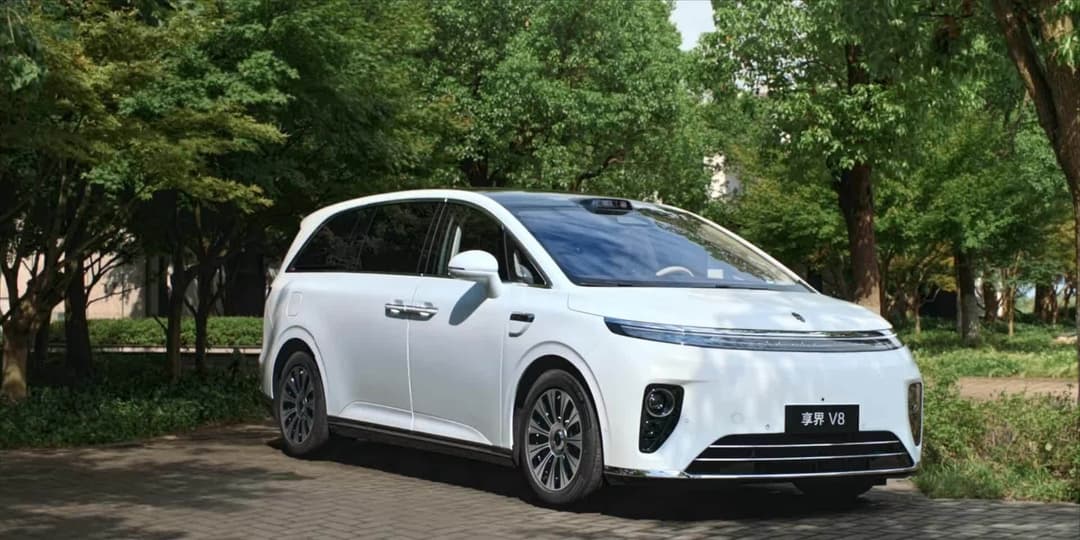
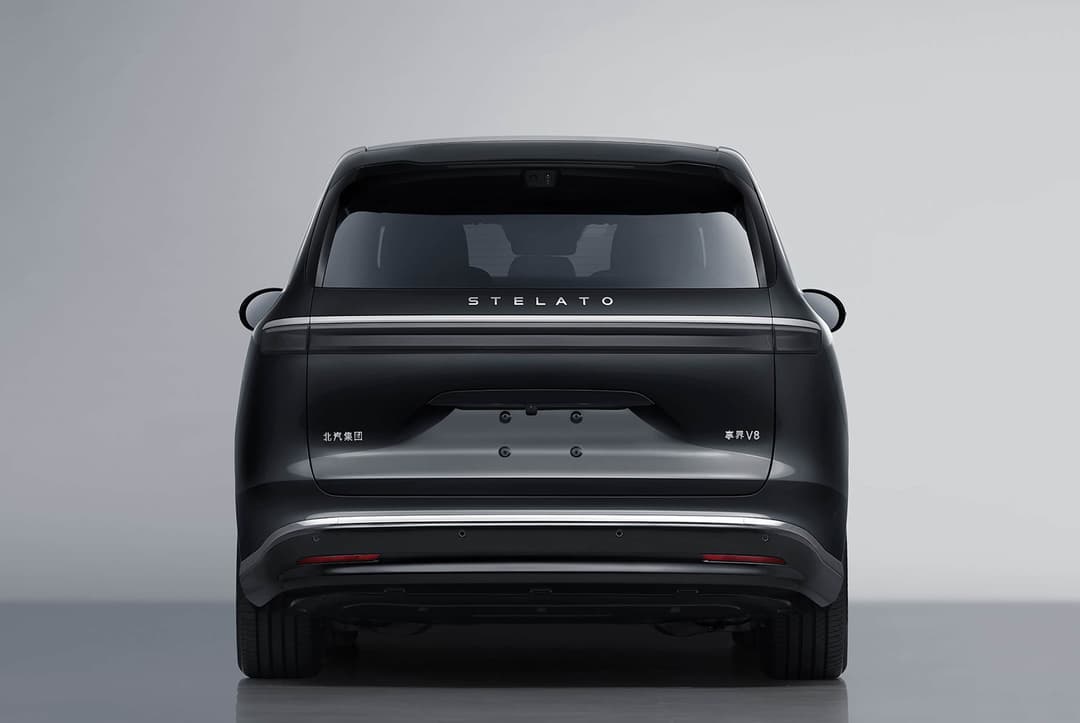
The V8 breaks with the boxy, chauffeur-car look of older MPVs. The front is closed off, with a continuous light bar running nearly two metres across the nose above a trapezoidal lower air intake, and the roofline is shaped for low drag. At the back, a full-width light strip carries the STELATO lettering. A LiDAR sits at the front edge of the roof, and the type-approval filing lists several wheel designs and red brake calipers as options. Inside, the cabin uses Huawei's family design language: a minimalist dashboard with almost no physical buttons, a three-spoke steering wheel with rollers and buttons, a wireless phone charging pad and built-in cup holders on the centre island. The rear cabin is where Stelato spends its effort. There is a 21.4-inch soft-light ceiling screen, switchable privacy glass, which the type-approval filing lists as an option on every version, and a Huawei audio system with 25 speakers.
Technology & Features
The cockpit runs Huawei's Harmony software and is built around a triple-screen layout that, according to Chinese reports of the launch, combines a 12.3-inch instrument cluster with a 17.2-inch central screen and a 17.2-inch passenger screen. The rear cabin adds the 21.4-inch ceiling display. Beyond the cabin, Stelato lists Huawei's Tuling chassis platform, Huawei's battery platform and the ADS 5 driver-assistance system as standard equipment on every trim. HIMA's official configuration sheet itemises the equipment differences between Max, Max+, Ultra and Ultra+; the main ones are the ADS 5 hardware (see below), air springs on the all-wheel-drive trims and second-row seat rotation.
Safety & ADAS
Huawei's ADS 5 comes in two hardware versions. The EREV Max, EREV Max+ and BEV Max carry ADS 5 Enhanced, a 33-sensor suite with one in-cabin LiDAR, three 4D millimetre-wave radars and 12 ultrasonic sensors. The EREV Ultra, EREV Ultra+, BEV Ultra and BEV Ultra+ carry ADS 5 Advanced: 38 sensors including four LiDARs (one 896-line unit mounted outside the cabin plus three solid-state units), five 4D millimetre-wave radars and 12 ultrasonic sensors, with full-vehicle redundancy. So the four-LiDAR headline applies only to the four Ultra and Ultra+ trims. Stelato says the car is designed on an L3-grade autonomous-driving architecture, but its own footnote states that ADS 5 is designed only for driver assistance, not autonomous driving, so the V8 is a Level 2-class car with Level 3-architecture hardware. CnEVPost reports that Level 3 intercity highway road testing at 120 km/h began on November 17, and some advanced functions, such as city navigation assist, are sold as separate software packages after purchase. Stelato also markets a Xuanwu body structure and a three-row, five-layer safety concept. The configuration sheet lists ten standard airbags (two front, two front-side, two second-row side, one front-centre, two side curtains and one third-row rear-windshield airbag), and zero-gravity cushion airbags come with the rotating second-row seats, which is how Stelato arrives at its figure of up to 12. It has not published crash-test results in the material we checked.
| ADAS LEVEL | L2-class driver assistance (Huawei ADS 5); hardware on an L3-grade architecture, per Stelato |
|---|---|
| ADAS FEATURES | Ultra and Ultra+: 4 LiDARs (one 896-line, three solid-state), 38 sensors; Max, Max+ and BEV Max: 1 in-cabin LiDAR, 33 sensors; rear-wheel steering, continuously variable dampers (air springs on AWD trims) |
Available Versions
| VERSION | POWER | TORQUE | 0-100 | TOP SPEED | DRIVETRAIN | BATTERY | EV RANGE | COMBINED RANGE | PRICE | KEY DIFFERENCES |
|---|---|---|---|---|---|---|---|---|---|---|
| EREV Max | 304 hp (227 kW) | 320 N·m | 8.4 s | 203 km/h | RWD | 56 kWh | 355 km | 1,445 km | CNY 319,800 (~$47,972) | Single rear motor; 1,825 mm tall, 2,810 kg; ADS 5 Enhanced (one in-cabin LiDAR) |
| EREV Max+ | 519 hp (387 kW) | 208 N·m front / 320 N·m rear | 5.9 s | 215 km/h | AWD | 56 kWh | 330 km | 1,365 km | CNY 349,800 (~$52,472) | 160 kW front + 227 kW rear; dual-chamber air springs; 1,805 mm tall, 2,895 kg; ADS 5 Enhanced |
| EREV Ultra | 304 hp (227 kW) | 320 N·m | 8.4 s | 203 km/h | RWD | 56 kWh | 355 km | 1,445 km | CNY 359,800 (~$53,972) | Single rear motor; 1,825 mm tall, 2,810 kg; ADS 5 Advanced (four LiDARs); second-row rotation optional |
| EREV Ultra+ | 519 hp (387 kW) | 208 N·m front / 320 N·m rear | 5.9 s | 215 km/h | AWD | 56 kWh (75.4 kWh optional) | 330 km (430 km with 75.4 kWh) | 1,365 km (1,465 km with 75.4 kWh) | CNY 399,800 (~$59,972) | Dual-chamber air springs; 1,805 mm tall, 2,925 kg as listed; ADS 5 Advanced (four LiDARs); second-row rotation standard; the 75.4 kWh ternary pack is an option whose price the sources do not give |
| BEV Max | 304 hp (227 kW) | 320 N·m | 8.4 s | 215 km/h | RWD | 120 kWh | 830 km | — | CNY 349,800 (~$52,472) | Single rear motor; 1,825 mm tall, 2,760 kg; ADS 5 Enhanced (one in-cabin LiDAR) |
| BEV Ultra | 304 hp (227 kW) | 320 N·m | 8.4 s | 215 km/h | RWD | 120 kWh | 830 km | — | CNY 389,800 (~$58,472) | Single rear motor; 1,825 mm tall, 2,760 kg; ADS 5 Advanced (four LiDARs); second-row rotation optional |
| BEV Ultra+ | 519 hp (387 kW) | 277 N·m front / 320 N·m rear | 4.93 s | 215 km/h | AWD | 120 kWh | 775 km | — | CNY 429,800 (~$64,473) | 160 kW front + 227 kW rear; dual-chamber air springs; 1,805 mm tall, 2,895 kg; ADS 5 Advanced (four LiDARs); second-row rotation standard |
Pricing & Availability
Stelato launched the V8 on November 20, 2026 with seven trims across four equipment levels, priced in China as follows. The extended-range versions cost CNY 319,800 (~$47,972) for the Max, CNY 349,800 (~$52,472) for the Max+, CNY 359,800 (~$53,972) for the Ultra and CNY 399,800 (~$59,972) for the Ultra+. The battery-electric versions are CNY 349,800 (~$52,472) for the Max, CNY 389,800 (~$58,472) for the Ultra and CNY 429,800 (~$64,473) for the Ultra+, so at the same equipment level the battery-electric car costs CNY 30,000 (~$4,500) more than the extended-range one. There is no battery-electric Max+. The starting price is CNY 10,000 (~$1,500) below the CNY 329,800 (~$49,472) pre-sale price announced on September 28. HIMA's official configuration sheet lists these as suggested retail prices, and CnEVPost and CarNewsChina report the same seven figures. The table above gives the drive layout, battery and range of each trim from that sheet. The optional 75.4 kWh pack is offered only on the EREV Ultra+, and the sources do not give its price. Separate from the list prices, CnEVPost reports that customers who order before January 4, 2027 are eligible for up to CNY 93,000 (~$13,951) in purchase perks; the coverage we checked does not itemise them, though the configuration sheet marks rear-wheel steering and the second-row zero-gravity seats as benefits given with the purchase. Initial deliveries began in Beijing on November 20, and large-scale deliveries started on November 21 across 18 cities in China, per CnEVPost. The V8 first surfaced in China's type-approval filings on July 10, made its show debut at the Chengdu auto show in August, and opened pre-sales on September 28, 2026, alongside the Luxeed RX. Huawei's Yu Chengdong said on Weibo on October 1 that pre-sale orders had passed 8,200 units in the first 72 hours. None of the launch coverage we checked mentions export plans, so availability outside China is unconfirmed.
How It Compares
The rival figures in the cards above come from our catalog, except the XPeng X9 price, which is recalculated from CNY 309,800 at 6.6664 yuan per US dollar because the catalog entry uses an older exchange rate. The Denza D9 and XPeng X9 are the cars that CnEVPost names as the V8's main competition. The V8's entry price of ~$47,972 is about $2,200 below the D9's $50,172, but about $1,500 above the X9 EREV's ~$46,472 (CNY 319,800 against CNY 309,800). Its combined range of up to 1,465 km (with the optional 75.4 kWh pack; 1,365 to 1,445 km on the 56 kWh pack) beats the D9's 1,040 km but falls short of the X9 EREV's 1,602 km. On power the V8's single-motor layout, at 304 hp, sits a shade under the D9's 308 hp but above the X9's 282 hp, while the dual-motor layout reaches 519 hp. On the battery-electric side, the ArcFox Wendao V9 is in the same price bracket as the V8's BEV versions (from ~$52,472) and makes 530 hp, but its 550 km range trails the V8's 775 to 830 km CLTC ratings by more than 200 km. These are catalog figures with different model years and test cycles, so treat the comparison as a guide to value rather than a like-for-like test.
- Competitive launch price: from CNY 319,800 (~$47,972) for a 5,335 mm seven-seater with an 800V platform and Huawei ADS 5
- Two powertrains to choose from, with up to 830 km CLTC on the battery-electric car and 1,365 to 1,465 km CLTC combined on the range-extender
- Family-first packaging: 674 L boot with all seven seats in use, second-row zero-gravity seats that rotate on the Ultra+ trims (optional on the Ultra) and 12-degree rear-wheel steering
- No peak charging power has been published, and the rear-wheel-drive trims take 8.4 seconds to reach 100 km/h against 5.9 seconds (EREV) or 4.93 seconds (BEV Ultra+) for the all-wheel-drive ones
- The headline 1,465 km needs the optional 75.4 kWh pack, which is offered only on the Ultra+; the standard 56 kWh pack is rated at 355 km on battery and 1,445 km combined (rear-wheel drive) or 330 km and 1,365 km (all-wheel drive)
The Stelato V8 is an ambitious family MPV that puts flagship-style hardware, from an 800V platform to a four-LiDAR sensor suite and rotating second-row seats on the higher trims, into a package that starts under $50,000 at its launch price. Buyers who need seven proper seats and a big boot will find the range-extender version especially compelling, while the 830 km battery-electric version suits those who can charge at home. The gaps are the unpublished peak charging power and the fact that the 1,465 km headline needs the optional 75.4 kWh pack on the Ultra+. With seven trims on sale and deliveries under way, the V8 is a serious contender in China's growing premium MPV segment.