
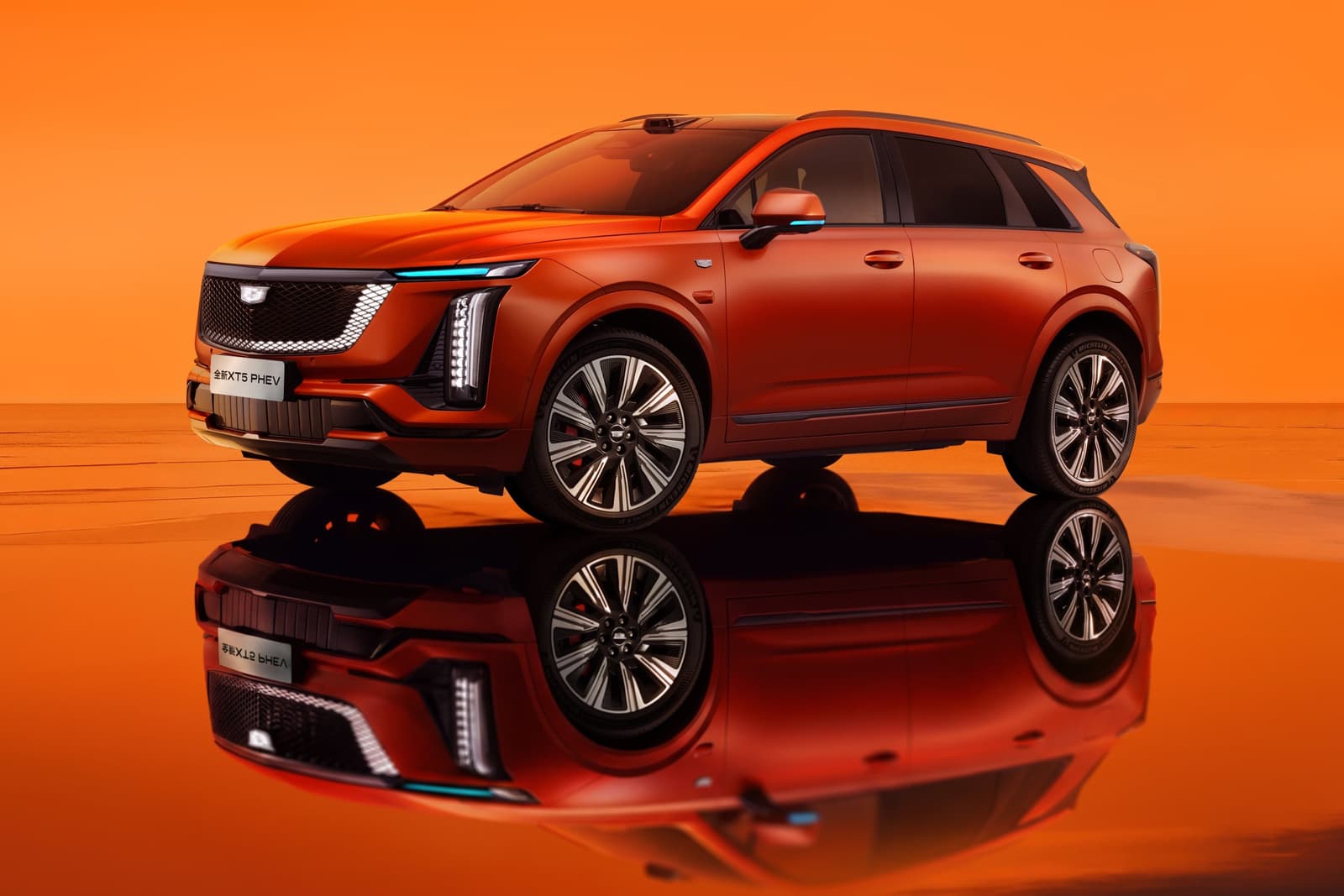
The 2027 Cadillac XT5 PHEV is a China-built, China-only plug-in hybrid (PHEV) mid-size SUV from SAIC-GM, and it is the first locally produced Cadillac built on the brand's locally developed electrical architecture. It pairs a 1.5-litre turbo petrol engine with a two-speed dedicated hybrid gearbox and two electric motors on a P1+P3+P4 layout, sends power to all four wheels, and carries a 35.5 kWh battery with 5C fast-charging capability. Cadillac China quotes 385 kW (523 PS, about 516 hp) and 740 Nm of system output, 215 km of pure-electric range on the CLTC cycle and 1,360 km of combined range with a full tank and a full battery. It debuted at the Chengdu Motor Show on 21 August 2026 with pre-orders, went on sale on 7 September 2026 in Pro and Pro Max trims, and gained a cheaper Air trim on 16 October 2026. The fixed all-in price starts at CNY 259,900 ($38,763 at 6.7048 CNY per USD) for the Air, against an official guide price of CNY 290,000 ($43,253).
Performance & Specs
Several early reports describe the car as "362 HP", and one outlet guessed that it is a range-extender (EREV). Neither fits the filings and the launch figures. The Chinese industry-ministry (MIIT) filing lists a 1.5-litre turbo engine rated 115 kW (about 154 hp, 156 PS), a front motor of 160 kW (about 215 hp) and a rear motor of 110 kW (about 148 hp). The two motors alone add up to 270 kW, which is the 362 hp figure. Cadillac's launch material gives the combined system maximum as 385 kW (about 516 hp) with 740 Nm of torque; the filed peaks of 115 + 160 + 110 kW add up to the same figure. Because a two-speed dedicated hybrid gearbox can connect the engine to the wheels, the car is a plug-in hybrid (PHEV) and not a range extender; Cadillac's filings and launch material call it a plug-in hybrid, and it markets the drivetrain as "Smart Hybrid AWD" (Zhihun Siqu in Chinese).
Cadillac claims 0 to 100 km/h in 4.8 seconds with a charged battery and 5.4 seconds with a depleted one, and no top speed has been published. The 35.5 kWh nickel-cobalt-manganese (NCM) battery is large for a plug-in hybrid and supports 5C charging, which Cadillac says takes the battery from 30 to 80 percent in about 15 minutes. Pure-electric range is 215 km on the CLTC cycle at launch; the MIIT filing listed 155 km, which some outlets label WLTC and others CLTC, so readers should treat 215 km (CLTC) as the marketing figure and 155 km as the more conservative filing figure. The 1,360 km combined range is Cadillac's full-tank-and-full-charge claim, and no test cycle is stated for the total. Fuel consumption is 6.05 L/100 km with the battery depleted, and Cadillac cites 0.61 L/100 km for a commute that starts on a full charge. Every trim shares the same drivetrain.

| Powertrain | PHEV, 1.5T + P1/P3/P4 motors, two-speed DHT, AWD |
|---|---|
| Power | 385 kW (523 PS / 516 hp) system |
| Torque | 740 Nm |
| 0–100 km/h | 4.8 s (charged) / 5.4 s (depleted) |
| Battery | 35.5 kWh NCM, 5C |
| Range | 215 km CLTC EV / 1,360 km combined |
| POWERTRAIN TYPE | Plug-in hybrid (PHEV), 1.5T petrol + three electric machines (P1+P3+P4), two-speed DHT |
|---|---|
| HORSEPOWER | 385 kW system (523 PS / 516 hp); motors only 270 kW (362 hp); engine 115 kW (154 hp) |
| TORQUE | 740 Nm system |
| ACCELERATION | 0-100 km/h in 4.8 s (charged); 5.4 s (depleted battery) |
| TOP SPEED | Not published |
| DRIVETRAIN | Electronic AWD |
| BATTERY | 35.5 kWh NCM, 5C (gross/net not stated) |
| ELECTRIC RANGE | 215 km CLTC (launch); 155 km in the MIIT filing |
| COMBINED RANGE | 1,360 km, full tank and full charge (Cadillac claim) |
| FUEL CONSUMPTION | 6.05 L/100 km depleted battery; 0.61 L/100 km with a full-charge start (Cadillac) |
Dimensions & Practicality

| Length | 4,888 mm |
|---|---|
| Width | 1,957 mm |
| Height | 1,688 mm |
| Wheelbase | 2,863 mm |
| Boot | 612 L / 1,548 L seats folded |
The XT5 PHEV is 4,888 mm long, 1,957 mm wide and 1,688 mm high on a 2,863 mm wheelbase, which makes it 6 mm lower than the petrol XT5 that Cadillac sells in China. The boot holds 612 litres with the rear seats up and 1,548 litres with them folded, according to the figures published at the Air launch. The MIIT filing gives a kerb weight of 2,170 to 2,200 kg depending on version. Pro and Pro Max sit on 21-inch wheels, the Air on 20-inch wheels with 235/55 R20 tyres. Ground clearance and fuel-tank size were not published in the material we could read.
| LENGTH | 4,888 mm |
|---|---|
| WIDTH | 1,957 mm |
| HEIGHT | 1,688 mm |
| WHEELBASE | 2,863 mm |
| CARGO VOLUME | 612 L (1,548 L seats folded) |
| KERB WEIGHT (MIIT) | 2,170-2,200 kg |
| WHEELS | 21-inch (Pro, Pro Max); 20-inch, 235/55 R20 (Air) |
Charging & Battery
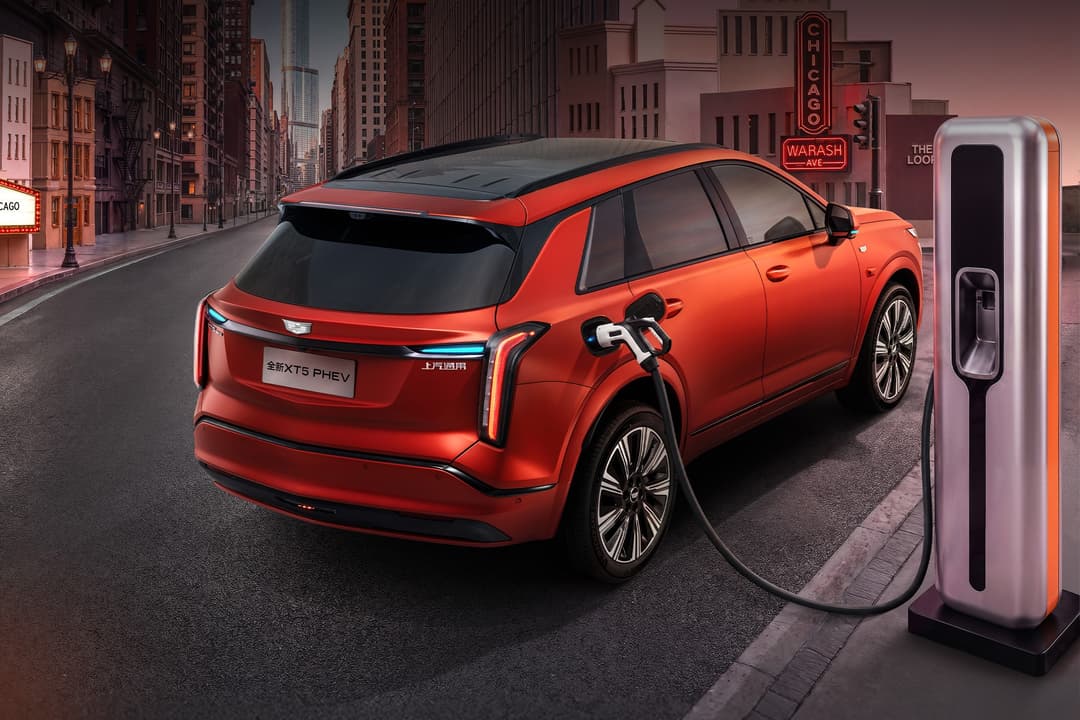
The 35.5 kWh battery is the headline of the plug-in system, because most Chinese and European PHEVs carry 15 to 25 kWh. Cadillac describes the platform as "5C-native": the battery can in principle accept a charging current of five times its capacity, and the official claim is 30 to 80 percent in about 15 minutes. The peak DC charging power in kW was not published in the sources we read, so the 15-minute figure is the number to rely on, and it is a manufacturer claim, not an independent test. The car can also power external loads at up to 6 kW (vehicle-to-load), which is useful for camping or for running tools.
The two range numbers need care. The 215 km CLTC figure announced at launch is the standard Chinese marketing number, and CLTC is generous compared with WLTP or EPA, so real-world electric range in mixed driving will be lower. Cadillac's 1,360 km combined figure adds the petrol range on top, and it is consistent with the charge-sustaining fuel use of 6.05 L/100 km, but no test cycle is stated for it. For a rough comparison of efficiency, 35.5 kWh over 215 km CLTC works out to about 16.5 kWh/100 km battery-to-wheel on the CLTC cycle, which is plausible for a 2.2-tonne SUV.
| BATTERY | 35.5 kWh NCM, 5C (gross/net not stated) |
|---|---|
| AC CHARGING | Not published |
| DC FAST CHARGING | 5C-capable; peak kW not published |
| DC 30-80% TIME | About 15 min (Cadillac claim) |
| EXTERNAL DISCHARGE | 6 kW (vehicle-to-load) |
Design & Interior
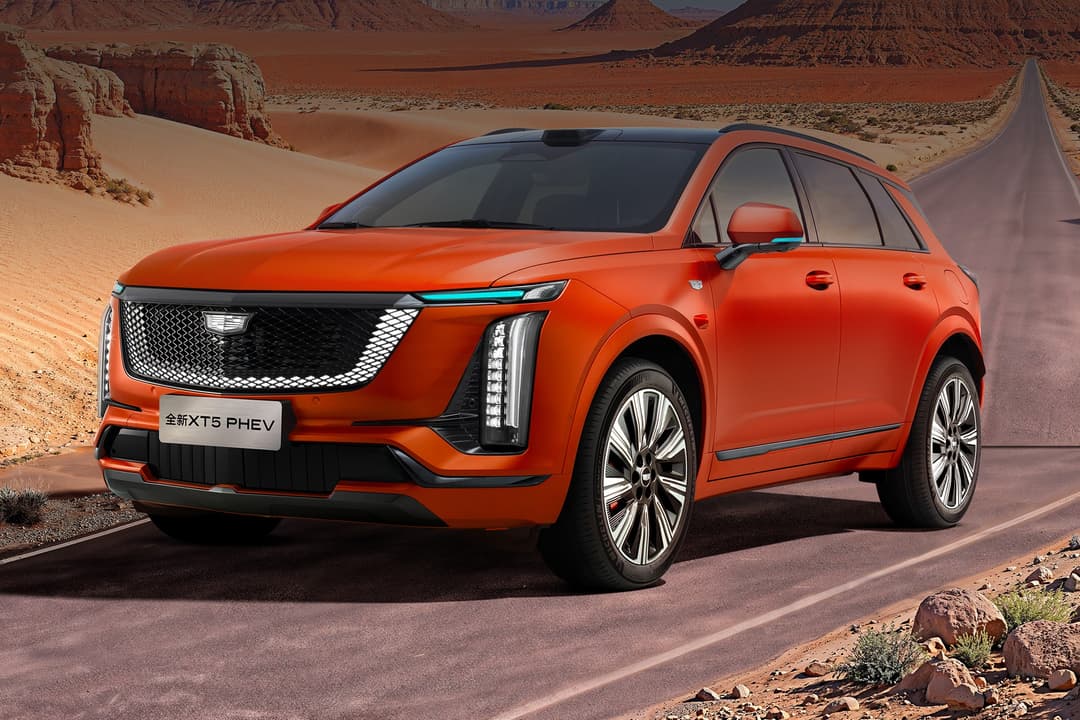
The exterior follows the Lyriq, Optiq and Vistiq design language, with a blacked-out shield grille that carries an illuminated badge, vertically split headlights with turquoise light elements, an active air-intake grille and traditional door handles. The rear has T-shaped lamps with a chrome strip, and the exhaust tips of the petrol XT5 are replaced by a hidden exhaust layout, so the PHEV has no visible tailpipes. The shark-fin antenna is gone, the lidar sits in a housing on the roof edge, and the door mirrors carry cameras for the driver-assistance system. Two new colours debuted with the car: Grand Canyon Orange, which is the colour in Cadillac's press photos, and Phantom Sand White.
Inside, the layout matches the standard XT5, with two new interior themes called Yellowstone Dawn and Screen Flow. The 33-inch 9K curved display spans the dashboard, and physical buttons and knobs remain on the centre console. Pro and Pro Max add an onboard hot and cold cooler box. The Air drops the cooler box and the cabin fragrance system.
Technology & Features
The infotainment runs on a Qualcomm Snapdragon 8775P on Pro and Pro Max and on a Snapdragon 8155 on the Air, and voice control uses ByteDance's Doubao large language model. Cadillac fits what it calls an electric Hummingbird chassis and an intelligent electronic all-wheel-drive system that distributes torque between the axles; only the Pro Max adds second-generation predictive electronic suspension and Brembo six-piston front calipers that Cadillac describes as Escalade-spec. Dual 50 W wireless phone chargers and a 66 W wired charger are listed for the cabin.
Safety & ADAS
The XT5 PHEV is the first production car to use Momenta's R7 world model, a driver-assistance system that Momenta and GM trained on more than 15 billion kilometres of driving data. On Pro and Pro Max it uses a roof-mounted lidar, cameras in the mirrors and other cameras, and Cadillac says it can handle highway and urban navigation assistance including city traffic, construction zones and cut-ins. It can squeeze through gaps with as little as 20 cm of clearance on one side, park in standard and narrow mechanical spaces and reverse along a recorded path of up to 150 m. This is a driver-supervised Level 2++ system, and the hardware is said to leave room for higher levels later. The Air removes the R7 system and the lidar and keeps a conventional sensor set of 5 cameras, 12 ultrasonic sensors and 3 millimetre-wave radars.
| ADAS LEVEL | L2++ (driver supervised) on Pro and Pro Max; conventional L2 hardware on Air |
|---|---|
| ADAS FEATURES | Momenta R7 highway and urban navigation assistance, roof LiDAR, narrow-gap passing, narrow-space parking, 150 m trail reversing (Pro, Pro Max); Air: 5 cameras, 12 ultrasonic sensors, 3 millimetre-wave radars |
Available Versions
| VERSION | POWER | TORQUE | 0-100 | DRIVETRAIN | BATTERY | EV RANGE | COMBINED RANGE | PRICE | KEY DIFFERENCES |
|---|---|---|---|---|---|---|---|---|---|
| Smart Hybrid AWD Air | 516 hp | 740 Nm | 4.8s | AWD | 35.5 kWh | 215 km | 1,360 km | CNY 290,000 ($43,253) guide; CNY 259,900 ($38,763) fixed | Added 16 October 2026; no Momenta R7 or lidar, 20-inch wheels, Snapdragon 8155, no cooler box |
| Smart Hybrid AWD Pro | 516 hp | 740 Nm | 4.8s | AWD | 35.5 kWh | 215 km | 1,360 km | CNY 310,000 ($46,236) guide; CNY 279,900 ($41,746) fixed | Momenta R7 with roof lidar, 21-inch wheels, Snapdragon 8775P, cooler box |
| Smart Hybrid AWD Pro Max | 516 hp | 740 Nm | 4.8s | AWD | 35.5 kWh | 215 km | 1,360 km | CNY 350,000 ($52,201) guide; CNY 299,900 ($44,729) fixed | Adds Brembo six-piston front calipers and second-generation predictive electronic suspension |
Pricing & Availability
Cadillac sells the XT5 PHEV in China with an official guide price and a lower fixed all-in price. The guide prices are CNY 290,000 ($43,253) for the Air, CNY 310,000 ($46,236) for the Pro and CNY 350,000 ($52,201) for the Pro Max, and the fixed launch prices are CNY 259,900 ($38,763), CNY 279,900 ($41,746) and CNY 299,900 ($44,729). On top of that, a limited-time "two-year anniversary" price takes CNY 20,000 off the fixed price (a CNY 10,000 anniversary subsidy plus a CNY 10,000 SAIC-brand owner replacement subsidy, subject to conditions), giving CNY 239,900 ($35,780), CNY 259,900 ($38,763) and CNY 279,900 ($41,746). Autohome's 16 October price table lists the offer and gives 31 October 2026 as the invoice deadline for the Air, so buyers should confirm the current price with a dealer. Dollar figures use the ECB rate of 6.7048 CNY per USD.
The timeline is short. A filing with MIIT appeared in May 2026, Cadillac showed the car and the Momenta R7 system in mid-August, the XT5 PHEV debuted at the Chengdu Motor Show on 21 August with pre-orders, and the official launch followed on 7 September 2026. Autohome reported, citing official data, that more than 3,000 cars were delivered in the first month. The car is built by SAIC-GM in Shanghai for the Chinese market only: Cadillac has not announced any export, an Australian outlet wrote that there is no current path to showrooms there, and a Middle East guide said no regional launch is planned. We found no announcement for Israel or Europe.
How It Compares
All four cars are China-market plug-in or range-extender SUVs priced from official CNY figures, and the rival figures come from our own articles on each car. The Li Auto L6 is an EREV with 402 hp and 1,250 km of total range from CNY 249,800 ($37,258), so the XT5 PHEV Air at a fixed CNY 259,900 costs CNY 10,100 (about $1,500) more for roughly 114 hp more and 110 km more total range, and it adds a Cadillac badge and a much larger battery. The Dongfeng M-Hero X700 is a 695 hp PHEV off-roader with a pre-sale price from CNY 249,800 ($37,258) for the base Max trim; its 1,300+ km total range belongs to the 360 km-EV Ultra at CNY 289,800, and pre-sale prices may change at launch. It is stronger than the Cadillac on paper, but it is a 5,035 mm boxy off-roader rather than a premium crossover. The Epicland X9 is an EREV with 402 hp in the Long Range trim from a promotional CNY 279,800 ($41,732) and 563 hp in the higher-priced Ultra+ trims, with up to 1,570 km of total range. It costs almost the same as the XT5 Pro (CNY 279,900), so the Cadillac's case rests on its brand, its 5C battery and the R7 driver-assistance package rather than on raw numbers.
- 516 hp (385 kW) and 740 Nm from a PHEV system with a claimed 0-100 km/h time of 4.8 s, and 1,360 km of combined range
- Large 35.5 kWh battery with 5C charging (30-80% in about 15 minutes by Cadillac's claim) and 215 km of CLTC electric range
- Momenta R7 driver assistance with roof lidar and a 33-inch 9K display, from a fixed CNY 279,900 ($41,746) on the Pro
- Costs more than comparable China-market PHEV and EREV SUVs such as the Li Auto L6 (CNY 249,800), and the cheapest Air trim has no R7 system or lidar
- Range and price figures are marketing numbers: the filing listed 155 km of electric range against 215 km CLTC at launch, and the anniversary prices are time-limited; the car is sold only in China
The 2027 Cadillac XT5 PHEV is a serious attempt to bring a premium badge into the Chinese plug-in hybrid market, with 516 hp, a 35.5 kWh 5C battery, 215 km of CLTC electric range, 1,360 km of total range and a driver-assistance system that rivals the best from local brands. It is a PHEV, not an EREV, and the 362 hp that circulates online is only the electric motors. The compromises are a price that sits CNY 10,000 above the Li Auto L6 and the M-Hero X700 pre-sale for similar range, the loss of lidar on the Air and a single-market launch. We would pick the Pro at CNY 279,900 ($41,746), because it is the cheapest trim with the R7 hardware that justifies the Cadillac premium.