

Jaguar has unveiled the production Type 01, a four-door electric grand tourer that marks the start of the brand's all-electric era. The car was shown at a world premiere in New York on 6 October 2026 and is the first production Jaguar built on the company's own Jaguar Electric Architecture (JEA). It uses three electric motors and an 850-volt system, and Jaguar quotes up to 1,030 PS, which is about 758 kW or 1,016 hp, together with 1,365 Nm of torque and a 0-100 km/h time of 3.2 seconds. The 118 kWh usable battery gives an anticipated EPA range of up to 400 miles (about 644 km) and a manufacturer-stated WLTP range of up to 720 km. Prices start at GBP 130,000 in the UK, orders open in early 2027 and the first client deliveries are expected in the second half of 2027.
Performance & Specs
The Type 01 is all-wheel drive with a tri-motor layout: one 260 kW motor (about 354 PS / 349 hp) at the front and two 310 kW motors (about 421 PS / 416 hp each) at the rear. The two rear motors share one compact housing, which Jaguar calls the rear electric drive unit, and Intelligent Torque Vectoring decides how much power goes to each wheel. The headline system figure is up to 1,030 PS, which Jaguar says equals 1,015 bhp; converted from PS (1 PS is about 0.9863 hp) it is roughly 1,016 hp, or about 758 kW. Jaguar does not say how the individual motor ratings add up to the system figure, so the 1,030 PS number is the one to quote. Peak torque is 1,365 Nm (about 1,007 lb-ft), split roughly 30:70 between the front and rear axles, and in Dynamic mode up to 87 percent of the power is sent to the rear axle.
Jaguar quotes 0-100 km/h (0-62 mph) in 3.2 seconds and 100-180 km/h (62-112 mph) in 4.0 seconds, the second figure being the one the company highlights as proof of "power in reserve". At a steady 100 km/h the car uses only about two percent of its available power. A top speed has not been announced; reports of 150 or 155 mph are not in Jaguar's release, and the only 155 figure in the press kit is the 155 km/h (96 mph) point above which the rear spoiler moves into its downforce mode. The motors use permanent magnets and silicon-carbide inverters that switch between 2 and 20 kHz, with peak efficiency of up to 95 percent. Jaguar says torque reaction at each wheel drops from 100 milliseconds to as little as one millisecond, using know-how from the Jaguar TCS Racing Formula E team. A patent-pending inverter deactivation feature can switch the car to front-axle operation when cruising, which Jaguar says adds up to 18 miles (29 km) of range.
The chassis uses double-wishbone front and integral-link rear suspension with Dynamic Air Suspension, switchable volume air springs and twin-valve active dampers. All-wheel steering turns the rear axle by up to six degrees, giving an 11.5 metre turning circle that Jaguar compares with a compact family car. Weight distribution is 50:50, the body is 73 percent aluminium and torsional rigidity is 51.7 kN/degree, which Jaguar calls its stiffest integrated body and battery structure. Custom Pirelli P Zero tyres in all-season, winter and summer compounds are quoted at up to 0.94 g of lateral grip. Kerb weight has not been published.

| Powertrain | Tri-motor AWD BEV (260 kW front, 2 x 310 kW rear) |
|---|---|
| Power | Up to 758 kW (1,030 PS / 1,016 hp) |
| Torque | Up to 1,365 Nm (30:70 front/rear) |
| 0–100 km/h | 3.2 s |
| Battery | 118 kWh usable, 850 V |
| Range | Up to 720 km WLTP; up to 400 mi EPA (anticipated) |
| POWERTRAIN TYPE | Tri-motor BEV (permanent-magnet motors), 850 V |
|---|---|
| HORSEPOWER | Up to 758 kW (1,030 PS / 1,016 hp); Jaguar quotes 1,015 bhp |
| TORQUE | Up to 1,365 Nm |
| ACCELERATION | 0-100 km/h in 3.2 s; 100-180 km/h in 4.0 s |
| TOP SPEED | Not announced |
| DRIVETRAIN | AWD with rear-biased torque vectoring |
| BATTERY | 118 kWh usable, 200 prismatic NMC cells |
| ELECTRIC RANGE | Up to 450 miles (720 km) WLTP, manufacturer figure; up to 400 miles EPA anticipated |
Dimensions & Practicality

| Length | 5,235 mm |
|---|---|
| Width | Not published |
| Height | 1,403 mm |
| Wheelbase | 3.2 m (Jaguar rounded figure) |
| Luggage | Over 450 L (1,000 L seats folded) |
The Type 01 is 5,235 mm long and 1,403 mm tall, with a wheelbase that Jaguar gives as 3.2 metres. It has a low roofline, a short front overhang, a long bonnet and an extended rear overhang. Standard wheels are 23 inches, with 21-inch wheels offered as an option, and Jaguar says the wheels are more than half of the car's height. The distance from the centre of the front axle to the front door, which Jaguar calls the luxury gap, is 898 mm, or 17 percent of the car's length, and the company says it is almost the same proportion as on the E-type. Jaguar has not published the car's width.
The cabin is divided by a central spine into four individual spaces, with brass-effect anodised aluminium finishers running the full length of the interior and across the tops of the doors. The front seats are 12-way electrically adjustable, heated and cooled with a hot-stone massage effect, and the split-folding 50:50 rear seats are heated and cooled as well. A panoramic glass roof with an adjustable virtual blind is standard. The powered tailgate opens to over 450 litres of load space, which grows to 1,000 litres with the rear seats folded, with extra storage under the floor and an emergency kit stowage under the bonnet.
| LENGTH | 5,235 mm |
|---|---|
| WIDTH | Not published |
| HEIGHT | 1,403 mm |
| WHEELBASE | 3.2 m (rounded figure from Jaguar) |
| CARGO VOLUME | Over 450 L (1,000 L seats folded) |
| FRUNK | No frunk stated; service stowage under the bonnet for the emergency kit |
| TURNING CIRCLE | 11.5 m wall to wall |
| WHEELS | 23-inch standard, 21-inch optional |
Charging & Battery
The battery is a 118 kWh usable pack made of 200 prismatic cells with Jaguar's own NMC chemistry, and Jaguar says 80 percent of the pack height is active energy, which is above the industry norm. The cell connectors sit on the sides of the cells rather than the top, and the underfloor pack is split to give rear passengers more legroom. Jaguar anticipates an EPA range of up to 400 miles (about 644 km) and quotes up to 450 miles (720 km) on the WLTP cycle; the WLTP number is a manufacturer figure, and Jaguar's release says full certification tests have yet to be completed. The company also says the car can cruise at a steady 120 km/h for up to 320 miles (about 515 km). The battery carries a warranty of eight years or 100,000 miles.
The 850-volt architecture supports 350 kW DC charging, which Jaguar says adds up to 200 miles (321 km) of range in as little as 13 minutes and takes the battery from 10 to 80 percent in around 22 minutes; Jaguar notes that charging times vary with battery age and condition, temperature, existing charge and the charger used. A split-charging function lets the car use 400-volt chargers at up to 250 kW. An onboard charger handles AC charging at up to 22 kW, and there are two AC ports, one on each side. In the United States the car is compatible with the North American Charging Standard and Tesla's Supercharger network, and the Jaguar App handles route planning, charger search and payment. Jaguar says that for 99.7 percent of journeys in its customer data, 320 miles of highway range would be enough to complete the trip without a stop. That figure comes from the company's own analysis of 920,000 JLR vehicles.
| BATTERY | 118 kWh usable, 850 V |
|---|---|
| AC CHARGING | Up to 22 kW, twin ports (one each side) |
| DC FAST CHARGING | Up to 350 kW (up to 250 kW at 400 V); NACS compatible in the US |
| DC 10-80% TIME | Around 22 min; up to 200 miles (321 km) in as little as 13 min |
| WLTP RANGE | Up to 450 miles / 720 km (manufacturer figure) |
| EPA RANGE | Up to 400 miles anticipated |
Design & Interior
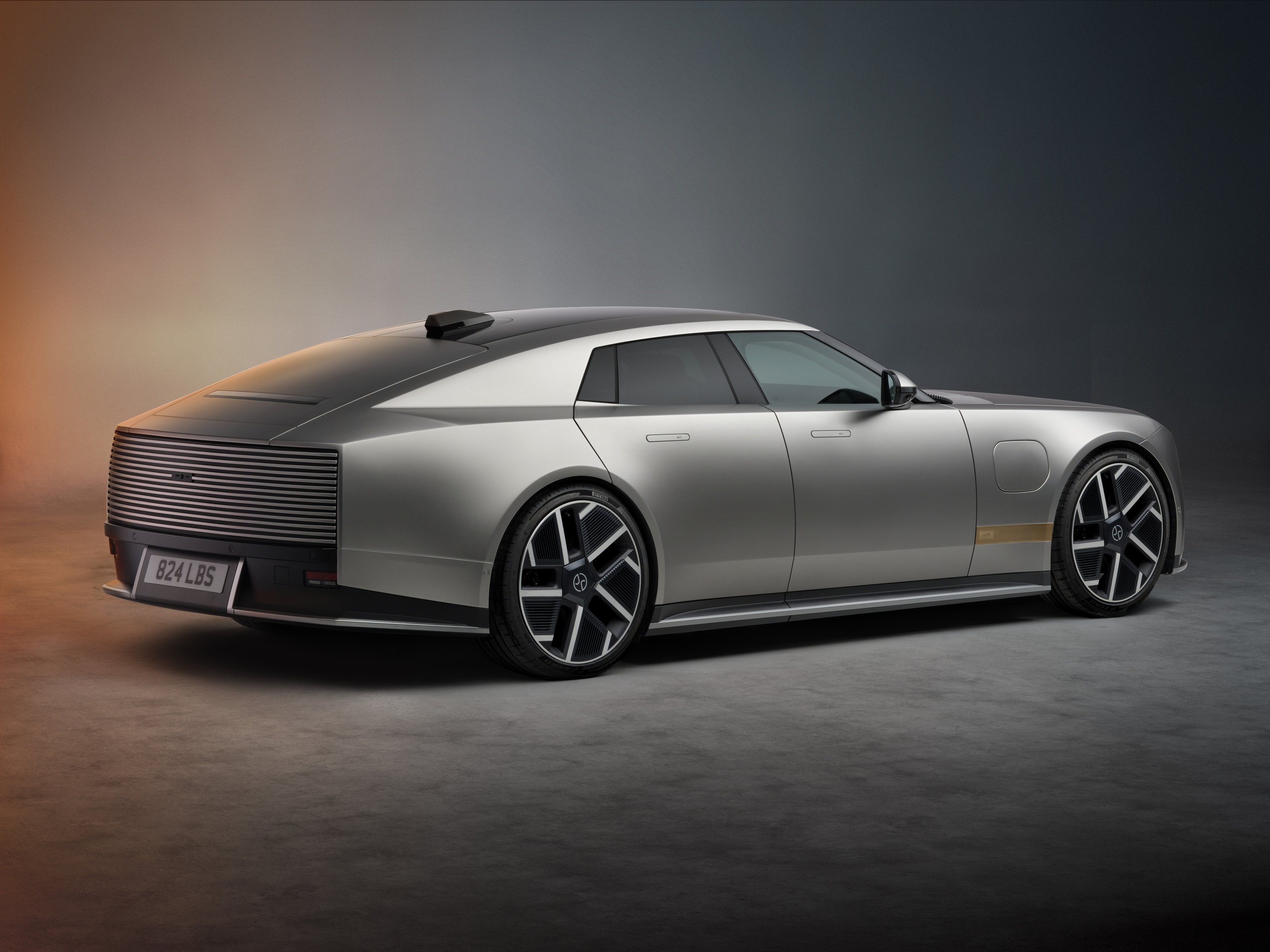
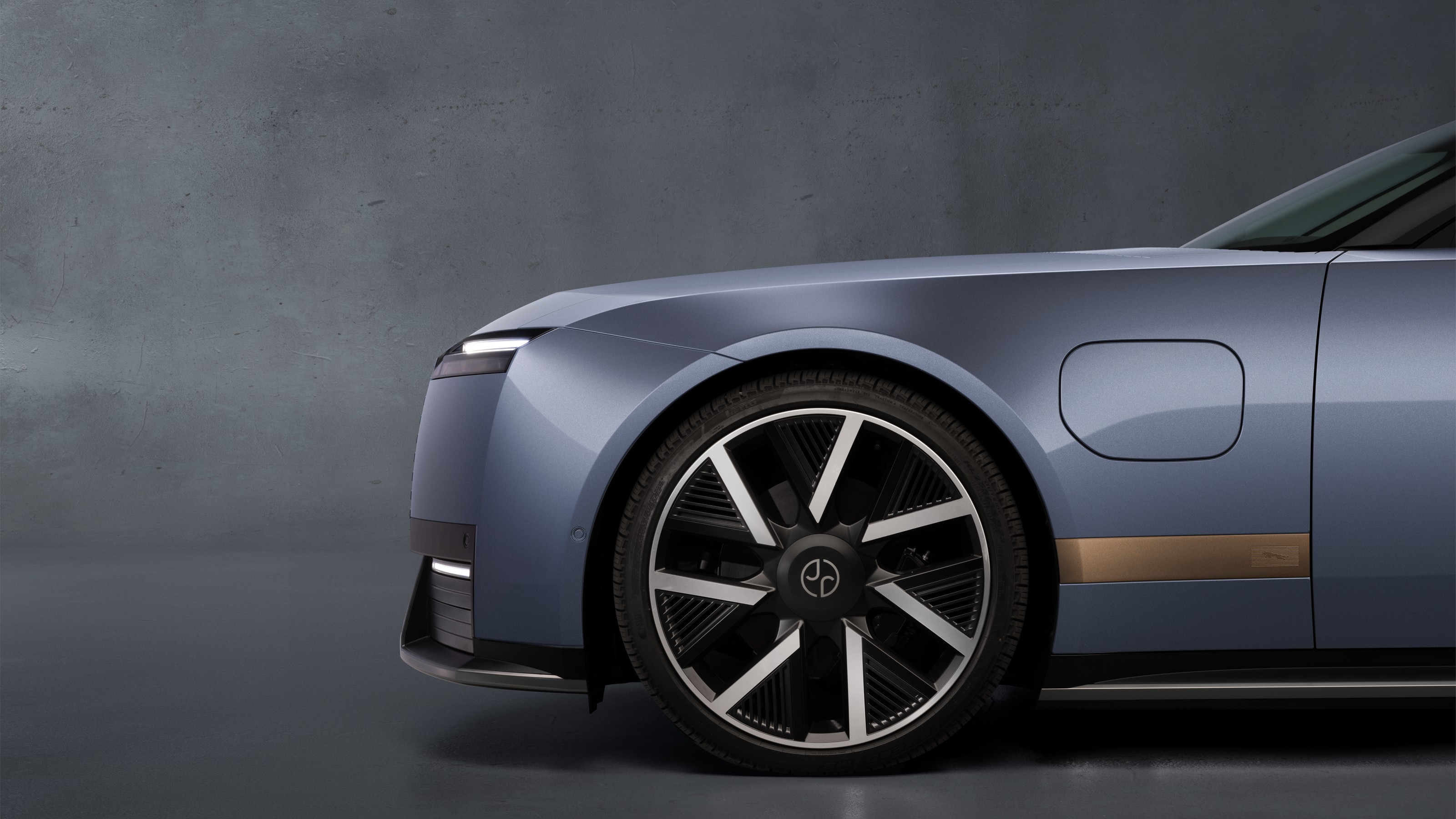
Jaguar says the Type 01 started from a single line on a blank sheet of paper, was refined in more than 7,000 wind-tunnel tests and reaches a drag coefficient of 0.23 Cd. The Impossible Panel, a three-metre aluminium bodyside, has five different planes meeting at one point and is pressed at Halewood in a six-stage process using 2,500 tons of pressure. The doors are frameless, the headlights are 84 mm high with 17,000 pixels each, and the rear lights are hidden until lit within horizontal strikethroughs. The tailgate is solid with no rear window, and the leaper badge appears on a brass-effect side finisher called the Fender Ingot. At the front, Active Vanes open and close to balance cooling and aerodynamics, and a three-stage spoiler deploys by seven degrees above 80 km/h and into a 21-degree aero-balance mode above 155 km/h, producing up to 75 kg of downforce.
Inside, the driver faces a duotone steering wheel and a 24-inch single-glass OLED display that stretches towards the centre of the car. A seven-inch smartphone-style screen between the front seats handles climate and audio, and a matching portrait screen sits in the rear centre console. Materials include Kvadrat Woolblend DuoWeave textile with leather or Ultrafabrics NeoGrain, and the palette is inspired by travertine stone. There are five gloss exterior colours, Visionary Silver, Dramatic White, Iconic Black, Compelling Blue and Refined Grey, plus two satin finishes, Modernist Blue and Mesmerising Copper. The launch Design Vision edition comes in Visionary Silver Satin with an Orchid White interior, and a Chromatic Moments collection in French Ultramarine and London Red is limited to 60 cars worldwide.
Technology & Features
The audio system, called the Jaguar Immersive Sound System and powered by Meridian, has 38 speakers. A 13-speaker Panoramic Soundbar runs across the base of the windscreen, 25 more speakers are hidden in the cabin, and Sensory Audio seats let the driver and front passenger feel the music through the seat. Jaguar says this removes the need for front door speakers. The ClearSight Rear View display sits in the soundbar in place of a conventional mirror, with a camera in the roof-mounted antenna pod, and works with a 3D Surround Camera. The infotainment runs on an NVIDIA-powered cockpit controller that Jaguar says is ten times faster than earlier generations. Wireless Apple CarPlay and Android Auto are standard, a 5G hotspot connects up to eight devices, and a voice assistant that understands multi-step requests supports 18 languages. Software updates arrive over the air.
Safety & ADAS
Jaguar's driver assistance suite uses 10 external cameras, five radars and 12 ultrasonic sensors, with an NVIDIA processor handling the data. The forward radar is hidden behind the device mark on the nose and heated for year-round performance. Jaguar has not published an SAE automation level for the system, and the car has not yet been crash-tested by Euro NCAP or NHTSA. The battery management software can isolate a single cell in as little as five milliseconds, the front structure is designed to absorb 26 tonnes of force, and in a side impact Jaguar says the battery pack absorbs 70 percent of the crash energy.
| ADAS LEVEL | Driver-supervised assistance (no SAE level stated by Jaguar) |
|---|---|
| ADAS FEATURES | 10 cameras, five radars, 12 ultrasonic sensors, 3D Surround Camera, ClearSight Rear View display, active road noise cancellation (full list not yet published) |
Available Versions
| VERSION | POWER | TORQUE | 0-100 | TOP SPEED | DRIVETRAIN | BATTERY | EV RANGE | COMBINED RANGE | PRICE | KEY DIFFERENCES |
|---|---|---|---|---|---|---|---|---|---|---|
| Type 01 | 1,016 hp | 1,365 Nm | 3.2s | — | AWD | 118 kWh | 720 km | — | From GBP 130,000 | Up to 1,030 PS; WLTP is a manufacturer figure, EPA up to 400 mi anticipated; the only version announced |
| Type 01 Design Vision | 1,016 hp | 1,365 Nm | 3.2s | — | AWD | 118 kWh | 720 km | — | Not announced | Launch edition: Visionary Silver Satin, Orchid White interior, 23-inch diamond-turned wheels; same powertrain |
Pricing & Availability
Jaguar says prices for the Type 01 start from GBP 130,000, a figure it published in the world-premiere release on 7 October 2026. Jaguar does not say in that release whether the price includes VAT, which trim it applies to, or what the Design Vision and Chromatic Moments editions cost, and it has not announced a US, European or other price. Orders open in early 2027 and first client deliveries are expected in the second half of 2027. The car is designed, engineered and built in the UK, and Jaguar says the Impossible Panel is pressed at Halewood; the release does not name the final assembly plant.
The North American market is a priority for the brand and the Type 01 premiere was held in New York, and the car's NACS charging compatibility is confirmed for the US, but Jaguar has not published US pricing or a US on-sale date. Jaguar Land Rover vehicles are imported to Israel by Hamizrach (Mizrach Group), and no Israeli launch, price or timing for the Type 01 has been announced as of October 2026.
How It Compares
The closest electric four-door rivals are German, and all three cost more than the Type 01 at list price. The Porsche Taycan Turbo GT makes 1,019 hp (760 kW, 1,034 PS) with Launch Control, which is within a few horsepower of Jaguar's figure, but it lists at GBP 189,200 in the UK against Jaguar's GBP 130,000 starting price and is rated at up to 559 km WLTP against Jaguar's 720 km. The Audi RS e-tron GT performance is rated at 912 hp with Launch Control and up to 592 km, and its UK on-the-road price is GBP 166,475. The Mercedes-AMG GT 63 4-Door is the most powerful of the group at 860 kW (1,169 PS / 1,153 hp), costs EUR 196,350 in Germany and has a 106 kWh battery with a quoted WLTP window of 596 to 700 km for the line-up.
These comparisons need care. Jaguar's GBP 130,000 is a starting price for a car that has not yet been priced by trim, while the rivals' prices are for the most powerful versions on sale; Jaguar has not said whether its 1,030 PS is a normal or boost figure; and Jaguar's WLTP figure comes before full certification, while the Porsche and Audi numbers are rated figures. The Mercedes price is German (incl. VAT) and for the 2026 model year, while the Porsche and Audi prices are British, and the Jaguar also lacks a published top speed and kerb weight. On paper, though, it undercuts all three on price while offering a higher range figure than each of them.
- Up to 1,030 PS (758 kW, about 1,016 hp) and 1,365 Nm from three motors, with 3.2 s to 100 km/h
- 118 kWh usable battery with up to 720 km WLTP (manufacturer figure) and 350 kW charging that adds 200 miles (321 km) in as little as 13 minutes
- Cd 0.23, 50:50 weight distribution, all-wheel steering with an 11.5 m turning circle and a 38-speaker Meridian system
- No rear window: the tailgate is solid, so rear visibility depends on the ClearSight camera display in the dashboard
- Key figures are still missing: top speed, kerb weight, width, final range certification and every price except the UK starting price, with deliveries not due until the second half of 2027
The Type 01 is a serious attempt at a luxury electric GT: three motors and up to 1,016 hp, a 118 kWh battery, 350 kW charging and a drag coefficient of 0.23 are all competitive with the German four-door electric cars, and the UK starting price of GBP 130,000 sits well below them. The design is unusual, with a glassless tailgate and a camera mirror, and some key numbers such as top speed, weight and final WLTP certification are still to come. Buyers outside the UK also have no price yet. It is a promising, distinctive proposition on paper that now has to be proven on the road.