
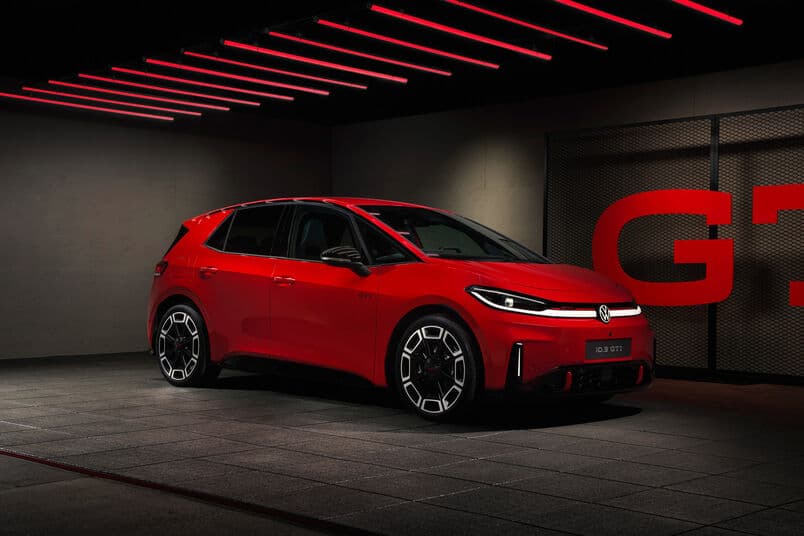
The GTI badge turns 50 this year, and Volkswagen just gave it the most powerful car it has ever worn -- and for the first time, an electric one. The new ID.3 GTI, revealed September 16, 2026, sends 326 hp to the rear wheels alone, making it not just the quickest series-production GTI in history but also the first one driven exclusively by its back axle. It's a genuinely significant reveal for the badge, even if full pricing and the final production spec are still a few months out.
50 Years of GTI, Reinvented as Rear-Wheel Drive
Volkswagen picked a loaded moment to reveal this car -- 2026 marks the 50th anniversary of the original Golf GTI, and the brand spent the earlier part of the year celebrating with an anniversary Golf GTI before pulling back the curtain on an electric one. The ID.3 GTI is based on the recently updated ID.3 Neo and replaces the outgoing ID.3 GTX as the range's sporting flagship, but it's a meaningfully different car in character: where the GTX sent power to all four wheels, the GTI's 240 kW (326 PS) motor drives the rear axle exclusively -- a genuine first for a production GTI, gasoline or electric. Volkswagen frames this as a deliberate return to the nameplate's driver-focused roots rather than a spec-sheet arms race, even as the car quietly becomes the most powerful GTI ever built in series production.
Tech Highlights
- 326 hp (240 kW) to the rear wheels only -- the first rear-wheel-drive GTI in the nameplate's 50-year history, with 545 Nm of torque and a 5.6-second 0-100 km/h with standard Launch Control.
- 79 kWh net battery for up to 601 km of range, with 183 kW DC fast charging taking the pack from 10-80% in roughly 29 minutes.
- Dedicated GTI drive mode -- a steering-wheel button sharpens the adaptive DCC suspension and throttle response, activates Launch Control, switches the ambient lighting and digital cockpit to red, and pipes in a synthesized engine soundtrack reminiscent of the combustion GTIs it succeeds.
- Vehicle-to-load via an optional PowerSocket adapter -- lets the GTI power external devices or top up e-bikes carried on an optional rear bicycle rack, a distinctly un-hot-hatch-like party trick for a car built around straight-line pace.
Design and Dimensions
Riding on the same ID.3 Neo bodyshell, the GTI measures roughly 4,265 mm long, 1,809 mm wide (2,070 mm including mirrors), and 1,561 mm tall on a 2,766 mm wheelbase -- squarely in compact-hatchback territory, close to a Golf in footprint. The GTI insignia are unmistakable: a red horizontal stripe across the nose (a direct callback to the 1976 original's red grille frame), new 20-inch "Wörthersee" wheels named for the annual Austrian GTI meet, and gloss-black mirror caps and side skirts. Volkswagen deliberately dropped the previous GTX's black-roof treatment -- the GTI's roof, spoiler, and tailgate are now finished in body colour, which the brand says gives the car a longer, sleeker silhouette and more road presence than its predecessor. Five colours are offered at launch, all drawn from GTI history: Tornado Red (the nameplate's signature shade, dating to the facelifted first-generation Golf GTI), Moonstone Grey, Scale Silver metallic, Grenadilla Black metallic, and Glacier White metallic.

| Layout | Single motor, rear axle |
| Drive | Rear-wheel drive |
| Power | 240 kW (326 hp) |
| Torque | 545 Nm |

| Length | 4,265 mm (167.9 in) |
| Width (w/ mirrors) | 2,070 mm (81.5 in) |
| Height | 1,561 mm (61.5 in) |
| Wheelbase | 2,766 mm (108.9 in) |
Performance and Specs
The headline figures put the ID.3 GTI in genuinely quick company: 326 hp and 545 Nm from a single rear-mounted motor, a 5.6-second sprint to 100 km/h with Launch Control engaged, and a top speed electronically capped at 200 km/h. Volkswagen credits the low centre of gravity and permanently available maximum torque -- rather than outright power -- as the real character of the drive, paired with a standard adaptive DCC sports chassis and direct progressive steering rather than passive suspension. The 79 kWh net battery is shared with other ID.3 Neo variants, and DC charging tops out at 183 kW, good for a 10-80% top-up in about 29 minutes -- respectable, if not class-leading, for a 2027-model-year EV. Range is rated at up to 601 km, though as with any hot hatch, actual real-world figures will depend heavily on how often GTI mode gets used.
| Spec | ID.3 GTI |
|---|---|
| Power | 240 kW (326 hp) |
| Torque | 545 Nm |
| Battery | 79 kWh (net) |
| Range (est.) | Up to 601 km |
| 0-100 km/h | 5.6 sec |
| Top Speed | 200 km/h (electronically limited) |
| DC Fast Charging | Up to 183 kW (10-80% in ~29 min) |
| Drive | Rear-wheel drive |
Interior and Technology
Inside, the GTI carries over the ID.3 Neo's redesigned cabin -- a larger digital instrument cluster and a 12.9-inch Innovision infotainment touchscreen sit on one visual axis, with a new physical button strip for climate controls and a rotary volume/track-skip dial restored to the centre console after years of touch-only criticism on earlier ID models. The GTI-specific touches lean hard into nostalgia: premium sport seats reinterpret the original 1976 Golf GTI's tartan check pattern, red topstitching runs throughout, and a red 12 o'clock marker sits on the multifunction steering wheel alongside a dedicated GTI-mode button. Pressing it sharpens every dynamic parameter, switches the ambient lighting and instrument graphics to red, and -- most divisively -- pipes a synthesized combustion-engine soundtrack through the speakers, VW's attempt at preserving some emotional connection to the nameplate's non-electric history. Optional equipment carried over from the ID.3 Neo includes a panoramic sunroof, massage and memory function for the front seats, a 480-watt Harman Kardon sound system, an augmented-reality head-up display, and a removable bicycle-carrier mount rated for 75 kg.
Pricing and Availability
Volkswagen has not yet published pricing for the ID.3 GTI -- this is what the brand itself describes as a "near-production concept vehicle," with pre-sales opening at the beginning of 2027 and market launch following shortly after. For context, the outgoing ID.3 GTX Performance -- which matched the GTI's 240 kW output but sent power to all four wheels -- started at €52,295 (roughly $56,500) in Germany, giving a rough sense of where the rear-wheel-drive GTI is likely to land once official pricing lands, though Volkswagen could position it either above or below that figure depending on how the brand wants to differentiate it from the GTX it replaces. As of this writing, Volkswagen has not confirmed which global markets will receive the ID.3 GTI or whether it will be sold in the US, where the standard ID.3 has not historically been offered.
How It Compares
CUPRA Born
$54,751 | 322 hp | 599 km range
The GTI's closest relative in every sense -- same VW Group MEB platform, near-identical power and range figures, and the same electric hot-hatch mission, just with Spanish styling and branding instead of German GTI heritage.
MG4 EV
$17,088 | 203 hp | 450 km range
Far less powerful and not a direct rival to the GTI specifically, but a useful reminder of how much a budget-focused electric hatchback undercuts a heritage-badged performance EV on raw price -- even before the GTI's pricing is even confirmed.
Pros and Cons
Pros
- 326 hp and rear-wheel drive make this the most powerful and most driver-focused GTI ever built, electric or otherwise
- Standard adaptive DCC chassis, progressive steering, and Launch Control rather than optional extras bolted onto a mainstream ID.3
- 601 km of estimated range and 183 kW charging bring genuine everyday usability to a performance-focused EV
- Vehicle-to-load PowerSocket and a proper bicycle-carrier mount keep the GTI's traditional everyday-practicality DNA intact
Cons
- No pricing announced yet -- Volkswagen itself still calls this a "near-production concept," not a confirmed final production car
- Pre-sales don't start until early 2027, so buyers have a real wait ahead even after today's reveal
- Synthesized engine sound in GTI mode will be a hard sell for purists who see it as artificial rather than authentic
- No US availability confirmed, continuing the standard ID.3's absence from that market
FAQs
Verdict
The ID.3 GTI is a genuinely significant reveal for a badge turning 50 this year -- the most powerful GTI Volkswagen has ever built, and the first one to send its power exclusively to the rear wheels. 326 hp, a 5.6-second sprint, and 601 km of estimated range give it real substance beyond the anniversary marketing, and the standard adaptive chassis and Launch Control suggest Volkswagen is taking the driving-enthusiast angle seriously rather than just slapping a GTI badge on a faster ID.3. The catch is timing: with no pricing yet and pre-sales not opening until early 2027, this is a car to get excited about now and actually cross-shop later.