
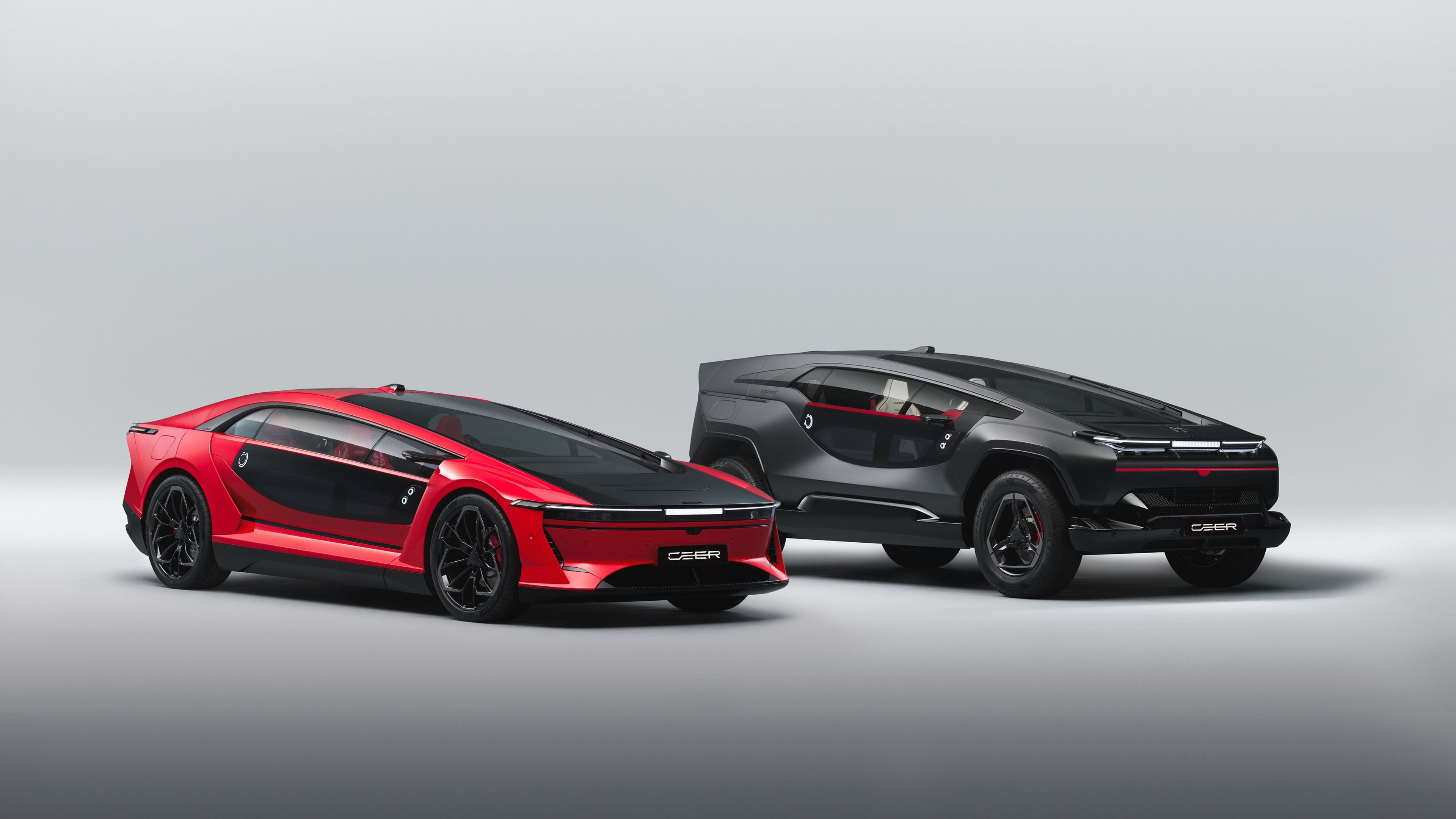
Ceer, Saudi Arabia's first homegrown automotive brand, has officially revealed its debut products: the Exobot sedan and the Exobot SUV. Unveiled on September 21, 2026 at Ceer's own manufacturing complex in King Abdullah Economic City (KAEC), the pair share an 800-volt electrical architecture, a 112 kWh battery and a tri-motor all-wheel-drive layout good for up to 1,111 hp in their most powerful tune. Ceer is a joint venture between Saudi Arabia's Public Investment Fund (PIF) and Taiwanese electronics giant Foxconn, with BMW supplying a component-technology license from the brand's 2022 founding. Both cars launch first in First Edition trim, with a more configurable Plus version to follow. Pricing has not been announced, and deliveries are Gulf-only, starting in March 2027.
Performance & Specs
Both Exobot body styles use a shared tri-motor AWD platform, with two power outputs. The First Edition tune makes 850 hp (634 kW) and 1,000 Nm, while a High-Performance version steps up to 1,111 hp (828 kW) and 1,500 Nm. On the sedan, that translates to a 0-100 km/h sprint of 2.6 seconds in First Edition trim and 2.1 seconds in High-Performance trim, with a 250 km/h top speed for the flagship tune. The SUV, riding on the same 3,200 mm wheelbase, is slightly slower at 2.9 seconds and 2.4 seconds respectively, with a 210 km/h top speed for its High-Performance version. Rimac Technology, in its first Gulf contract, supplies the rear motor, while Hyundai Transys builds the front motor pair — both under the BMW-licensed engineering umbrella. The chassis adds steer-by-wire (with a reported 160-degree reduction in steering input), rear-wheel steering, torque vectoring and an active chassis system.

| Powertrain | Tri-motor AWD BEV, High-Performance tune |
|---|---|
| Power | 828 kW (1,111 hp) |
| Torque | 1,500 Nm |
| 0–100 km/h | 2.1 s (sedan) / 2.4 s (SUV) |
| Battery | 112 kWh |
| Range | Up to 670 km NEDC (First Edition sedan) |
| POWERTRAIN TYPE | Tri-motor AWD BEV |
|---|---|
| HORSEPOWER | 850 hp (First Edition) / 1,111 hp (High-Performance) |
| ACCELERATION | 2.1 s sedan / 2.4 s SUV (High-Performance, 0-100 km/h) |
| TOP SPEED | 250 km/h sedan / 210 km/h SUV |
| DRIVETRAIN | Tri-motor AWD |
| BATTERY | 112 kWh |
| ELECTRIC RANGE | Up to 670 km sedan / up to 560 km SUV (NEDC, First Edition) |
Dimensions & Practicality

| Length | 5,260 mm |
|---|---|
| Width | 2,100 mm |
| Height | 1,430 mm |
| Wheelbase | 3,200 mm |
The Exobot sedan stretches 5.26 metres long on a 3.2-metre wheelbase, giving it proportions closer to a full-size flagship than a mid-size sedan, while its sloped fastback roofline and near-3-metre "Shahin" wing doors (named after the Saudi falcon) open in a 60 cm arc for a wider entry to both rows. The windshield alone runs 2.4 metres at a 15-degree incline, described by Ceer as the largest ever fitted to a production car. Inside, the cabin uses triple silver-coated glass and a tri-zone climate system to manage Gulf heat, and the lower half of each door can switch between tinted and opaque via a control button.

| Length | 5,020 mm |
|---|---|
| Width | 2,100 mm |
| Height | 1,690 mm |
| Wheelbase | 3,200 mm |
The SUV shares its 3.2-metre wheelbase and 2.1-metre width with the sedan but trades length for height, standing 260 mm taller at 1.69 metres while measuring 5.02 metres long — slightly shorter overall than its sedan sibling. Both bodies ride on forged-aluminium wheels finished in a triangular motif drawn from Saudi Arabia's Al-Lahuj architectural style. Cargo volume, frunk capacity and exact seat count have not been published by Ceer as of this writing.
Charging & Battery
Both Exobot models share a single 112 kWh battery pack built on an 800-volt architecture, the voltage tier increasingly common among performance EVs because it allows thinner cabling and faster charging without excessive heat buildup. Ceer states the pack recovers from a 10-80% state of charge in under 30 minutes on a suitable DC fast charger, a figure roughly in line with other 800V halo EVs like the Lotus Eletre. Ceer has not yet published AC home-charging figures or a maximum DC charging-power number.
| BATTERY | 112 kWh |
|---|---|
| VOLTAGE ARCHITECTURE | 800V |
| DC 10-80% TIME | Under 30 minutes |
Design & Interior
The Exobot's design leans hard into Saudi symbolism: 32 individual light bars across the front and rear reference 1932, the year of the Kingdom's founding, while the Shahin wing doors take their name and silhouette cues from the native falcon. First Edition cars come in just two exterior finishes, Harrat Grey or White Musk, paired with red brake calipers on the optional Black Pack. Inside, the First Edition uses black-and-red Nappa leather and carries a numbered plaque matching the car's VIN. The cabin is dominated by a 48-inch curved 8K "Digital Horizon" display that spans from pillar to pillar ahead of the driver, a yoke-style steering wheel built around steer-by-wire, a 10.4-inch vertical central touchscreen with physical controls below it, and an 8-inch screen for rear passengers. A built-in fragrance system and a 360-degree "SoundStage" audio setup round out the cabin tech.
Technology & Features
Ceer has built a bilingual virtual voice assistant, in Arabic and English, into the Exobot's infotainment stack, running across the 10.4-inch central screen and the 8-inch rear display. A digital key with smartwatch integration lets owners unlock and start the car without a physical fob, and the whole system receives continuous over-the-air software updates rather than requiring dealer visits for feature upgrades. Ceer has not disclosed the specific chip platform or infotainment software partner powering these displays.
Safety & ADAS
Ceer describes the Exobot's driver-assistance suite as capable of up to Level 3 automation, covering hands-free highway driving, automated lane changes and point-to-point highway autonomous navigation. The underlying sensor suite handles forward collision warning, blind-spot detection, rear cross-traffic alert and automatic parking, backed by a body structure Ceer highlights for rigidity. As with other Level 3 systems, real-world availability typically depends on local regulatory approval market by market, which Ceer has not detailed for the Gulf region yet.
| ADAS LEVEL | Up to L3 (hands-free highway driving) |
|---|---|
| ADAS FEATURES | Automated lane change, point-to-point highway navigation, forward collision warning, blind-spot detection, rear cross-traffic alert, automatic parking |
Available Versions
| VERSION | POWER | TORQUE | 0-100 | TOP SPEED | DRIVETRAIN | BATTERY | EV RANGE | PRICE | KEY DIFFERENCES |
|---|---|---|---|---|---|---|---|---|---|
| Exobot Sedan First Edition | 850 hp | 1,000 Nm | 2.6 s | — | AWD | 112 kWh | 670 km | TBA | Standard-tune tri-motor; numbered VIN plaque; Harrat Grey or White Musk finish |
| Exobot Sedan High-Performance | 1,111 hp | 1,500 Nm | 2.1 s | 250 km/h | AWD | 112 kWh | — | TBA | Higher-output tri-motor tune on the same 112 kWh pack |
| Exobot SUV First Edition | 850 hp | 1,000 Nm | 2.9 s | — | AWD | 112 kWh | 560 km | TBA | Standard-tune tri-motor SUV; numbered VIN plaque |
| Exobot SUV High-Performance | 1,111 hp | 1,500 Nm | 2.4 s | 210 km/h | AWD | 112 kWh | — | TBA | Higher-output tri-motor tune on the same 112 kWh SUV pack |
Pricing & Availability
Ceer has not announced pricing for either Exobot body style or either power tune. Series production starts in January 2027 at Ceer's plant in King Abdullah Economic City, with the first customer deliveries following in March 2027 — itself a delay from the brand's original 2025 target and a January 2026 revision that had pointed to late 2026. Both cars are homologated for Gulf markets only at launch; Ceer has said future models in its seven-car, five-year roadmap are being engineered with global homologation in mind, but has not confirmed export plans for the Exobot itself. Ceer says its order-to-delivery process is measured in weeks rather than months once sales open.
How It Compares
With no Ceer pricing published yet, this is a power-and-segment contrast rather than a strict cross-shop. The Lotus Emeya is the closest fastback-sedan match in our own catalog, at 893 hp and a $113,330 price that hints at where a tri-motor 1,111 hp flagship sedan might land once Ceer names a number. The Lotus Eletre lines up almost exactly with the Exobot SUV on power (905 hp) and range (560 km), making it a useful yardstick for what a similarly specced Gulf-market SUV costs elsewhere. The GAC Hyptec SSR sits above both Exobot tunes on raw output at 1,225 hp, but trades range down to 450 km and carries a nearly $190,000 sticker — useful context for just how aggressively priced the still-unrevealed Exobot would need to be to undercut established hypercar-adjacent EVs.
- Genuinely halo-tier hardware: 800V architecture, sub-30-minute fast charging and up to 1,111 hp from a shared tri-motor platform across two body styles
- Backed by serious engineering partners — a BMW technology license, Rimac Technology's first Gulf contract for the rear motor, and Hyundai Transys for the front motors
- Dramatic, distinctive design with the wing doors, 2.4-metre windshield and desert-tuned Halo Cooling climate system built specifically for Gulf conditions
- No pricing has been announced for either model, making it impossible to judge value, and sales are homologated for Gulf markets only
- Deliveries slipped roughly four years from Ceer's original 2025 promise to March 2027, a track record that raises fair questions about a first-time automaker hitting its next milestones
The Exobot is a legitimately serious opening statement from a brand nobody outside Saudi Arabia had to take seriously before this week: an 800V, tri-motor, 112 kWh platform stretched across two genuinely distinct body styles, with real engineering partners attached to the drivetrain rather than just marketing partners attached to the launch event. It's aimed squarely at Gulf buyers who want a flagship EV that isn't a Tesla, a Lucid or a Chinese import, and on paper it can match or beat several established performance EVs on power alone. The real test is still ahead: Ceer has already slipped its delivery date by roughly four years and has yet to say what either car costs, and until pricing lands this is a spec sheet to admire rather than a car to recommend buying. Worth watching closely once March 2027 approaches and real numbers appear.