
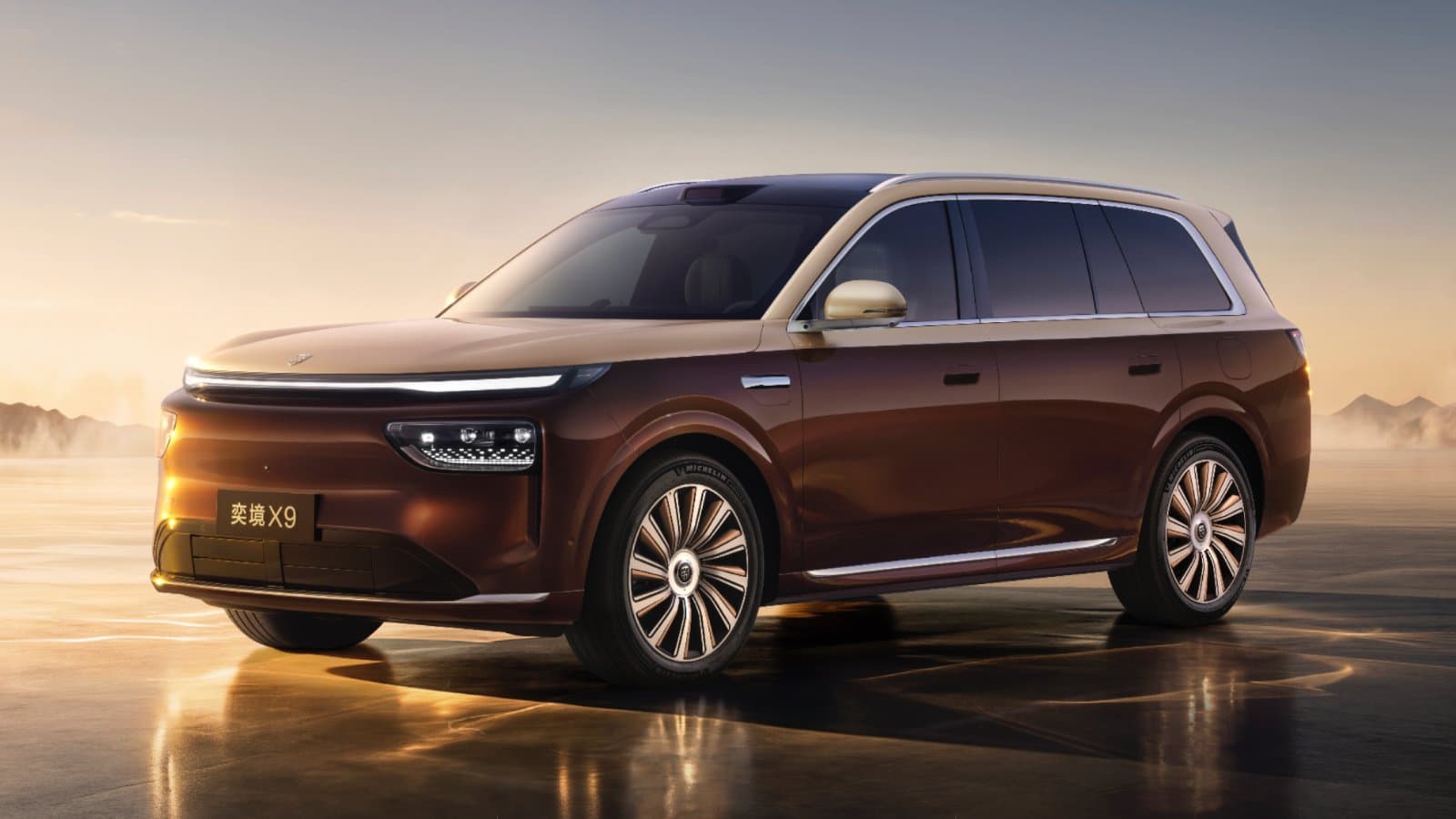
Epicland is the new joint brand from Dongfeng Motor and Huawei, and the X9 is its opening statement: a three-row, six-seat extended-range SUV built to challenge the AITO M9 and Li Auto L9 in China's fiercely contested large-family-SUV segment. The X9 officially went on sale in China on September 24, 2026, with a limited-time launch price of 279,800 to 359,800 yuan (about $41,460 to $53,460) across four trims, undercutting the 299,800 yuan starting price that greeted pre-sales back on August 18. That earlier pre-sale window drew more than 20,000 orders in its first 24 hours, a strong signal for a brand-new nameplate with zero sales history. Positioned by Dongfeng as a "second-generation family flagship," the X9 pairs an 800V EREV powertrain rated for up to 1,570 km of combined range with Huawei's full-stack Qiankun ADS 5 driver-assist suite and a HarmonySpace 6 cockpit built around dual 17.2-inch adjoining displays. It should not be confused with the unrelated Xpeng X9, a minivan from a completely different maker; Epicland's X9 is a full-size SUV aimed squarely at premium six-seat family buyers.
Performance & Specs
The X9 is an EREV only — there is no pure-gasoline or plug-in-hybrid version, and a separate battery-electric Epicland SUV on a 1,000V platform is reportedly following later this year as its own model, not a trim of the X9. Power comes from a 1.5-liter turbocharged four-cylinder engine that works purely as a generator, contributing about 95 kW (127 hp) to the 800V electrical system rather than driving the wheels directly. The entry Long Range trim runs a single rear motor good for up to 300 kW (402 hp), while the Ultra+ and Ultra+ Flagship trims add a second motor up front for dual-motor all-wheel drive rated at a combined 420 kW (563 hp) and 760 Nm, enough for 0-100 km/h in 5.1 seconds. All trims ride on an all-aluminum chassis Dongfeng says was tuned by a European engineering team, built on the "Red Rabbit" platform with Huawei's XMC Qiankun digital chassis control, dual-chamber air suspension with continuously variable damping, double-wishbone front and five-link rear axles, and rear-wheel steering of up to plus/minus 7 degrees that shrinks the turning circle to 5.3 meters despite the car's near-5.3-meter length.

| Powertrain | EREV (1.5T range-extender + dual-motor AWD) |
|---|---|
| Power | 420 kW (563 hp) |
| Torque | 760 Nm |
| 0–100 km/h | 5.1 s |
| Battery | 74.29 kWh CATL LFP |
| Range | 465 km EV / 1,570 km combined (CLTC) |
| POWERTRAIN TYPE | EREV (range-extended electric) |
|---|---|
| HORSEPOWER | Up to 420 kW (563 hp) |
| ACCELERATION | 5.1 s (0-100 km/h, AWD) |
| DRIVETRAIN | RWD (entry) / AWD (Ultra+ trims) |
| BATTERY | 74.29 kWh CATL LFP, 800V architecture |
| ELECTRIC RANGE | 465 km (CLTC) |
| COMBINED RANGE | Up to 1,570 km (CLTC) |
Dimensions & Practicality

| Length | 5,301 mm |
|---|---|
| Width | 2,015 mm |
| Height | 1,820 mm (RWD) / 1,805 mm (AWD) |
| Wheelbase | 3,120 mm |
At 5,301 mm long and 2,015 mm wide with a 3,120 mm wheelbase, the X9 is genuinely large — longer than both the AITO M9 and the Li Auto L9 — and Dongfeng leans into that space with a 2+2+2 six-seat layout it markets as "three-row equality," aiming for near-identical comfort in row two and row three rather than treating the back bench as an afterthought. Cargo space behind the third row is a claimed 484 liters, growing to as much as 1,368 liters with the second and third rows folded, enough for a family's luggage or a home-improvement run without resorting to a roof box. Height varies slightly by drivetrain — 1,820 mm on the single-motor rear-wheel-drive version and 1,805 mm on the dual-motor all-wheel-drive trims, a function of the different underbody packaging around the extra front motor.
| LENGTH | 5,301 mm |
|---|---|
| WIDTH | 2,015 mm |
| HEIGHT | 1,820 mm (RWD) / 1,805 mm (AWD) |
| WHEELBASE | 3,120 mm |
| CARGO VOLUME | 484 L (1,368 L seats folded) |
Charging & Battery
Every X9 trim uses the same CATL-supplied 74.29 kWh lithium-iron-phosphate pack riding on an 800V electrical architecture, which is what allows the EREV to post a 465 km CLTC pure-electric range despite carrying a mid-size rather than an oversized battery. Combined with the 1.5T range-extender, total range climbs past 1,500 km CLTC, with Epicland citing a peak figure of 1,570 km for the most efficient configuration. Chinese launch-day coverage puts a 20-80% DC fast charge at roughly 10 minutes, though some pre-launch estimates ran as high as 18 minutes — either way, the 800V platform keeps the X9 competitive with newer EREV rivals rather than stuck on an older 400V charging curve. LFP chemistry also tends to tolerate frequent fast-charging and cold climates better than a nickel-based pack, a sensible trade-off for a family SUV that will spend time both around town on battery power and on long highway runs with the generator running.
| BATTERY | 74.29 kWh CATL LFP |
|---|---|
| VOLTAGE ARCHITECTURE | 800V |
| DC 20-80% TIME | ~10 min per Chinese launch coverage (some pre-launch estimates cited up to 18 min) |
Design & Interior
Exterior design centers on a full-width lighting signature nearly 1.83 meters wide up front, using Huawei's XPIXEL projection headlamps, which can throw interactive light patterns onto the road ahead. Semi-flush door handles, a flat roofline and minimal surface creasing keep the silhouette clean, while a stretched greenhouse and slanted D-pillars signal the cabin space packed between the wheels. Around back, a full-width taillight built from 1,172 individually controlled light elements mirrors the front signature at night. Inside, the two adjoining 17.2-inch 3.4K "Butterfly Wing" displays anchor a ten-screen HarmonySpace 6 cabin, and Epicland pairs that hardware with AI-based occupant monitoring and a multilingual voice assistant meant to serve both Mandarin-speaking buyers at home and the right-hand-drive markets planned for later. Structurally, the body uses 2,400 MPa ultra-high-strength hot-formed steel around the B-pillars and a three-layer, what Dongfeng calls "bulletproof-grade," battery armor package, underlining how much of the X9's pitch rests on safety credentials as much as tech novelty.
Technology & Features
Every X9 trim, not just the range-topper, gets Huawei's four-unit sensing suite: one 896-channel dual-optical-path imaging-grade LiDAR paired with three additional solid-state LiDAR units, for four lasers total — a spec Chinese launch-day coverage has flagged as unmatched under 300,000 yuan in this segment. That hardware feeds Huawei's Qiankun ADS 5 assisted-driving system, described in Chinese-market marketing as a jointly developed full-stack solution rather than a licensed-in system. The car also carries 11 cameras, 5 millimeter-wave radar units and 12 ultrasonic sensors, per specifications reported around the Beijing Auto Show debut. On the cockpit side, HarmonySpace 6 runs the dual-screen setup along with laser-projection elements for a ten-screen total, and Dongfeng has confirmed the platform will carry the multilingual voice system into the right-hand-drive export versions planned for Hong Kong, Macau and Southeast Asia.
Safety & ADAS
Huawei's Qiankun CAS 5.0 "full-dimension" safety system layers active-safety functions on top of the ADAS sensor suite, working alongside the AEB, adaptive cruise, lane-keeping and 360-degree camera coverage expected at this price point. The four-LiDAR sensing package — unusual for a car starting under $42,000 — is aimed specifically at improving detection of small or partially obscured obstacles that pure-camera systems can miss, a priority Dongfeng has repeatedly tied to family-buyer trust rather than outright autonomy bragging rights. Structural safety measures include the 2,400 MPa steel B-pillar reinforcement and the three-layer battery armor mentioned above, both aimed at protecting the extended-range powertrain and the cabin's third row in a side-impact scenario.
| ADAS LEVEL | L2+ (Huawei Qiankun ADS 5) |
|---|---|
| ADAS FEATURES | 4x LiDAR (1 dual-optical-path + 3 solid-state), 11 cameras, 5 mmWave radar, 12 ultrasonic sensors, AEB, ACC, LKA, 360° camera |
Available Versions
| VERSION | POWER | TORQUE | 0-100 | DRIVETRAIN | BATTERY | EV RANGE | COMBINED RANGE | PRICE | KEY DIFFERENCES |
|---|---|---|---|---|---|---|---|---|---|
| Long Range | 402 hp | — | — | RWD | 74.29 kWh | 465 km | 1,570 km | $41,460 | Entry single-motor rear-drive trim; limited-time launch price |
| Ultra+ Long Range | 563 hp | 760 Nm | 5.1s | AWD | 74.29 kWh | 465 km | 1,570 km | — | Dual-motor AWD; mid-tier equipment level, price not broken out at launch |
| Ultra+ Flagship Long Range | 563 hp | 760 Nm | 5.1s | AWD | 74.29 kWh | 465 km | 1,570 km | $53,460 | Same AWD powertrain as Ultra+; adds top interior and equipment package |
Pricing & Availability
Epicland opened X9 pre-sales on August 18, 2026, at a starting price of 299,800 yuan (about $44,400) across three trims topping out at 379,800 yuan (about $56,300) — and pre-orders topped 16,000 within 12 hours and 20,000 within 24 hours, an unusually strong debut for a brand with no prior sales history. When the X9 actually went on sale on September 24, the starting price came in noticeably below that pre-sale figure: a limited-time launch price of 279,800 to 359,800 yuan (about $41,460 to $53,460), with regular post-promotion pricing set at 289,800 to 369,800 yuan (about $42,940 to $54,820). Dongfeng also added a fourth trim to the lineup at launch, giving buyers a new entry point alongside the three original pre-sale configurations, though full specifications and pricing for that added trim were not broken out in launch-day coverage. For now the X9 is sold only in mainland China, but Dongfeng has confirmed a right-hand-drive version is already in development for Hong Kong and Macau, with Southeast Asia named as the next step in what the company describes as a shift from exporting products to exporting the Epicland brand itself. Deliveries have not been given an exact start date, but industry norms and Chinese media both point to first customer deliveries within the fourth quarter of 2026.
How It Compares
Against its two most direct rivals, the X9 undercuts both on price while roughly matching them on power and range. The AITO M9 EREV six-seater starts at $69,326 with 530 hp and 1,362 km combined range — meaningfully more expensive than the X9's $41,460 entry point for comparable combined-range performance, though the M9 has a longer track record and a more mature dealer network. The Li Auto L9, the segment's pioneer, comes in at $63,423 with 563 hp — identical peak power to the X9's flagship AWD trim — and 1,315 km combined range, again well above the X9 on price for similar range and marginally less power at the top end. The Denza N9 sits closer to the X9 on price at $51,648 but trades the EREV format for a PHEV setup with a shorter 1,000 km combined range, despite a much larger 912 hp output, a reminder that raw horsepower isn't the deciding factor for family-SUV buyers prioritizing range and cabin tech. If Epicland can back up its launch pricing with solid build quality and software polish, the X9's combination of a standard four-LiDAR sensing suite and a starting price tens of thousands of dollars below the M9 and L9 could reshape value expectations in this segment quickly.
- Four-LiDAR Huawei Qiankun ADS 5 sensing suite standard on every trim, not gated to the flagship
- Meaningfully cheaper than the AITO M9 and Li Auto L9 at a comparable 1,570 km combined range
- Genuine three-row family space with a 2+2+2 six-seat layout and up to 1,368 L of cargo room
- Brand-new nameplate with zero ownership track record or resale data to lean on
- Full specs and pricing for the newly added fourth, entry-level trim were not disclosed at launch
The Epicland X9 is a confident opening move for a brand that didn't exist a year ago: real Huawei driver-assist hardware, a genuinely spacious six-seat cabin, and pricing that undercuts the AITO M9 and Li Auto L9 by tens of thousands of dollars for broadly comparable range and tech. The catch is exactly what you'd expect from a first-year nameplate — no service history, no resale data, and a launch-day trim lineup that still has a few unanswered details. For a family buyer in China comfortable betting on Huawei's engineering pedigree over Dongfeng's own limited premium-SUV track record, the X9 is one of the strongest value arguments in the segment right now. Recommended for early adopters chasing spec-per-dollar; more risk-averse buyers may want to wait for the first wave of ownership reports.