
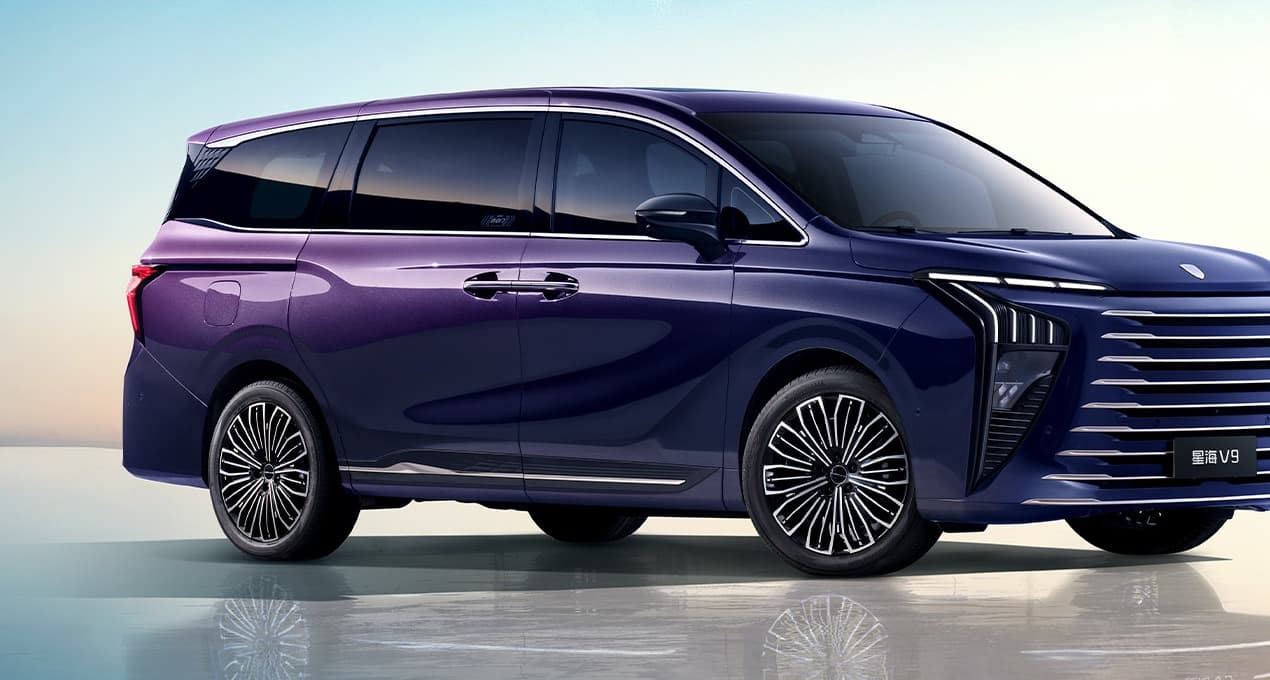
The 2026 Forthing Xinghai V9 is Dongfeng's value play in China's booming plug-in hybrid MPV segment, built by Dongfeng Liuzhou Motor under the newer Forthing sub-brand. Sold in China under the manufacturer's own "2027 model year" naming, the current Xinghai V9 lineup launched in June 2026 with sharply cut pricing and an upgraded chip set, undercutting most large PHEV people-movers by a wide margin. It pairs a 1.5-liter turbo engine with a single electric motor through a dedicated hybrid transmission, a 34.9 kWh LFP battery good for a CLTC-rated 200 km on electricity alone, and a combined range of roughly 1,300 km. Seven seats in a 2+2+3 layout, a twin-screen cockpit built around a Qualcomm Snapdragon 8295P chip, and a starting price around $26,650 position it as a budget-friendly alternative to pricier family MPVs from BYD and GAC. It is a China-first launch, though Dongfeng Forthing has already shown the same MPV in Europe.
Performance & Specs
Power comes from Dongfeng's Mach hybrid system: a 1.5T petrol engine producing 113 kW (154 hp) on its own, paired through a 1-speed dedicated hybrid transmission (1DHT) with an electric motor that contributes 150 kW (201 hp) of its own. Together, the two power sources deliver a combined system output of 228 kW (306 hp) and 540 Nm of torque to the front wheels only — there is no all-wheel-drive option on the Xinghai V9. Official Chinese-market figures put 0-100 km/h at roughly 9.5 seconds and top speed at 180 km/h, modest numbers for a nearly 2.4-tonne, 7-seat MPV rather than a performance target. The 154 hp figure describes the combustion engine alone, and 201 hp describes the electric motor alone; neither is the car's total output, which is the higher 306 hp combined system figure used throughout this article.

| Powertrain | 1.5T PHEV, 1-speed DHT |
|---|---|
| Power | 228 kW (306 hp) system |
| Torque | 540 Nm |
| 0–100 km/h | ≈9.5 s |
| Battery | 34.9 kWh LFP |
| Range | 1,300 km combined (200 km EV, CLTC) |
| POWERTRAIN TYPE | PHEV (1.5T petrol + electric motor) |
|---|---|
| HORSEPOWER | 228 kW (306 hp) combined |
| ACCELERATION | ≈9.5 s (0-100 km/h) |
| TOP SPEED | 180 km/h |
| DRIVETRAIN | FWD |
| BATTERY | 34.9 kWh LFP |
| ELECTRIC RANGE | 200 km (CLTC) |
| COMBINED RANGE | 1,300 km (CLTC) |
Dimensions & Practicality

| Length | 5,230 mm |
|---|---|
| Width | 1,920 mm |
| Height | 1,820 mm |
| Wheelbase | 3,018 mm |
At 5,230 mm long with a 3,018 mm wheelbase, the Xinghai V9 sits in the same size class as large three-row MPVs like the GAC Trumpchi E8 and Denza D9, with enough interior length for genuinely usable second- and third-row space rather than a cramped 7th seat. The cabin is laid out 2+2+3, with individual second-row captain's chairs described by Dongfeng as "aviation-grade" seating, aimed squarely at family and business-shuttle buyers who actually use all three rows. Curb weight ranges from 2,325 kg on the entry Comfort trim to 2,415 kg on the top-spec car, reflecting the added battery buffering and equipment on higher grades. Cargo figures behind the third row have not been published by Dongfeng as of this writing, so we have left that number out rather than estimate it.
Charging & Battery
Every Xinghai V9 trim shares the same 34.9 kWh lithium iron phosphate (LFP) battery, chosen for cost and long-term durability over the higher energy density of a ternary-lithium pack. On a home or public AC charger, a full charge takes about 6 hours. The bigger number worth flagging: on a DC fast charger, Forthing quotes a 30-80% top-up in around 18 minutes — not the 18 hours that shows up in some spec databases, which appears to be a units error carried over from an AC-charging context. Chinese-market reporting on the car's real-world charging behavior notes that multi-hour charge times do occur, but only when the battery is nearly empty (below roughly 20%) or in cold weather, when the battery management system deliberately throttles charging power to protect the cells — a normal PHEV safeguard, not the car's standard charging speed.
| BATTERY | 34.9 kWh LFP |
|---|---|
| AC CHARGING | ≈6 hours (0-100%) |
| DC FAST CHARGING | 66 kW |
| DC 30-80% TIME | ≈18 min |
Design & Interior
The Xinghai V9's front end is dominated by a tall, heavily slatted vertical grille flanked by narrow split headlights, a look Dongfeng carries over from the Yuexiang series facelift, with a full-width light bar and chrome-effect trim along the beltline to visually stretch the body. Frameless door mirrors, flush-ish door handles and a set of multi-spoke alloy wheels round out an exterior that reads more premium than the car's sub-$30,000 starting price suggests, at least in the metallic purple and pearl-white finishes Dongfeng uses in its own press material. Inside, the dashboard is built around dual 15.6-inch displays on the current model — one central touchscreen and one dedicated to the front passenger — stacked above a 12.3-inch digital instrument cluster, all trimmed with soft-touch materials, ambient lighting and open-pore wood-effect inserts on higher trims. The second-row captain's chairs recline, and Dongfeng markets the whole cabin as a "premium smart-electric first-class cabin," language aimed at buyers cross-shopping this against pricier Chinese MPVs.
Technology & Features
The 2026/2027-model Xinghai V9 runs on a Qualcomm Snapdragon 8295P chip, an upgrade over the Snapdragon 8155 fitted to the outgoing 2025/2026 Yuexiang-series cars, paired with Tencent's TAI 4.0 in-car operating system. Standard smart features include four-zone voice recognition, Wi-Fi hotspot support, remote control via a companion phone app, and over-the-air (OTA) update capability. Higher trims add extras like an in-cabin refrigerator/cooler box, a sentry-mode security camera system, blind-spot monitoring alerts and door-opening warnings for rear passengers — features Dongfeng has been adding specifically on the current model year versus the outgoing lineup.
Safety & ADAS
The Xinghai V9 is fitted with an L2+ driver-assistance suite that includes highway NOA (navigate-on-autopilot), adaptive cruise control, lane-keeping assist and a 360-degree camera system, aimed at reducing driver fatigue on the long-distance trips its 1,300 km combined range is built for. Dongfeng has not published a China-NCAP or equivalent crash-test rating for the current Xinghai V9 as of this writing, so we have not included a star rating here.
| ADAS LEVEL | L2+ (highway NOA) |
|---|---|
| ADAS FEATURES | ACC, LKA, highway NOA, blind-spot monitoring, 360° camera, door-opening warning |
Available Versions
| VERSION | POWER | TORQUE | 0-100 | TOP SPEED | DRIVETRAIN | BATTERY | EV RANGE | COMBINED RANGE | PRICE | KEY DIFFERENCES |
|---|---|---|---|---|---|---|---|---|---|---|
| Comfort | 306 hp | 540 Nm | ≈9.5s | 180 km/h | FWD | 34.9 kWh | 200 km | 1,300 km | $26,650 | Entry trim; dual 15.6-in screens, Snapdragon 8295P, 2,325 kg |
| Luxury | 306 hp | 540 Nm | ≈9.5s | 180 km/h | FWD | 34.9 kWh | 200 km | 1,300 km | $30,650 | Adds refrigerator box, sentry mode, blind-spot monitoring, 2,325 kg |
| Flagship | 306 hp | 540 Nm | ≈9.5s | 180 km/h | FWD | 34.9 kWh | 200 km | 1,300 km | $34,060 | Top trim; fullest ADAS and comfort package, 2,415 kg |
Pricing & Availability
The current Xinghai V9 lineup — badged by Dongfeng as its "2027 model year" range even though it went on sale in China in June 2026 — is priced from CNY 179,900 to CNY 229,900 (about $26,650 to $34,060) across the Comfort, Luxury and Flagship trims, a cut of more than CNY 30,000 versus the outgoing 2025/2026 Yuexiang-series cars it replaces at the top of the lineup. The nameplate itself dates back further: the original Forthing V9 launched in China in mid-2024 and was shown in Europe under the "V9 U-Tour" name at IAA Mobility in Munich in September 2023, alongside "V-Tour" branding in Poland and "Tiger Nine" branding in Italy, confirming genuine export intent for this MPV. Whether the specific current-generation Xinghai V9 detailed in this article carries over to those export markets with the same specs and pricing is not confirmed.
How It Compares
The GAC Trumpchi E8 is the Xinghai V9's closest same-price rival on our own catalog: for less than $1,000 more, the E8 still out-powers it (374 hp vs. 306 hp) and offers a similar 1,200 km combined range, making it a close call for buyers who cross-shop purely on the spec sheet. More striking is the Denza D9: at nearly double the Xinghai V9's price, BYD's premium MPV flagship makes only marginally more power (308 hp) despite its much stronger badge and tech reputation, underlining just how competitive the Xinghai V9's system output actually is for its money. The GWM WEY GaoShan sits between the two on power (458 hp) at a mid-range price. The Xinghai V9's pitch is straightforward: it undercuts all three on entry price while still delivering genuinely competitive system output, a usable 7-seat cabin, and a 1,300 km combined range, making it a strong value pick rather than a compromise buy.
- Sharp entry pricing from $26,650 for a genuinely large, 7-seat PHEV MPV with a 306 hp combined system output
- 1,300 km CLTC combined range and an 18-minute DC 30-80% fast charge minimize road-trip downtime
- Dual 15.6-inch displays, Snapdragon 8295P chip and L2+ highway NOA are strong tech for the price bracket
- Front-wheel drive only, with no AWD option even on the top Flagship trim
- All three current trims share one 200 km-range battery; the shorter-range, cheaper 100 km/20.2 kWh entry pack offered on the original 2024 launch lineup is no longer part of the current range
The 2026 Forthing Xinghai V9 is built for buyers who need genuine 7-seat space and long-distance range but don't want to pay Denza or Li Auto money to get it. Its 306 hp combined system output, 1,300 km combined range, quick DC top-ups and surprisingly current tech package (Snapdragon 8295P, dual 15.6-inch screens) punch well above its sub-$30,000 starting price — it even roughly matches the far pricier Denza D9 on power. It still gives up brand cachet to better-established rivals, is front-wheel drive only, and Forthing itself is a newer, less-established name outside China. For a value-focused family that mostly drives in China and wants a big, well-equipped PHEV MPV without a big bill, the Xinghai V9 is a genuinely competitive pick; shoppers who prioritize all-wheel drive or a more prestigious badge should look up the price ladder instead.