
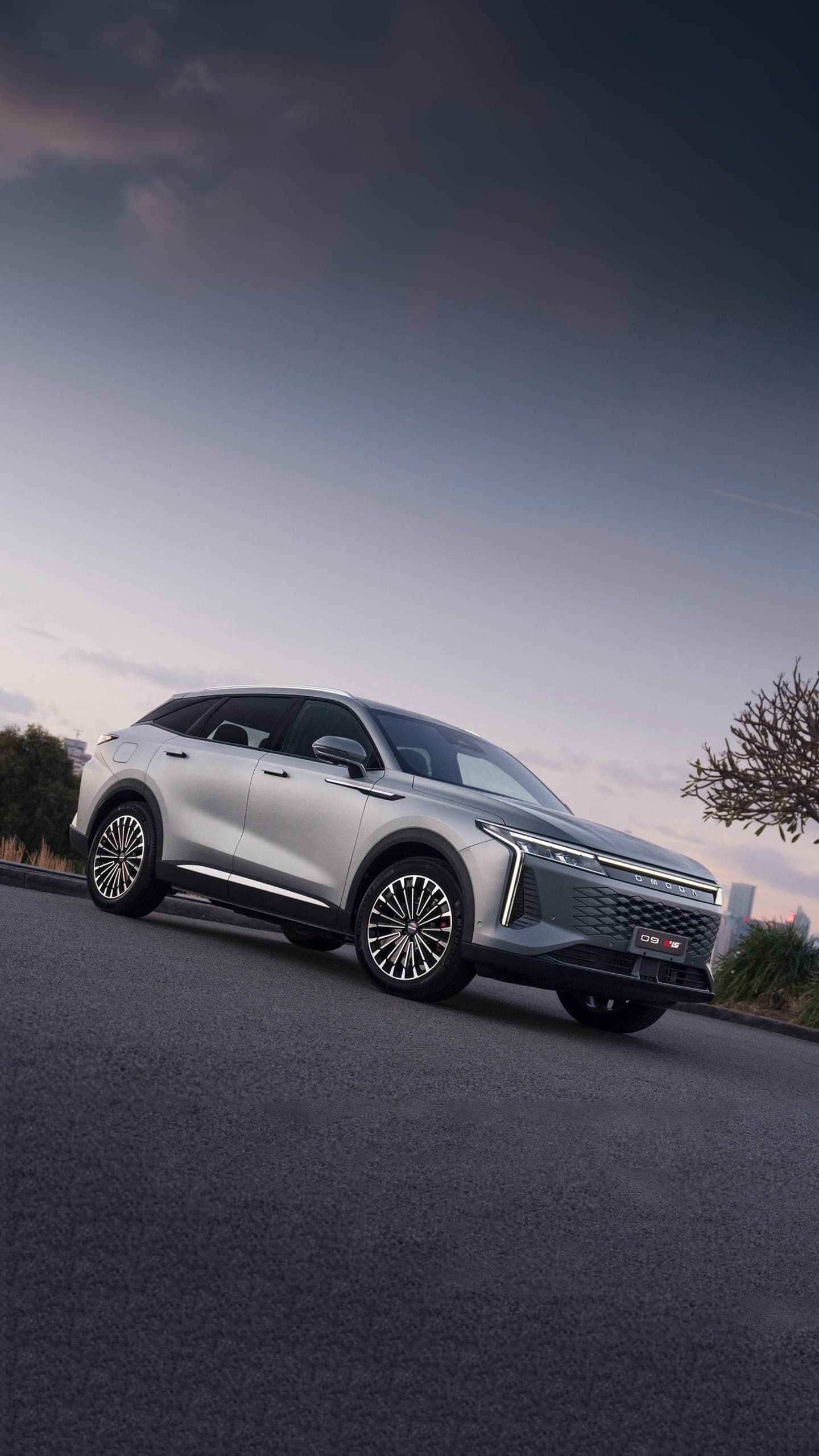
The 2026 Omoda 9 is Chery's flagship export SUV, and the plug-in hybrid version — badged SHS-P for its top-tier tune of the group's Super Hybrid System — is the most powerful passenger vehicle Chery has ever sent overseas. It pairs a 1.5-litre turbo four-cylinder with three electric motors for a combined 395 kW (530 hp), enough for a sub-5-second 0-100 km/h run in a two-tonne five-seat SUV. Already on sale in Australia, New Zealand, the UK and Germany since 2025, the Omoda 9 undercuts most premium PHEV SUVs by a wide margin while packing a panoramic sunroof, massage front seats and a 14-speaker Sony-branded audio system as standard. Pricing starts from roughly $44,100 in Australia, its best-documented right-hand-drive market, making it a genuine value play against established European and Japanese three-row-adjacent SUVs. This is a China-built product wearing a European-sounding name, competing hardest on spec-sheet horsepower and equipment-per-dollar rather than badge prestige.
Performance & Specs
The Omoda 9 SHS-P powertrain combines a 105 kW / 215 Nm 1.5-litre turbocharged petrol engine with three electric motors — two on the front axle (75 kW and 90 kW) and one 175 kW unit on the rear axle — routed through a 3-speed Dedicated Hybrid Transmission (DHT) for all-wheel drive. In Sport mode with the battery above 90 percent charge, the system delivers its peak combined 395 kW (537 PS / 530 hp) and 650 Nm of torque, good for 0-100 km/h in 4.9 seconds and a 180 km/h top speed. Outside of Sport mode, output is capped lower — around 220 kW in Normal and 180 kW in Eco — so the headline figure is a specific, achievable peak rather than an always-on number. Chery's own group PHEV numbers get confusing fast: the mechanically related Jaecoo J8 SHS, a seven-seat sibling under a different badge, uses a lower-output tune of the same architecture (315 kW / 580 Nm combined) — that is a genuinely different vehicle with its own separate coverage, not a mislabeled version of this one. Every figure quoted here for the Omoda 9 specifically comes from Omoda's own Australian, UK and German technical data sheets, cross-checked against independent Australian and European road tests.

| Powertrain | 1.5T + 3 e-motors (SHS-P), AWD PHEV |
|---|---|
| Power | 395 kW (537 PS / 530 hp) |
| Torque | 650 Nm (system peak) |
| 0–100 km/h | 4.9 s |
| Battery | 34.5 kWh LFP |
| Range | 145 km EV / 1,100 km combined |
| POWERTRAIN TYPE | Plug-in Hybrid (PHEV) |
|---|---|
| HORSEPOWER | 395 kW (537 PS / 530 hp) |
| ACCELERATION | 4.9 s (0-100 km/h) |
| TOP SPEED | 180 km/h |
| DRIVETRAIN | AWD |
| BATTERY | 34.5 kWh LFP (CATL M3P) |
| ELECTRIC RANGE | 145 km (WLTP) |
| COMBINED RANGE | 1,100 km |
Dimensions & Practicality

| Length | 4,775 mm |
|---|---|
| Width | 1,920 mm |
| Height | 1,671 mm |
| Wheelbase | 2,800 mm |
| Ground clearance | 200 mm |
At 4,775 mm long on a 2,800 mm wheelbase, the Omoda 9 sits in D-segment territory — roughly the footprint of a Volkswagen Tayron or Mazda CX-60, rather than a compact crossover. It is a strict five-seater rather than a 6/7-seat family hauler, which keeps the second row generously proportioned but means shoppers wanting a third row should look at the related Jaecoo J8. Boot space is a claimed 660 litres with the rear seats up and a flat, square load floor, growing to 1,783 litres with the 60/40 split-fold seats down; there is no spare wheel, only a tyre repair kit, which is how Chery finds the extra underfloor space. Curb weight lands around 2,270 kg depending on market — a function of the three-motor hardware and the 34.5 kWh battery pack it has to carry — with a braked towing capacity of 1,500 kg.
| LENGTH | 4,775 mm |
|---|---|
| WIDTH | 1,920 mm |
| HEIGHT | 1,671 mm |
| WHEELBASE | 2,800 mm |
| CARGO VOLUME | 660 L (1,783 L seats folded) |
| SEATING | 5 |
Charging & Battery
The Omoda 9 SHS-P uses a 34.5 kWh CATL M3P lithium-iron-phosphate (LFP) battery — 34.46 kWh usable per Chery's own figures — chosen over a more energy-dense NMC pack for its thermal stability and long-term durability, a common trade-off on PHEVs that spend much of their life partially charged. On AC power, a 6.6 kW onboard charger takes a depleted pack to full in around 5.5 hours from a home Type 2 wallbox or public AC point. On DC fast charging via CCS2, the Omoda 9 accepts up to 70 kW, enough to take the battery from 30-80% in roughly 25 minutes — quick for a PHEV, though well short of what a dedicated 800V BEV platform manages. Chery quotes combined fuel consumption of around 1.4-1.6 L/100 km on the WLTP cycle with a charged battery, which is how the brand arrives at its 1,100 km combined range claim between a full tank and a full charge.
| BATTERY | 34.5 kWh LFP (CATL M3P), 34.46 kWh usable |
|---|---|
| AC CHARGING | 6.6 kW (Type 2) |
| DC FAST CHARGING | 70 kW (CCS2) |
| DC 10-80% TIME | ≈30 min (30-80% in 25 min) |
Design & Interior
The Omoda 9's exterior leans on a full-width front light bar, a sharply creased diamond-pattern grille and a coupe-like roofline that tapers toward a wraparound rear light strip — styling that reviewers have called striking from some angles and generic from others, but distinctive enough to stand apart from the Omoda 5 and Jaecoo J8 it's related to underneath. Standard 20-inch alloy wheels, retractable flush door handles, a power tailgate and LED lighting front and rear round out the exterior kit on the range-topping Virtue/Noble grade. Inside, dual 12.3-inch displays dominate the dashboard — a curved digital instrument cluster paired with a touchscreen running the drive-mode, climate and infotainment functions — while Chery has kept physical switchgear for climate control, which reviewers have specifically praised. Materials run to synthetic leather upholstery with contrast stitching and ambient lighting that syncs to the sound system, and the front seats add heating, ventilation and massage functions, with heated and ventilated rear seats as well. A panoramic glass roof, 50 W wireless phone charger, head-up display and a built-in dashcam are all standard equipment rather than options.
Technology & Features
Audio comes from a 12-to-14-speaker Sony-branded surround sound system (specification varies slightly by market listing), paired with the dual-screen digital cockpit. Convenience features include walk-away auto-locking, a retractable door handle system, and a cabin fragrance dispenser built into the climate system. Adjustable dampers give the driver a choice between Normal and Sport chassis tunes, working alongside the drivetrain's own Eco/Normal/Sport power modes that also govern how much of the 395 kW peak is actually available. The infotainment stack supports smartphone mirroring and over-the-air update capability, standard for a 2026-model-year Chinese-built SUV competing on tech-per-dollar rather than legacy brand cachet.
Safety & ADAS
The Omoda 9 holds a five-star ANCAP rating (2025 testing) and a five-star Euro NCAP rating, backed by eight airbags as standard. The driver-assistance suite is a straightforward Level 2 package rather than a hands-off highway-driving system: autonomous emergency braking, lane-keep assist, blind-spot monitoring, rear cross-traffic alert, adaptive cruise control, front and rear parking sensors, a 360-degree surround camera and a driver attention monitor are all fitted across the range. Independent reviewers have noted the driver-monitoring camera can be overly sensitive to sunglasses, a minor but real usability niggle rather than a safety shortfall.
| ADAS LEVEL | L2 |
|---|---|
| ADAS FEATURES | AEB, ACC, LKA, BSM, RCTA, 360° camera, driver attention monitor |
Available Versions
| VERSION | POWER | TORQUE | 0-100 | TOP SPEED | DRIVETRAIN | BATTERY | EV RANGE | COMBINED RANGE | PRICE | KEY DIFFERENCES |
|---|---|---|---|---|---|---|---|---|---|---|
| Virtue SHS-P (Australia) | 530 hp | 650 Nm | 4.9s | 180 km/h | AWD | 34.5 kWh | 169 km (NEDC) / 145 km (WLTP) | 1,100 km | $44,100 | Single Australian grade; panoramic roof, massage seats, HUD standard |
| Noble / Black Noble SHS-P (UK & Europe) | 530 hp | 650 Nm | 4.9s | 180 km/h | AWD | 34.5 kWh | 145–149 km | 1,100 km | $57,100–$60,100 | Same mechanical package; Black Noble adds cosmetic black-out trim only |
Pricing & Availability
The Omoda 9 SHS-P has been on sale since 2025 and is not a new nameplate for 2026 — this is a currently in-showroom, actively updated model rather than a fresh launch. In Australia, the single "Virtue" grade lists from roughly $44,100 (AU$61,990 before on-road costs; around $47,850/AU$67,207 driveaway in Sydney), making it the best-value entry point into this specific power figure anywhere it's sold. The UK gets the same mechanical package as the "Noble" trim from about $60,100 (£44,995 on-road), with a cosmetic-only "Black Noble" edition added for 2026 at a roughly $2,000 premium — no extra power, just black paint, black wheels and black suede interior trim. Germany prices the equivalent single "Exclusive" grade from about $57,100 (€52,900 including 19% VAT). New Zealand also carries the SHS-P under the same "Omoda 9 SHS" naming. The price gap between Australia and Europe reflects VAT, import duty and local market positioning rather than any difference in specification — every market gets the same 395 kW powertrain, battery and equipment list.
How It Compares
Against the BYD Tang DM-i, the Omoda 9 asks a similar price for meaningfully more horsepower (530 hp vs 456 hp) but a shorter combined range, since Chery's SHS-P math leans harder into peak performance than maximum tank-plus-battery distance. The BYD Tang L is the closest price match of the three and actually out-ranges the Omoda 9 by nearly 300 km combined while giving up 20 hp — a genuine cross-shop for a buyer who prioritizes long-haul range over outright power. The GWM Tank 500 PHEV competes on a completely different premise — rugged off-road capability over outright pace — and costs more for notably less power and range, illustrating that within Chery/BYD/GWM's own PHEV SUV lineups, the Omoda 9's 530 hp figure is unusually strong for its roughly $44,000 starting price. None of these three are direct segment twins of a five-seat D-segment crossover SUV, but they sit in the same price band and same broad "large PHEV SUV" category, which is the fairest available comparison from our current catalog.
- 395 kW (530 hp) combined output and a 4.9-second 0-100 km/h time are genuinely rare at this price point
- 34.5 kWh LFP battery and 70 kW DC fast charging give real usable EV range plus a 1,100 km combined range
- Panoramic sunroof, massage seats, dual 12.3-inch screens, HUD and a 5-star safety rating all come standard, no options list required
- Reviewers consistently flag vague, over-light steering and a chassis that lacks body control on rougher roads
- Strictly five seats with no spare wheel (repair kit only), and the 395 kW peak is gated behind Sport mode and a near-full battery, not always on tap
The Omoda 9 PHEV is for the buyer who wants big horsepower-per-dollar and a loaded equipment list more than they want driving polish or badge prestige. Chery's SHS-P system genuinely delivers a 530 hp, sub-5-second SUV with real electric-only range and a 1,100 km combined figure, undercutting most rivals with comparable output by a wide margin, especially in its best-value Australian market. The trade-offs are real — light, vague steering and a ride that can feel under-damped on broken pavement — but neither is a dealbreaker for a family SUV that spends most of its time cruising rather than cornering hard. For buyers cross-shopping large PHEV SUVs around the $44,000-$50,000 mark who care more about power, tech and range than outright dynamics, the Omoda 9 earns a genuine recommendation.