
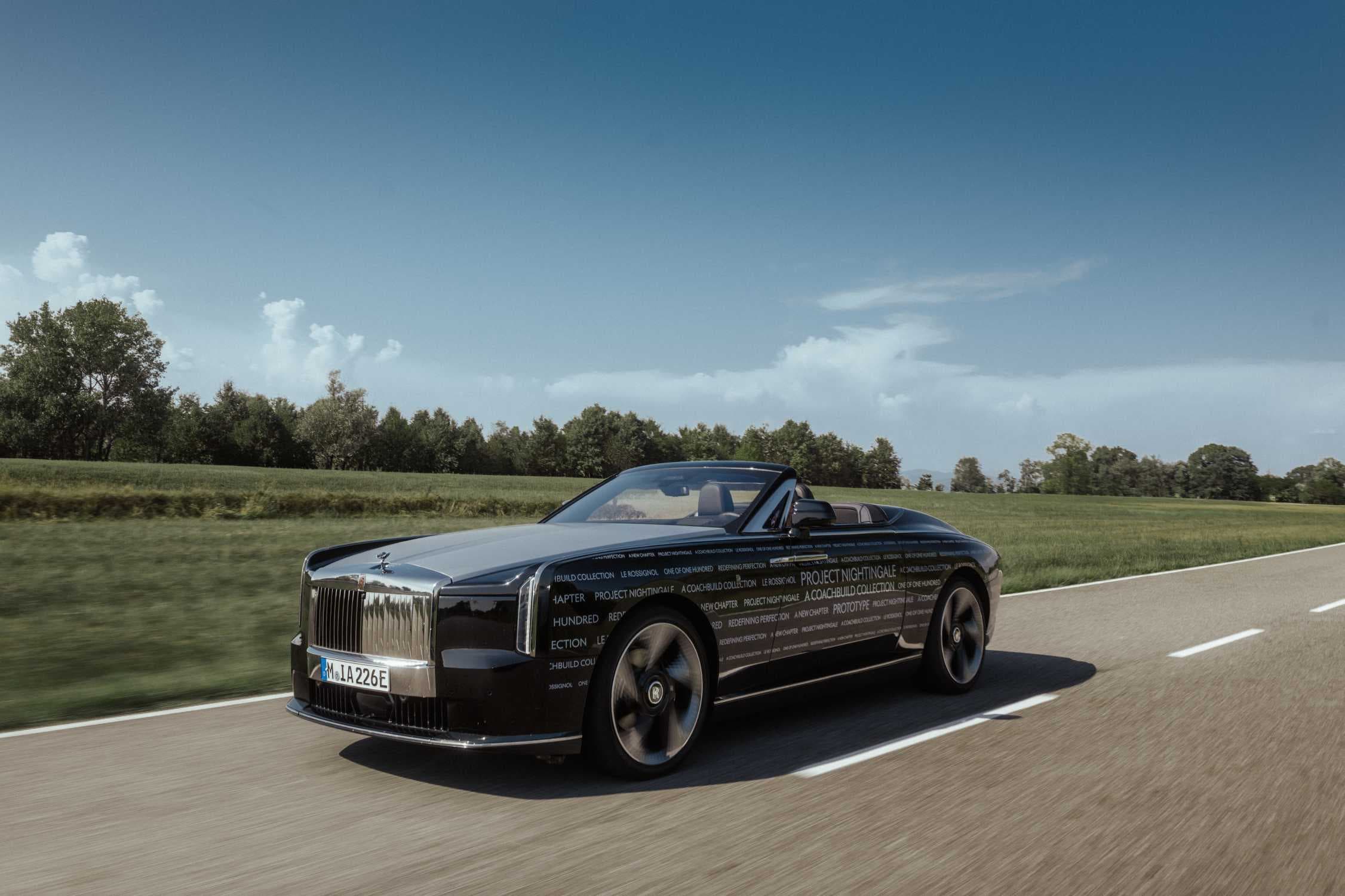
Rolls-Royce Motor Cars has moved Project Nightingale, its first all-electric Coachbuild Collection car, into a global validation programme ahead of customer deliveries. Revealed on April 14, 2026, Project Nightingale is a two-seat, open-top convertible limited to just 100 individually commissioned examples, each built by hand at Goodwood and shaped around a single client's personal taste rather than a fixed specification sheet. It rides on Rolls-Royce's Architecture of Luxury aluminum spaceframe and shares its fully electric drivetrain with the production Spectre, the marque's only current battery-electric model. On September 21, 2026, Rolls-Royce confirmed that development prototypes have begun 350 collective weeks of durability testing spanning the Mediterranean, the Arctic Circle and the deserts of the Arabian Peninsula, ahead of deliveries that are scheduled to begin in 2028. Every one of the 100 cars was reportedly allocated by invitation to existing Rolls-Royce clients before the car was even shown publicly, and Rolls-Royce has not published an official price.
Performance & Specs
Rolls-Royce has not published a standalone powertrain spec sheet for Project Nightingale. What is confirmed, across the official reveal release and independent reporting (Motor1, among others), is that the car shares its Architecture of Luxury spaceframe and drivetrain with the standard-production Spectre: twin electric motors driving all four wheels, good for 430 kW (577 hp) and 900 Nm (664 lb-ft) of torque from a 102 kWh battery in the Spectre's launch specification, with a 0-100 km/h time of roughly 4.5 seconds and a limited top speed of 250 km/h (155 mph) — the same 155 mph ceiling Rolls-Royce cited for Project Nightingale's own high-speed test runs. One wrinkle worth flagging for readers tracking the Spectre line: Rolls-Royce updated the production Spectre to "Series II" specification in June 2026 (up to 500 kW / 680 PS / 671 hp and a larger 112.4 kWh battery, per freshmotors.net's own coverage at the time), several weeks after Project Nightingale's April reveal. Whether the 100 Nightingale cars reaching clients in 2028 will carry the original Spectre powertrain or the newer Series II hardware has not been stated by Rolls-Royce, so treat every power, torque, battery and range figure below as the shared-platform baseline, not a confirmed Nightingale-specific number.

| Powertrain | Dual-motor AWD BEV (Spectre-shared, unconfirmed for Nightingale) |
|---|---|
| Power | 430 kW (577 hp) |
| Torque | 900 Nm (664 lb-ft) |
| 0–100 km/h | ~4.5 s |
| Battery | 102 kWh |
| Range | up to 530 km WLTP |
| POWERTRAIN TYPE | BEV, dual-motor AWD (Spectre-shared, unconfirmed for Nightingale) |
|---|---|
| HORSEPOWER | 430 kW (577 hp) |
| ACCELERATION | ~4.5 s (0-100 km/h) |
| TOP SPEED | 250 km/h (155 mph) |
| DRIVETRAIN | AWD |
| BATTERY | 102 kWh |
| ELECTRIC RANGE | up to 530 km (WLTP) |
| COMBINED RANGE | — (pure BEV) |
Dimensions & Practicality

| Length | 5,760 mm |
|---|---|
| Width | Not disclosed |
| Height | Not disclosed |
| Wheelbase | Not disclosed |
| Ground clearance | Not disclosed |
At 5,760 mm long, Project Nightingale is a genuinely enormous two-seater — roughly 300 mm longer than the standard Spectre coupe it's mechanically related to, and closer in length to a Phantom than to any conventional convertible. Rolls-Royce's own description leans into that scale, calling the design "almost entirely bonnet and tail," with the two-seat cabin positioned as "an intimate counterpoint" to the car's overall grandeur. The cabin itself accommodates only a driver and one passenger, with luggage handled through the "Piano Boot," a sideways-opening, cantilevered trunk lid designed to echo the ceremonial opening of a grand piano rather than a conventional top-hinged boot lid. Rolls-Royce has not published width, height, wheelbase or ground clearance figures, nor a cargo or frunk volume, for Project Nightingale specifically — unusual by mainstream-car standards, but consistent with how the brand treats its low-volume Coachbuild Collection, where a full public spec sheet has historically taken a back seat to the design story.
| LENGTH | 5,760 mm |
|---|---|
| WIDTH | Not disclosed |
| HEIGHT | Not disclosed |
| WHEELBASE | Not disclosed |
| CARGO VOLUME | Not disclosed (Piano Boot cantilever trunk) |
| FRUNK | Not disclosed |
Charging & Battery
Rolls-Royce has not issued a separate charging or battery specification for Project Nightingale, so the figures below reflect the shared Spectre platform rather than a confirmed Nightingale number. The standard Spectre's 102 kWh battery pack sits on a 400V architecture and supports DC fast charging at up to 195 kW, enough for a 10-80% top-up in roughly 34 minutes; AC home/destination charging tops out around 11 kW. Whether Project Nightingale's finished cars, arriving from 2028, will carry this original battery pack or the larger 112.4 kWh unit Rolls-Royce introduced on the Series II Spectre in June 2026 is not something the brand has addressed publicly. Given the car's role as a rolling showcase for Rolls-Royce's electric future, it would not be surprising if the newer pack found its way in by the time deliveries begin, but that remains speculation rather than a confirmed spec.
| BATTERY | 102 kWh (Spectre-shared baseline; unconfirmed for Nightingale) |
|---|---|
| AC CHARGING | 11 kW (Spectre reference) |
| DC FAST CHARGING | up to 195 kW (Spectre reference) |
| DC 10-80% TIME | ~34 min (Spectre reference) |
Design & Interior
Project Nightingale takes its name from Le Rossignol — French for "the nightingale" — the house Sir Henry Royce's design and engineering team used near his winter estate on the Cote d'Azur. The design language is built around Streamline Moderne, the late Art Deco aesthetic Rolls-Royce traces back to its own experimental "EX" cars of the 1920s (the 16EX and 17EX), favouring what the brand calls "sheer, monolithic volumes" over applied ornamentation. The reveal car wears Cote d'Azur Blue paint, a pale solid blue finished with a subtle red fleck referencing Rolls-Royce's heritage red badge, over a body built from an aluminum spaceframe with a carbon fiber front apron, sills and "Aero Afterdeck." A fully integrated Spirit of Ecstasy sits within the grille surround with a flowing-motion effect, and the car rides on 24-inch wheels, the largest ever fitted to a Rolls-Royce.
Inside, the two-seat cabin pairs Charles Blue leather seats with Grace White contrast stitching, Deep Navy inserts and Peony Pink accent flourishes, set against Openpore Blackwood veneer arranged in a "V" formation across the dashboard and console. The signature interior feature is "Starlight Breeze," an evolution of Rolls-Royce's familiar starlight headliner that scatters roughly 10,500 individually placed fibre-optic points of light across the cabin in a pattern the brand says is derived from an analysis of an actual nightingale's soundwaves — a level of conceptual indulgence that is very much the point of a coachbuild commission rather than a production car. Because each of the 100 examples is individually curated with its own client, the colours, materials and detailing shown at the April 2026 reveal represent only the very first of what Rolls-Royce says will be 100 visually distinct cars.
Technology & Features
Much of Project Nightingale's engineering effort visible so far is about mechanism and craft rather than digital feature count. The Piano Boot's sideways-opening, electrically actuated cantilever mechanism is engineered to open and close with the same theatrical smoothness on car number 100 as on car number one, which is why Rolls-Royce is putting it through 15,000 full open/close cycles during validation testing. A bespoke electric wind deflector is being tuned across a range of speeds to cut interior turbulence with the roof down, while also helping retain cabin warmth in cold-weather testing. Rolls-Royce has not detailed the infotainment platform, driver display or connectivity suite fitted to Project Nightingale; given the shared Spectre underpinnings, the standard Spectre's digital cockpit and connected-car features are a reasonable baseline, but the brand has not confirmed this in writing for Nightingale specifically.
Safety & ADAS
Rolls-Royce's public materials on Project Nightingale focus on structural and mechanical validation rather than a driver-assistance feature list. As a Spectre-platform derivative, the car would be expected to carry a broadly similar driver-assistance suite to the production Spectre, but Rolls-Royce has not published a Nightingale-specific ADAS specification, so none should be assumed or advertised as confirmed at this stage.
| ADAS LEVEL | Not disclosed for Nightingale (Spectre-based suite expected) |
|---|---|
| ADAS FEATURES | Not disclosed for Nightingale |
Available Versions
Project Nightingale does not have a conventional trim lineup. Rolls-Royce has been explicit that each of the 100 cars is "meticulously curated with its commissioning client to reflect their personal taste, character and vision" — meaning exterior colour, interior palette, veneer choice and personalization details are unique to every single example, with no two cars specified alike. The table below reflects the one specification that is shared across all 100 cars: the underlying Spectre-based drivetrain and platform.
| VERSION | POWER | TORQUE | 0-100 | TOP SPEED | DRIVETRAIN | BATTERY | EV RANGE | COMBINED RANGE | PRICE | KEY DIFFERENCES |
|---|---|---|---|---|---|---|---|---|---|---|
| Coachbuild Collection (each of 100 individually commissioned) | 577 hp | 900 Nm | ~4.5 s | 250 km/h | AWD | 102 kWh | up to 530 km | — | Not disclosed | Mechanically identical Spectre-shared platform across all 100 cars; every exterior colour, interior material and personalization detail is unique per client commission |
Pricing & Availability
Rolls-Royce has not published an official price for Project Nightingale. Independent outlets that covered the April 2026 reveal have estimated figures ranging from roughly $3 million to more than $13 million per car depending on the scope of personalization — a wide enough spread that none of these numbers should be treated as confirmed pricing, only as third-party estimation. For context, and clearly not the same car: Rolls-Royce's standard-production Spectre Series II, the closest thing the brand sells off a price list, starts at $397,750 for the base version and $467,750 for Black Badge, per freshmotors.net's own June 2026 coverage.
All 100 Project Nightingale examples were reportedly allocated before the car was even shown to the public in April 2026, with Rolls-Royce personally selecting commissioning clients from its existing customer base rather than opening a public configurator, waiting list or dealer allocation process. As of September 2026, there is no route for a new customer to order one; the commissioning process runs entirely through Rolls-Royce's Bespoke and Coachbuild teams and existing client relationships. Deliveries of the finished cars are scheduled to begin in 2028, once the current global testing programme — 350 collective weeks of durability validation across Southern Europe, the Arctic Circle and the Arabian Peninsula — is complete.
How It Compares
Project Nightingale genuinely has no direct rival in freshmotors.net's catalog, or arguably anywhere — it isn't cross-shopped against anything, it's commissioned. The closest mechanical relative is Rolls-Royce's own production Spectre Series II, which shares the same electric underpinnings but costs a fraction of even the most conservative Nightingale estimate and can, at least, actually be ordered. Bentley's Continental GT S and Flying Spur Hybrid sit in our catalog as the nearest brand-adjacent ultra-luxury options by power and positioning, but both are hybrids rather than pure BEVs, both are regular-production cars anyone with the money can order, and neither approaches Nightingale's level of bespoke coachbuilding or its estimated multi-million-dollar price. These comparisons exist purely for context on where Rolls-Royce's electric technology and Bentley's ultra-luxury hybrids sit relative to one another — not as cars a Project Nightingale client would ever actually cross-shop.
- Genuinely one-of-a-kind coachbuilding: every one of the 100 cars is individually designed with its client, not just color-and-wheel personalization on a fixed shape
- Inherits the Spectre's near-silent, torque-rich EV drivetrain in an open-top body, and Rolls-Royce is putting prototypes through an unusually rigorous 350-week global validation programme before any client car is delivered
- Details like the electrically actuated "Piano Boot" and the 10,500-point "Starlight Breeze" lighting show a level of mechanical and conceptual craft well beyond a standard-production convertible
- No public pricing, configurator or order process exists — all 100 allocations reportedly went to existing clients by invitation before the car was even revealed, so this is not a car most readers could buy even with unlimited funds
- Rolls-Royce has not confirmed Nightingale-specific power, battery or range figures, and it remains unclear two years before deliveries begin whether the finished cars will use the original Spectre powertrain or the newer, more powerful Series II hardware
Project Nightingale isn't really a car you review in the normal sense — it's Rolls-Royce using its electric powertrain as the mechanical foundation for the most ambitious coachbuilding exercise the brand has attempted in decades, and using an unusually public, unusually rigorous testing programme to prove it isn't just a design exercise. For the 100 clients who already have one allocated, this is about as far as automotive personalization goes: a bespoke, hand-built, all-electric two-seater with genuinely unique detailing per car, backed by 350 weeks of Arctic-to-desert validation before a single unit reaches its owner. For everyone else, it's a fascinating look at where Rolls-Royce's Bespoke and Coachbuild divisions intend to take electric luxury, precisely because it's completely unattainable. Recommended reading for anyone who wants to understand how a heritage luxury brand thinks about EVs when price is removed from the equation entirely — not a car anyone should expect to actually cross-shop.