
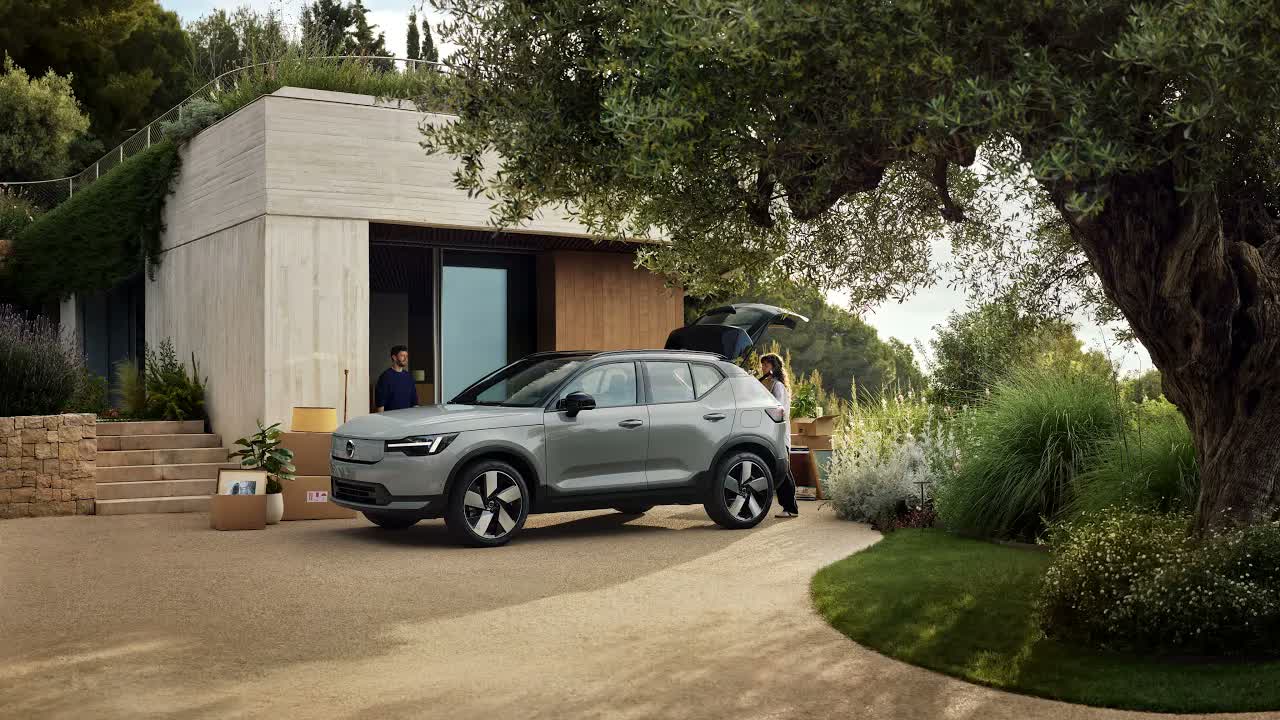
Volvo has pulled the wraps off the 2026 EX40, the Model Year 2026 update to its compact electric SUV, with a global marketing push that dropped a new official teaser on September 10, 2026. Built on the same CMA platform as the EX30 but a size class up, the EX40 now spans a Single Motor rear-wheel-drive version with up to 296 miles (476 km) of EPA range and a Twin Motor all-wheel-drive version with 402 hp, giving Volvo's electric compact SUV lineup a wider spread between value and performance than before.
What's New for 2026
The EX40 name has carried Volvo's electric compact SUV since the 2024 rebrand of the XC40 Recharge, and the Model Year 2026 version keeps the same core proportions and CMA-platform underpinnings while widening the trim spread. In the United States the lineup now runs from the Single Motor Plus ($55,150) through the Twin Motor Plus ($56,900) to the range-topping Twin Motor Ultra Black Edition ($60,850), which adds Harman Kardon audio, standard Pilot Assist, 20-inch gloss-black wheels, and blacked-out exterior trim. In Europe, Volvo sells a wider trim ladder under Core, Plus, Plus Black Edition, and Ultra badges, and also offers the Single Motor with a choice of two battery sizes -- something not currently offered in the US lineup.
Tech Highlights
- Two distinct powertrains: a 79 kWh Single Motor rear-drive version and a 79 kWh Twin Motor all-wheel-drive version sharing the same battery but with very different performance characters.
- 200 kW DC fast charging takes either powertrain from 10-80% in roughly 28 minutes, per Volvo's own figures.
- Google built-in infotainment with Google Maps, Assistant, and the Play Store native to the car's Android Automotive OS, plus over-the-air update support.
- Standard heat pump and Volvo's usual suite of safety systems, including Pilot Assist adaptive cruise (standard on Ultra, optional lower down the range).
Design and Dimensions
The EX40 keeps the boxy, upright compact-SUV silhouette Volvo established with the XC40 nearly a decade ago, now with the closed-off "iron mark" grille treatment shared across the brand's EV lineup and Thor's Hammer LED headlights. At 174.8 inches (4,440 mm) long, 75.2 inches (1,910 mm) wide, and 65 inches (1,651 mm) tall on a 106.4-inch (2,702 mm) wheelbase, it sits squarely in the compact-SUV class -- close in footprint to a Volkswagen ID.4's smaller sibling rather than a full-size three-row. Ground clearance is rated at 175 mm. Cargo space is a claimed 410 liters (14.5 cu ft) behind the rear seats, expanding to 1,286 liters (45.4 cu ft) with the second row folded, plus a 31-liter front trunk under the hood for the charging cables. Curb weight lands around 2,040-2,205 kg depending on powertrain, and the range is offered with wheel sizes from 19 up to 20 inches, with the Ultra Black Edition's gloss-black 20s being the visual giveaway for the top trim from across a parking lot.

| Layout | Single motor, rear axle |
| Drive | Rear-wheel drive |
| Power | 175 kW (238 hp) |
| Torque | 420 Nm |

| Length | 4,440 mm (174.8 in) |
| Width | 1,910 mm (75.2 in) |
| Height | 1,651 mm (65.0 in) |
| Wheelbase | 2,702 mm (106.4 in) |
Performance and Specs
The Single Motor uses a 175 kW (238 hp), 420 Nm rear-mounted motor paired with a 79 kWh battery (67-82 kWh in European market configurations, depending on battery option), good for an EPA-rated 296 miles (476 km) and a 0-100 km/h time in the mid-7-second range. Step up to the Twin Motor and Volvo adds a second motor over the front axle for all-wheel drive, lifting combined output to 300 kW (402 hp) and 670 Nm of torque, with 0-60 mph dropping to 4.6 seconds (one independent test measured 4.4 seconds) at the cost of some range -- EPA rates the Twin Motor at 260 miles (418 km) on the same 79 kWh pack. Both powertrains share a 200 kW DC fast-charging ceiling and a claimed 10-80% charge time of about 28 minutes; Volvo's own European figures put the Twin Motor slightly higher, at up to 207 kW peak DC charging with a 32-minute 10-80% time.

| Layout | Dual motor, front + rear axle |
| Drive | All-wheel drive |
| Power | 300 kW (402 hp) |
| Torque | 670 Nm |
| Spec | Single Motor | Twin Motor |
|---|---|---|
| Drive | Rear-wheel drive | All-wheel drive |
| Power | 175 kW (238 hp) | 300 kW (402 hp) |
| Torque | 420 Nm | 670 Nm |
| Battery (usable) | 79 kWh (US); 67-82 kWh (EU options) | 79 kWh |
| EPA Range | 296 mi (476 km) | 260 mi (418 km) |
| 0-60 mph | ~6.9 sec (est. from 0-100 km/h) | 4.6 sec |
| DC Fast Charging | Up to 180-200 kW | Up to 200-207 kW |
| 10-80% Charge Time | ~28-30 min | ~28-32 min |
| Top Speed | 180 km/h (112 mph) | 180 km/h (112 mph) |
Pricing and Trims
In the US, the 2026 EX40 starts at $55,150 for the Single Motor Plus, $56,900 for the Twin Motor Plus, and $60,850 for the Twin Motor Ultra Black Edition -- the only trim with the 20-inch gloss-black wheel and blacked-out styling package, plus standard Harman Kardon audio and Pilot Assist. European pricing follows a different trim ladder: from roughly €51,025 for the Single Motor Core through €53,075-€53,865 for Plus and Plus Black Edition, up to €55,995 for the Ultra and for the Single Motor Extended Range Plus, which uses a larger battery for a WLTP-rated 566-569 km. Volvo backs the EX40 with its standard new-vehicle warranty plus an 8-year/100,000-mile battery warranty in the US, in line with the rest of the brand's EV lineup, and the car qualifies for federal and state EV incentives in some US markets depending on final assembly and battery-sourcing rules at the time of purchase.
| Trim | Market | Power | Range | Price |
|---|---|---|---|---|
| Single Motor Core | Europe | 238 hp | 477 km WLTP | €51,025 |
| Single Motor Plus | US | 238 hp | 296 mi EPA | $55,150 |
| Single Motor Extended Range Plus | Europe | 252 hp | 566-569 km WLTP | €55,995 |
| Twin Motor Plus | US | 402 hp | 260 mi EPA | $56,900 |
| Twin Motor Ultra Black Edition | US | 402 hp | 260 mi EPA | $60,850 |
| Twin Motor Ultra | Europe | 402 hp | 458-461 km WLTP | ~€55,995+ |
Safety and Technology
Volvo's pitch for the EX40 leans heavily on the brand's safety reputation rather than headline range or acceleration figures. The car carries Volvo's standard suite of driver-assistance systems -- forward collision warning with automatic emergency braking, blind-spot monitoring, lane-keeping assist, and a 360-degree camera -- with Pilot Assist adaptive cruise control standard on the Ultra Black Edition and available as an option on lower trims. Inside, the portrait touchscreen runs Google built-in, meaning Google Maps, Google Assistant, and the Play Store are native to the car rather than bolted on through a phone-mirroring app, and the system receives over-the-air updates the way a phone does rather than requiring a dealer visit. Both powertrains also get a standard heat pump, which matters more for real-world winter range than most spec sheets let on -- EVs without one can lose a significant chunk of their rated range in freezing temperatures just running the cabin heater.
How It Compares
Xiaomi YU7 Max
$51,648 | 400 hp | 600 km range
A larger, cheaper Chinese SUV with more range and comparable power -- not sold in the same markets as the EX40, but the value gap between Western and Chinese EV pricing shows clearly here.
ZEEKR 7X Ultra 4WD
$51,648 | 544 hp | 650 km range
More power and more range for less money than even the base EX40, underscoring how far ahead Chinese automakers are on raw spec-per-dollar in this segment -- though the EX40 counters with Volvo's safety pedigree and dealer network reach.
Geely Galaxy M9
$51,648 | 536 hp | 630 km range
A bigger three-row SUV for similar money to the EX40 Twin Motor -- a size-up alternative for buyers cross-shopping on price rather than footprint.
Pros and Cons
Pros
- Two genuinely different personalities in one nameplate -- efficient RWD commuter or quick AWD performer
- 200 kW+ DC fast charging keeps both versions competitive on road-trip charge stops
- Google built-in infotainment avoids the clunky proprietary systems still common at this price point
- Volvo's safety reputation and dealer/service network, a real advantage over newer entrants
Cons
- Range and price both trail newer Chinese rivals by a wide margin at similar or lower cost
- US buyers don't get the Single Motor Extended Range or Core trims sold in Europe
- Cargo space (410L) is modest for the segment even with the frunk included
- CMA platform is now several years old relative to newer 800V-native EV architectures
FAQs
Verdict
The 2026 Volvo EX40 doesn't reinvent anything -- it's the same compact electric SUV Volvo has sold since rebranding the XC40 Recharge in 2024, now with a wider trim spread between an efficiency-focused Single Motor and a genuinely quick 402 hp Twin Motor. For buyers who value Volvo's safety record, dealer network, and clean Google-based infotainment over outright range or price, it remains a sensible choice; for anyone cross-shopping purely on spec-per-dollar, the newest Chinese SUVs above make the EX40 look expensive for what it offers.