
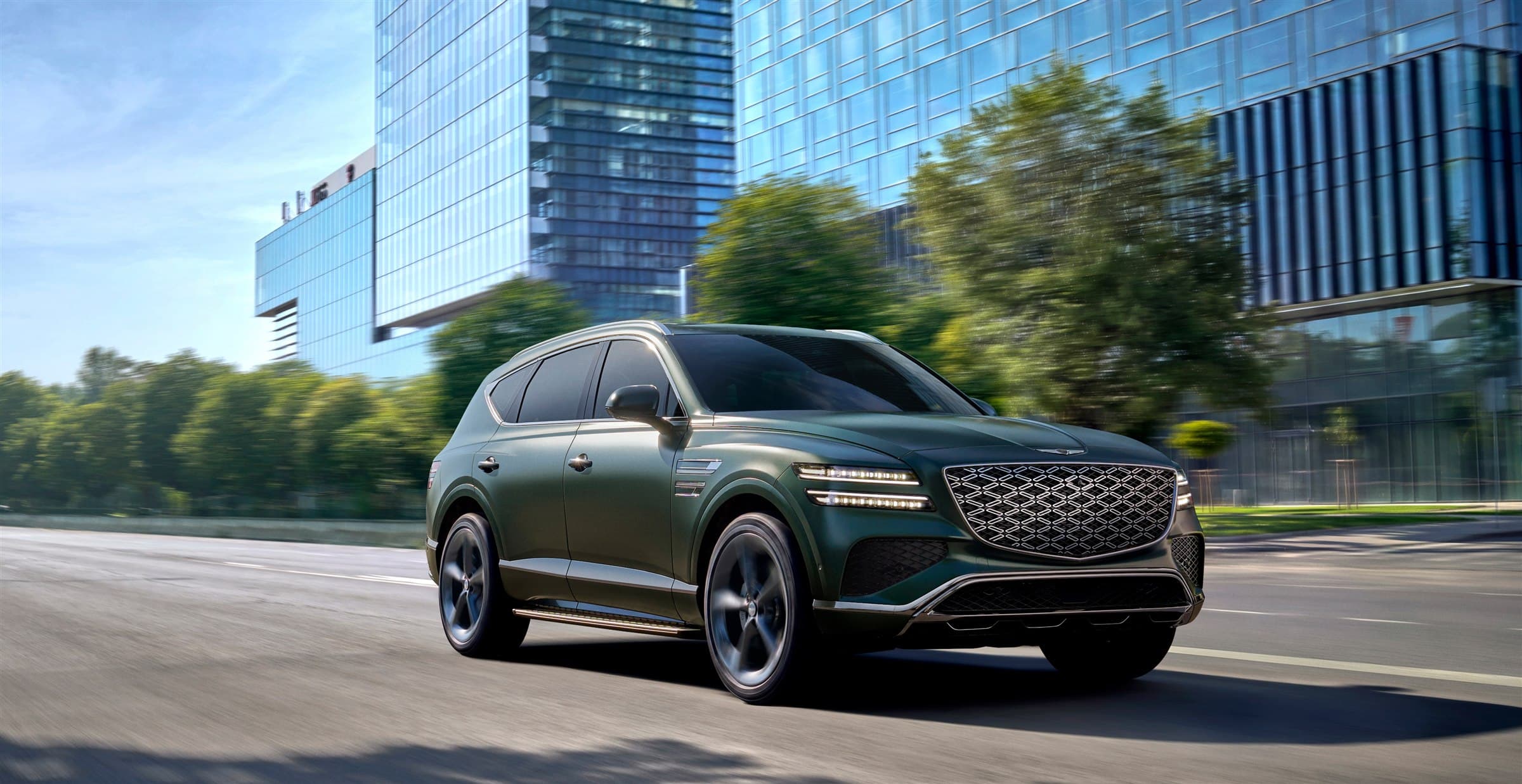
The 2027 Genesis GV80 Hybrid is the first hybrid the Korean luxury brand has ever built, and it arrives with a bigger claim than simple fuel savings. Genesis unveiled the powertrain on August 13, 2026, describing it as a next-generation system engineered for an EV-like driving experience. It pairs the familiar 2.5-liter turbocharged four-cylinder with two electric motors for a combined 259 kW (352 PS, about 347 hp) and 54.0 kgf·m (roughly 529 Nm) of torque, which is around 16% more power and 26% more torque than the gasoline GV80 2.5T. Genesis quotes 0–100 km/h in about 7.1 seconds and a fuel-economy gain of roughly 25% or more. This is a conventional, non-plug-in hybrid (HEV): there is no charging port and no pure-electric range to plan around. Official pricing has not been announced, so the starting price stays “TBA” here until Genesis publishes it.
Performance & Specs
Genesis calls the setup the 2.5 Turbo Hybrid System, a parallel hybrid with two electric machines. A starter-generator motor (P1) starts the engine and generates power, while a drive motor (P2) helps propel the car and handles regenerative braking. Together with the 2.5-liter turbo four, they produce a combined system output of 259 kW (352 PS / 347 hp) and 54.0 kgf·m of torque. For an English-speaking reader, that is a 347-hp SUV that sits between the gasoline GV80 2.5T (300 hp) and the twin-turbo 3.5T V6 (375 hp), while matching that V6 closely on torque. Genesis says the car reaches 100 km/h in approximately 7.1 seconds, and that re-acceleration from 100 km/h is about 18% quicker than the 2.5T thanks to a simultaneous downshift and engine-clutch engagement. Power goes through a seven-speed transmission built for rear-wheel-drive layouts; there is no dedicated reverse gear, because the P2 motor simply spins backward. Korean coverage of the certification data indicates that both rear-wheel-drive and all-wheel-drive versions are coming, while U.S. reports from Cars.com and Kelley Blue Book also list RWD and AWD.

| Powertrain | Parallel hybrid (HEV, non-plug-in) |
|---|---|
| Power | 259 kW (352 PS / 347 hp) combined |
| Torque | 54.0 kgf·m (approx. 529 Nm) |
| Engine | 2.5L turbo inline-four + P1/P2 electric motors |
| Transmission | 7-speed, RWD-based |
| 0–100 km/h | approx. 7.1 s |
| POWERTRAIN TYPE | Parallel hybrid (HEV), no plug-in |
|---|---|
| HORSEPOWER | 259 kW (352 PS / 347 hp) combined |
| TORQUE | 54.0 kgf·m (approx. 529 Nm / 391 lb-ft) |
| ACCELERATION | 0–100 km/h in approx. 7.1 s |
| TOP SPEED | Not yet disclosed |
| DRIVETRAIN | RWD-based; RWD and AWD reported |
| TRANSMISSION | 7-speed automatic (RWD-type) |
| BATTERY | Liquid-cooled; capacity not yet disclosed |
| FUEL ECONOMY | Approx. 25%+ better than GV80 2.5T (Genesis internal test, 19-inch 2WD 5-seater) |
Dimensions & Practicality

| Length | 4,945 mm |
|---|---|
| Width | 1,975 mm |
| Height | 1,715 mm |
| Wheelbase | 2,955 mm |
Genesis has not published separate dimensions for the hybrid, and the visual changes it has announced are limited to a redesigned grille and new wheels, so the figures above are those of the standard GV80 SUV body: about 4,945 mm long, 1,975 mm wide and 1,715 mm tall on a 2,955 mm wheelbase. The tested efficiency figure refers to a five-seat car, and Korean certification reports say both five- and seven-seat layouts are planned, matching the way the gasoline GV80 is sold. Cargo volume for the hybrid has not been released, and Genesis has not said how much space, if any, the liquid-cooled battery takes from the floor, so we are not printing a boot figure until the company does. Genesis has also not announced a hybrid version of the swoopier GV80 Coupe; every official hybrid image and statement so far refers only to the standard SUV.
| LENGTH | 4,945 mm (standard GV80 body) |
|---|---|
| WIDTH | 1,975 mm |
| HEIGHT | 1,715 mm |
| WHEELBASE | 2,955 mm |
| SEATING | 5 or 7 seats reported |
| CARGO VOLUME | Not yet disclosed |
Charging & Battery
There is nothing to plug in. The GV80 Hybrid is a self-charging hybrid: its battery is topped up by the engine through the P1 starter-generator and by regenerative braking, so owners simply fill the tank with gasoline as they would in any other car. What makes the battery notable is not its size, which Genesis has not disclosed, but its cooling. It is the first liquid-cooled hybrid battery in the Hyundai Motor Group, and Genesis says coolant-based temperature control lets the pack deliver higher peak discharge and be used more aggressively than the air-cooled batteries in earlier group hybrids. In practice that supports the brand’s EV-like promise: the car starts off in electric mode and stays there up to roughly 30 km/h, which keeps cold starts quiet in parking garages, and it tries to maximise electric running in stop-and-go traffic.
| BATTERY | Liquid-cooled hybrid battery, capacity not disclosed |
|---|---|
| EXTERNAL PLUG-IN CHARGING | Not available (non-plug-in hybrid) |
| EV MODE | From standstill up to approx. 30 km/h |
| FUEL TYPE | Gasoline |
Design & Interior
Genesis keeps the GV80’s upright, two-line-headlight face but gives the hybrid a newly designed grille and new wheels so it can be told apart from the gasoline models. Inside, the hybrid gets four new two-tone colour combinations, including Obsidian Black with Taiga Green and Ultramarine Blue with Travertine Beige, plus two new real-wood trim options with updated quilting patterns. The press photos show diamond-quilted leather seats with contrast stitching and a wide curved display that flows into a slim centre console with a rotary controller. Genesis’s press material focuses on quietness, and it lists several noise-control measures aimed at the engine: a lower final-drive ratio than the gasoline car, a new crankshaft damper pulley, and a centrifugal pendulum absorber on the transmission.
Technology & Features
The hybrid’s software is where most of the announced new technology sits. Hierarchical Predictive Control looks at the planned route and road conditions to decide when to charge and when to use electric power, while Smart Regenerative Braking uses navigation data and the distance to the vehicle ahead to set the strength of regeneration, reducing how often the driver needs the brake pedal. Stay Mode lets the climate control and multimedia keep running from the high-voltage battery without waking the engine, which is useful when waiting in the car. Genesis has not announced infotainment or driver-assistance changes specific to the hybrid, so we treat those as carried over from the standard GV80 until the company says otherwise.
Available Versions
| VERSION | POWER | TORQUE | 0-100 | TOP SPEED | DRIVETRAIN | PRICE | KEY DIFFERENCES |
|---|---|---|---|---|---|---|---|
| GV80 Hybrid (2.5T HEV) | 347 hp | 529 Nm | 7.1s | — | RWD / AWD | TBA | Individual trim levels not yet published; new grille and wheels, four new interior colour combinations, liquid-cooled battery |
Pricing & Availability
Genesis unveiled the GV80 Hybrid on August 13, 2026 and said it would launch in South Korea the following month, but Seoul Economic Daily reported on September 23 that sales would begin in October. Genesis itself has said the final Korean price has not been set and will be released when sales open. Korean press expects an entry price near 80 million won (about $57,600), against 68.86 million won for the current GV80 2.5 Turbo; that is a press expectation, not an official figure. In the United States the hybrid is confirmed as a 2027 model, but Genesis says launch timing and pricing will follow later, and U.S. fuel-economy ratings from the EPA have not been published. It will be the first hybrid Genesis sells in America.
How It Compares
The Genesis is expected to land in the same money as the two hybrid SUVs in our catalog. The Hyundai Palisade Hybrid is its corporate cousin, and its hybrid system is the starting point for the Genesis one: the Palisade uses a transverse layout with 329 hp, while the GV80 Hybrid is longitudinal and RWD-based with 347 hp, roughly 5% more. The Toyota Land Cruiser hybrid at 326 hp is a rugged, boxier alternative, and Lexus’s TX 500h reaches 366 hp, per Cars.com, a benchmark that outguns the Genesis on paper. To be clear, these are catalog prices in the U.S. market against a GV80 Hybrid price that has not been announced, so treat the pricing as context, not a head-to-head. The Zeekr 8X is a different story: at $54,600 in China it offers 1,381 hp and a 1,416 km combined range, a stark value contrast for buyers whose budget is around $57,000. It is not sold where the GV80 is, so it is a value snapshot, not a cross-shop.
- 347 hp and 529 Nm from a self-charging hybrid, about 16% and 26% more than the GV80 2.5T
- Claimed fuel-economy gain of 25% or more, with quiet electric starts up to about 30 km/h
- First liquid-cooled hybrid battery in Hyundai Motor Group, plus RWD-based layout and AWD reported
- No official price, battery size, cargo volume or top speed yet, and U.S. timing is still open
- Not a plug-in: no pure-electric range beyond low-speed EV mode, unlike PHEV rivals
The GV80 Hybrid is aimed at luxury SUV buyers who want lower fuel bills and a smoother, quieter drive without giving up power or dealing with a charger. On paper it is the best GV80 short of the V6: more torque than the gasoline four, a claimed 25% efficiency gain and thoughtful software for quiet city driving. What is missing matters, though: price, battery capacity, cargo space and confirmed U.S. dates. If Genesis prices it near the 80 million won figure that Korean media expects, it will be a strong, if not cheap, hybrid choice. We recommend waiting for official pricing and EPA numbers before committing.