
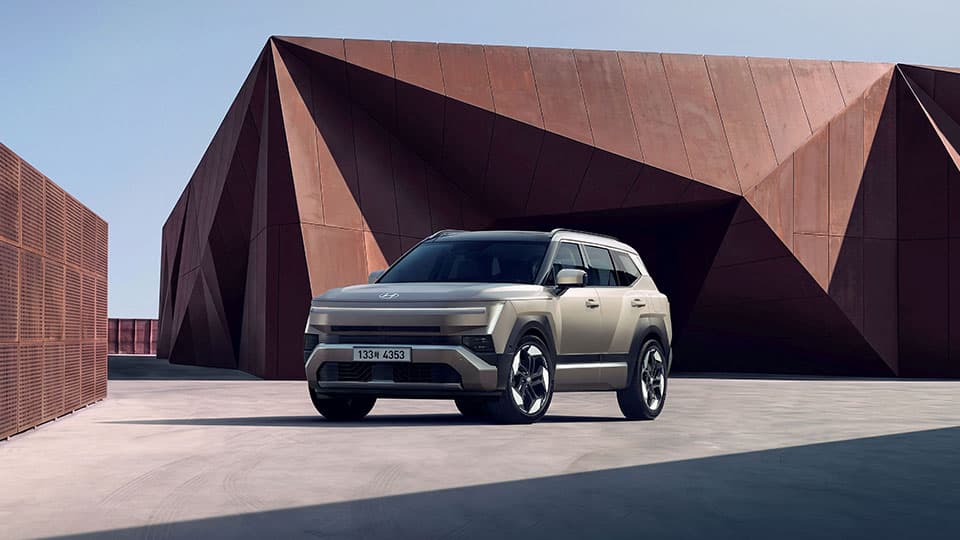
Hyundai has pulled the cover off the fifth-generation Tucson, its first full redesign of the compact SUV in six years, at a media event in Paju, South Korea. The headline news is the next-generation hybrid powertrain: a 1.6-liter turbocharged four-cylinder paired with a new dual-motor hybrid transmission that raises system output to 245 PS (242 hp), up from 172 kW in the outgoing hybrid. Hyundai says the new Tucson Hybrid is roughly a second quicker to 100 km/h than the non-hybrid model and posts a combined 17.4 km/L on the Korean test cycle, which converts to about 41 mpg. The bodywork has grown in every direction, the cabin gets Hyundai's new Pleos Connect software platform with a generative-AI assistant, and this is not the brand's first attempt at an electrified Tucson — the nameplate has offered a hybrid since the fourth generation launched in 2020, so this is a next-generation update to an established powertrain rather than a debut. Domestic Korean sales open in October 2026, with pricing to follow at that time and other markets, including North America, expected to get their own specifications and launch windows afterward.
Performance & Specs
The new hybrid system, internally called TMED-II FF, pairs the familiar 1.6-liter turbo four with two electric motors instead of one. A P1 motor starts the engine, generates electricity, and assists propulsion, while a P2 motor drives the wheels directly and handles regenerative braking. Combined output is 180 kW (245 PS / 242 hp) and 380 Nm (280 lb-ft) of torque, an increase of 8 kW and 13 Nm over the current Tucson Hybrid. Hyundai quotes 0-100 km/h in 8.5 seconds, about a second quicker than the non-hybrid version, and a Korean-cycle combined fuel economy of 17.4 km/L, roughly 41 mpg by U.S. conversion — ahead of the Honda CR-V Hybrid's 35-40 mpg, though just behind the Toyota RAV4 Hybrid's 42-43 mpg. Front-wheel drive is standard, with Hyundai's HTRAC all-wheel-drive system available as on the current model. Hyundai has not yet disclosed a top speed or the hybrid battery's exact capacity.

| Powertrain | 1.6L Turbo + TMED-II FF Dual-Motor Hybrid |
|---|---|
| Power | 180 kW (245 PS / 242 hp) |
| Torque | 380 Nm (280 lb-ft) |
| 0–100 km/h | 8.5 s |
| Drivetrain | FWD (HTRAC AWD available) |
| Fuel Economy | 17.4 km/L (≈41 mpg combined) |
| POWERTRAIN TYPE | HEV (conventional hybrid, no plug-in) |
|---|---|
| HORSEPOWER | 242 hp (245 PS / 180 kW) |
| TORQUE | 280 lb-ft (380 Nm) |
| ACCELERATION | 8.5 s (0–100 km/h) |
| DRIVETRAIN | FWD standard, HTRAC AWD available |
| FUEL ECONOMY | 17.4 km/L combined (Korean cycle, ≈41 mpg US) |
Dimensions & Practicality

| Length | 4,700 mm |
|---|---|
| Width | 1,905 mm |
| Height | 1,685 mm |
| Wheelbase | 2,785 mm |
Every headline dimension grows over the outgoing model: length is up 60 mm to 4,700 mm, width up 40 mm to 1,905 mm, and the wheelbase stretches 30 mm to 2,785 mm. Hyundai says that translates directly into cabin space, with second-row headroom growing 29 mm to 1,031 mm and the rear doors now opening to 83 degrees, up from 73 degrees, for easier entry and child-seat access. The larger footprint also improves aerodynamics rather than hurting it — Hyundai quotes a drag coefficient of 0.30, down from 0.33 on the previous generation, aided by revised wheel designs and active air flaps. Hyundai has not yet published official cargo volume or ground-clearance figures for the redesigned model; those are expected alongside the full Korean specification and pricing release in October 2026.
| LENGTH | 4,700 mm |
|---|---|
| WIDTH | 1,905 mm |
| HEIGHT | 1,685 mm |
| WHEELBASE | 2,785 mm |
| CARGO VOLUME | TBA (not yet disclosed) |
Charging & Battery
The Tucson Hybrid is a conventional, non-plug-in hybrid, so there is no charge port and no external charging to plan for — the compact lithium-ion battery is topped up automatically by the P1 generator motor and by regenerative braking every time the driver lifts off the throttle or brakes. Hyundai has not disclosed the exact battery capacity for the new TMED-II FF system, though the outgoing Tucson Hybrid uses a battery in the 1.5 kWh class, sized purely to smooth out power delivery and enable short electric-only crawling rather than meaningful EV range. Owners refuel with regular gasoline exactly as they would a non-hybrid Tucson, with the hybrid system working in the background to cut fuel use in stop-and-go driving and around town.
| BATTERY TYPE | Compact lithium-ion hybrid battery (capacity not yet disclosed) |
|---|---|
| CHARGING METHOD | Self-charging via regenerative braking and P1 generator motor — no external plug |
| REFUELING | Standard gasoline; no plug-in required |
Design & Interior
Hyundai calls the new design language "Art of Steel," and it shows up as a much boxier, more angular silhouette than the outgoing Tucson's swoopy surfacing. The front end carries a full-width lighting bar and a sharper, more upright grille, while official photos also reveal a rugged XRT trim with contrast cladding, unique dark-finish wheels, and its own "TUCSON XRT" badge, alongside the standard model's smoother, chrome-accented treatment. Around back, a full-width light bar and a raised, more vertical tailgate emphasize the extra cargo space Hyundai is promising even before official volume figures land. Inside, the redesigned dashboard pairs a wide, 16:9 infotainment display — offered in 12.9-inch or 17-inch sizes — with a digital instrument cluster, and Hyundai has deliberately kept physical buttons and dials for climate control rather than pushing every function into the touchscreen. The steering wheel, seats, and door panels all carry updated trim and stitching, and the greenhouse benefits from the enlarged glass area that comes with the bigger body. It is a more grown-up cabin than before, aimed squarely at buyers cross-shopping the RAV4 and CR-V rather than budget-focused compact crossovers.
Technology & Features
The biggest technology story is Pleos Connect, Hyundai's new software-defined infotainment platform, making its SUV debut on the Tucson. It bundles navigation, media, and vehicle functions into one interface and introduces Gleo AI, a generative-AI voice assistant that Hyundai says can handle natural-language requests rather than rigid voice commands. A new Pleos App Market lets owners download third-party streaming, music, and gaming apps directly to the car, and the system supports over-the-air updates so features can keep improving after purchase. Display options run up to a 17-inch, 16:9 panel, paired with the earlier-generation Tucson's now-familiar dual-screen layout reworked around the new software. Hyundai has not detailed connected-services pricing or a specific chip/compute platform for Pleos Connect as of this reveal.
Safety & ADAS
Alongside the redesign, Hyundai is introducing a handful of safety features that are new to the brand or the segment. A backup power system keeps the door-unlock mechanism functional after a collision, which Hyundai says is a first for any of its models, while Memory Reverse Assist — which can recall and re-drive a previously recorded reversing route — is described as a segment-first for the Tucson. The car also gains pedal misapplication assistance to help prevent sudden unintended-acceleration incidents, plus a Surround View Monitor with a Ground View mode that renders a transparent view of the terrain beneath the vehicle for tighter parking and light off-road maneuvering. Additional driver-assistance features carried over and updated include navigation-based adaptive cruise control and rear parking collision-avoidance assistance.
| ADAS FEATURES | Navigation-based adaptive cruise control, forward/rear parking collision-avoidance assist, pedal misapplication assistance, Surround View Monitor with Ground View, Memory Reverse Assist |
|---|---|
| SAFETY FIRST | Backup power for door unlock after a collision (Hyundai-first) |
Available Versions
| VERSION | POWER | TORQUE | 0-100 | TOP SPEED | DRIVETRAIN | BATTERY | PRICE | KEY DIFFERENCES |
|---|---|---|---|---|---|---|---|---|
| Hybrid | 242 hp | 280 lb-ft | 8.5s | — | FWD (HTRAC AWD available) | — | TBA | Next-gen TMED-II FF dual-motor hybrid; 17.4 km/L (≈41 mpg) combined |
| Hybrid XRT | 242 hp | 280 lb-ft | 8.5s | — | FWD (HTRAC AWD available) | — | TBA | Rugged-styled trim seen at the reveal: contrast cladding, dark-finish wheels, "TUCSON XRT" badge; same hybrid powertrain |
Pricing & Availability
Hyundai has not announced pricing for the fifth-generation Tucson, hybrid or otherwise. Full Korean-market pricing and the trim lineup are scheduled to be revealed in October 2026, alongside the start of domestic sales. For context only, the outgoing gasoline Tucson has been priced from around 28 million Korean won in its home market, with the closest rival, the Kia Sportage, starting near 29 million won — neither figure should be read as a preview of the new hybrid's price. Hyundai has said other markets will follow Korea, with North American specifications expected as soon as early October 2026, but a confirmed U.S. on-sale date and MSRP have not been released as of this writing.
How It Compares
With Tucson Hybrid pricing still unannounced, the fairest comparison right now is power-for-power rather than dollar-for-dollar. In our own catalog, the closest same-segment hybrid is the Subaru Forester Hybrid, and the Tucson's 242 hp comfortably beats its 194 hp while promising similar real-world efficiency. Stack the Tucson's output against our Chinese EV/PHEV coverage and the number that jumps out is how little outright power now costs there: the XPENG Mona L03 matches the Tucson's 242 hp almost exactly for roughly half the money (if it ever lands in Tucson's markets), and the GAC Aion i60 REV is within a hair of it for even less. None of these are direct cross-shops for a mainstream gasoline-hybrid buyer, but they illustrate the power-per-dollar gap Chinese EVs and EREVs have opened up. Against real-world segment rivals, the story is closer: Hyundai's 242 hp beats the Honda CR-V Hybrid's 204 hp outright and edges the Toyota RAV4 Hybrid's 226-236 hp, though the RAV4 still claims a slight edge in combined fuel economy.
- 242 hp combined output beats the Honda CR-V Hybrid and matches or exceeds the Toyota RAV4 Hybrid, with a quoted 41 mpg combined
- Meaningfully larger cabin than before, with a 30 mm longer wheelbase, 29 mm more rear headroom, and wider-opening rear doors
- New Pleos Connect infotainment with a generative-AI assistant, while keeping physical climate controls instead of going touch-only
- No pricing announced yet for any market, including Korea, making it impossible to judge value until October 2026 at the earliest
- Toyota's RAV4 Hybrid still posts slightly better combined fuel economy (42-43 mpg vs. the Tucson's 41 mpg)
The fifth-generation Tucson Hybrid looks like exactly the update this segment needed: more power than its two biggest hybrid rivals, a noticeably roomier cabin, and genuinely new safety and infotainment tech rather than a routine refresh. It's aimed at buyers who want a Toyota RAV4 Hybrid or Honda CR-V Hybrid alternative with a bit more punch and a more modern cabin, not at anyone chasing outright EV range or a plug. The only real unknown is money — Hyundai has stayed quiet on pricing for every market, so this remains a strong-on-paper redesign until Korea's October reveal fills in the numbers that actually decide whether it's a good deal.