
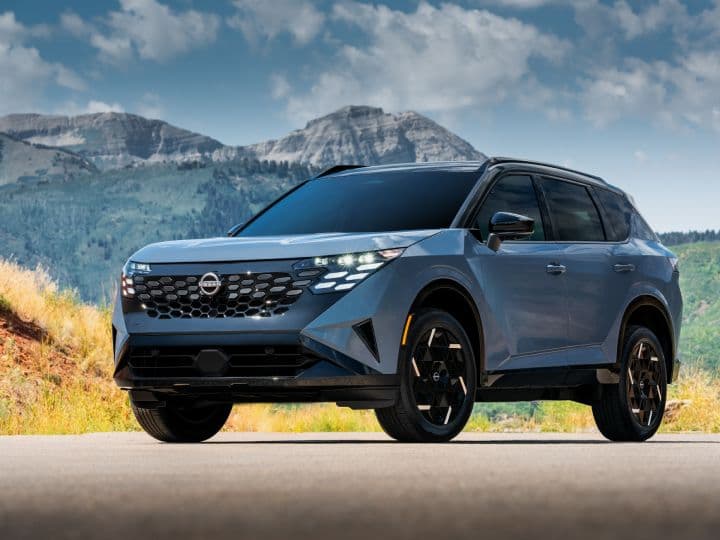
The 2027 Nissan Rogue Hybrid marks the American debut of Nissan's e-POWER technology, a series-hybrid system the automaker has already sold nearly 2 million copies of across 68 countries since 2016 — just never before in the United States. Revealed at Nissan's Vision Event on September 21, 2026, the new Rogue Hybrid pairs a 1.5-liter turbocharged three-cylinder engine, used purely as a generator, with two electric motors that do all the actual driving. Pricing starts at $37,065 including destination for the SV AWD grade, rising to $45,065 for the range-topping Platinum AWD. Every single trim comes standard with dual-motor electric AWD, a distinction Nissan is leaning on hard against the front-wheel-drive-standard Toyota RAV4 Hybrid and Honda CR-V Hybrid. The SR AWD with SR Technology Package leads the charge this fall, with the rest of the lineup following in early 2027. This is a conventional hybrid with no plug and no external charging port — but its series-hybrid layout gives it a noticeably different driving character than a typical parallel hybrid.
Performance & Specs
Under the hood, a 1.5-liter turbocharged inline-three makes 148 hp and 171 lb-ft on its own — but in the Rogue Hybrid it never turns the wheels. Instead it spins a generator that feeds a 1.67-kWh lithium-ion battery and two electric motors: a 202-hp, 243-lb-ft unit up front and a 134-hp, 144-lb-ft unit at the rear, for a combined system output of 225 horsepower. Nissan calls this its third-generation e-POWER system, engineered for 42% thermal efficiency, and says the result is instant, EV-like torque delivery with none of the RPM flare or gear-hunting typical of a parallel hybrid. Every grade gets the dual-motor setup as standard, giving genuine all-wheel drive with torque vectoring rather than treating AWD as an options-list add-on like most hybrid rivals do. Nissan hasn't published a 0-60 mph time or top speed, describing acceleration only as "swift, smooth and confident," and early prototype drives back that up, comparing the initial punch to a Nissan Leaf rather than a traditional turbo SUV. A class-exclusive e-Pedal with Smooth Stop technology also enables true one-pedal driving down to a complete stop.

| Powertrain | Series Hybrid (e-POWER, 3rd gen) |
|---|---|
| Total System Power | 225 hp |
| Front Motor | 202 hp / 243 lb-ft |
| Rear Motor | 134 hp / 144 lb-ft |
| Generator Engine | 1.5L turbo I3, 148 hp (never drives wheels) |
| Battery | 1.67 kWh lithium-ion |
| POWERTRAIN TYPE | Series Hybrid (e-POWER) |
|---|---|
| HORSEPOWER | 225 hp (combined system) |
| ACCELERATION | Not yet disclosed by Nissan |
| TOP SPEED | Not yet disclosed by Nissan |
| DRIVETRAIN | Standard Dual-Motor AWD |
| BATTERY | 1.67 kWh lithium-ion |
| FUEL ECONOMY (COMBINED) | 38 mpg (40 city / 36 highway, SR trim) |
| TOWING CAPACITY | 1,500 lbs (680 kg) |
Dimensions & Practicality

| Length | ≈ 4,651 mm |
|---|---|
| Width | ≈ 1,829 mm |
| Height | ≈ 1,720 mm |
| Wheelbase | 2,705 mm |
Nissan says the Hybrid's body is only about 0.1 inch longer, 0.4 inch narrower and 1.2 inches taller than the outgoing gas-only Rogue, which puts it at roughly 4,651 mm long on a 2,705 mm wheelbase — unchanged from the standard Rogue. Inside, Nissan claims more front headroom than any hybrid in its class and class-leading front legroom among hybrids, a genuine differentiator in a segment where hybrid battery packaging often eats into cabin space. Cargo capacity holds up well too: 31.1 cubic feet (881 L) behind the rear seats, expanding to 65.9 cubic feet (1,866 L) with them folded flat, figures that are competitive with the RAV4 Hybrid and CR-V Hybrid despite the underfloor battery and dual-motor hardware. Rear passengers get their own climate and device-charging controls on higher trims, and the panoramic glass roof carries over as an available feature.
| LENGTH | ≈ 4,651 mm (183.1 in) |
|---|---|
| WIDTH | ≈ 1,829 mm (72.0 in) |
| HEIGHT | ≈ 1,720 mm (67.7 in) |
| WHEELBASE | 2,705 mm (106.5 in) |
| CARGO VOLUME | 881 L seats up (1,866 L seats folded) |
Charging & Battery
There's no plug on the 2027 Rogue Hybrid, and that's the point of the e-POWER layout: the 1.67-kWh lithium-ion battery is replenished entirely by the 1.5-liter turbo engine acting as a generator and by regenerative braking through the e-Pedal system, never by an external charger. That's a much smaller pack than a plug-in hybrid carries, because it only needs to buffer power between the generator and the drive motors rather than store miles of pure-electric range. The tradeoff is simplicity for the owner — refuel with regular gasoline exactly like any other car, with none of the home-charger installation or public-charging planning a PHEV or EV demands, while still getting EV-style instant torque and a 38-mpg combined rating that beats the outgoing gas Rogue by more than six mpg.
| BATTERY | 1.67 kWh lithium-ion |
|---|---|
| CHARGING METHOD | Engine-generator + regenerative braking only |
| EXTERNAL PLUG-IN CHARGING | Not available (non-plug hybrid) |
| FUEL TYPE | Regular unleaded gasoline (generator engine) |
Design & Interior
Exterior styling keeps the current Rogue's silhouette but sharpens nearly every panel, with a bolder split-headlight face, more angular fender flares and a new lighting signature Nissan describes as "Japanese-inspired." SR grades pick up darker exterior trim and unique wheel designs, while the Platinum wears a distinct grille treatment, its own badge, and standard 19-inch wheels with a more upscale two-tone stance. Inside, the cabin trades the outgoing Rogue's mixed-material dash for a cleaner, more horizontal layout dominated by the available dual 14.3-inch display pairing, framed by a new twin-spoke steering wheel that echoes the Nissan Leaf's cabin language. Physical climate controls remain below the main touchscreen rather than disappearing into a menu, and Nissan has reworked interior storage with deeper door bins and a reshaped center console. Ventilated front seats and heated rear seats are available options, and the Platinum trim adds quilted leather upholstery and dual Qi2 wireless phone chargers rated at 15 watts — Nissan calls it the segment's first magnetic Qi2 setup, which keeps a phone from sliding around under hard cornering. Overall, the cabin feels noticeably more premium than the price suggests, a deliberate move to close the gap with pricier hybrid crossovers.
Technology & Features
The standard infotainment setup is a 12.3-inch touchscreen with wireless Apple CarPlay and wireless Android Auto built in, no dongles required. Stepping up to the optional (SR) or standard (Platinum) 14.3-inch display adds Google built-in, giving the Rogue Hybrid native Google Maps routing, Play Store app access, and Google Gemini as a voice assistant that understands natural conversational requests rather than a fixed command list. The digital gauge cluster shown through the new twin-spoke wheel carries drive-mode and energy-flow readouts specific to the e-POWER system, letting drivers watch the generator, battery and motors work in real time. Every grade includes the class-exclusive 15-watt Qi2 magnetic wireless charger, and the Platinum doubles that with a second pad for front passengers.
Safety & ADAS
Nissan's latest-generation ProPILOT Assist headlines the safety suite, built around a new front radar sensor and a front camera with a 20% wider field of view than the outgoing Rogue's system. Adaptive cruise control now offers four following-distance settings and reacts to slowing or stopped traffic roughly a third sooner than before, while steering assist and lane centering have both been retuned for smoother, less-twitchy corrections. Higher grades add temporary hands-off driving during low-speed traffic jams and automated lane changes on divided highways, supervised features that stop short of full self-driving but meaningfully cut driver workload on long commutes. Automatic emergency braking with pedestrian and cyclist detection, blind-spot warning, automatic high beams, lane departure warning and rear cross-traffic alert are all standard from the base SV grade up.
| ADAS LEVEL | L2 (ProPILOT Assist, latest generation) |
|---|---|
| ADAS FEATURES | AEB w/ pedestrian & cyclist detection, adaptive cruise, lane departure warning, lane centering, blind-spot warning, rear cross-traffic alert, hands-off traffic jam support and auto lane change (higher trims) |
Available Versions
| VERSION | POWER | TORQUE | 0-100 | TOP SPEED | DRIVETRAIN | BATTERY | PRICE | KEY DIFFERENCES |
|---|---|---|---|---|---|---|---|---|
| SV AWD | 225 hp | 243 lb-ft front / 144 lb-ft rear | — | — | AWD | 1.67 kWh | $37,065 | Entry grade; 12.3-in touchscreen, wireless CarPlay/Android Auto, e-Pedal, ProPILOT Assist standard |
| SV AWD w/ SV Premium Package | 225 hp | 243 lb-ft front / 144 lb-ft rear | — | — | AWD | 1.67 kWh | $39,165 | Adds SV Premium Package equipment over base SV |
| SR AWD | 225 hp | 243 lb-ft front / 144 lb-ft rear | — | — | AWD | 1.67 kWh | $39,065 | Mid-grade trim, sportier exterior detailing |
| SR AWD w/ SR Technology Package | 225 hp | 243 lb-ft front / 144 lb-ft rear | — | — | AWD | 1.67 kWh | $43,065 | First trim on sale (fall 2026); adds optional 14.3-in Google built-in display, hands-off Traffic Jam Support, auto lane change |
| Platinum AWD | 225 hp | 243 lb-ft front / 144 lb-ft rear | — | — | AWD | 1.67 kWh | $45,065 | Standard dual 14.3-in displays, quilted upholstery, dual Qi2 wireless chargers, 19-in wheels |
Pricing & Availability
The 2027 Nissan Rogue Hybrid was revealed on September 21, 2026 at Nissan's Vision Event, with pricing running from $37,065 for the SV AWD up to $45,065 for the Platinum AWD, all figures including a $1,575 destination charge. Nissan is staging the rollout: the SR AWD with SR Technology Package is the only configuration on sale this fall, arriving at US dealers in late 2026, with the SV, SV Premium, base SR and Platinum grades following in early 2027. This is Nissan's first e-POWER model sold in the United States and Canada, even though the underlying technology has already powered nearly 2 million vehicles across 68 countries — including Japan, several European markets, Australasia, Turkey, Israel and Morocco — since its 2016 debut.
How It Compares
The Rogue Hybrid doesn't have a same-segment rival in freshmotors' own catalog — our coverage skews heavily toward Chinese EVs, PHEVs and EREVs, and America's conventional-hybrid compact SUV segment (RAV4 Hybrid, CR-V Hybrid) simply isn't something we track spec-for-spec. So instead of forcing an apples-to-apples comparison, it's worth seeing what a similar budget buys on the other side of the world: for almost exactly the Rogue Hybrid's $37,065 starting price, our database shows Chinese electrified SUVs like the XPENG G7 and AVATR 07 REV already delivering 50-110 more horsepower and well over 1,000 km of combined range from a plug-in EREV setup, while the BYD Tang packs more than double the Rogue's power in a PHEV SUV at essentially the same money. None of these three are sold in the US, so this isn't a real cross-shop — it's a value snapshot of how far a comparable dollar stretches in China's much more competitive electrified-SUV market versus what a mainstream American buyer gets from a brand-new, plug-free hybrid architecture. For American buyers who can't or don't want to plug in, the Rogue Hybrid's appeal is precisely that it avoids the range anxiety and charging-infrastructure questions these three cars still carry outside China.
- Standard dual-motor AWD on every single trim, unlike the front-wheel-drive-standard RAV4 Hybrid and CR-V Hybrid
- 225-hp series-hybrid system delivers genuinely EV-like, instant torque with no plug or charging infrastructure required
- Class-leading front headroom and legroom among hybrid compact SUVs, plus competitive 881-1,866 L cargo capacity
- Nissan has not disclosed a 0-60 mph time or top speed, making it hard to judge real-world performance against rivals
- Only the SR AWD with SR Technology Package is available this fall; the rest of the lineup (including the base SV) doesn't arrive until early 2027
The 2027 Nissan Rogue Hybrid is for buyers who want a hybrid's fuel savings and an EV's smoothness without ever touching a charging cable, and standard all-wheel drive on every trim is a genuine edge over the segment's two biggest sellers. Nissan nails the fundamentals here: real cargo space, class-leading front-seat room, and a series-hybrid layout that should feel noticeably calmer than a conventional hybrid's constant engine drone under acceleration. The trade-offs are that Nissan is still holding back hard performance numbers, and the fully-loaded lineup won't be complete at dealers until early 2027, so shoppers in a hurry are limited to one configuration this fall. For a first-generation e-POWER launch in a brand-new market, this is a confident, well-equipped effort rather than a tentative toe in the water — recommended for hybrid shoppers who value all-weather traction over outright plug-in range.