
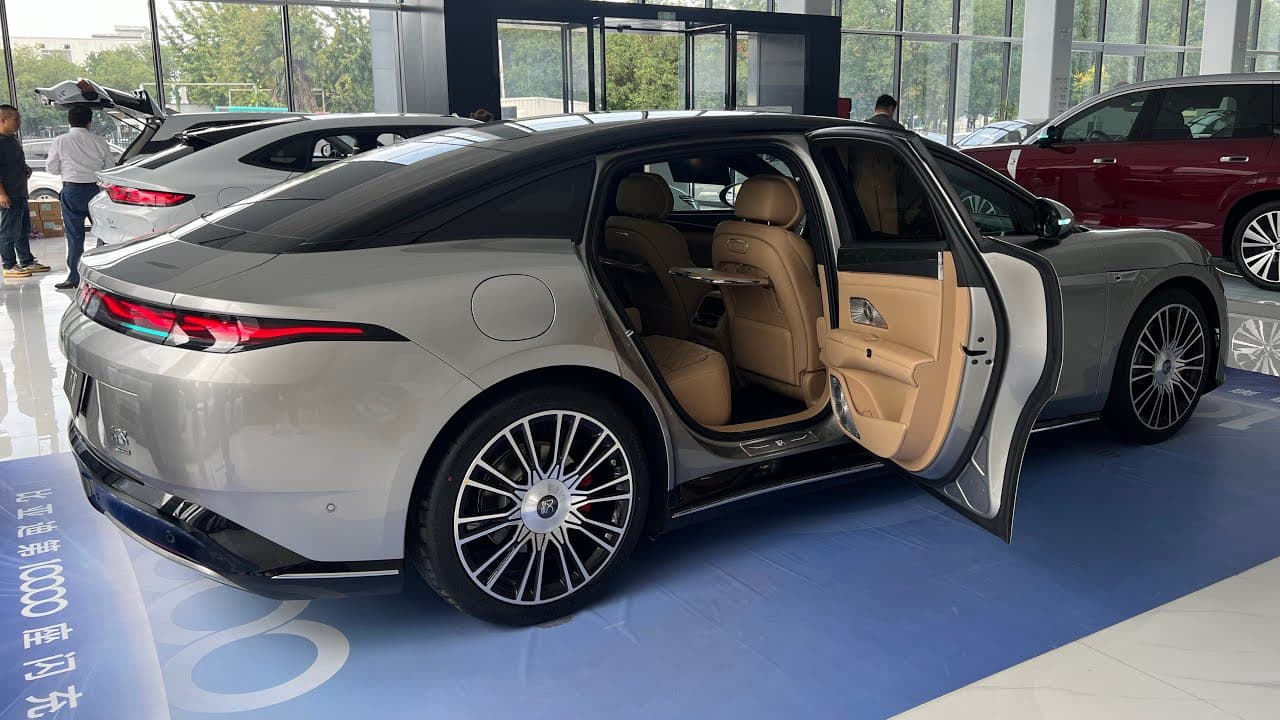
BYD has opened pre-sales on the Da Han EV (called the Great Han in some English-language coverage), a 5,256 mm flagship sedan that Chinese press positions as the top large sedan in BYD's Dynasty range. It debuted on 21 August 2026 at the Chengdu Auto Show with three trims priced from 249,900 yuan, about $37,300 at the roughly 6.7 yuan-per-dollar rate used in the reviewer's video. The rear-drive versions claim 1,008 km of CLTC range from a 102.3 kWh second-generation Blade Battery, and BYD quotes its 1,000 V flash-charging system at 10 to 97 percent in 9 minutes. Every trim comes with dual-chamber air suspension, rear-wheel steering and a roof-mounted LiDAR for the God's Eye B driver-assistance system, while the top all-wheel-drive version makes 570 kW (764 hp). Official launch and first deliveries are expected in the fourth quarter of 2026, and this walkthrough combines the launch specifications, regulatory filings and a hands-on showroom video of the car.
Performance & Specs
The rear-drive Da Han uses a single permanent-magnet motor that produces 370 kW (496 hp) and, according to the MIIT regulatory filing, tops out at 240 km/h. The all-wheel-drive flagship adds a 200 kW (268 hp) asynchronous motor on the front axle to that 370 kW rear motor, for a combined 570 kW (764 hp) and a 270 km/h top speed. BYD lists the AWD car at 3.8 seconds from 0 to 100 km/h and says its best measured run is 3.3 seconds, with 100 to 150 km/h taking 3.2 seconds and a 100 to 0 km/h stop needing 32.83 metres. An acceleration time for the rear-drive trims has not been published, and neither has a torque figure for either powertrain. Curb weight is 2,505 kg for the AWD car and roughly 2,260 to 2,325 kg for the rear-drive versions, and the 102.3 kWh battery pack alone weighs 725.9 kg.

| Powertrain | Single-motor RWD BEV |
|---|---|
| Power | 370 kW (496 hp) |
| Top speed | 240 km/h |
| Battery | 102.326 kWh LFP |
| Range | 1,008 km (CLTC) |
| Curb weight | 2,260–2,325 kg |
| POWERTRAIN TYPE | Battery electric (BEV), single-motor RWD or dual-motor AWD |
|---|---|
| HORSEPOWER | 370 kW (496 hp) RWD; 570 kW (764 hp) AWD |
| ACCELERATION | AWD 3.8 s 0–100 km/h (3.3 s best measured); RWD not published |
| TOP SPEED | 240 km/h RWD; 270 km/h AWD |
| DRIVETRAIN | RWD (370 kW rear motor) or AWD (200 kW front + 370 kW rear) |
| BATTERY | 102.326 kWh LFP |
| ELECTRIC RANGE | 1,008 km RWD; 880 km AWD (CLTC) |
Dimensions & Practicality

| Length | 5,256 mm |
|---|---|
| Width | 1,999 mm |
| Height | 1,510 mm |
| Wheelbase | 3,130 mm |
| Curb weight | 2,260–2,505 kg |
At 5,256 mm long, 1,999 mm wide and 1,510 mm high on a 3,130 mm wheelbase, the Da Han is about 77 mm longer than a standard-wheelbase Mercedes-Benz S-Class (5,179 mm), and its wheelbase is 160 mm longer than that of BYD's own Han L. It is a five-seater with a low, fastback-style roofline and a claimed drag coefficient of 0.197 Cd. BYD has not published a boot volume; in the video the reviewer estimates roughly 550 litres by eye, so treat that as a rough guide rather than a spec. The showroom car also has a separate front trunk under the bonnet, and its capacity has not been confirmed either.
Rear passengers are clearly the priority. The video shows fold-out tray tables, a screen on the back of each front seat, a ceiling-mounted screen and a touch panel in the rear armrest that controls the cabin settings, and the reviewer says the second row has plenty of leg and head room. Front and rear seats are wrapped in Nappa leather, and the rear seat backs recline electrically by up to 12 degrees.
| LENGTH | 5,256 mm |
|---|---|
| WIDTH | 1,999 mm |
| HEIGHT | 1,510 mm |
| WHEELBASE | 3,130 mm |
| CURB WEIGHT | 2,260–2,325 kg RWD; 2,505 kg AWD |
| TURNING RADIUS | 4.95 m |
| DRAG COEFFICIENT | 0.197 Cd |
| SEATS | 5 |
| CARGO VOLUME | Not yet published |
| FRUNK | Fitted; capacity not yet published |
Charging & Battery
Every pure-electric Da Han carries the same 102.326 kWh lithium iron phosphate pack, a second-generation Blade Battery built by BYD's FinDreams unit, on a 1,000 V architecture. BYD claims 10 to 70 percent in 5 minutes and 10 to 97 percent in 9 minutes; charging 60 percent of a 102.3 kWh pack in 5 minutes implies an average of roughly 740 kW, far above what conventional DC chargers deliver. Chinese press reports that cold weather adds only about 3 minutes at minus 30 degrees Celsius, and pre-sale buyers get 18 months of free flash charging. A peak charging power for this car has not been published.
The rear-drive car's 1,008 km CLTC range works out to about 10.2 kWh per 100 km battery-to-wheel (102.3 kWh divided by 10.08); the 11.5 kWh per 100 km figure quoted in Chinese press is about 13 percent higher, consistent with a charger-side measurement that includes charging losses. The AWD version's 880 km rating equals about 11.6 kWh per 100 km on the same basis. As with any CLTC claim, real-world range will be noticeably lower.
| BATTERY | 102.326 kWh LFP (second-generation Blade Battery, FinDreams) |
|---|---|
| ARCHITECTURE | 1,000 V |
| DC 10-70% TIME | 5 min |
| DC 10-97% TIME | 9 min |
| ENERGY CONSUMPTION | 11.5 kWh/100 km (CLTC, as quoted in Chinese press; likely charger-side) |
Design & Interior
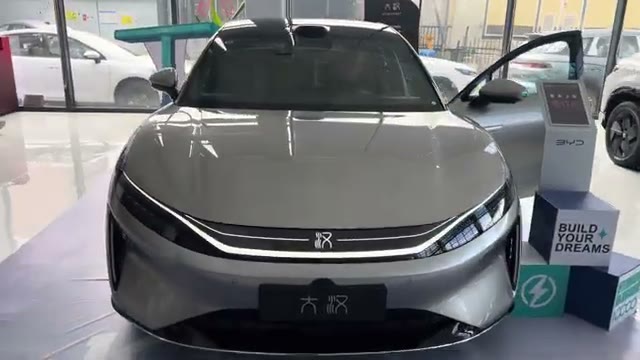
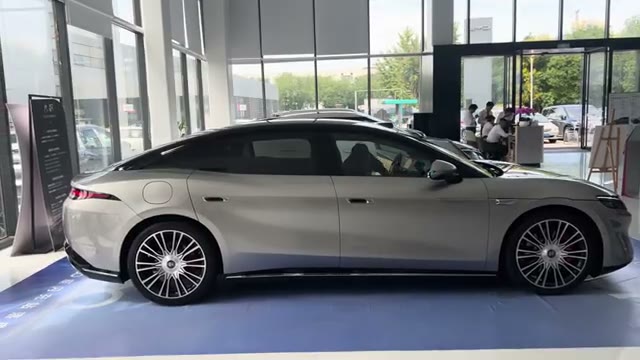
The Da Han is a long, low four-door with the pillars blended into a contrasting silver roofline, semi-hidden door handles and a thin, full-width LED light strip at the nose that BYD says runs 2.41 metres including the daytime running lights. Headlights are slim and the lower intake is trapezoidal, while the rear carries a continuous light bar; the reviewer likens the tail-lamp graphic to the Yangwang U7. Wheels are 21-inch multi-spoke units, and the reviewer reads Continental 255/40 R21 tyres off the showroom car. Chinese press lists nine colour options including two-tones, and the pre-sale offer includes four two-tone paint options free of charge, worth 10,000 yuan.
Inside, the showroom car is trimmed in tan Nappa leather with a diamond-quilted pattern, real white-ash wood trim, chrome switchgear and a steering wheel carrying the Da Han badge. The front seats are zero-gravity chairs with heating, ventilation and massage, and the doors are soft-closing. The rear glass uses black PDLC film that BYD says switches from transparent to fully opaque in about one second, and a panoramic glass roof is listed as standard in the regulatory filing. Audio comes from Devialet with up to 31 speakers, including speakers in the headrests, and the reviewer also points out wireless phone charging.
Technology & Features
The front of the cabin is a three-screen layout: a wide digital instrument cluster, a floating central touchscreen and a display for the front passenger, plus an AR head-up display. The reviewer scrolls through the central screen menus, which include vehicle, lighting, energy, drive and ADAS pages and a seat-control page with a zero-gravity mode, and notes that the interface is available in both Chinese and English on the unit he filmed. Rear passengers get their own screens on the seat backs and the ceiling, and a touch panel in the armrest controls the cabin functions. These are the features of the showroom car; BYD has not published a full per-trim equipment list, so the AR head-up display and rear-seat screens may not be fitted to every trim.
Safety & ADAS
All three trims carry BYD's God's Eye B driver-assistance system in its LiDAR version, the middle tier of BYD's three-level God's Eye range. Hardware includes one roof-mounted LiDAR, five millimeter-wave radars, twelve ultrasonic sensors and eleven cameras. The system offers city navigation assist, highway navigation assist and automated parking. Passive safety figures such as crash ratings have not been published yet, though the car stops from 100 km/h in 32.83 metres according to BYD.
| ADAS LEVEL | L2+ (God's Eye B, LiDAR version) |
|---|---|
| ADAS FEATURES | City and highway navigation assist, automated parking, roof LiDAR, 5 radars, 12 ultrasonic sensors, 11 cameras |
Available Versions
| VERSION | POWER | 0-100 | TOP SPEED | DRIVETRAIN | BATTERY | EV RANGE | COMBINED RANGE | PRICE | KEY DIFFERENCES |
|---|---|---|---|---|---|---|---|---|---|
| RWD LiDAR Premium | 496 hp | — | 240 km/h | RWD | 102.3 kWh | 1,008 km | — | $37,300 | Entry trim (249,900 yuan) with the full 1,008 km battery, air suspension, rear steering and LiDAR |
| RWD LiDAR Flagship | 496 hp | — | 240 km/h | RWD | 102.3 kWh | 1,008 km | — | $40,300 | Same powertrain, 269,900 yuan, a higher equipment level |
| AWD LiDAR Flagship | 764 hp | 3.8 s | 270 km/h | AWD | 102.3 kWh | 880 km | — | $44,700 | 299,900 yuan, adds the 200 kW front motor; BYD's best measured 0-100 is 3.3 s |
Pricing & Availability
Pre-sales opened on 21 August 2026 at 249,900 yuan (about $37,300) for the RWD LiDAR Premium, 269,900 yuan (about $40,300) for the RWD LiDAR Flagship and 299,900 yuan (about $44,700) for the AWD LiDAR Flagship, converted at the roughly 6.7 yuan-per-dollar rate the reviewer uses; other outlets round these to $36,850 to $37,200 for the entry trim. These are pre-sale prices and final launch pricing is not yet confirmed. Orders placed during the pre-sale period include 18 months of free flash charging and a free two-tone paint option, and Chinese press says official sales and first deliveries follow in the fourth quarter of 2026.
BYD has also filed a plug-in hybrid Da Han with a 1.5-litre turbo engine (115 kW, 154 hp), a 200 kW motor (268 hp) and a 54.489 kWh battery. Chinese filing summaries put its electric-only range at 370 km on the WLTC cycle, while some English-language reports quote 470 km, so the figure is unconfirmed, and that version has not been priced. So far the Da Han is a China-market car; BYD has not announced any export markets.
How It Compares
Against the ZEEKR 007 (from $30,974), the entry Da Han costs about $6,300 more but adds roughly 320 km of quoted range and 80 hp, and the AWD version has 348 hp more than the ZEEKR. The XPENG P7 Plus ($35,401) is the closer price match: for about $1,900 extra, the Da Han offers 432 km more range and 220 hp more. Neither of these is a like-for-like flagship rival, since the 007 and P7 Plus are mid-size sedans, but they show how much range and power the Da Han's price bracket buys.
The better size match is the NIO ET9, a luxury flagship sedan priced at $118,052 with 697 hp and 700 km. The AWD Da Han undercuts it by more than $73,000 on the quoted numbers while offering 67 hp and 180 km more, though the NIO is a far more exclusive car with its own luxury hardware, so this is a value contrast rather than a cross-shop. Range figures across these cars come from different test cycles and should be read as brochure numbers.
Pros & Cons
- 1,008 km CLTC range and a claimed 10 to 97 percent charge in 9 minutes
- Flagship hardware standard on every trim: air suspension, rear-wheel steering and roof LiDAR
- 764 hp AWD version with a claimed 3.8 second 0-100 km/h for $44,700 in pre-sale form
- Rear cabin with electrically reclining Nappa seats and switchable privacy glass
- Boot and front-trunk volumes, torque and rear-drive acceleration have not been published
- Pre-sale pricing only, and no export markets have been announced
- CLTC range flatters real-world driving, and the AWD version gives up 128 km of it
FreshMotors Verdict
The Da Han EV pairs a 1,008 km CLTC range, a 10 to 97 percent charge in 9 minutes and an air-sprung, LiDAR-equipped 5.26 m body with a pre-sale price of about $37,300, which is strong value for a car of this size. The AWD version lifts output to 764 hp for about $7,400 more. The trade-offs are practical: several key numbers are still unpublished, the price is not final, and outside China there is currently no way to buy one. If BYD holds these prices at launch, this is one of the strongest flagship EV sedans on the market for the money.