
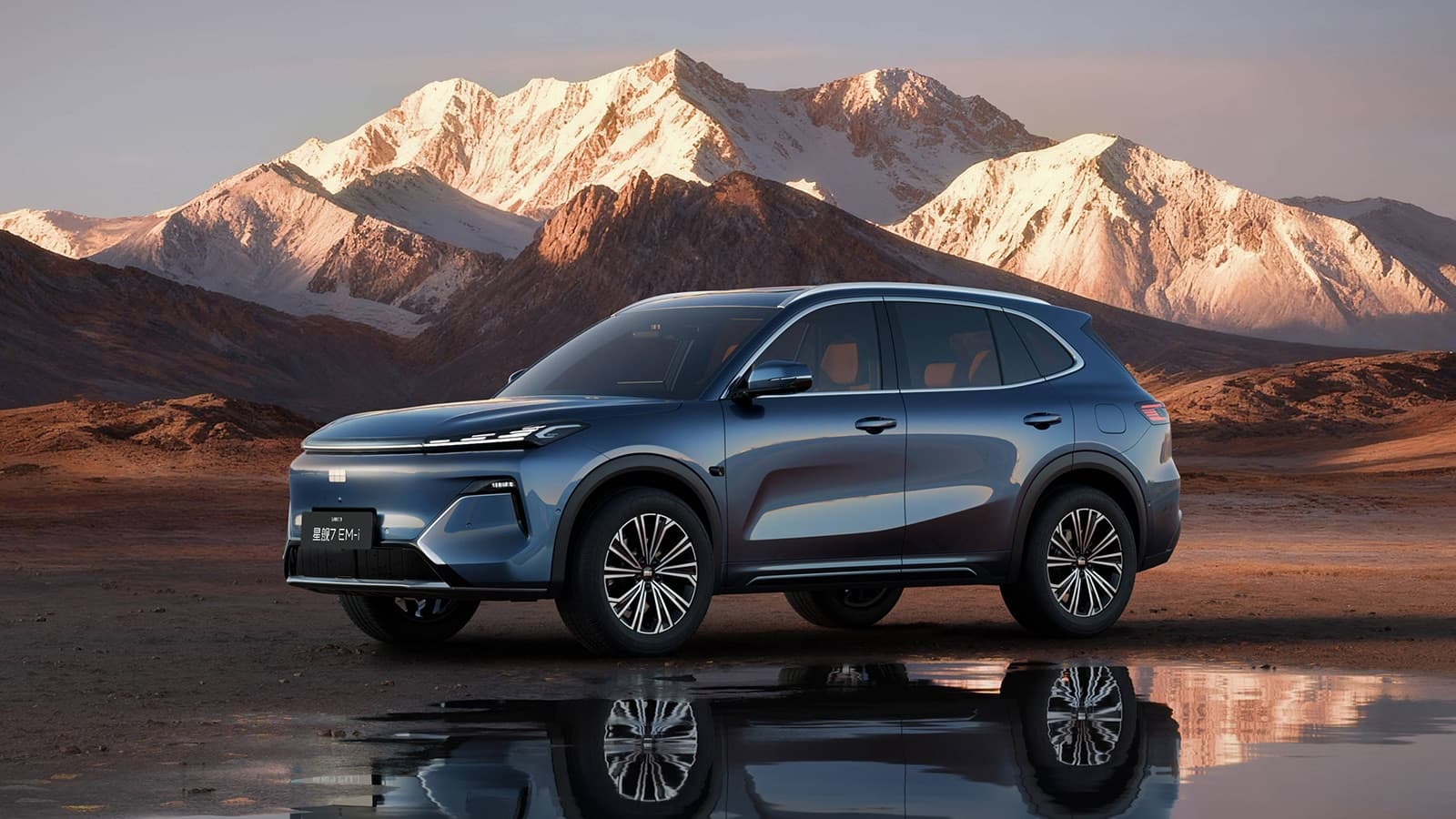
The Geely Galaxy Starship 7 has quietly become one of the best-selling electrified compact SUVs in China, and for 2026 Geely sells it two distinct ways: as the NordThor EM-i 2.0 plug-in hybrid that started this nameplate in late 2024, and now as a companion pure-electric Starship 7 EV that launched in June 2026. Both share the same 4,740–4,750 mm body and Flyme Auto cockpit, but they are aimed at different buyers — the EM-i chases maximum range per dollar with a 1,575 km combined figure, while the EV chases simplicity with a single 800V battery-electric drivetrain and up to 605 km on the CLTC cycle. This is not a brand-new reveal; the EM-i has been in Chinese showrooms since December 2024 and is exported under the Starray, Proton eMas 7 and BelGee X80 badges, so this is a current-generation spec and value update rather than a launch story. Pricing starts at a discounted RMB 95,800 (about $13,470) for the entry EM-i Pioneer trim, with the EV opening at roughly $14,730 after subsidies. Both versions target the same buyer: someone who wants a family-sized SUV with real range for well under $20,000.
Performance & Specs
The EM-i uses Geely's NordThor EM-i 2.0 hybrid system (badged Leishen AI Hybrid 2.0 domestically), pairing a 1.5-liter naturally aspirated engine rated at 82 kW (110 hp) and 46.5% thermal efficiency with an 11-in-1 electric drive unit through a single-speed E-DHT gearbox. For 2026 the drive motor was upgraded from 160 kW to 175 kW (235 hp), which does the actual driving most of the time — the engine mainly runs as a generator and only clutches in directly at highway speed for efficiency. That combination is good for a 7.5-second 0-100 km/h run and a 180 km/h top speed, with fuel consumption dropping to a claimed 3.15 L/100 km once the 19.09 kWh Aegis Short Blade LFP battery is depleted. The pure-electric Starship 7 EV drops the engine entirely for a single 160 kW (215 hp) front motor producing roughly 300 Nm, good for 0-100 km/h in about 7.3 seconds and a 175 km/h top speed — a front-wheel-drive layout on both versions, so neither is aimed at off-road or performance buyers.

| Powertrain | NordThor EM-i 2.0 PHEV |
|---|---|
| Engine | 1.5L I4, 82 kW (110 hp) |
| Drive motor | 175 kW (235 hp) |
| 0–100 km/h | 7.5 s |
| Battery | 19.09 kWh LFP |
| Combined range | Up to 1,575 km (CLTC) |
| POWERTRAIN TYPE | PHEV (EM-i) or BEV, buyer's choice |
|---|---|
| HORSEPOWER | 235 hp (EM-i) / 215 hp (EV) |
| ACCELERATION | 7.5 s (EM-i) / 7.3 s (EV) 0–100 km/h |
| TOP SPEED | 180 km/h (EM-i) / 175 km/h (EV) |
| DRIVETRAIN | FWD (both versions) |
| BATTERY | 19.09 kWh LFP (EM-i) / 60.22 or 68.39 kWh LFP (EV) |
| ELECTRIC RANGE | 130–135 km (EM-i, CLTC) |
| COMBINED RANGE | Up to 1,575 km (EM-i, CLTC) |
Dimensions & Practicality

| Length | 4,740 mm (EM-i) / 4,750 mm (EV) |
|---|---|
| Width | 1,905 mm |
| Height | 1,685 mm (EM-i) / 1,680 mm (EV) |
| Wheelbase | 2,755 mm |
Both versions share the same GEA-based platform and wheelbase, so cabin space is essentially identical: a five-seat compact SUV with a 4,740–4,750 mm footprint that lands between a Honda CR-V and a RAV4 in overall length, but with a longer 2,755 mm wheelbase that Geely uses for rear-seat legroom. Trunk capacity is rated at 528 liters with the rear bench up and 2,065 liters with it folded flat on both versions. The EM-i adds a 100-liter underfloor storage well around its smaller drive battery, while the EV substitutes a 51-liter front trunk since there's no engine under the hood — a genuine practicality edge for the electric version, useful for charging cables or a soft bag that would otherwise eat into rear cargo space.
| LENGTH | 4,740 mm (EM-i) / 4,750 mm (EV) |
|---|---|
| WIDTH | 1,905 mm |
| HEIGHT | 1,685 mm (EM-i) / 1,680 mm (EV) |
| WHEELBASE | 2,755 mm |
| CARGO VOLUME | 528 L (2,065 L seats folded) |
| FRUNK | 51 L (EV only) |
Charging & Battery
The two powertrains use unrelated battery packs, which is worth knowing before cross-shopping trims. The EM-i's 19.09 kWh Aegis Short Blade LFP pack is a plug-in-hybrid-sized battery meant for short EV hops (130–135 km CLTC) rather than a road-trip range extender, and Geely hasn't published a DC fast-charge figure for it — expect an AC home charge to be the normal routine given the small pack size. The Starship 7 EV is the more serious charger: it rides on an 800V architecture with two Aegis Gold Brick LFP battery options, 60.22 kWh (525 km CLTC) or 68.39 kWh (605 km CLTC), and Geely quotes a 30-80% DC top-up in about 20 minutes at a peak of roughly 110 kW, plus roughly 350 km of range added in a 10-minute splash-charge. Both battery grades also pass Geely's own needle-piercing, immersion and drop-test safety program. The EV further supports 3.3 kW vehicle-to-load (V2L) output for running external devices and a 6 kW vehicle-to-vehicle (V2V) charging function to top up another EV.
| BATTERY | 19.09 kWh LFP (EM-i) / 60.22 or 68.39 kWh LFP (EV) |
|---|---|
| AC CHARGING | 11 kW (EV) |
| DC FAST CHARGING | ~110 kW peak (EV, 800V) |
| DC 10-80% TIME | ~20 min, 30-80% (EV) |
Design & Interior
The Starship 7's exterior language is shared across both powertrains: a full-width front light bar, a squared-off nose with a body-color lower grille panel, sharply creased shoulder lines and slim wraparound taillights that give the rear a wider stance than the actual width suggests. Geely differentiates the two visually with small badging (EM-i vs EV script on the tailgate and front fender) and the EV runs a slightly cleaner front fascia since it doesn't need engine cooling ducts. Inside, both versions get the same cabin: a two-tone dashboard with an ambient-lit trim strip running door to door, a 15.4-inch floating center touchscreen running Flyme Auto, and a 13.8-inch head-up display on upper trims. Seat upholstery ranges from cloth on the base EM-i Pioneer trim to leatherette with 14-point massage and heating on the range-topping EM-i Starship and EV Yuanhangjia trims, and both front seats get heating on higher grades. Dual-layer acoustic glass on the front and rear doors is standard across the lineup, which is a genuine comfort feature at this price point that many rivals reserve for pricier trims.
Technology & Features
Both the EM-i and EV run Geely and Meizu's Flyme Auto software on a 7nm Longying No.1 chip, which handles the 15.4-inch center display, voice assistant, phone mirroring and over-the-air updates. A 16-speaker Flyme Sound audio system is available on upper trims, alongside a digital instrument cluster and the optional 13.8-inch HUD. Smart-device integration is a Flyme Auto selling point — the system pairs tightly with Meizu and other Flyme-ecosystem phones for near-instant Bluetooth key and navigation handoff, and both versions get a digital key function so the car can be unlocked and started from a phone or smartwatch.
Safety & ADAS
For 2026, Geely standardized its Qianli Haohan ("Thousand Li Vast Ocean") H3 driver-assist package across the entire Starship 7 lineup, EM-i and EV alike — a meaningful upgrade since the original 2024 EM-i shipped without any assisted-driving hardware. The H3 suite uses 26 sensors (a mix of cameras, radar and ultrasonic units) feeding 128 TOPS of onboard compute, enough for both highway NOA (navigate-on-autopilot for expressway lane changes and on/off-ramp handling) and urban commuting NOA in supported cities. Passive safety follows the same Aegis-branded approach as the batteries: Geely markets the whole car around its "safety over tiered configurations" pitch for the EV specifically, meaning the driver-assist suite and structural safety features are not walled off to the most expensive trim the way many Chinese rivals still do it.
| ADAS LEVEL | L2+ (Qianli Haohan H3) |
|---|---|
| ADAS FEATURES | Highway NOA, Urban NOA, AEB, ACC, LKA, 360° camera, 26-sensor suite (128 TOPS) |
Available Versions
| VERSION | POWER | TORQUE | 0-100 | TOP SPEED | DRIVETRAIN | BATTERY | EV RANGE | COMBINED RANGE | PRICE | KEY DIFFERENCES |
|---|---|---|---|---|---|---|---|---|---|---|
| EM-i Pioneer (130 EV-Range) | 235 hp | — | 7.5s | 180 km/h | FWD | 19.09 kWh | 130 km | Up to 1,575 km | $13,470 | Entry trim, cloth seats, base ADAS hardware |
| EM-i Smart (135 EV-Range) | 235 hp | — | 7.5s | 180 km/h | FWD | 19.09 kWh | 135 km | Up to 1,575 km | $15,020 | Adds convenience/comfort package |
| EM-i Pilot (135 EV-Range) | 235 hp | — | 7.5s | 180 km/h | FWD | 19.09 kWh | 135 km | Up to 1,575 km | $16,290 | Leatherette seats, upgraded audio |
| EM-i Starship (135 EV-Range) | 235 hp | — | 7.5s | 180 km/h | FWD | 19.09 kWh | 135 km | Up to 1,575 km | $17,410 | Flagship trim, massage seats, HUD, 16-speaker audio |
| EV 525 (60.22 kWh) | 215 hp | ~300 Nm | 7.3s | 175 km/h | FWD | 60.22 kWh | 525 km | — | $14,730 | Entry EV battery, current guide price after subsidy |
| EV Yuanhangjia 605 (68.39 kWh) | 215 hp | ~300 Nm | 7.3s | 175 km/h | FWD | 68.39 kWh | 605 km | — | $17,700 | Long-range flagship EV, "Yuanhangjia" (Long Voyage) trim |
Pricing & Availability
The 2026 Starship 7 EM-i went on sale in China on November 19, 2025 with official guide prices of RMB 101,800 to 129,800, discounted at launch to a limited-time RMB 95,800 to 123,800 (about $13,470 to $17,410) across its four trims — that limited-time pricing was still the figure being quoted in the most recent coverage found as of this writing, so treat it as the current going rate rather than an expired flash sale. The Starship 7 EV followed roughly seven months later, unveiled in teaser form on April 29, 2026 and going on sale June 10, 2026. Its official sticker runs RMB 109,800 to 129,800 (about $16,200 to $19,150), with a limited-time guide price of RMB 99,800 to 119,800 (about $14,730 to $17,700) after trade-in and insurance incentives — the entry 525 km trim is the one that reportedly dips below $14,800 with subsidies applied, not the 605 km flagship. Buyers should treat the sticker figure as the baseline and the discounted figure as what dealers are actually quoting, since Chinese OEMs routinely roll these "limited-time" incentives forward rather than letting them lapse. The Starship 7 nameplate has already passed 220,000 cumulative sales and is sold new or rebadged in 57 countries and regions, including as the Geely Starray in several Asian and European markets, the Proton eMas 7 in Malaysia, and the BelGee X80 in Belarus.
How It Compares
Against the BYD Song Pro DM-i, the Starship 7 EM-i undercuts it on price at the entry trim while comfortably beating it on horsepower (235 hp vs 130 hp), though the Song Pro's 1,100 km combined range is still competitive if slightly behind the Starship 7's 1,575 km claim. The BYD Sealion 05 DM-i is the closer fight on power (218 hp) and edges the Starship 7 EM-i on combined range at 1,200 km, but it costs roughly $4,200 more at $17,708 versus the Starship 7 Pioneer's $13,470 — a meaningful gap for a similarly-sized PHEV SUV. On the electric side, the GAC Aion i60 REV actually out-powers the Starship 7 EV (241 hp vs 215 hp) at a similar $15,494 price, but its 500 km range trails the Starship 7 EV's 525–605 km band, and the Aion i60 REV is itself a range-extended hybrid rather than a pure BEV, so cross-shoppers who specifically want a plug-only electric SUV in this price band have few other in-catalog options as complete as the Starship 7 EV.
- Genuine choice between a PHEV with 1,575 km combined range and a BEV with up to 605 km CLTC range, both under $20,000
- Qianli Haohan H3 driver-assist suite (highway + urban NOA) now standard across the entire lineup, not locked to the flagship trim
- Dual-layer acoustic glass, heated seats and a 15.4-inch Flyme Auto display are available well below $20,000
- FWD-only on both versions — no AWD option for buyers who want extra traction
- EM-i's 130–135 km EV range is short for daily all-electric commuting compared to rivals with 200+ km EV range in the same segment
The Galaxy Starship 7 works because Geely lets the buyer pick the trade-off instead of making it for them: the EM-i is the pragmatic choice for anyone who wants near-1,600 km of combined range and a starting price under $14,000, while the EV is the simpler, quieter option for someone who charges at home and wants to skip the gas station entirely. Both share the same well-equipped cabin, the same now-standard driver-assist suite, and the same competitive pricing against in-house and BYD rivals. The compromises are real but narrow — no AWD, and the EM-i's EV-only range won't satisfy someone chasing a 200 km all-electric commute — but for a family SUV priced from the low-to-mid teens in USD, the Starship 7 is a legitimate value pick in both flavors.