
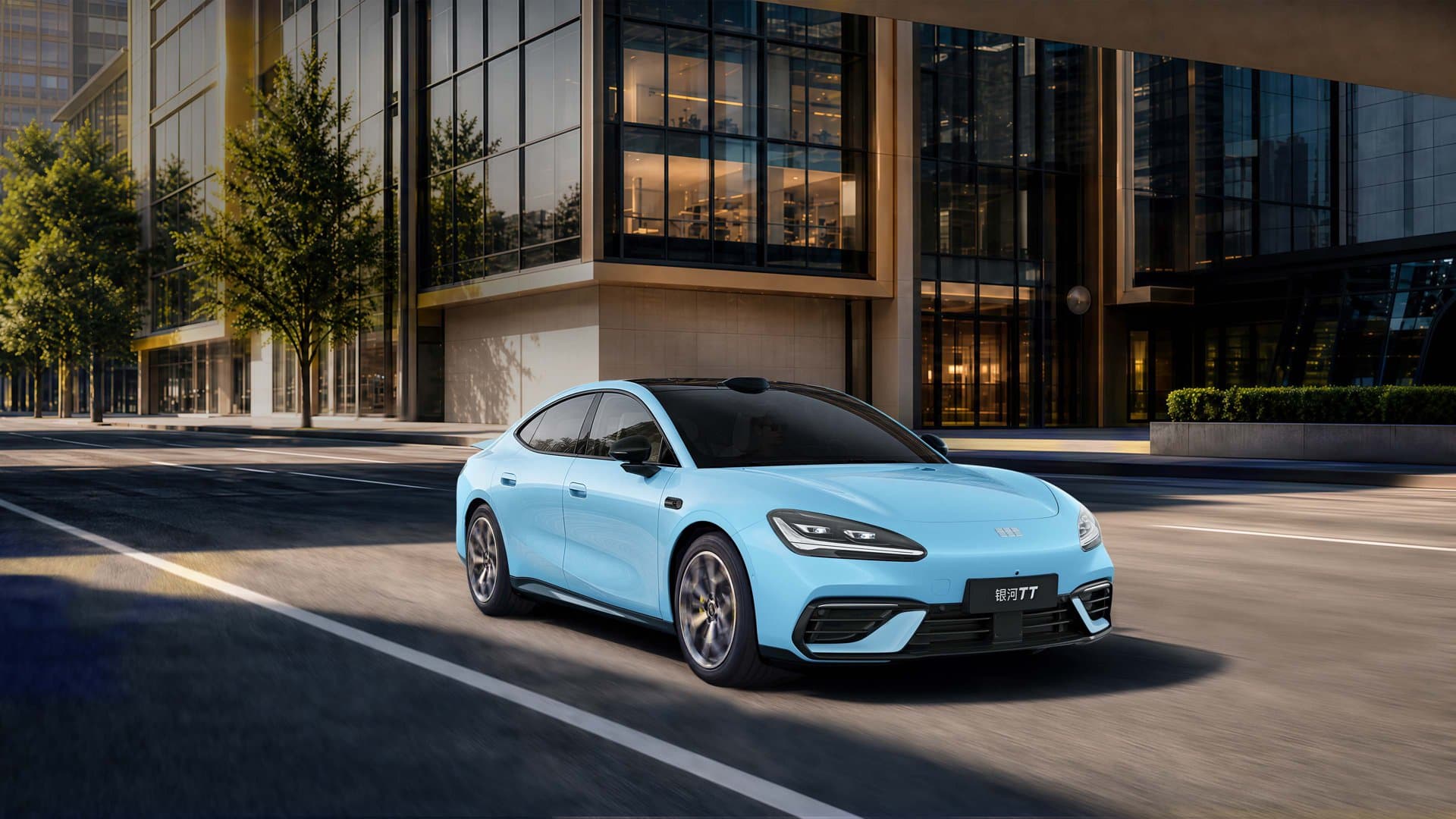
The 2026 Geely Galaxy TT is the C-segment electric sedan that Geely's mass-market Galaxy brand is aiming at the Xiaomi SU7 crowd. It went on sale in China on September 10, 2026, as a five-trim lineup of C-segment electric sedans with a standard 800V platform, CATL Shenxing TT LFP batteries capable of 6C charging, and a nearly five-metre body with a claimed 0.22 drag coefficient. Limited-time launch prices run from ¥129,900 (about $19,100) to ¥185,900 (about $27,400), which is 16,000 yuan, or roughly 11%, below the ¥145,900 entry price announced when pre-sales opened in August — and the entry car now carries a bigger 63.8-kWh battery and 640 km of CLTC range instead of the 540 km pre-sale version. Single-motor rear-drive versions make 245 kW (329 hp), while the flagship TT Ultra adds a front motor for 425 kW (570 hp) and a 3.8-second 0–100 km/h time. Geely reported more than 10,000 firm orders within 15 minutes of the launch.
Performance & Specs
Every rear-drive Galaxy TT uses a single rear motor rated at 245 kW (333 PS, about 329 hp) and 320 Nm, part of what Geely calls a 16-in-1 electric drive unit. Acceleration from 0–100 km/h is quoted at 7.2 seconds for the 640 km cars and 6.5 seconds for the 725 km version. The TT Ultra is the performance flagship: a 180 kW front motor joins the 245 kW rear motor for 425 kW (578 PS, about 570 hp) and 597 Nm, dropping 0–100 km/h to 3.8 seconds, and it is the only trim on the more advanced H7 driver-assistance package. The chassis pairs an all-aluminium double-wishbone front suspension with a five-link rear, and continuously variable damping is offered on the higher trims, with an AI-controlled “magic carpet” chassis package reserved for the Ultra and the optional upgrade pack. An active rear spoiler and active grille shutters support the 0.22 Cd figure, and a BOOST button on the steering wheel unlocks a short full-power mode.

| Powertrain | Single-motor rear-drive BEV |
|---|---|
| Power | 245 kW (333 PS / 329 hp) |
| Torque | 320 Nm |
| 0–100 km/h | 7.2 s (6.5 s on 725 km version) |
| Battery | 63.8 kWh CATL LFP |
| Range | 640 km CLTC |
| POWERTRAIN TYPE | Battery electric (BEV), 800V |
|---|---|
| HORSEPOWER | 329 hp single motor / 570 hp dual motor (Ultra) |
| ACCELERATION | 7.2 s / 6.5 s (RWD) · 3.8 s (Ultra) |
| TOP SPEED | Not confirmed by Geely in launch materials |
| DRIVETRAIN | RWD (Ultra: AWD) |
| BATTERY | 63.8 kWh or 75.2 kWh LFP (CATL) |
| CLTC RANGE | 640 km / 725 km (RWD) · 650 km (Ultra) |
Dimensions & Practicality

| Length | 4,999 mm |
|---|---|
| Width | 1,919 mm |
| Height | 1,479 mm |
| Wheelbase | 2,920 mm |
| Drag coefficient | 0.22 Cd |
At 4,999 mm long on a 2,920 mm wheelbase, the Galaxy TT is a genuine C-segment car, and it is officially pitched as a “C-class AI electric sports sedan.” The 1,479 mm roofline keeps the fastback profile low. Practicality gets a boost from a 110-litre front trunk that is designed to drain, plus 37 storage spaces across the cabin, and the seats are listed with heating and ventilation as standard. Geely has not disclosed a curb weight or a rear cargo volume for the launch trims in the sources we could verify, so we leave those out rather than guess.
| LENGTH | 4,999 mm |
|---|---|
| WIDTH | 1,919 mm |
| HEIGHT | 1,479 mm |
| WHEELBASE | 2,920 mm |
| FRUNK | 110 L (drainable) |
| STORAGE SPACES | 37 |
Charging & Battery
The Galaxy TT's headline engineering claim is charging. All five trims sit on an 800V architecture and use a customised CATL Shenxing TT lithium iron phosphate battery that supports charging rates up to 6C. Geely quotes roughly 11.8 minutes for a 10–80% charge on the 63.8-kWh pack and 11.6 minutes on the 75.2-kWh pack, and its marketing line is that 11 minutes adds more than 400 km of CLTC range. The entry-level and mid-tier rear-drive cars use the 63.8-kWh pack for 640 km CLTC, while the 725 km rear-drive flagship and the AWD Ultra use the 75.2-kWh pack; the Ultra's second motor costs it range, giving 650 km. Dividing pack size by CLTC range, that works out to roughly 10.0 kWh/100 km for the 640 km car, 10.4 for the 725 km car and 11.6 for the Ultra, which fits the difference in motors and weight. The pack also debuts CATL's NP3.0 thermal-runaway protection.
| BATTERY | 63.8 kWh LFP (640 km) / 75.2 kWh LFP (725 km and Ultra) |
|---|---|
| CHARGING RATE | Up to 6C, 800V platform |
| DC 10-80% TIME | 11.8 min (63.8 kWh) / 11.6 min (75.2 kWh) |
| RANGE ADDED IN 11 MIN | 400 km+ (CLTC, manufacturer claim) |
Design & Interior
Outside, the TT is a low, wide fastback with diamond-style floating headlights, an active front grille, a full-width tail-light bar and an active rear spoiler that Geely says generates 508 N of downforce at its 22.5 degree angle. The launch colour is a light pastel blue, while the Ultra is shown in a saturated turquoise with red brake calipers, black wheels and carbon-fibre trim. Inside, the cabin follows a horizontal dashboard layout with a 15.4-inch 2.5K central display, a 10.2-inch instrument screen, a 25.6-inch AR head-up display in the launch material and a 23-speaker audio system, all running Flyme Auto 2 on the Longying 6P chip. A red BOOST knob sits at the steering wheel, echoing the performance positioning. The seats are heated and ventilated, and the cabin offers 37 storage spaces.
Technology & Features
The infotainment stack runs Flyme Auto 2 on the Longying 6P 4 nm cockpit chip, tying the 15.4-inch central screen, the 10.2-inch digital cluster and the head-up display together. The higher-spec cars add continuously variable damping and the driver-assistance upgrades described below. Geely also lists a 23-speaker sound system in the material published at launch, although the exact trim on which each of these features arrives should be confirmed with a dealer before ordering.
Safety & ADAS
The Galaxy TT uses Geely's Qianli Haohang (G-ASD) driver-assistance system in two levels. The H5 package, on the LiDAR-equipped mid trims, supports highway and urban navigate-on-autopilot, door-to-door navigation and automated parking, with a roof-mounted LiDAR on every trim except the base 640 RWD car. The H7 package is reserved for the Ultra, and an optional upgrade pack that adds H7 and the adaptive suspension is offered on the two middle 640 km trims. Buyers of the entry version should note that it goes without LiDAR, which is the main compromise of the cheapest trim.
| ADAS LEVEL | L2+ (Qianli Haohang G-ASD H5 / H7) |
|---|---|
| ADAS FEATURES | Highway and urban NOA, door-to-door navigation, automated parking, roof-mounted LiDAR (not on entry trim) |
Available Versions
| VERSION | POWER | TORQUE | 0-100 | TOP SPEED | DRIVETRAIN | BATTERY | RANGE | PRICE | KEY DIFFERENCES |
|---|---|---|---|---|---|---|---|---|---|
| 640 RWD Enjoyment | 329 hp | 320 Nm | 7.2s | — | RWD | 63.8 kWh | 640 km | $19,100 | ¥129,900 launch price (¥139,900 list); no LiDAR |
| 640 RWD Premium | 329 hp | 320 Nm | 7.2s | — | RWD | 63.8 kWh | 640 km | $20,600 | ¥139,900 launch price (¥149,900 list); adds LiDAR and H5 assistance |
| 640 RWD Flagship | 329 hp | 320 Nm | 7.2s | — | RWD | 63.8 kWh | 640 km | $22,100 | ¥149,900 launch price (¥159,900 list); top 640 km equipment |
| 725 RWD Flagship | 329 hp | 320 Nm | 6.5s | — | RWD | 75.2 kWh | 725 km | $23,500 | ¥159,900 launch price (¥169,900 list); larger pack, longest range |
| TT Ultra | 570 hp | 597 Nm | 3.8s | — | AWD | 75.2 kWh | 650 km | $27,400 | ¥185,900 launch price (¥195,900 list); dual motor, H7 assistance |
Pricing & Availability
The Galaxy TT launched on September 10, 2026 with two sets of prices. The official list prices run from ¥139,900 to ¥195,900, while the limited-time launch prices of ¥129,900 to ¥185,900 (about $19,100 to $27,400 at 6.79 yuan to the dollar) apply to buyers who place an order by October 7, 2026. The ¥10,000 difference is a cash incentive made up of a ¥6,000 purchase-tax subsidy and a ¥4,000 insurance subsidy, so it is a time-limited offer rather than a permanent price cut; once the offer ends, the higher list prices apply. Compared with the August pre-sale, the entry price is 16,000 yuan lower and the entry battery is larger, because the 52.4-kWh, 540 km version announced at pre-sale was dropped from the launch lineup. The car is sold in China only for now; The 10,000-order figure counts firm orders, not deliveries, so actual delivery timing may vary by dealer.
How It Compares
All three rivals come from our own catalog and were chosen by price. At almost the same money as the Galaxy TT's $19,100 entry, the Nissan N7 gives 268 hp and 635 km, so the TT's 329 hp, 640 km and standard 800V charging give it a clear power and charging edge. The MG 07 Semi Solid costs slightly less at $18,595 and quotes a longer 845 km, but it makes 236 hp, roughly 90 hp less than the TT, and does not offer a 6C charging story. Moving up the ladder, the Hongqi Tiangong 07 800V sits at $25,000 with 456 hp and 730 km; the TT 725 RWD Flagship at $23,500 undercuts it while matching its range within a few kilometres, and the Ultra's 570 hp beats it by more than 110 hp for about $2,400 more. CLTC ranges are not directly comparable across every brand's test method, so treat the km figures as marketing-cycle numbers.
- 800V platform with 6C charging on every trim, adding more than 400 km of CLTC range in about 11 minutes
- Entry price of ¥129,900 (about $19,100) for a 4,999 mm C-segment sedan with a 63.8-kWh battery and 640 km CLTC range
- TT Ultra delivers 570 hp and 0–100 km/h in 3.8 seconds from about $27,400
- The cheapest trim has no LiDAR and only basic assistance, and the launch prices depend on a ¥10,000 incentive that ends October 7
- Curb weight, top speed and rear cargo volume are not confirmed in the launch materials
The Geely Galaxy TT is a serious attempt to bring 800V charging, a 570 hp flagship and a near-five-metre body to buyers who would otherwise stop at a compact hatchback. The mid trims look like the sweet spot: LiDAR and H5 assistance are included at around $20,600, and the 725 km RWD Flagship at about $23,500 stretches range without a big price jump. The compromises are the stripped-down entry trim, the October 7 incentive cliff and thin data on weight and top speed. Overall, it is a strong value offer in China, and worth watching for export news — recommended for buyers there who value fast charging and long range over brand prestige.