
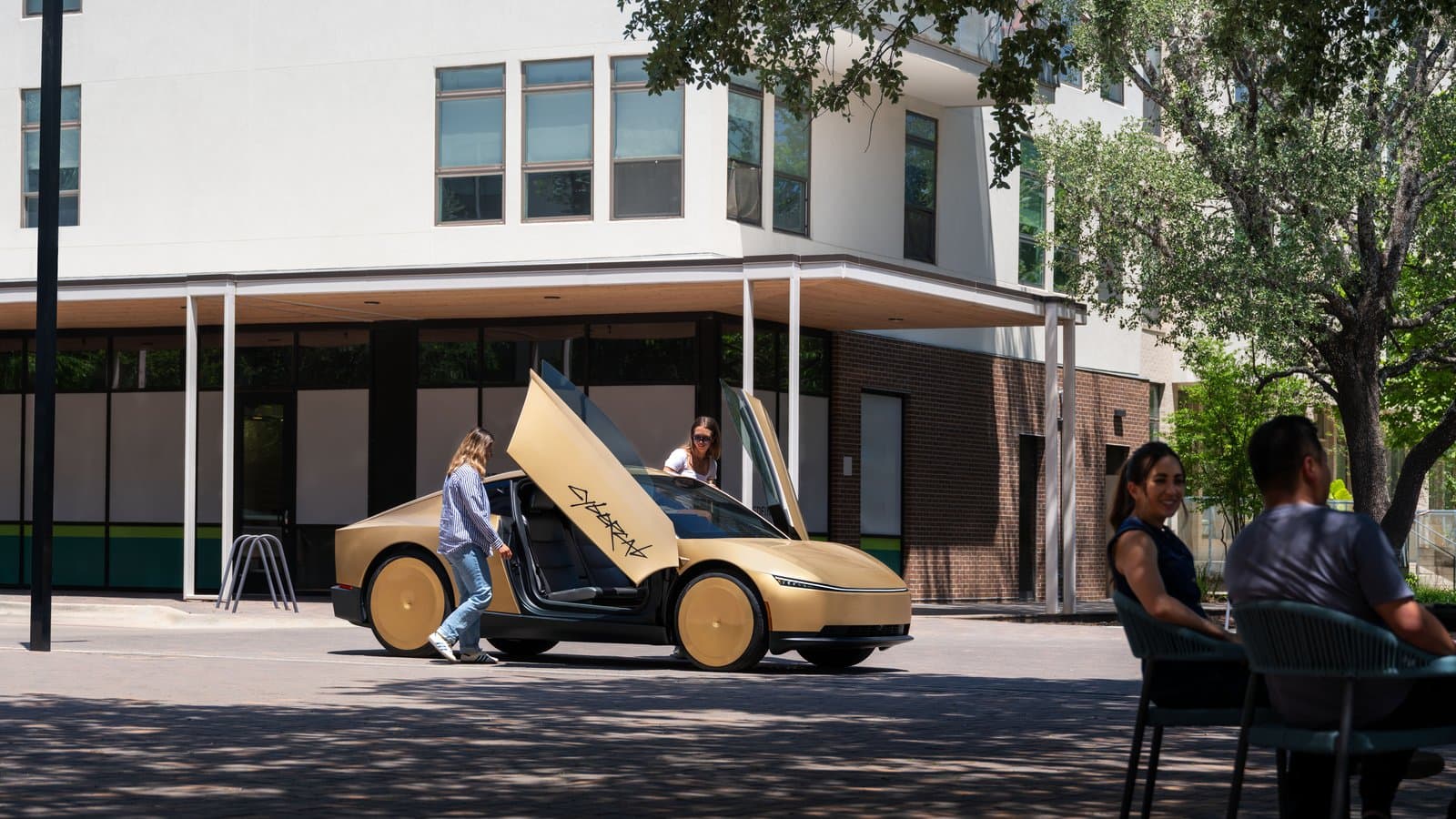
The Tesla Cybercab is the first Tesla built purely for autonomy: a two-seat coupe-shaped robotaxi with no steering wheel, no pedals, no side mirrors and no rear window. The first production unit rolled off the line at Giga Texas in February 2026, and Tesla staged an invitation-only production reveal in Austin on September 3, 2026, followed by paid rides through its existing Robotaxi service the next day. The hardware numbers are now solid thanks to an EPA certification filing: a single 163 kW (219 hp) front motor, a 47.6 kWh battery and an adjusted range of roughly 293 miles (about 472 km). Pricing is a different story. Tesla has never published a price, and the widely quoted "under $30,000" is a target repeated by Tesla and Elon Musk, not a price list. Regulators are also asking hard questions: on September 10, NHTSA issued a Special Order demanding that Tesla prove, under oath, that a car without a brake pedal meets federal safety standards. This is a genuinely new kind of vehicle, but for now it is a very small fleet in one city.
Performance & Specs
The Cybercab is powered by one AC three-phase permanent-magnet motor driving the front wheels through a single-speed gearbox, rated at 163 kW (219 hp). Tesla has said the drive unit is smaller, lighter and more efficient than other top-performing EV drive units, but it has not published torque, 0-100 km/h or top-speed figures, and none are listed here because none are confirmed. What the EPA filing does confirm is efficiency: 165 Wh per mile (about 103 Wh/km), which coverage of the filing describes as the most efficient EV the agency has processed. With a curb weight of 3,113 lb (1,412 kg), the Cybercab is roughly as light as a small hatchback, and that is a large part of why a 47.6 kWh pack goes so far. The battery-to-range math checks out: 47.6 kWh at 165 Wh/mi works out to about 290 miles, in line with the roughly 293-mile adjusted estimate. It is a purpose-built ride-hailing tool rather than a performance car, so the spec sheet is deliberately short on acceleration bragging rights.

| Powertrain | Single-motor FWD BEV |
|---|---|
| Power | 163 kW (219 hp) |
| Battery | 47.6 kWh (EPA filing) |
| Range (EPA adjusted, est.) | ~472 km (293 mi) |
| Range (EPA unadjusted) | 673 km (418.2 mi) |
| Efficiency | 165 Wh/mi (~103 Wh/km) |
| POWERTRAIN TYPE | BEV, single motor |
|---|---|
| HORSEPOWER | 219 hp (163 kW) |
| ACCELERATION | Not published |
| TOP SPEED | Not published |
| DRIVETRAIN | FWD |
| BATTERY | 47.6 kWh |
| EPA RANGE (UNADJUSTED COMBINED) | 673 km (418.2 mi) |
| EPA RANGE (ADJUSTED, ESTIMATE) | ~472 km (~293 mi) |
Dimensions & Practicality

| Seats | 2 |
|---|---|
| Doors | 2 butterfly doors |
| Curb weight | 1,412 kg (3,113 lb) |
| Gross vehicle weight | 1,690 kg (3,730 lb) |
| Payload | 280 kg (617 lb) |
Tesla has not published length, width, height or wheelbase for the Cybercab, and measurements floating around online are estimates from photos, so they are left out here. What is confirmed is the layout: two seats side by side, two upward-swinging butterfly doors, and a payload of 617 lb (280 kg), which is enough for two adults plus modest luggage. The body is a low, teardrop-shaped fastback with a very short overhang at the rear and a full-width light bar at each end. Inside, the show cars have a bench-style pair of seats, a cupholder console and a single screen on the dashboard, and no driver controls of any kind. Because the car is designed to run all day as a shared vehicle, the cabin is built around simplicity and easy cleaning rather than seat variety.
Charging & Battery
The Cybercab uses a single 47.6 kWh lithium-ion pack (146 Ah). The EPA filing lists 53.365 kWh of AC energy drawn from the wall to refill it, which reflects charging losses. Tesla's intended way to charge is wireless: the car drives onto an inductive pad, and Tesla won an FCC waiver in February 2026 for the ultra-wideband system that aligns the car over the pad. Demonstration footage has been reported at up to about 25 kW, far below a Supercharger's roughly 250 kW peak, which suits a fleet vehicle that tops up between rides. Reports differ on whether a wired backup exists: some outlets say the car has a hidden NACS port for DC fast charging, while others say it has no conventional port. One widely cited report, from reviewer Kyle Conner on September 5, states the Cybercab has no onboard AC charger, so it cannot use a home wall connector without new equipment. Tesla has not published a complete charging spec sheet, so treat the details below as reported rather than confirmed.
| BATTERY | 47.6 kWh (EPA filing) |
|---|---|
| WALL ENERGY TO RECHARGE | 53.365 kWh (EPA filing) |
| WIRELESS CHARGING | Inductive pad, reported up to ~25 kW (not a Tesla spec sheet figure) |
| WIRED DC CHARGING | Hidden NACS port reported by some outlets; not confirmed by Tesla |
| AC HOME CHARGING | Reported not supported (no onboard AC charger) |
Design & Interior
The Cybercab looks like nothing else on the road. The nose is low and rounded, with a curved light bar running across the full width of the front, and the roof sweeps back in a single arc to a short, truncated tail. Butterfly doors hinge from the roofline, and the wheels wear large flat covers. The first-run cars appear in a matte gold finish, and there are no side mirrors and no rear window, since cameras replace them. Inside, the two seats face forward with a shared centre console, and a single display sits on the dashboard for passengers. With no steering wheel or pedals, the footwell is completely open, which makes the cabin feel larger than the small exterior suggests. It is a design that only makes sense if the software never needs a human to take over.
Technology & Features
The Cybercab runs Tesla's Full Self-Driving software with no human fallback in the cabin, which is why the software's record matters far more than the hardware. Electrek noted in April 2026 that Tesla's supervised robotaxi fleet crashed at a higher rate than human drivers, and Tesla has a history of shifting timelines for unsupervised driving. Perception is reported to be camera-only, in contrast with rivals such as Waymo that combine cameras, radar and lidar. The passenger experience is delivered through the Robotaxi app, which already handles Tesla's Model Y ride-hailing service in Austin. Tesla has not detailed the infotainment hardware, audio system or in-cabin features, so this article does not speculate on them.
Safety & ADAS
Safety is where the Cybercab is most contested. Tesla self-certified the car to Federal Motor Vehicle Safety Standards rather than applying for a Part 555 exemption, and in April 2026 Tesla vehicle engineering VP Lars Moravy said NHTSA's 2,500-vehicle annual exemption cap does not apply. On September 10, 2026, NHTSA Chief Counsel Peter Simshauser signed a Special Order with 21 requests, asking Tesla to explain under an officer's sworn affidavit how the car meets the standards, including FMVSS 135, which calls for a foot-operated service brake. Tesla's answers are due September 30, and penalties for non-compliance can reach a reported $139 million. Tesla's position is that standards written for human-driven cars should be read differently for a fully autonomous vehicle; NHTSA's position is that until the rules change, they stand. The outcome could decide whether the Cybercab can scale.
| AUTONOMY | Tesla Full Self-Driving software, no human controls |
|---|---|
| SENSORS | Camera-only (reported) |
| REGULATORY PATH | Self-certified to FMVSS, no Part 555 exemption |
| NHTSA SPECIAL ORDER | Issued September 10, 2026; answers due September 30, 2026 |
Available Versions
| VERSION | POWER | TORQUE | 0-100 | TOP SPEED | DRIVETRAIN | BATTERY | EV RANGE | PRICE | KEY DIFFERENCES |
|---|---|---|---|---|---|---|---|---|---|
| Cybercab (single version) | 219 hp | — | — | — | FWD | 47.6 kWh | ~472 km | TBA | Two seats, no steering wheel or pedals; Robotaxi service only for now |
Pricing & Availability
Tesla has not published a price for the Cybercab, so the starting price stays at TBA. The figure most people quote is Tesla's stated target of a price below $30,000, first mentioned at the October 2024 unveiling, and in February 2026 Elon Musk answered "Yes" on X when asked whether Tesla would sell a Cybercab to consumers for $30,000 or less before 2027. That is a claim, not a price list. As of early September 2026, Tesla had not published an MSRP, order terms or a consumer configurator, and interested buyers can only register interest through a form. Today the Cybercab is a fleet vehicle: paid rides began in Austin on September 4, 2026, and Texas records showed about 45 Cybercabs authorised for driverless operation at launch, out of roughly 314 driverless Tesla vehicles in the state. Musk has said production will be "agonizingly slow" at first, and Tesla dropped the Cybercab from its 2026 volume-production plan in July, citing battery pack capacity as the main limit, even though the Giga Texas line is designed for more than 125,000 vehicles a year.
How It Compares
Nothing in our catalog is a direct rival to a two-seat robotaxi, so this is a value contrast rather than a cross-shop: Tesla's roughly $30,000 target price sits in the same bracket as several cars we have covered, but those cars come with steering wheels, rear seats and published prices. The figures below come from our own database.
Against the Leapmotor B03X, the Cybercab has more power (219 hp against 181 hp) and a longer estimated range, but the B03X is on sale today at $29,000 with a steering wheel and a rear seat. The BYD Sealion 05 gives 215 hp and 450 km for $26,562, so on raw numbers the Cybercab's advantage is small; its real difference is that it drives itself. The BYD Seagull shows the other end of the value story: at $11,628 it is far cheaper, though with just 74 hp and 305 km it is a different kind of car. If Tesla ever does sell the Cybercab at $30,000, the interesting question is not spec-sheet value but whether a car with no controls can be legal and useful to a private owner.
- Exceptional efficiency: 165 Wh/mi filed with the EPA, giving about 293 miles from just 47.6 kWh
- Purpose-built two-seat robotaxi with no controls, so the cabin is open and simple
- Paid rides already running in Austin, a real service rather than a concept
- No published price or order terms; the $30,000 figure is only a stated target
- Open NHTSA Special Order over FMVSS compliance, with a September 30 response deadline
- Tiny fleet (about 45 in Texas) and a single service city so far
The Cybercab is the most radical production car Tesla has built, and the EPA numbers show it is an unusually efficient one. But as of September 2026 it is a small robotaxi fleet in one city, with no price, no consumer sales and a federal regulator asking whether it is legal without a brake pedal. It is worth watching closely as a signal of where ride-hailing is going, but it is not something a buyer can plan around yet. Watch the NHTSA response and the first real price announcement.
Photos: Courtesy of Tesla, Inc.