
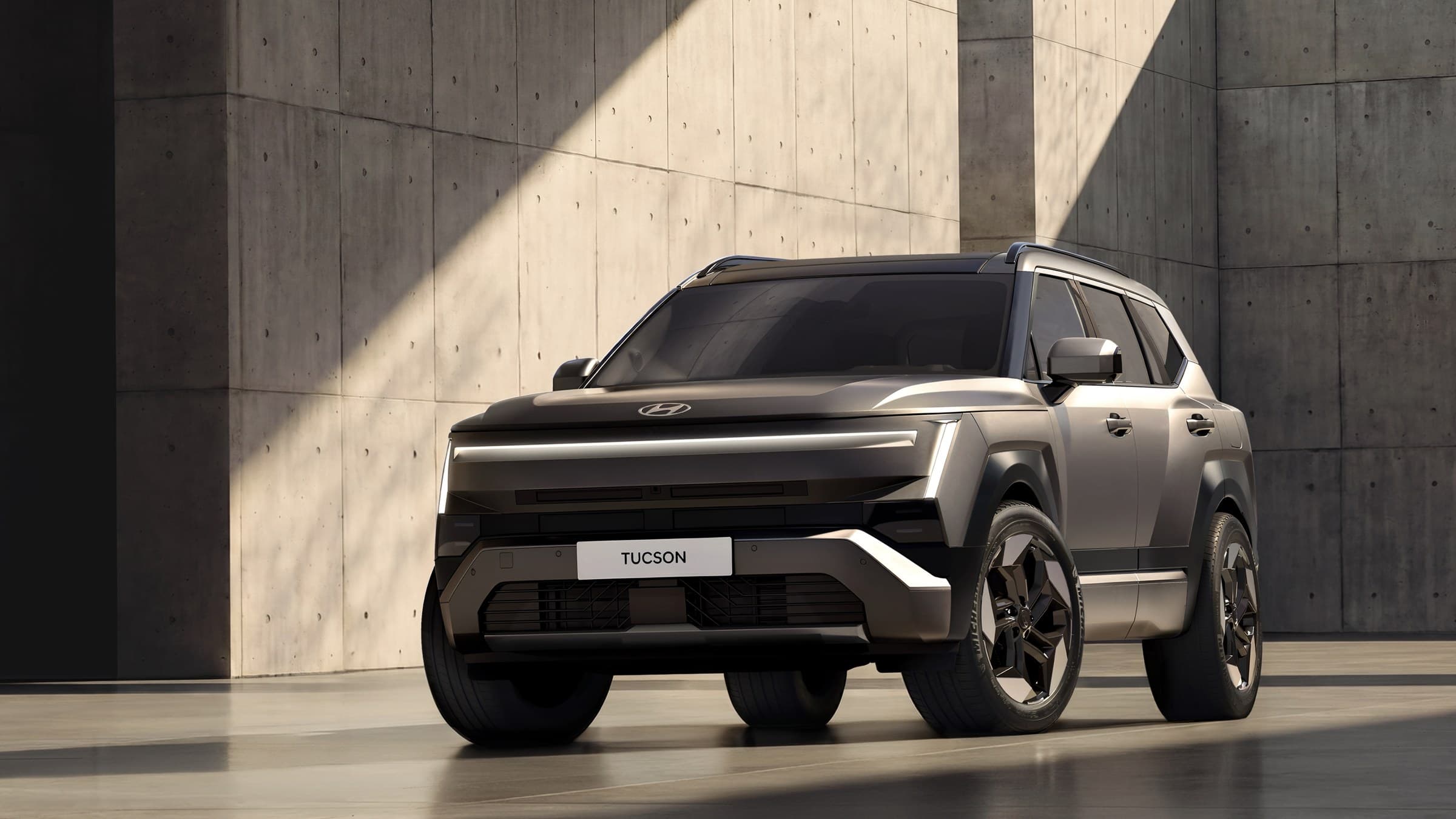
The 2027 Hyundai Tucson Plug-in Hybrid steps up to a 17.1 kWh battery, a 292 PS (about 288 hp) system and an estimated 81 km (50 miles) of electric range. Hyundai Motor Company unveiled it with the fifth-generation Tucson at a world premiere in Long Island City, New York, on October 1, 2026. The plug-in sits in Hyundai's global specification table next to a new Next-generation Hybrid System, but Hyundai describes it as available only in select markets, and the United States is not one of them: Autoblog reports that Hyundai Motor America will not offer a Tucson plug-in, so American buyers get petrol and hybrid versions only. The US-spec hybrid makes 233 hp and targets up to 42 mpg. Korea gets the new Tucson later in 2026, with North America, Europe and other markets following in 2027, and Hyundai has not announced a price anywhere yet.
Performance & Specs
The plug-in system pairs a 1.6-litre turbocharged petrol engine with two electric motors and a six-speed automatic transmission. Hyundai lists a 13 kW P1 motor and a 79 kW P2 traction motor (about 106 hp), and quotes 292 PS for the combined output. That is about 215 kW, or roughly 288 hp using 1 PS as about 0.986 hp. Combined torque is 38.7 kgf·m, which works out to about 380 Nm or 280 lb-ft. Hyundai gives a 0–60 mph time of 7.9 seconds for the four-wheel-drive car, and Carscoops reports the plug-in is sold exclusively with four-wheel drive. The company has not published a 0–100 km/h time, a top speed, a separate engine output or a curb weight. The towing figure in its table for this powertrain is 1,910 kg, and for Europe the table lists CO2 emissions of 91 g/km for the plug-in.
The hybrid that sits below it is built around the same engine and uses a smaller motor setup: a 13 kW P1 motor, a 47.7 kW P2 motor and a 1.49 kWh, 270 V battery. In US specification Hyundai quotes 233 hp and 279.9 lb-ft (38.7 kgf·m), with 0–60 mph in 8.5 seconds. For the North American front-drive hybrid on 17-inch wheels the target is up to 42 mpg, and Hyundai's table lists 40 mpg for other front-drive versions, 40 mpg for all-wheel drive on 17-inch wheels and 38 mpg for the remaining all-wheel-drive cars. Those are targets rather than final EPA ratings. Korean-specification hybrids are listed at 236–245 PS (about 233–242 hp). The hybrid also gets Hyundai's E-Traction torque control for cornering and a HEV Stay Mode that runs the climate control, audio and device charging with the engine off, and the North American hybrid is rated to tow 3,000 lb (1,361 kg). A 1.6T-GDI petrol engine (184 hp in US specification) completes the range, but this article concerns the electrified versions.

| Powertrain | 1.6T plug-in hybrid, 6-speed automatic, 4WD |
|---|---|
| Power | 292 PS (about 215 kW / 288 hp) |
| Torque | 38.7 kgf·m (about 380 Nm / 280 lb-ft) |
| 0–60 mph | 7.9 s (Hyundai figure, 4WD) |
| Battery | 17.1 kWh, 351 V |
| Range | 81 km (50 mi) electric, estimated |
| POWERTRAIN TYPE | Plug-in hybrid (PHEV), 1.6T engine with P1 13 kW and P2 79 kW motors, 6-speed automatic |
|---|---|
| HORSEPOWER | 292 PS (about 215 kW / 288 hp) |
| TORQUE | 38.7 kgf·m (about 380 Nm / 280 lb-ft) |
| ACCELERATION | 0–60 mph in 7.9 s (4WD) |
| TOP SPEED | Not published |
| DRIVETRAIN | 4WD |
| BATTERY | 17.1 kWh, 351 V |
| ELECTRIC RANGE | 81 km (50 mi), Hyundai estimate |
| COMBINED RANGE | Not published |
Dimensions & Practicality

| Length | 4,700 mm |
|---|---|
| Width | 1,905 mm |
| Height | 1,685 mm (1,700 mm with roof rack) |
| Wheelbase | 2,785 mm |
| Ground clearance | 180 mm (210 mm on XRT PRO) |
The numbers in Hyundai's table are for the long-wheelbase body, which is 4,700 mm long (60 mm more than the outgoing Tucson), 1,905 mm wide (+40 mm, which Hyundai calls the largest width increase in the segment), 1,685 mm tall (+20 mm) and rides on a 2,785 mm wheelbase (+30 mm). Standard ground clearance is 180 mm and the XRT PRO raises it by 30 mm to 210 mm. Front headroom is 1,036 mm (990 mm with the sunroof), rear legroom is 1,064 mm and front shoulder room is 1,470 mm, and the doors now open to 83 degrees instead of 73. Hyundai lists a cargo volume of 41.7 cu ft (1,067 L) in its spec table without saying which powertrain it applies to, so it should not be assumed to be the plug-in figure. The car seats five, the rear seat splits 60:40 in North America and Korea, and the largest tyres are 235/50R20 on 17- to 20-inch wheels. Hyundai has not published a curb weight.
| LENGTH | 4,700 mm |
|---|---|
| WIDTH | 1,905 mm |
| HEIGHT | 1,685 mm (1,700 mm with roof rack) |
| WHEELBASE | 2,785 mm |
| CARGO VOLUME | 41.7 cu ft (1,067 L), powertrain not specified |
Charging & Battery
The plug-in hybrid uses a 17.1 kWh, 351 V battery, and Hyundai quotes an estimated 81 km (50 miles) of all-electric range without naming the test cycle, so the figure should be read as a manufacturer estimate until homologation data appears. That is a clear step up from the 13.8 kWh pack in the outgoing Tucson plug-in. Dividing the full capacity by the claimed range gives roughly 21 kWh per 100 km, although Hyundai does not say how much of the 17.1 kWh is usable. A 7.2 kW onboard charger handles AC charging, and on that rating an empty battery would need roughly two and a half hours at full power by simple arithmetic, which is our calculation and not a Hyundai figure. The company has not published a DC fast-charging rate, a charge time or a fuel tank size for the plug-in.
| BATTERY | 17.1 kWh, 351 V |
|---|---|
| AC CHARGING | 7.2 kW onboard charger |
| DC FAST CHARGING | Not specified |
| DC 10-80% TIME | Not published |
Design & Interior
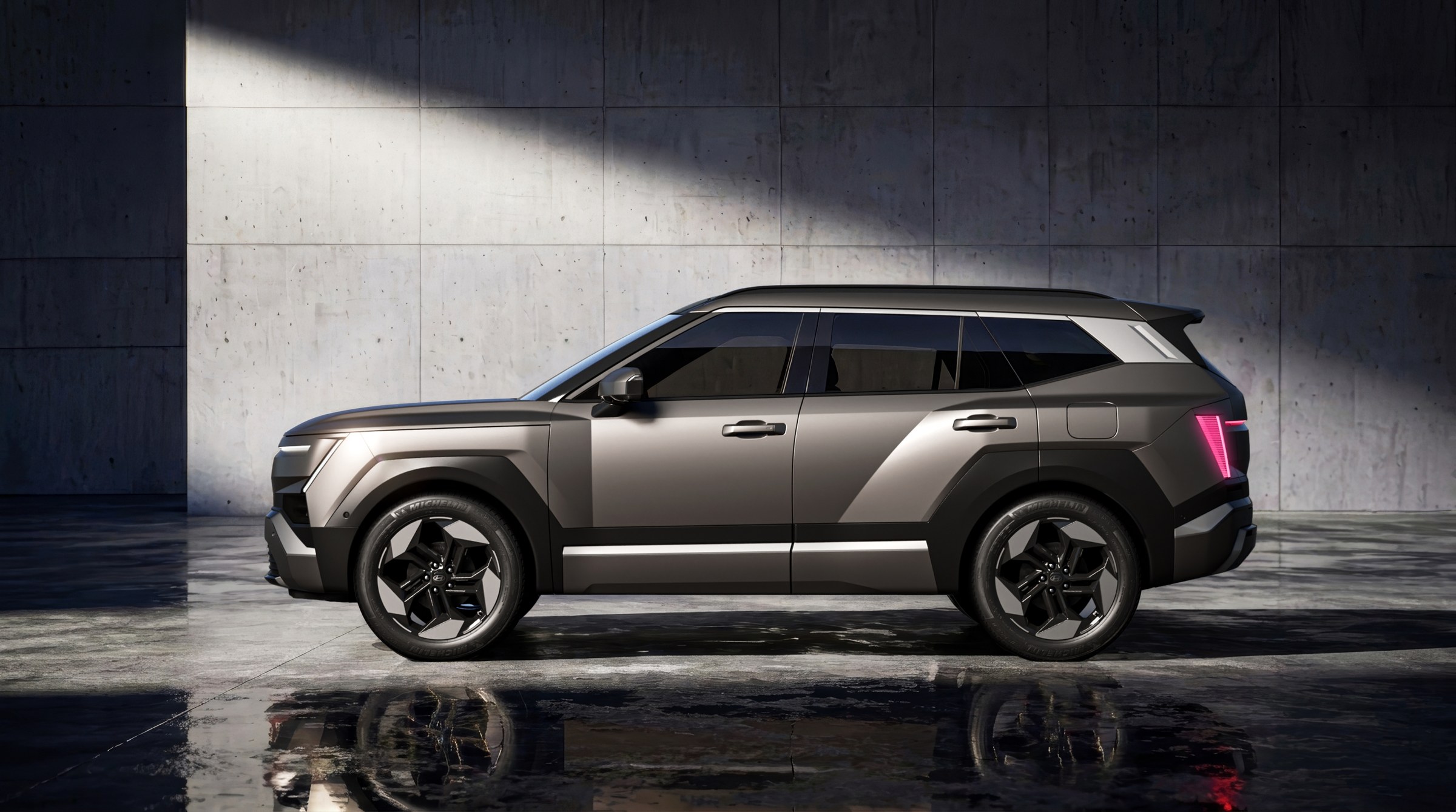
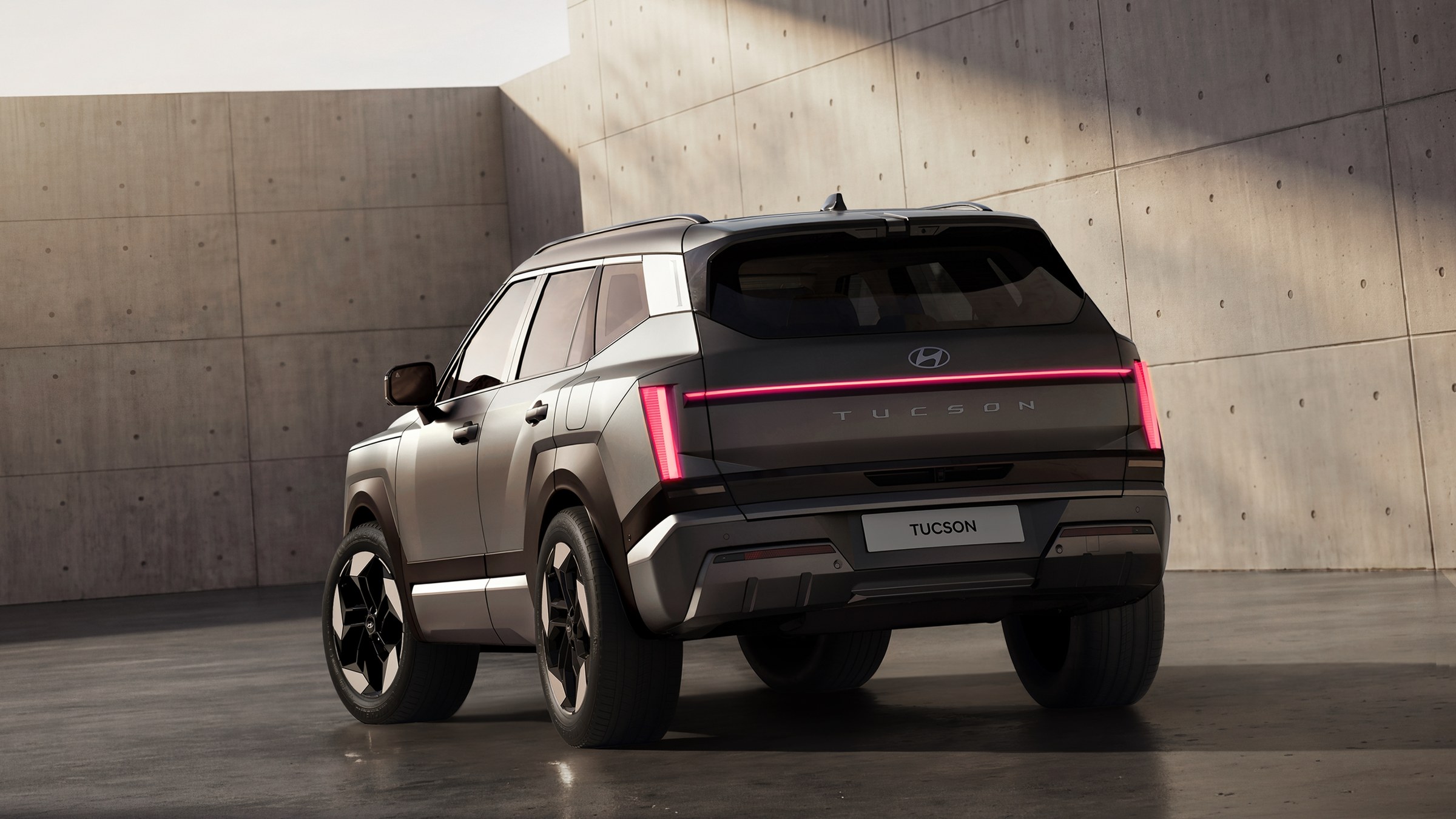
Hyundai calls the design language "Art of Steel" and builds the exterior around pronounced, muscular fenders, restrained door surfaces and crisp body lines. At the front, H-Edge lighting combines indirect centre lighting with edge lighting to make the nose look wider, and at the rear the Prism lamps sit at the edge of a transparent lens that reveals an internal pattern. A full-width light bar links the taillamps across the tailgate, and Hyundai says the front end was shaped to help pedestrian safety. Micro Pixel Lighting with 25,600 LED pixels is available, but Hyundai marks it as short-wheelbase only, so it is not offered in North America. The North American colour palette is Serenity White Pearl, Ranger Green Pearl or Matte, Kodiak Blue Pearl, Driftwood Gray Metallic or Matte and Red Rock Orange Pearl or Matte.
Inside, Hyundai describes a furniture-inspired cabin with a two-layer instrument panel: a horizontal upper layer and a deep open tray below it. A Double D-cut steering wheel sits in front of a 9.9-inch slim display, a 12.9-inch or 17-inch touchscreen handles infotainment, and physical buttons below the screen cover frequent climate and audio functions. The gear selector moves to a steering-column stalk, the console armrest is extended and available dual 15 W wireless charging pads sit in the console. Interior colours include black, black with dove gray, mud gray with dove gray and black with brown, while the XRT and XRT PRO use a black interior with dark metal accents. The Ergo Motion massage seat, the Relaxation Comfort Seat, the three-zone climate system and the metal-coated heated glass are short-wheelbase only.
Technology & Features
The new Tucson is the first Hyundai SUV with Pleos Connect, an infotainment platform built on Android Automotive OS. It supports third-party entertainment, productivity and gaming apps without phone mirroring, receives over-the-air updates and offers three-finger gesture controls and a single-screen mode on the wide display. Gleo AI is the in-car assistant, designed to understand natural requests such as asking for a hiking trailhead with parking within 30 minutes. For driving, Hyundai lists Navigation-Linked Smart Cruise Control, which slows the car for curves, roundabouts and speed bumps, and Intelligent Speed Limit Assist, which reads signs and adjusts the set speed. Memory Reversing Assist can record up to 30 km/h of driving and steer the car back out along the same path on a narrow road, and the available Ground View Monitor shows the ground ahead and beneath the car.
The XRT variants add the off-road side. Smart Terrain Assist, which is exclusive to the North American XRT PRO, rates traction and slip in real time and shows a green, orange or red "stuck score", while Target Speed Control holds a chosen speed between 2 and 25 km/h by managing throttle and brakes. The XRT adds wider black cladding, a forged-carbon-inspired pattern on the arches and lower body and bold skid-plate bumpers. The XRT PRO adds all-wheel drive, all-terrain tyres, front recovery hooks, steeper approach and departure angles and 210 mm of ground clearance. Hyundai has also said that a sport-inspired Tucson will debut at the Paris Motor Show on October 12, 2026.
Safety & ADAS
The structure uses hot-stamped steel in key areas and reinforced 2.0 mm centre pillars, and the airbag set covers driver and passenger front, front side, rear side and full-length curtain airbags, with a centre side airbag available. An In-Cabin Monitoring Unit watches the driver's eyes for drowsiness and issues fatigue alerts, and Child Presence Detection and Rear Occupant Alert warn the driver if a child or pet is left behind. Hyundai lists Level 2+ assisted driving with stop-and-go cruise control, lane following and an emergency stop function. The company says it is targeting five stars from NHTSA, an IIHS Top Safety Pick+ award and five stars from Euro NCAP, but these are targets and no independent crash-test result exists yet.
| ADAS LEVEL | L2+ (Hyundai Level 2+ assisted driving) |
|---|---|
| ADAS FEATURES | Smart Cruise Control with Stop & Go, Lane Following Assist, Emergency Stop, Navigation-Linked Smart Cruise Control, Intelligent Speed Limit Assist, Memory Reversing Assist, Ground View Monitor, In-Cabin Monitoring Unit, Child Presence Detection |
Available Versions
| VERSION | POWER | TORQUE | 0-100 | TOP SPEED | DRIVETRAIN | BATTERY | EV RANGE | COMBINED RANGE | PRICE | KEY DIFFERENCES |
|---|---|---|---|---|---|---|---|---|---|---|
| Tucson Plug-in Hybrid | 288 hp | 380 Nm | — | — | 4WD | 17.1 kWh | 81 km | — | TBA | 0–60 mph in 7.9 s; 7.2 kW onboard charger; not offered in the US |
| Tucson Hybrid (US spec) | 233 hp | 380 Nm | — | — | FWD / AWD | 1.49 kWh | — | — | TBA | 0–60 mph in 8.5 s; up to 42 mpg targeted (FWD, 17-inch wheels); not a plug-in |
Pricing & Availability
Hyundai has not announced pricing for any market. The new Tucson launches in Korea later in 2026, and Hyundai says North America, Europe and other markets follow in 2027, without naming dates for them. The plug-in is the part of the lineup that does not travel evenly: Hyundai's own table gives no US output or EPA figure for it, and Autoblog quotes Olabisi Boyle, senior vice president of product and mobility at Hyundai Motor America, saying that buyers ask for plug-ins but rarely plug them in. Hyundai Motor America instead points to extended-range electric vehicles, with the Santa Fe first, as the better fit for American buyers. In Europe the plug-in is part of the plan, since Hyundai's table lists a 91 g/km CO2 figure and a larger towing gain for the European plug-in. Hyundai has also stated that the XRT PRO is a North America-only trim. Outside the plug-in question, the Tucson is Hyundai's best-selling SUV worldwide with more than 11.1 million cumulative sales, about 20 percent of them in the US, where hybrids made up 31 percent of Tucson sales in 2025.
How It Compares
The most direct rival is the Toyota RAV4 Plug-in Hybrid, which is one of the few compact plug-in SUVs American buyers can actually buy. It makes 324 hp, offers 52 miles (84 km) of EPA-estimated electric range and starts at $42,950 for the SE, so the Tucson's 288 hp and 50-mile estimate are close on range and about 36 hp behind on power. The RAV4 is the plug-in that matters most to US shoppers precisely because the Tucson will not be sold there. The BYD Tang DM-i is a value contrast rather than a cross-shop: a larger 4,870 mm seven-seater with 272 hp, 175 km of electric range and 1,240 km of total range on the more generous CLTC cycle, priced from $24,700 in China, which shows how much cheaper a long-range Chinese plug-in SUV starts compared with a Western compact. The Tucson's own advantages are a bigger-than-before body, the Pleos Connect software and a 0–60 mph time of 7.9 seconds. The price that decides all of these comparisons is still missing.
- 17.1 kWh battery and an estimated 81 km (50 miles) of electric range, with a 7.2 kW onboard charger
- 292 PS (about 288 hp) and 0–60 mph in 7.9 seconds from the plug-in system
- Larger body with a 2,785 mm wheelbase, 83-degree door openings and Pleos Connect with Gleo AI
- US-spec hybrid at 233 hp with an up-to-42 mpg target and 3,000 lb towing
- No plug-in version for the United States, and no price, top speed, DC charging rate or curb weight published yet
- The 81 km electric range is an estimate with no test cycle stated
- Several features, including Micro Pixel Lighting and the massage seat, are not offered in North America
The Tucson Plug-in Hybrid is a large step forward on paper: a 17.1 kWh battery, 288 hp, a 7.9-second 0–60 time and a much more modern cabin, all in a body that has grown in every direction. It is a strong answer to the RAV4 Plug-in Hybrid for the markets that get it, but Americans will have to settle for the hybrid, and the missing price, charging rate and test cycle mean the real-world case is still unproven. It is best suited to European and Korean buyers who want to do most of their commuting on electricity. We would wait for pricing and homologated range before treating it as a class leader.