
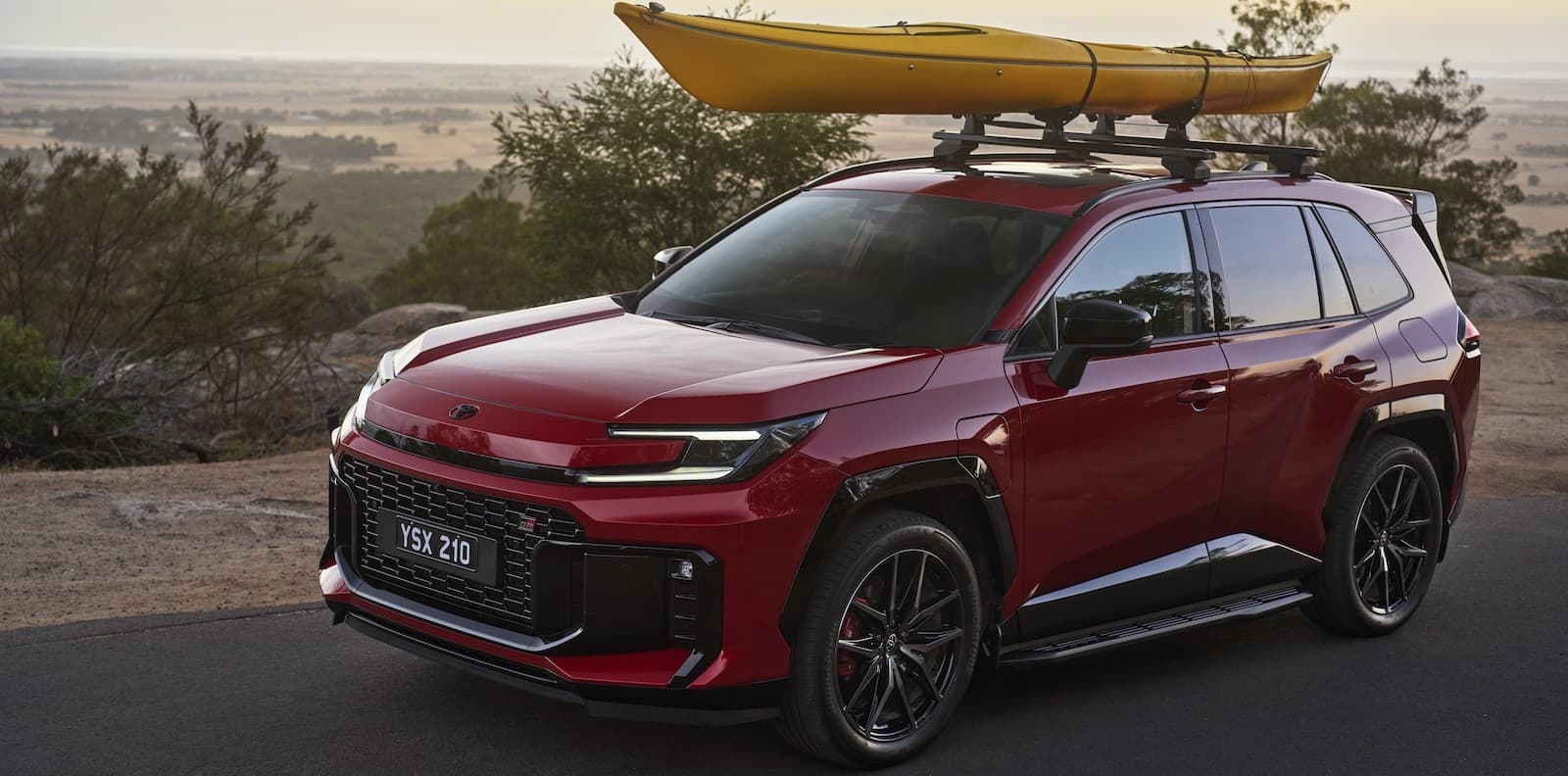
The sixth-generation Toyota RAV4 Plug-in Hybrid is the most capable plug-in the nameplate has ever offered, and it is now spreading across markets with very different price tags and very different test cycles. In the United States, Toyota rates the all-wheel-drive system at 324 net combined horsepower, with an EPA-estimated all-electric range of up to 54 miles from a new 22.7-kWh battery, and prices start at $41,500 MSRP for the SE. In Australia, Toyota has just confirmed a cheaper mid-range GXL 2WD plug-in for the first quarter of 2027, a front-wheel-drive version rated at 201 kW (273 PS / 270 hp) with a 121 km EV-only range on the WLTP cycle. That move puts the RAV4 closer to the wave of Chinese plug-in SUVs that have been undercutting established brands down under. Because the same hardware is quoted in miles, kilometres, hp, PS and kW depending on the market, this guide spells out which number belongs to which country and which test cycle, so nothing gets mixed up.
Performance & Specs
Every RAV4 plug-in uses Toyota's sixth-generation plug-in hybrid system: a 2.5-liter four-cylinder engine, a front electric motor and, on all-wheel-drive versions, a dedicated rear motor, all feeding the wheels through an electronically controlled CVT. In the US, where AWD is standard on every plug-in grade, Toyota quotes 324 net combined hp, 172 lb-ft from the engine alone, and a front motor rated at 203 hp (about 151 kW) and 201 lb-ft (about 272 Nm). The rear motor adds 91 lb-ft (about 123 Nm). Toyota's US site lists a 0–60 mph time of 5.4 seconds, and the system gained 22 hp over the outgoing generation while adding silicon-carbide semiconductors on the front axle to shrink and cool the power electronics. The front motor is the same unit Toyota Australia describes as 151.4 kW and 272 Nm, which is a good sanity check that the hardware is shared worldwide.
What changes by market is the rating. Toyota Australia lists the AWD plug-in at 227 kW (309 PS / 304 hp) combined, and the front-wheel-drive version at 201 kW (273 PS / 270 hp), while Toyota UK lists up to 309 BHP for the AWD GR SPORT (which matches 227 kW expressed in PS) and 272 for the FWD grades, with 0–62 mph in 6.1 seconds quoted for the range. The US figure of 324 hp is higher than the roughly 304 hp implied by 227 kW; Toyota's material does not reconcile the two, so treat them as different rating methods for the same powertrain rather than different hardware. The front-wheel-drive layout is a first for a RAV4 plug-in, and it is the version the new Australian GXL uses.

| Powertrain | 2.5L 4-cyl plug-in hybrid (6th gen), eCVT |
|---|---|
| Power (US) | 324 hp net combined (about 242 kW) |
| Motors | Front 203 hp / 201 lb-ft; rear 91 lb-ft |
| 0–60 mph (US) | 5.4 s |
| Battery | 22.7 kWh lithium-ion |
| EV Range (US, EPA est.) | Up to 54 mi (87 km) |
| POWERTRAIN TYPE | Plug-in hybrid (PHEV) |
|---|---|
| HORSEPOWER | 324 hp (US, AWD) / 227 kW (309 PS / 304 hp) (Australia, AWD) / 201 kW (273 PS / 270 hp) (Australia, FWD) |
| ACCELERATION | 0–60 mph in 5.4 s (Toyota US); 0–62 mph in 6.1 s (Toyota UK, top grade) |
| TOP SPEED | Not published by Toyota |
| DRIVETRAIN | AWD (US, all grades); FWD or AWD (Australia, UK) |
| BATTERY | 22.7 kWh lithium-ion |
| ELECTRIC RANGE | 54 mi EPA est. (SE, US) / 121 km WLTP-based (Australia GXL 2WD) / 85.13 mi WLTP EAER (UK Icon FWD) |
| COMBINED RANGE | Not published by Toyota US |
Dimensions & Practicality

| Length | 4,601 mm |
|---|---|
| Width | 1,855 mm |
| Height | 1,700 mm |
| Wheelbase | 2,690 mm |
| Ground clearance | 206 mm |
The sixth-generation RAV4 keeps dimensions close to its predecessor, so the plug-in remains a compact five-seater. Toyota Canada's official specifications list the SE and XSE at 4,601 mm long, 1,855 mm wide and 1,700 mm tall on a 2,690 mm wheelbase, with 206 mm of ground clearance. The GR SPORT is longer and wider at 4,644 mm by 1,880 mm, but sits lower at 1,685 mm tall with 191 mm of clearance, while Toyota US lists the Woodland at 8.5 inches (about 216 mm). Cargo space behind the rear seats is rated at 951 liters (33.6 cu ft) by Toyota Canada, while Toyota UK quotes a lower 446 liters under its own measurement method, so the two numbers should not be compared directly. Toyota US rates the SE, XSE and Woodland plug-ins at 3,500 lb (about 1,588 kg) of towing, and the SE has a base curb weight of roughly 2,012 kg per Toyota Canada.
| LENGTH | 4,601 mm (GR SPORT 4,644 mm) |
|---|---|
| WIDTH | 1,855 mm (GR SPORT 1,880 mm) |
| HEIGHT | 1,700 mm (GR SPORT 1,685 mm) |
| WHEELBASE | 2,690 mm |
| CARGO VOLUME | 951 L / 33.6 cu ft (Toyota Canada); up to 446 L (Toyota UK, different method) |
| FRUNK | None |
Charging & Battery
The 22.7-kWh lithium-ion pack is the heart of the upgrade. Toyota Europe says it holds 30 percent more energy than the previous plug-in's battery, and the US rating of up to 52 manufacturer-estimated miles at launch was 23 percent higher than the outgoing model's. Charging is where the market differences get interesting. In the US, the XSE and Woodland get an 11 kW onboard AC charger with a CCS1 port and DC fast-charging capability, which Toyota says can take the battery from 10 to 80 percent in approximately 30 minutes under ideal conditions. The SE and GR SPORT instead get a 7 kW charger with a J1772 port and no DC fast charging, with a Level 2 charge from 10 to 80 percent in around four hours. Every US car ships with a dual-voltage 120 V/240 V cable.
Toyota Europe and Toyota Australia both quote a 50 kW DC rate, a rare feature in this class, and an 11 kW AC rate, which Toyota Europe says fills the pack in as little as three hours; Australian cars use three-phase AC. The European brand also highlights geo-fencing, a navigation-linked function that automatically saves electric range for low-emission zones. Toyota does not publish a 10–80 percent DC time that depends on anything other than ideal conditions, so real-world results will vary with temperature and charger quality.
| BATTERY | 22.7 kWh lithium-ion |
|---|---|
| AC CHARGING | 11 kW (US XSE/Woodland, Europe, Australia); 7 kW (US SE/GR SPORT) |
| DC FAST CHARGING | 50 kW (Europe, Australia); US XSE/Woodland supported, kW not stated; none on US SE/GR SPORT |
| DC 10-80% TIME | About 30 min under ideal conditions (Toyota US/Europe) |
Design & Interior
The RAV4 plug-in is offered in the same three exterior styles as the rest of the lineup: core, rugged and sport. In the US plug-in range, the SE, XSE and the new GR SPORT make up the sport design, while the Woodland carries the rugged look. Common design cues include the hammerhead front end, a contoured hood, a flat roofline and new LED signature taillights. The body also adds an active front aerodynamic spat that deploys at higher speeds. Wheels range from 18-inch units on the SE and Woodland to 20-inch black alloys on the XSE and GR SPORT, and the Woodland adds all-terrain tires, a two-inch tow hitch receiver and Rigid Industries fog lights.
The GR SPORT, the first ever for the RAV4, is exclusive to the plug-in powertrain. It sits on a wider track with front performance dampers, a rear suspension brace, unique springs, dampers and steering mapping, and body aero parts such as a functional rear spoiler and active sport ducts. Inside, it gets Brin Naub synthetic suede and SofTex seats with GR badges on the headrests, red stitching, aluminum pedals and a GR start-up screen. Across the range, the cabin is organized around a new center stack, a toggle-style shift-by-wire shifter on select grades, a reversible armrest and a rear seatback that folds flat to maximize cargo space.
Technology & Features
The RAV4 launches Toyota's new Arene software platform and a new generation of Toyota Audio Multimedia. A 12.3-inch digital gauge cluster is standard, with a 10.5-inch touchscreen on lower grades and a 12.9-inch screen on the XSE and GR SPORT. The US version adds Toyota's first application of onboard 5G connectivity and a faster voice assistant. The XSE plug-in adds an available head-up display, heated and ventilated front seats and a three-dimensional 360-degree camera view, and Toyota's US system also includes a built-in dash cam. Over-the-air updates keep the safety suite current in Europe, and remote-controlled Advanced Park lets drivers move the car from outside with a smartphone.
The gap between the new GXL and the XSE in Australia is about equipment more than hardware. Toyota says the GXL 2WD PHEV shares its feature list with the GXL 2WD hybrid, including full LED lights, 18-inch alloys, an 8-way powered driver's seat, dual-zone climate control, a 12.3-inch digital instrument cluster, a 10.5-inch touchscreen and a wireless phone charger. XSE plug-ins in Australia add larger disc brakes and a 1,500 W inverter with a three-pin plug in the luggage space.
Safety & ADAS
Toyota Safety Sense 4.0 is standard on every RAV4, with improved detection for pre-collision braking and Lane Tracing Assist. Blind-spot monitoring with rear cross-traffic alert is standard across the US plug-in range, and parking assist with automatic braking is fitted on the SE and above. XSE and Woodland add Front Cross-Traffic Alert, Lane Change Assist, Traffic Jam Assist and a 3D Panoramic View Monitor, with Traffic Jam Assist depending on an active Drive Connect trial or subscription.
| ADAS LEVEL | L2 (Toyota Safety Sense 4.0) |
|---|---|
| ADAS FEATURES | Pre-Collision System, Lane Tracing Assist, adaptive cruise, BSM with RCTA, front and rear parking assist with automatic braking, 3D panoramic view (XSE/Woodland), Lane Change Assist, Advanced Park |
Available Versions
| VERSION | POWER | DRIVETRAIN | BATTERY | EV RANGE | PRICE | KEY DIFFERENCES |
|---|---|---|---|---|---|---|
| SE | 324 hp | AWD | 22.7 kWh | 87 km (54 mi, EPA est.) | $41,500 | US spec; 7 kW AC charging, no DC fast charging; fabric seats, 18-inch wheels |
| Woodland | 324 hp | AWD | 22.7 kWh | 79 km (49 mi, EPA est.) | $45,300 | US spec; 11 kW AC plus DC fast charging, all-terrain tires, 8.5-inch clearance |
| XSE | 324 hp | AWD | 22.7 kWh | 84 km (52 mi, EPA est.) | $47,200 | US spec; 11 kW AC plus DC fast charging, 20-inch wheels, 12.9-inch screen, ventilated seats |
| GR SPORT | 324 hp | AWD | 22.7 kWh | 79 km (49 mi, EPA est.) | $48,500 | US spec; 7 kW AC charging, wider track, GR-tuned suspension and steering |
| GXL 2WD (Australia) | 270 hp | FWD | 22.7 kWh | 121 km (WLTP-based) | Not announced | Australia only, due Q1 2027; 201 kW, 11 kW AC, 50 kW DC, 18-inch alloys |
Pricing & Availability
In the United States, the 2026-model-year RAV4 Plug-in Hybrid is priced from $41,500 for the SE, $45,300 for the Woodland, $47,200 for the XSE and $48,500 for the GR SPORT. These are manufacturer's suggested retail prices that exclude Toyota's $1,595 delivery, processing and handling fee for small SUVs. Toyota built the plug-in for the US in Japan and planned a spring 2026 arrival. Toyota's price list dated 3 September 2026 shows no separate 2027-model-year RAV4 plug-in pricing yet, so these are the figures buyers see today.
In Australia, Toyota's first plug-in hybrid arrived in mid-2026 priced at A$58,840 for the XSE 2WD, A$63,340 for the XSE AWD and A$66,340 for the GR Sport AWD, all manufacturer's recommended retail prices before on-road costs. The new GXL 2WD PHEV sits below the XSE and is due in showrooms in the first quarter of 2027, but Toyota Australia has not announced its price, so none is given here. In the UK, Toyota lists the plug-in from £44,195 on the road for the Icon FWD, rising to £46,095 for the Design, £50,045 for the Excel and £52,045 for the AWD GR SPORT. Toyota Europe says the new RAV4 is sold in Europe only as a plug-in hybrid or a full hybrid.
How It Compares
The RAV4 is not a direct cross-shop for large Chinese plug-in SUVs, but the price bracket makes the contrast hard to ignore. For roughly what Toyota asks for an SE in the US, Chinese-market catalog cars like the BYD Tang DM-i and Tang L deliver 456 to 510 hp and more than 1,000 km of combined range, although those prices are China-market figures and not what a US or Australian buyer would pay. The practical point is that Toyota is leaning on its hybrid reputation, a 22.7-kWh battery, a rare 50 kW DC option and a brand-new body rather than on raw output or sticker price.
That is exactly why the Australian GXL matters. Independent Australian outlets such as EVCentral and CarsGuide frame the GXL 2WD as ammunition against the BYD Sealion 6 and the Geely Starray, with EVCentral citing Chinese plug-in SUVs from A$37,490 for the Starray EM-i. Toyota has not said where the GXL will land, but it describes the new grade as bringing the PHEV powertrain to a wider market: the same 201 kW system and 121 km WLTP-based range as the XSE 2WD, wrapped in the equipment list of the popular mid-range GXL grade.
- Up to 324 hp in the US and a 5.4-second 0–60 mph time from a family-friendly compact SUV
- 22.7-kWh battery gives up to 54 EPA-estimated miles in the US and a 121 km WLTP-based rating on Australia's FWD GXL
- Rare 50 kW DC fast charging on a plug-in in this class, with 11 kW AC on most trims
- US SE and GR SPORT lack DC fast charging and are limited to 7 kW AC
- Power and range figures differ by market and test cycle, and the GXL's price is still unannounced
The 2026 Toyota RAV4 Plug-in Hybrid is a strong all-rounder for buyers who want electric commuting without a range-anxiety trade-off. The US SE at $41,500 pairs up to 324 hp, up to 54 EPA-estimated miles and AWD with a proven hybrid system, while the new Australian GXL 2WD makes the plug-in more accessible once Toyota announces pricing. The trade-offs are charging limits on the SE and GR SPORT, market-by-market rating differences and the fact that Chinese rivals offer more power and range for similar money. Pick the XSE or Woodland if DC fast charging matters, and wait for official GXL pricing if you are shopping in Australia.