
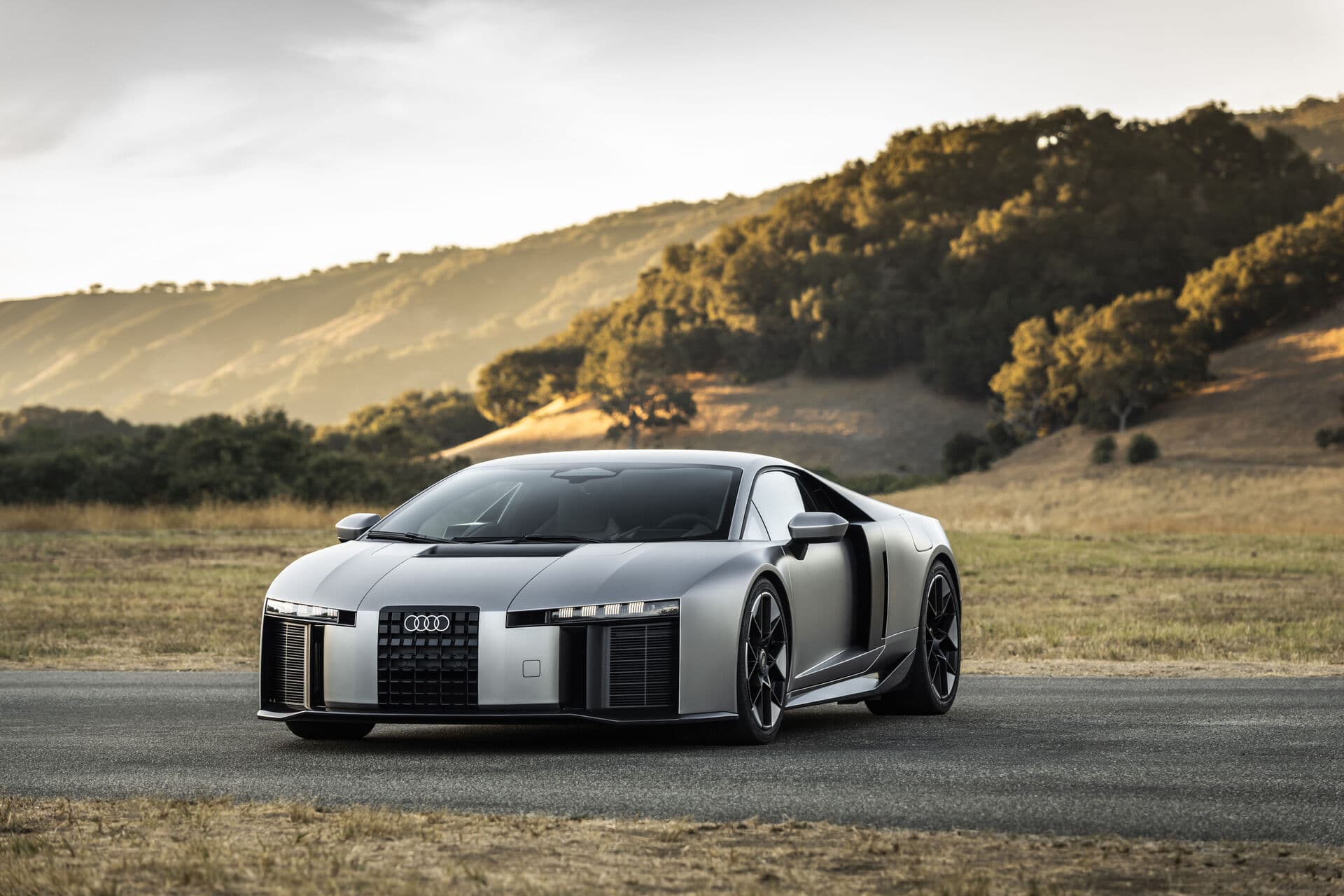
The 2027 Audi Nuvolari is the most extreme road car Audi has ever announced: a mid-engine, carbon-bodied plug-in-hybrid supercar with a system output of 736 kW (1,001 PS, about 987 hp), a 0–100 km/h time of 2.6 seconds and a top speed above 350 km/h. Audi revealed it on June 4, 2026 in Antibes, France, and presents it as its first supercar with a high-performance hybrid powertrain. Production is capped at 499 units worldwide, European presales open in the fourth quarter of 2026, and first deliveries are planned for the first half of 2027. The car shown so far is what Audi itself calls a near-production prototype, which is why weight, dimensions and electric-only range are still unpublished. Audi has also not listed a price in its press releases; outlets report roughly £500,000 in the UK and around €600,000 in Germany. Beyond the numbers, the Nuvolari is the first production Audi to follow the brand's new design philosophy and is being positioned as a technology and design flagship for the company's renewal.
Performance & Specs
At the heart of the Nuvolari is a 4.0-liter twin-turbo V8 rated at 588 kW (800 PS / 789 hp) and 730 Nm of torque, and it revs to 10,000 rpm — a range Audi says was previously reserved for motorsport. Audi's release labels the V8 output as 800 hp, but 588 kW works out to roughly 800 PS, so we quote it as 800 PS (789 hp). Three axial-flux electric motors, each rated at 110 kW (150 PS / 148 hp), complete the drivetrain. Two oil-cooled units sit on the front axle and together deliver up to 2,150 Nm, working as part of the quattro system to vary torque between the wheels, while a third motor sits between the mid-mounted V8 and the transmission. Audi quotes a maximum system output of 736 kW (1,001 PS / 987 hp). The component ratings add up to 918 kW, so the engine and motors clearly do not all peak at the same moment; 736 kW is the number that matters. Audi's release does not name the gearbox, but independent reports describe an eight-speed dual-clutch unit with the third motor integrated into it.
The performance claims are striking. Audi says the Nuvolari reaches 100 km/h in 2.6 seconds and 200 km/h in 6.8 seconds, with a top speed of more than 350 km/h (217 mph). The company notes that the acceleration figures apply under specific conditions, namely an initial battery temperature above 28 °C and a state of charge above 80 percent, so they describe a best case rather than a cold-start average. Drivers choose between four driving modes with rotary controls on the steering wheel: E-Hybrid for fully electric urban and short-distance driving, Balanced, Dynamic and Dynamic+. A separate Track Mode adjusts traction control from Wet through Dry and Race to fully off. A Launch Control function draws on stored battery energy for maximum acceleration, an idea Audi says comes straight from Formula 1.
The chassis and control systems are just as central to the story as the engine. Audi calls the new all-wheel-drive logic quattro predictive ride: it models the car's state from steering angle, acceleration, yaw rate and grip level, and if it expects a loss of traction in a corner it reacts before the slide starts, using torque distribution, brake intervention and aerodynamic downforce together. Braking is by wire, with the pedal decoupled from the actual force at the wheels so that recuperation and hydraulic braking can be blended invisibly. The new Audi Ceramic Pro system uses 10-piston fixed calipers with 420 × 40 mm discs at the front and 4-piston calipers with 410 × 32 mm discs at the rear. Audi says the F1-derived long-fiber carbon discs can absorb up to 2.8 megawatts, which it compares to a current Formula 1 car. Purely electric deceleration of up to 0.3 g is possible, covering a large share of everyday braking.
Aerodynamics are active. A vented front end with an S-duct cuts lift and helps cool the powertrain, while a deployable adaptive rear wing works in three positions: Closed, Low Downforce and High Downforce. In the performance modes it moves automatically, and a Drag Reduction System button on the steering wheel, borrowed from Formula 1, lowers it further for top speed. In High Downforce mode Audi claims more than 400 kg of downforce, depending on the driving situation. The solid-metal Audi rings are set flush into the wing itself.

| Powertrain | Mid-engine V8 plug-in hybrid, AWD (quattro predictive ride) |
|---|---|
| Power | 736 kW (1,001 PS / 987 hp) system |
| V8 engine | 588 kW (800 PS / 789 hp), 730 Nm |
| E-motors | 3 × 110 kW (148 hp), up to 2,150 Nm at front axle |
| 0–100 km/h | 2.6 s |
| Battery | 7.3 kWh gross |
| POWERTRAIN TYPE | Plug-in hybrid (PHEV), mid-engine V8 + 3 electric motors |
|---|---|
| HORSEPOWER | 736 kW (1,001 PS / 987 hp) system output |
| V8 OUTPUT | 588 kW (800 PS / 789 hp), 730 Nm |
| ACCELERATION | 0–100 km/h in 2.6 s; 0–200 km/h in 6.8 s |
| TOP SPEED | More than 350 km/h (217 mph) |
| DRIVETRAIN | AWD (quattro predictive ride) |
| BATTERY | 7.3 kWh gross lithium-ion |
| ELECTRIC RANGE | Not published |
| COMBINED RANGE | Not published |
Dimensions & Practicality

| Length | Not yet published |
|---|---|
| Width | Not yet published |
| Height | Not yet published |
| Wheelbase | Not yet published |
| Layout | Mid-engine, two-door coupe |
Audi has not published dimensions, curb weight or luggage capacity for the Nuvolari, so those figures will have to wait for homologation. Individual outlets have offered numbers, such as a length of about 4.74 meters from Auto Express and a dry weight below 1,750 kg from evo, but neither is confirmed by Audi and neither appears in the tables here. What Audi does describe is the structure: a newly developed Audi Space Frame with a carbon exterior, a first for the brand, designed for low weight and high torsional rigidity. Almost all exterior components are carbon fiber reinforced polymer (CFRP), made with prepreg autoclave technology and manual layup, and heat-resistant materials are used where temperatures peak. The mid-engine layout gives the body a monolithic volume, and the press photos show a low two-door coupe with a dark louvered panel over the engine bay, large side intakes and a full-width rear light strip.
| LENGTH | Not yet published |
|---|---|
| WIDTH | Not yet published |
| HEIGHT | Not yet published |
| WHEELBASE | Not yet published |
| CARGO VOLUME | Not published |
| FRUNK | Not published |
Charging & Battery
The Nuvolari is a plug-in hybrid, but the battery is sized for performance rather than range. Audi specifies a lithium-ion pack with a gross capacity of 7.3 kWh, which feeds the three electric motors for boost and Launch Control and allows fully electric driving in E-Hybrid mode for urban and short-distance use. Audi has not published an electric-only range, AC or DC charging speeds. Its preliminary WLTP figures for the near-production prototype are 11.3 l/100 km and 7.8 kWh/100 km (weighted combined), 270 g/km of CO2 and CO2 class G, rising to 14.7 l/100 km with a discharged battery. Energy recovery is a major theme: adaptive coasting and brake recuperation cover almost all driving phases, with the front axle taking a significant part of braking and the rear axle recuperating during coasting, partial load and traction-control phases.
| BATTERY | 7.3 kWh gross, lithium-ion |
|---|---|
| AC CHARGING | Not published |
| DC FAST CHARGING | Not published |
| WLTP (PRELIMINARY) | 11.3 l/100 km; 7.8 kWh/100 km; 270 g/km CO2 |
| REGENERATION | Up to 0.3 g electric deceleration |
Design & Interior
Audi describes the Nuvolari's design as visceral: taut surfaces, seamlessly integrated technology and intelligent aerodynamics, wrapped around a mid-engine layout that gives the car a monolithic volume and a strong stance. The exterior wears Titanium, a new Audi signature color also used on the Audi Concept C and the Audi Formula 1 car, set off by exposed carbon elements. The photos show a black-mesh front grille with a grid pattern, slim light signatures above large air intakes, and forged center-lock wheels, which make their debut in Audi's production portfolio. Inside, the cockpit is built around the act of driving. Controls are reduced to essentials and placed in the driver's field of view, with anodized aluminum for the vents, controls and the frame of the central display. The cabin is split into two color zones, a deep dark tone at the front to aid concentration and a lighter tone called Shadow Dune at the rear, while accents in the interface nod to the Auto Union Type C race car of the 1930s. The seats use carbon fiber in the base and backrest to save weight while giving precise lateral support.
The name carries history. It honors Tazio Nuvolari, the Italian racing driver known for fearlessness and a single-minded will to win, and it is not the first time Audi has used it: an Audi Nuvolari quattro concept with a 5.0-liter twin-turbo V10 rated at 600 PS was shown at the 2003 Geneva Motor Show but never built. This time the car is real. Audi's own history also shows why it calls the Nuvolari a first. The R8 was a combustion-only V8 and V10 car throughout its production life, ending with the 620 hp R8 GT limited to 333 units. The all-electric R8 e-tron of 2015 was a battery-electric special of fewer than 100 units, and the 2013 Sport quattro plug-in-hybrid concept never reached showrooms. By Audi's account, the Nuvolari is therefore the first Audi supercar to combine a combustion engine and electric motors for outright performance.
Technology & Features
The interface is deliberately minimal. Digital displays and physical controls follow a single logic, and the most relevant information sits directly in front of the driver while secondary content stays in the background. The steering wheel carries rotary controls for drive modes and for the rear wing, plus the dedicated DRS button. The electrified chassis is where the real technology sits: brake-by-wire, variable torque vectoring through the front electric motors, and an energy management system that links boost and recuperation to torque distribution and grip. Audi also worked with its Formula 1 drivers during aerodynamic development and credits the F1 program for the carbon components, the brake discs and the active aero concept. The message from Audi CEO Gernot Döllner is that the Nuvolari serves as a technology and design flagship for the renewal of the brand, and Audi CTO Rouven Mohr ties it to moving racing innovation quickly onto the road.
Safety & ADAS
Audi has not published an automation level or a driver-assistance equipment list for the Nuvolari, and the prototype is presented as a performance and technology showcase. What the company does detail are the stability systems: quattro predictive ride, torque vectoring by the front motors, brake-by-wire with blended recuperation, and downforce that adjusts to the driving situation. Crash-test ratings and final safety equipment will only be known once the production specification is homologated.
| ADAS LEVEL | Not published |
|---|---|
| ADAS FEATURES | Not published; stability: quattro predictive ride, torque vectoring, brake-by-wire |
Available Versions
| VERSION | POWER | TORQUE | 0-100 | TOP SPEED | DRIVETRAIN | BATTERY | EV RANGE | COMBINED RANGE | PRICE | KEY DIFFERENCES |
|---|---|---|---|---|---|---|---|---|---|---|
| Nuvolari | 987 hp | 730 Nm (V8 only) | 2.6s | 350+ km/h | AWD | 7.3 kWh (gross) | — | — | Price on request | Single specification, limited to 499 units; up to 2,150 Nm from the front electric axle |
Pricing & Availability
Audi's press releases do not state a price for the Nuvolari. Independent outlets report roughly £500,000 in the UK and about €600,000 in Germany, which is close to $700,000 at current exchange rates, and one Austrian report mentions around €590,000; none of these figures is confirmed by Audi's own release, so we list the price as on request until it is. What Audi has confirmed is the timeline and volume. The car was unveiled on June 4, 2026, appeared at the 2026 Monaco Grand Prix, and made its North American debut at Monterey Car Week in August, displayed at The Quail and on the Concept Lawn at the Pebble Beach Concours d'Elegance before a road debut around Carmel-by-the-Sea. Production is limited to 499 units worldwide, official presales in Europe begin in the fourth quarter of 2026, and first deliveries are planned for the first half of 2027. Audi says the car is already drawing significant interest from buyers around the world. As of September 2026 the company has not announced US pricing, allocation or on-sale timing.
How It Compares
The closest relative is the Lamborghini Temerario, which independent outlets say the Nuvolari shares its mid-engine hybrid architecture and V8 concept with. The Temerario makes 920 PS (907 hp) and costs about $358,000, so the Audi offers roughly 80 hp more and a 0.1-second quicker 0–100 km/h time for a reported price that is nearly double. The Lamborghini Revuelto SV sits at the other end of the same family: 1,050 hp from a plug-in V12 at $741,172, which puts it in the same price bracket as the reported Nuvolari price with more power than the Audi. Audi's own past makes a useful contrast too, as the last R8 GT topped out at 620 hp. For a value contrast rather than a cross-shop, the Denza Z is a battery-electric supercar with 1,582 hp and 410 km of range that starts at about $100,300 in China. If the reported Nuvolari price holds, it costs about seven times as much as the Denza Z does in China and delivers roughly 62 percent of its horsepower, which shows how much of a halo supercar's price goes to exclusivity, carbon craftsmanship and a badge rather than raw output.
- 987 hp (1,001 PS), 2.6 seconds to 100 km/h, 6.8 seconds to 200 km/h and more than 350 km/h make it the fastest and most powerful production Audi, by Audi's own account
- Formula 1-derived engineering: carbon Audi Space Frame, active three-position rear wing with more than 400 kg of downforce, and brake-by-wire carbon discs that absorb up to 2.8 MW
- Limited to 499 units with a distinctive design and interior, giving it real collector appeal
- Reported price of roughly £500,000 to €600,000 is close to double the related Lamborghini Temerario, and Audi has not confirmed it
- Weight, dimensions, gearbox details and electric range are not yet published, and the car shown is a near-production prototype
- The 7.3 kWh battery limits electric-only driving to short urban hops, so it is a performance hybrid rather than an efficient plug-in
The Nuvolari is a genuine statement from Audi: a carbon-structured, F1-inspired hybrid that finally gives the four rings a supercar of its own, with a 987 hp system and numbers that lead its brand. The trade-offs are those of any halo car. It is a limited run built for collectors, its reported price is high for a car that shares its basic hybrid concept with a much cheaper Lamborghini, and key figures such as weight and electric range remain unpublished until production specifications are final. Judged for its price and segment, it is a strong and exciting debut rather than a flawless one. Recommended for collectors and performance-hybrid fans who want a brand-new Audi story; buyers who need proven numbers should wait for the production specification.