
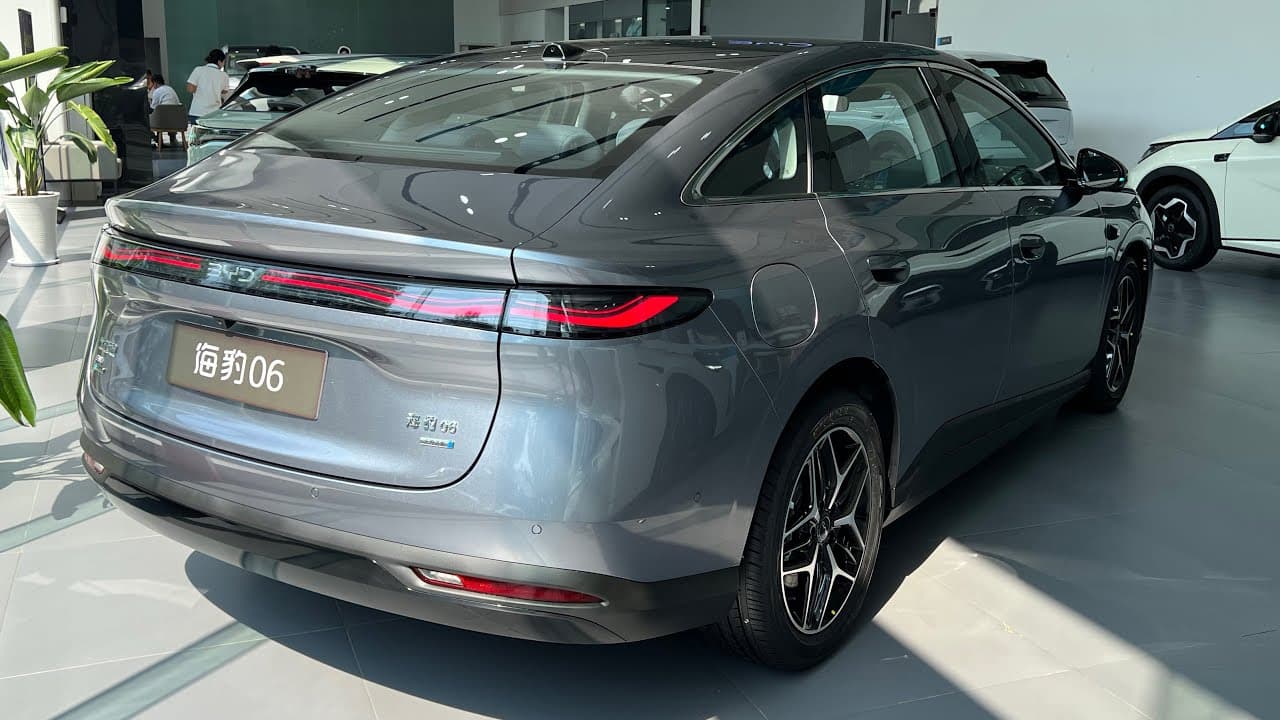
The 2027 BYD Seal 06 EV is the battery-electric version of BYD's Ocean-series mid-size sedan, and the model-year update that went on sale in China on August 11, 2026 is a much bigger step than the unchanged badge suggests. The body grows by 150 mm to 4,870 mm, the battery becomes BYD's second-generation Blade pack in 52.9 kWh and 64.3 kWh sizes, and a new 240 kW (322 hp) rear motor joins a 120 kW (161 hp) entry motor. Range reaches 630 km on the CLTC cycle, while the 800V platform is rated for 10-70% in five minutes and 10-97% in nine minutes on BYD's Flash Charging network. Six EV trims cover ¥109,900 to ¥155,900 (about $16,500 to $23,400), and the top trim adds a roof LiDAR with God's Eye B driver assistance. A walkaround from the Chinese Car Reviewer channel shows a showroom car and confirms details that press releases skip, from a 530-litre boot to a 115-litre front trunk.
Performance & Specs
Two single-motor, rear-drive powertrains are on offer. The three 530 km trims use a 120 kW (161 hp) motor with the 52.868 kWh battery, and the three 630 km trims use a 240 kW (322 hp) motor with the 64.315 kWh battery. The stronger motor is an 80 kW step up from the 160 kW (215 hp) maximum of the outgoing car and is quoted at 5.9 seconds from 0 to 100 km/h, with a 190 km/h top speed in Chinese spec listings. The reviewer reads 240 kW, a 9.6-second 0-100 time and a 170 km/h top speed off a sheet on camera, but the 9.6 seconds matches Chinese listings for the 120 kW trims rather than the 240 kW car, so his sheet looks mixed and the official 5.9 seconds stands for the stronger motor. The entry trims are therefore relaxed family transport rather than a performance sedan. The motor sits at the rear: the regulatory filing data and Chinese spec sheets list it there, and the 115-litre front trunk the reviewer opens on camera fits that layout.
Underneath, the car uses MacPherson struts at the front and a five-link rear axle, and the mid and upper trims add BYD's DiSus-C intelligent damping, which reads the road ahead and adjusts all four dampers continuously. Chinese spec listings quote average energy consumption as low as 10.7 kWh per 100 km, which lines up with the 64.3 kWh battery and the 630 km CLTC range to within about 5%.

| Powertrain | Single-motor rear-drive BEV |
|---|---|
| Power | 120 kW (161 hp) / 240 kW (322 hp) |
| 0–100 km/h | 5.9 s (240 kW) |
| Battery | 52.868 / 64.315 kWh LFP |
| Range | 530 / 630 km CLTC |
| DC charging | 10–97% in 9 min |
| POWERTRAIN TYPE | Single-motor rear-drive battery electric |
|---|---|
| HORSEPOWER | 161 hp (120 kW) / 322 hp (240 kW) |
| ACCELERATION | 5.9 s (240 kW); about 9.6 s reported for the 120 kW car |
| TOP SPEED | 190 km/h (240 kW) |
| DRIVETRAIN | RWD |
| BATTERY | 52.868 kWh / 64.315 kWh LFP Blade (2nd gen) |
| ELECTRIC RANGE | 530 km / 630 km CLTC |
| COMBINED RANGE | — (pure BEV) |
Dimensions & Practicality

| Length | 4,870 mm |
|---|---|
| Width | 1,890 mm |
| Height | 1,495 mm |
| Wheelbase | 2,820 mm |
| Boot | 530 L |
| Front trunk | 115 L |
The 2027 body measures 4,870 mm long, 1,890 mm wide and 1,495 mm tall on a 2,820 mm wheelbase. Compared with the outgoing car's 4,720 mm length and 1,880 mm width, that is 150 mm more length and 10 mm more width, while height and wheelbase carry over. The reviewer reads the same figures out on camera: 1.49 metres high, 4.87 metres long, 2.82 metres between the axles and 1.89 metres wide.
Practicality is one of the strongest arguments for the EV. The boot is rated at 530 litres, which the reviewer also states, and it opens into a wide, flat-floored space in his footage. A 115-litre front trunk sits under the bonnet and the reviewer shows it open, while the plug-in hybrid sibling is listed with a 550-litre boot in Chinese spec coverage. The showroom car has a fold-down rear armrest with cup holders, and the reviewer says the rear bench has enough leg and head room for the ride-hailing work these sedans do all over China.
| LENGTH | 4,870 mm |
|---|---|
| WIDTH | 1,890 mm |
| HEIGHT | 1,495 mm |
| WHEELBASE | 2,820 mm |
| CARGO VOLUME | 530 L |
| FRUNK | 115 L |
Charging & Battery
Every 2027 Seal 06 EV runs on an 800V architecture and BYD's second-generation Blade battery, an LFP chemistry chosen for durability and cost. The 52.868 kWh pack delivers 530 km CLTC and the 64.315 kWh pack delivers 630 km. On a compatible Flash Charging station BYD rates the car at 10% to 70% in about five minutes and 10% to 97% in about nine minutes, and Chinese launch coverage adds that a -30°C charge takes only around three minutes longer. BYD does not publish the peak charging power; simple arithmetic on the 64.3 kWh pack puts the five-minute, 60-point top-up at roughly 460 kW on average.
The reviewer describes two separate charging inlets, one for slow AC and one for DC fast charging. He says a slow AC charge takes 10 to 12 hours and a DC fast charge takes about 15 minutes to reach roughly 80%. That is slower than BYD's own rating, a reminder that the headline five-minute figure needs the brand's high-power Flash Charging stations. CnEVPost reports that launch-period EV buyers also got free flash charging for the first year.
| BATTERY | 52.868 kWh / 64.315 kWh LFP Blade (2nd gen) |
|---|---|
| ARCHITECTURE | 800V |
| DC FAST CHARGING | Flash Charging network; peak power not published |
| DC 10-70% TIME | about 5 min |
| DC 10-97% TIME | about 9 min |
| CONSUMPTION | as low as 10.7 kWh/100 km |
Design & Interior
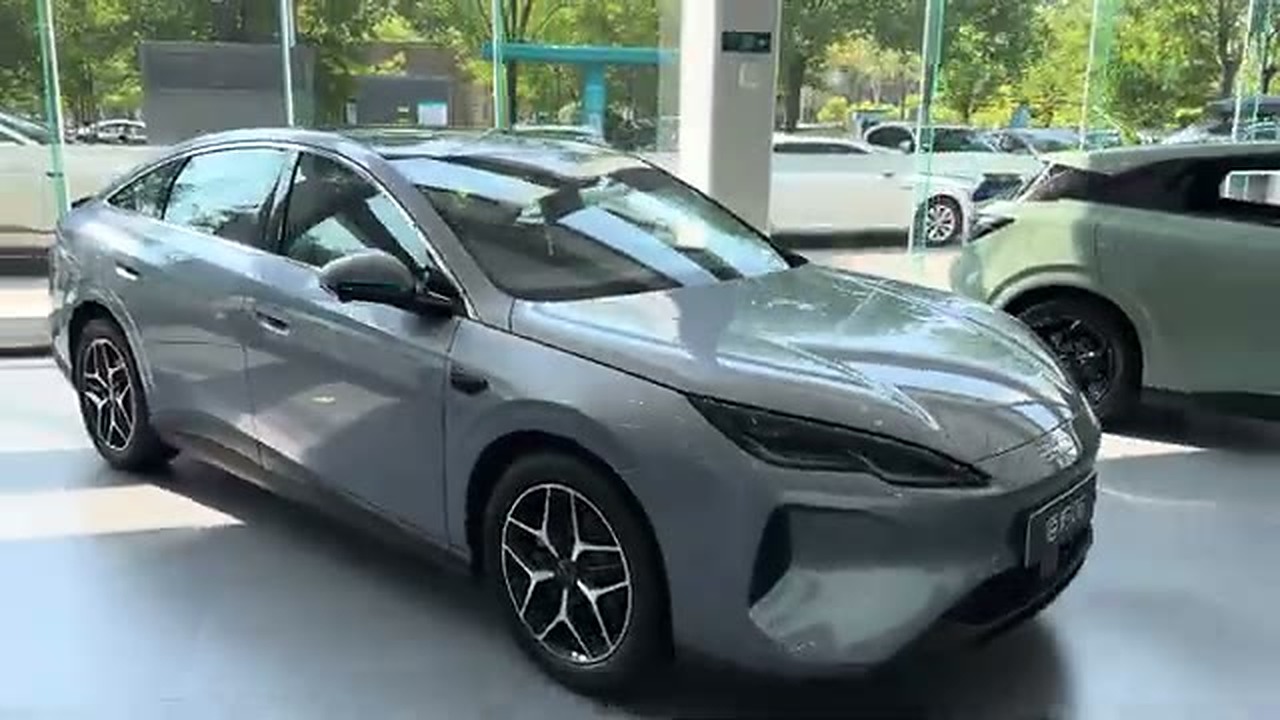
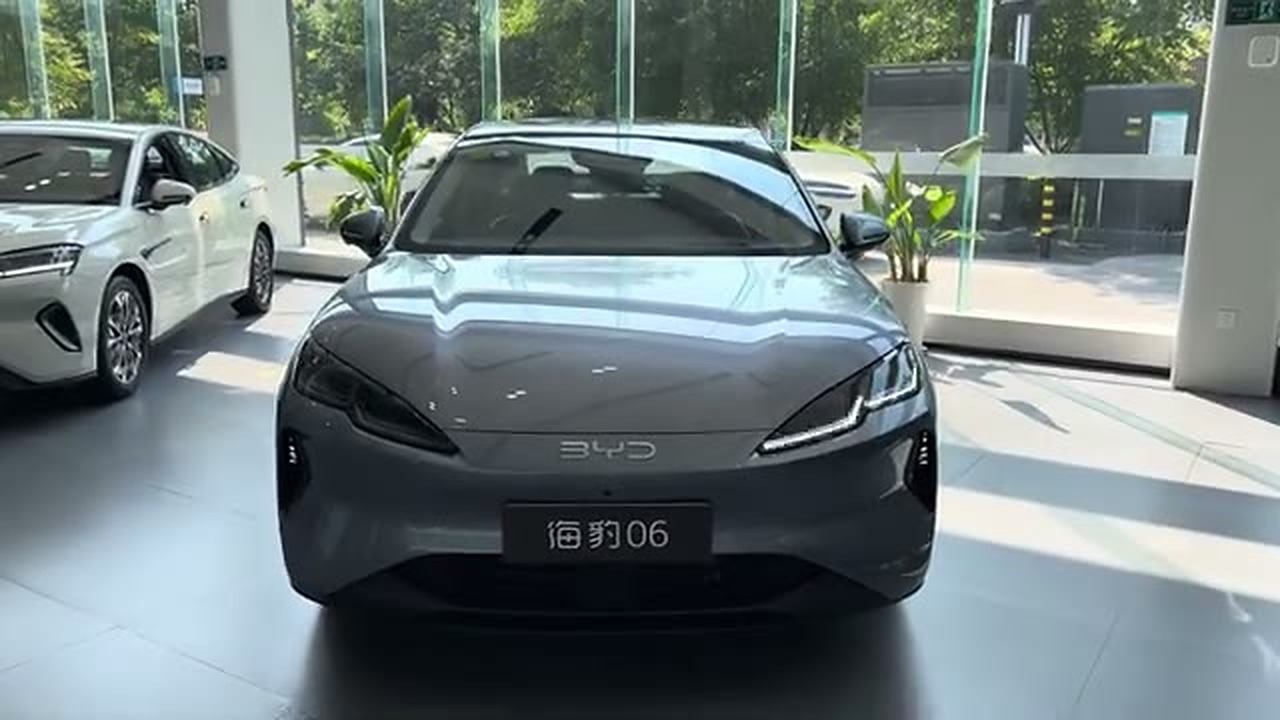
The 2027 update keeps the sleek proportions of the earlier Seal 06 EV but cleans up the details. The nose has slimmer headlights and a simple closed face with the BYD lettering set on the bonnet edge, and the rear carries a full-width light bar with the BYD name lit in the middle, a look the reviewer compares to the larger Seal 08. In the footage the car sits on dark multi-spoke alloy wheels, has flush door handles and a small integrated ducktail on the boot lid, and the roof is glass with a sunshade.
The cabin on the reviewer's car is finished in blue-grey upholstery with teal contrast stitching on the seats and steering wheel. The dashboard is dominated by a 15.6-inch rotating touchscreen with an 8.8-inch driver display behind the steering wheel, and the centre console has a wireless charging pad and cup holders. The reviewer points out a head-up display, front seats that are electrically adjustable and offer massage, and an interface that can be switched to English. He also shows the ambient lighting menu, where the colour and brightness of the interior lighting can be adjusted from the main screen.
Technology & Features
The infotainment runs on BYD's DiLink 150 platform with DeepSeek voice assistant integration, and the 15.6-inch screen rotates between landscape and portrait mode. Menus for the seat, lighting and vehicle settings are on the main display, and the reviewer demonstrates the 360-degree camera view with parking sensors around the car. A wireless charger rated at 50 W sits on the centre console. Higher trims add a windshield-projected head-up display and front-seat massage, and the top trim adds a heated steering wheel, according to Chinese launch coverage.
Safety & ADAS
Driver assistance depends on the trim. Mid trims use BYD's camera-based God's Eye C, while the top 630 Flagship adds a roof-mounted LiDAR and God's Eye B as standard, which supports urban and highway navigation assistance and full-scenario parking. Some Chinese coverage also mentions the LiDAR package as a paid option of roughly ¥12,000 on lower trims. Up to seven airbags are fitted, with the seventh a remote collision-prevention airbag on the higher trims according to Chinese launch coverage. The reviewer's car shows no LiDAR pod on the roof, only a shark-fin antenna at the rear, so it is not the LiDAR-equipped Flagship.
| ADAS LEVEL | L2+ (God's Eye B with LiDAR on the top trim) |
|---|---|
| ADAS FEATURES | Urban and highway navigation assist, parking assist, AEB, lane keeping, 360° camera, up to 7 airbags |
Available Versions
| VERSION | POWER | TORQUE | 0-100 | TOP SPEED | DRIVETRAIN | BATTERY | EV RANGE | COMBINED RANGE | PRICE | KEY DIFFERENCES |
|---|---|---|---|---|---|---|---|---|---|---|
| 530 Comfort | 161 hp | — | 9.6s | — | RWD | 52.868 kWh | 530 km | — | $16,500 | Entry car with the 120 kW motor (¥109,900) |
| 530 Smart | 161 hp | — | 9.6s | — | RWD | 52.868 kWh | 530 km | — | $18,000 | Adds God's Eye C assistance and powered, heated and ventilated front seats (¥119,900) |
| 530 Premium | 161 hp | — | 9.6s | — | RWD | 52.868 kWh | 530 km | — | $19,500 | Adds DiSus-C damping, head-up display, seat massage and 18-inch wheels (¥129,900) |
| 630 Smart | 322 hp | — | 5.9s | 190 km/h | RWD | 64.315 kWh | 630 km | — | $19,950 | 240 kW motor and larger battery with Smart-level equipment (¥132,900) |
| 630 Premium | 322 hp | — | 5.9s | 190 km/h | RWD | 64.315 kWh | 630 km | — | $21,450 | Premium equipment plus a cooler and warmer box (¥142,900) |
| 630 Flagship | 322 hp | — | 5.9s | 190 km/h | RWD | 64.315 kWh | 630 km | — | $23,400 | Roof LiDAR with God's Eye B and a heated steering wheel (¥155,900) |
Pricing & Availability
The 2027 Seal 06 line-up went on sale in China on August 11, 2026 with 12 versions: the six EV trims above and six DM-i plug-in hybrid trims from ¥99,900 to ¥141,900. The first-generation Seal 06 EV launched in China in June 2025 at ¥109,800 to ¥129,800 with 470 to 545 km of CLTC range, so the entry price is essentially unchanged while range, power and equipment rise. Dollar figures here use about ¥6.66 to the dollar, the rate behind the reviewer's $16,500 headline; the yuan prices are the ones that matter.
The reviewer quotes roughly $16,400 for the base car and about $24,000 for the top spec on camera. Note that the video title pairs the 630 km range with the $16,500 starting price, but the 630 km version starts at ¥132,900 (about $19,950), and $16,500 buys the 530 km car. Chinese launch coverage listed first-year free flash charging of up to 300 kWh a month, trade-in support of up to ¥4,000 and zero-percent 24-month financing for the launch window of August 11 to 31, so current dealer terms may differ. The reviewer's channel sells cars for export and says on camera that it can supply the earlier 2025 model to overseas buyers; no export plans for the 2027 update have been announced.
How It Compares
The closest relative is BYD's own Seal 06 GT, the hatchback that shares the 2,820 mm wheelbase and the same 240 kW motor at the top of its range. The GT costs about ¥19,000 more at the entry point and offers a similar 620 km, so the sedan is the cheaper way into the same flash-charging hardware, while the GT adds a hatchback boot. Among sedans, the XPeng Mona M03 asks ¥119,800 for its base trim, ¥9,900 more than the Seal 06 EV, and tops out at 160 kW (215 hp) against the BYD's 322 hp, although its 640 km maximum edges past the BYD's 630 km. The Nissan N7 starts at ¥119,900 and reaches 635 km with 200 kW (268 hp), but it is a larger 4.9-metre car, and a revised version is due on September 22, so its numbers may move. All dollar figures here use the same ¥6.66 rate, so they may differ from the dollar prices shown on those cars' own pages; the yuan prices are the ones to compare.
- Up to 630 km CLTC range and 800V flash charging (10-97% in about nine minutes) from ¥109,900
- Roomy 530-litre boot plus a 115-litre front trunk in a 4.87-metre sedan
- 240 kW (322 hp) and 5.9-second 0-100 on the 630 km trims, with LiDAR and God's Eye B available
- The 630 km range and the 240 kW motor only come on trims from ¥132,900; the entry car is a 120 kW (161 hp) sedan that takes about 9.6 seconds to 100 km/h
- Roof LiDAR and God's Eye B come standard only on the top trim, and the five-minute charge needs BYD's own Flash Charging stations
The 2027 Seal 06 EV is a well-judged value sedan: a 4.87-metre body, a 530-litre boot, 800V flash charging and up to 630 km of CLTC range at prices that start near $16,500. The smart buy looks like the 630 Smart at ¥132,900 (about $19,950), which brings the 240 kW motor and the big battery without the Flagship premium. The entry trims are more sedate and CLTC range is optimistic, so treat the headline numbers as best case. Buyers who charge on BYD's own network get the most from it, and for them this is one of the strongest electric sedans at the price in China.