The 2027 Geely Dihao i-HEV (Emgrand i-HEV), the fifth-generation model sold in China, is a conventional full hybrid (HEV) sedan that cannot be plugged in. It pairs a 1.5-litre petrol engine rated at 82 kW (112 PS / 110 hp) with a P1+P3 dual-motor system and an integrated 11-in-1 electric drive with a dedicated hybrid transmission (DHT), and the front-wheel-drive traction motor is rated at 140 kW (190 PS / 188 hp) and 240 Nm. Geely quotes 3.83 L/100 km on the WLTC cycle, and says a Hainan highway-loop test returned 2.22 L/100 km, which it has submitted as a Guinness World Record for a mass-production hybrid. The car is 4,815 mm long with a 610-litre boot and a 14.6-inch screen running Flyme Auto, and it costs CNY 87,900 to CNY 97,900 in China, or about $13,186 to $14,686. It uses Geely's i-HEV system, not the plug-in EM-i (Thor) hybrid used in the Galaxy and Monjaro EM-i models, and it is aimed squarely at the Toyota-style family sedan buyer who wants low fuel bills without a charging cable.
Performance & Specs
The powertrain is built around a dedicated 1.5-litre hybrid engine with a CATARC-certified peak thermal efficiency of 48.41 percent, which Geely describes as the highest of any mass-production engine. Chinese launch specifications list the engine at 82 kW (112 PS / 110 hp) and 136 Nm and the drive motor at 140 kW (190 PS / 188 hp) and 240 Nm. Geely's own marketing figure is a peak drive-motor power of up to 230 kW (313 PS / 308 hp), a number Geely says is 1.72 times that of mainstream Japanese hybrid systems. Geely has not explained how the 230 kW figure relates to the 140 kW P3 motor rating and has not published one combined system output, so this article treats 230 kW as a marketing claim, gives no total system horsepower and uses the 140 kW (190 PS / 188 hp) traction motor as the headline figure.
In a P1+P3 layout one electric motor sits on the engine as a starter and generator, while the second drives the front wheels through the DHT. Geely says the engine, the P1 motor and the P3 motor are fully decoupled, so the car can run in pure electric, hybrid and direct engine-drive modes, and can keep moving if one component fails. It can drive on electric power alone up to 66 km/h, accelerates from 0 to 30 km/h in 1.84 seconds with a 10 ms power response, and under the WLTC cycle the electric drive is active in more than 80 percent of operating conditions. Geely says the engine runs more than 27 percent less than in a conventional hybrid, start-up vibration is 32.7 percent lower, and cabin noise is only 1 dB higher than in a battery-electric car. A 0 to 100 km/h time has not been published, so none is given here; the Autohome spec sheet lists a top speed of 160 km/h.
Fuel consumption is where the car is positioned. The official WLTC combined figure is 3.83 L/100 km, according to Chinese regulatory-filing and launch coverage. The headline 2.22 L/100 km comes from a highway-loop test around Hainan Island, not from a standard cycle, and Geely says it is more than 12 percent below a comparable Toyota Prius result although the differences in test method were not disclosed. One Chinese outlet reported 2.6 L/100 km on launch day in Chengdu, again without test conditions, so a realistic expectation is somewhere between the record and the WLTC figure.

| Powertrain | Full hybrid (HEV), P1+P3, FWD, non-plug-in |
|---|---|
| Engine | 1.5L, 82 kW (112 PS / 110 hp), 136 Nm |
| Traction motor | 140 kW (190 PS / 188 hp), 240 Nm |
| Fuel (WLTC) | 3.83 L/100 km |
| EV driving | Up to 66 km/h |
| 0–30 km/h | 1.84 s |
| POWERTRAIN TYPE | Full hybrid (HEV), non-plug-in, P1+P3 dual motor with DHT |
|---|---|
| HORSEPOWER | Traction motor 140 kW (190 PS / 188 hp); engine 82 kW (112 PS / 110 hp); Geely's peak drive-motor claim 230 kW (313 PS / 308 hp) |
| TORQUE | Motor 240 Nm; engine 136 Nm |
| ACCELERATION | 0-30 km/h in 1.84 s; 0-100 km/h not published |
| TOP SPEED | 160 km/h (Autohome spec sheet) |
| DRIVETRAIN | FWD |
| BATTERY | Small hybrid battery, capacity not published |
| ELECTRIC RANGE | Not applicable (EV driving up to 66 km/h) |
| FUEL CONSUMPTION | 3.83 L/100 km WLTC; 2.22 L/100 km Hainan highway-loop test (Geely) |
Dimensions & Practicality

| Length | 4,815 mm |
|---|---|
| Width | 1,885 mm |
| Height | 1,480 mm |
| Wheelbase | 2,755 mm |
| Boot | 610 L / 1,779 L seats folded |
The Emgrand i-HEV is a compact five-seat sedan on Geely's BMA Evo global modular architecture, and its body is the same size as the petrol Emgrand: 4,815 mm long, 1,885 mm wide and 1,480 mm high on a 2,755 mm wheelbase. That is a long body for a car at this price. The boot holds 610 litres and grows to 1,779 litres with the rear seats folded, according to two Chinese launch reports, and Geely says 70 percent of the body is high-strength steel. The 26,000 N·m per degree torsional stiffness figure Geely quotes is for the platform's petrol version, so it is not a measured hybrid number. The Autohome spec sheet lists a kerb weight of 1,450 kg and a 58 L fuel tank; Geely has not published a ground clearance for the hybrid.
| LENGTH | 4,815 mm |
|---|---|
| WIDTH | 1,885 mm |
| HEIGHT | 1,480 mm |
| WHEELBASE | 2,755 mm |
| CARGO VOLUME | 610 L (1,779 L seats folded) |
| SEATS | 5 |
| WHEELS | 16-inch (Wind Chaser); 17-inch (Light Chaser, Peak) |
Charging & Battery
The Emgrand i-HEV has no charging socket, so there is nothing to plug in: the battery is topped up by the engine and by regenerative braking only. Geely describes a flat, liquid-cooled hybrid-specific battery with an IP68 rating and a shallow 30 to 80 percent charge-and-discharge strategy, and says its protection exceeds the national standard by 48 times. The capacity is small and has not been published by Geely; one Chinese outlet cites 1.38 kWh and 1.83 kWh options, but this is not confirmed by Geely, so no capacity is given in the tables. The battery supports assisted driving and energy recovery rather than any meaningful electric range, which is why the table lists EV driving as a speed limit of 66 km/h and not as a distance.
| BATTERY | Small flat liquid-cooled hybrid battery, IP68, capacity not published |
|---|---|
| AC CHARGING | None (non-plug-in HEV) |
| DC FAST CHARGING | None (non-plug-in HEV) |
| FUEL (WLTC) | 3.83 L/100 km |
Design & Interior
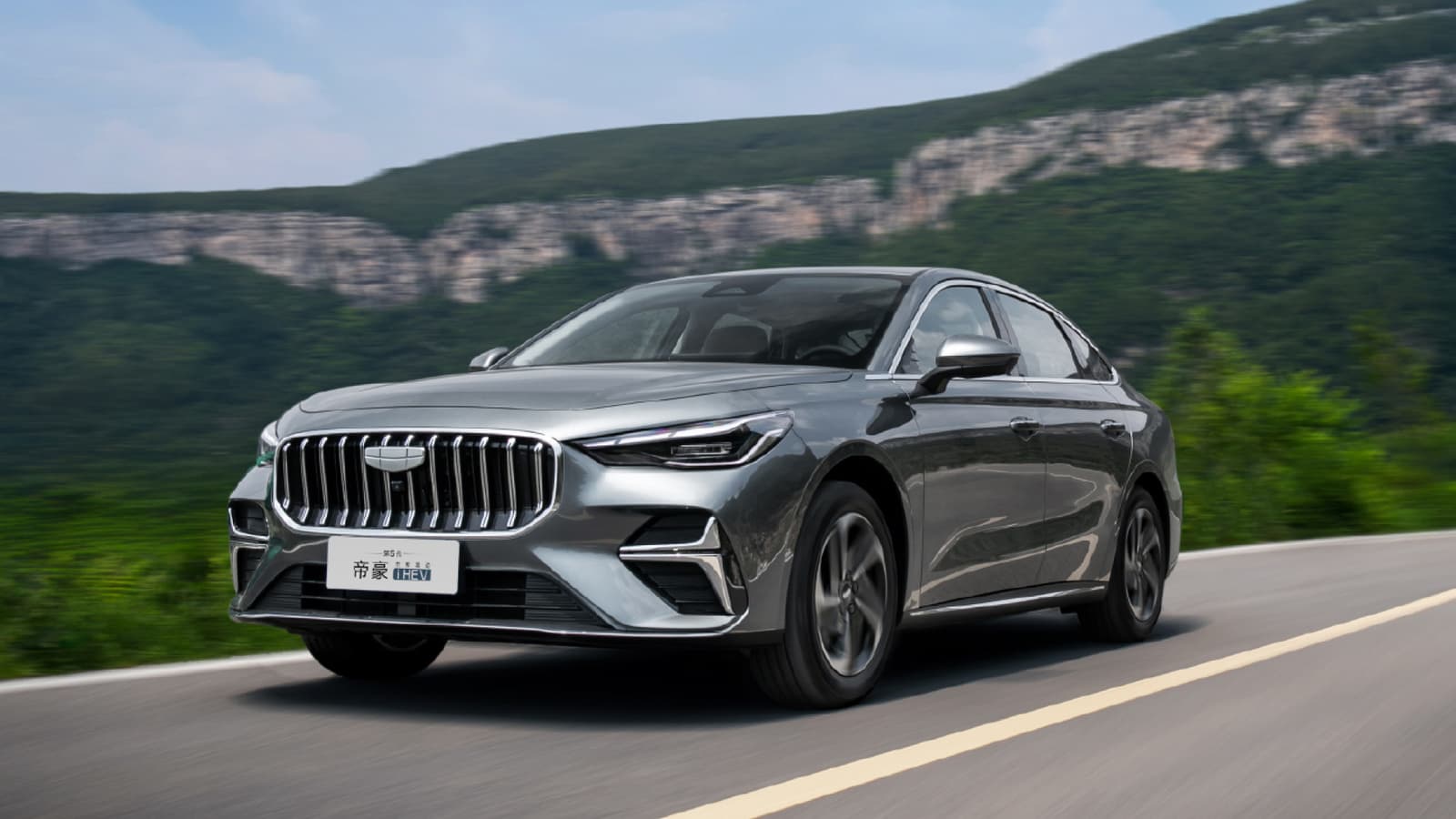
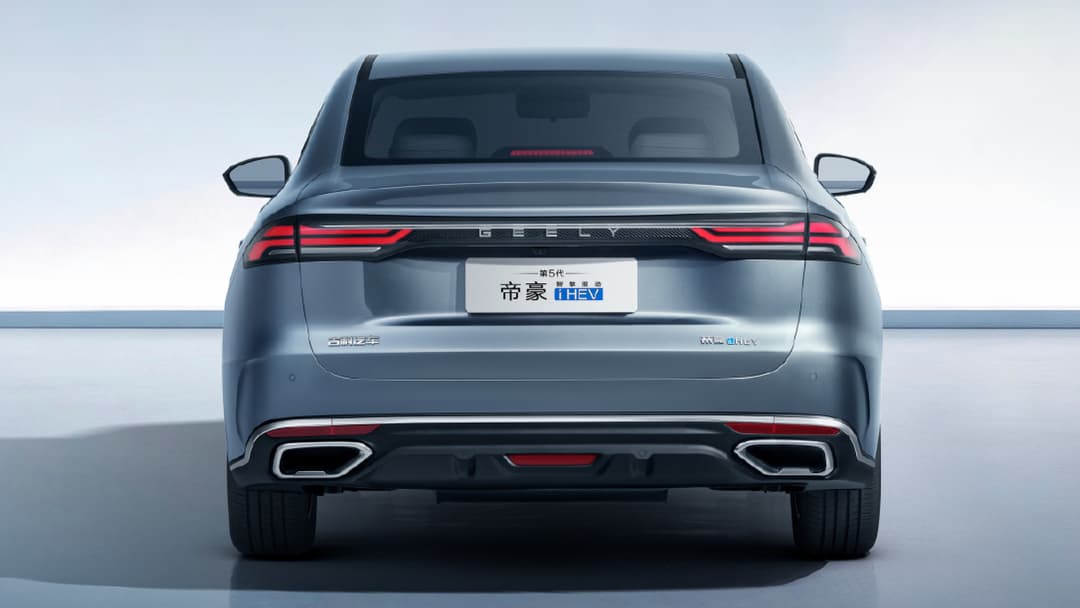
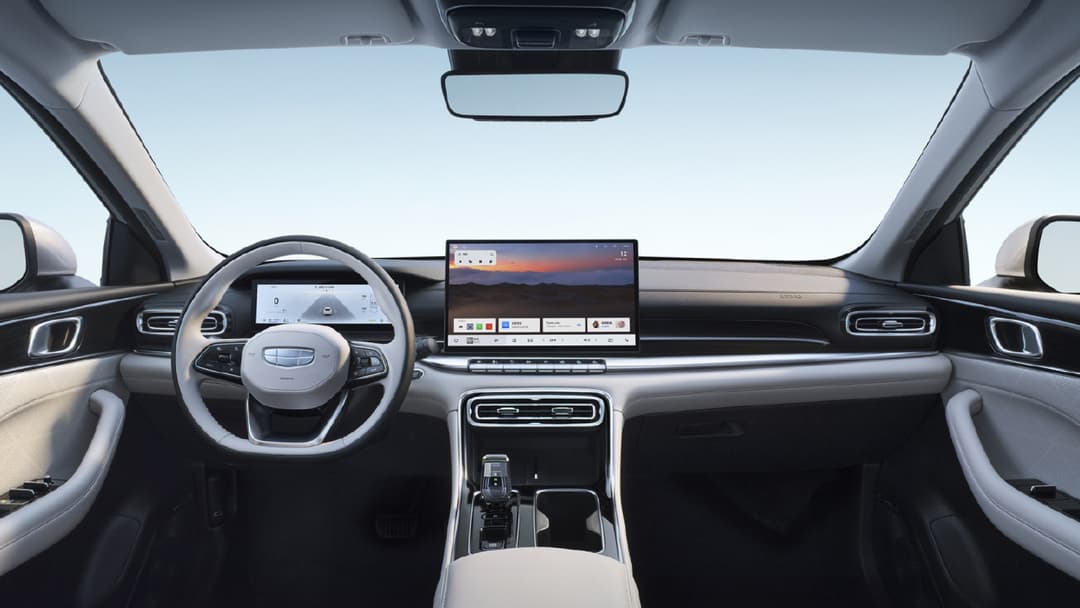
The exterior is shared with the petrol Emgrand: a large polygonal grille with vertical chrome slats, slim LED headlights with a three-stage daytime running light signature, a low sloping roofline and a full-width rear light bar with the Geely name across it. The official press photos show a grey and a blue car, and the hybrid is identified by the Dihao i-HEV badge on the tailgate. The wheels are 16-inch on the Wind Chaser and 17-inch on the two upper trims. Inside, the dashboard is dominated by a floating 14.6-inch touchscreen next to a 10.2-inch instrument cluster, with a four-spoke flat-bottom steering wheel, a retractable gear selector, a separate row of physical buttons below the screen and, on the Light Chaser and Peak, two wireless phone charging pads. The front seats are power-adjustable on the upper trims, the rear bench has an integrated middle headrest and armrest, and the audio system has six speakers. According to the Autohome spec sheet, only the Peak adds front seat heating and ventilation.
Technology & Features
The infotainment runs Meizu's Flyme Auto, with several home-screen layouts, a small-window mode and full-scene voice control in Mandarin and Cantonese, plus Flyme Link, Carlink for 12 phone brands and Huawei HiCar. The electronics sit on Geely's GEEA 3.0 architecture, which shares data between the driver-assistance, cockpit, chassis and powertrain systems. Geely's Cloud Power 2.0 energy-management model adjusts the fuel and electric strategy to temperature, humidity and altitude, and Geely claims it improves combined energy use by more than 10 percent. According to Chinese reports, the Eva agent cockpit and LiDAR-assisted driving that Geely is rolling out on some other models are not offered on the i-HEV, so this is a simple, well-equipped family sedan rather than a technology showcase.
Safety & ADAS
All trims have driver and front-passenger front airbags, side airbags and full-length side curtain airbags. Driver assistance is split by trim: the mid Light Chaser (Zhuiguang) and top Peak (Dengfeng) trims add full-speed adaptive cruise control and the L2 package with automatic emergency braking and lane keeping assist, according to the Autohome spec sheet, while the entry Wind Chaser (Yufeng) has only conventional cruise control. The entry trim does come with a 14.6-inch screen and a 10.2-inch cluster as standard. Geely has not published a crash-test rating for the hybrid, so buyers who want assistance should look at the two upper trims.
| ADAS LEVEL | L2 on the Light Chaser and Peak; none on the entry trim |
|---|---|
| ADAS FEATURES | Full-speed adaptive cruise, automatic emergency braking and lane keeping assist (Zhuiguang and Dengfeng), front, side and curtain airbags on all trims |
Available Versions
| VERSION | POWER | TORQUE | 0-100 | TOP SPEED | DRIVETRAIN | BATTERY | EV RANGE | COMBINED RANGE | PRICE | KEY DIFFERENCES |
|---|---|---|---|---|---|---|---|---|---|---|
| Wind Chaser (Yufeng) | 140 kW (190 PS / 188 hp) | 240 Nm | — | — | FWD | — | — | — | CNY 87,900 (~$13,186) | Entry trim; 14.6-inch screen and 10.2-inch cluster, 16-inch wheels; conventional cruise control only, no L2 assistance; dealer reference price from CNY 78,900 (~$11,835) listed on Autohome in October 2026 |
| Light Chaser (Zhuiguang) | 140 kW (190 PS / 188 hp) | 240 Nm | — | — | FWD | — | — | — | CNY 93,900 (~$14,086) | Adds L2 assistance (full-speed adaptive cruise, automatic emergency braking, lane keeping), 360-degree camera, 17-inch wheels, sunroof and 50 W wireless charging; dealer reference price from CNY 84,900 (~$12,736) listed on Autohome in October 2026 |
| Peak (Dengfeng) | 140 kW (190 PS / 188 hp) | 240 Nm | — | — | FWD | — | — | — | CNY 97,900 (~$14,686) | Adds seat heating and ventilation and power-adjustable front seats; dealer reference price from CNY 88,900 (~$13,336) listed on Autohome in October 2026 |
Pricing & Availability
The Emgrand i-HEV was shown at the Beijing Auto Show on 26 April 2026 and went on sale in China on 16 June 2026, with a Chengdu launch event for customers on 21 June. The official guide prices are CNY 87,900 for the Wind Chaser, CNY 93,900 for the Light Chaser and CNY 97,900 for the Peak, which is about $13,186, $14,086 and $14,686 at 6.6664 yuan per US dollar (ECB, 28 October 2026). Launch "thank-you" prices of CNY 78,900, CNY 84,900 and CNY 88,900 (~$11,835, ~$12,736 and ~$13,336) were announced at launch; their end date has not been confirmed, and Autohome still listed dealer prices from these levels on 30 October 2026. Dealer discounts and local incentives vary, so the real transaction price should be confirmed with a dealer. Autohome's catalogue lists the i-HEV trims as 2027 model-year cars while the fifth-generation petrol Emgrand is still listed as 2026; the cheaper Emgrand Xiangshang range launched on 25 October 2026 is a separate line.
The car is sold only in China at the moment. Geely has not confirmed any export of the i-HEV: CarNewsChina wrote that it may enter overseas markets, and some European outlets expect it in Europe, but no market or date has been announced. It should not be confused with the Emgrand L EM-i, a plug-in hybrid (PHEV) sedan that Geely will launch in Australia in the first half of 2027 and that is a different car, the Galaxy Starshine 6. The Emgrand nameplate is Geely's volume sedan, with domestic sales of 9,278 units in March 2026 across all powertrains.
How It Compares
The Emgrand i-HEV competes with plug-in hybrid sedans from its own price bracket as much as with other full hybrids. The Geely Galaxy A7 PHEV is a plug-in sedan with an 82 kW engine and a 175 kW (238 PS / 235 hp) motor, 150 km of CLTC electric range on the version that starts at CNY 97,800 (~$14,671) and more than 2,100 km of total range. At guide prices that is about $1,485 more than the Emgrand's CNY 87,900 Wind Chaser, but almost exactly the price of the CNY 97,900 Peak, so the Galaxy offers far more electric driving, though it needs a charger to deliver it. The BYD Qin L DM-i, a plug-in sedan with a 120 kW (163 PS / 161 hp) motor and up to 210 km of CLTC electric range (128 km on the CNY 96,800 entry version), starts at CNY 96,800 (~$14,521). That is about $1,335 more than the Wind Chaser, so the Emgrand is the cheaper car at entry level, while the Qin L is about $165 cheaper than the Peak. The Emgrand's argument is simplicity: no charging habit, no battery to size, and a rated 3.83 L/100 km (WLTC), with a larger body than the entry price implies. Rival figures are taken from our own articles and use the Chinese CLTC cycle for electric range, which is more optimistic than WLTP, while the Emgrand's consumption is WLTC, so the fuel numbers are not like for like.
- Official WLTC fuel consumption of 3.83 L/100 km in a 4,815 mm sedan, with a Hainan highway-loop result of 2.22 L/100 km claimed by Geely
- Starts at CNY 87,900 (~$13,186) with a 610 L boot, a 14.6-inch screen and 16-inch wheels (17-inch on the upper trims)
- No charging needed: P1+P3 hybrid with 140 kW (190 PS / 188 hp) and 240 Nm, up to 66 km/h on electric power and a 1.84 s 0-30 km/h time
- No plug-in capability and a small battery, so there is no meaningful electric range, and 0-100 km/h and battery capacity are unpublished
- The entry trim has no L2 driver assistance, the 2.22 L/100 km record was set on a highway loop rather than a standard cycle, and the car is sold only in China for now
The Emgrand i-HEV is a cleverly engineered, cheap and roomy family hybrid: a 48.41 percent thermal-efficiency engine, a P1+P3 system with a 140 kW (190 PS / 188 hp) motor, a 3.83 L/100 km WLTC rating and a CNY 87,900 (~$13,186) starting price make it a very efficient sedan for the money. The trade-offs are the absence of a plug, a thin set of published figures and driver assistance that is held back for the upper trims. We would pick the Light Chaser at CNY 93,900 (~$14,086) for the L2 package and adaptive cruise, and treat the 2.22 L/100 km claim as a best case rather than a daily number.