
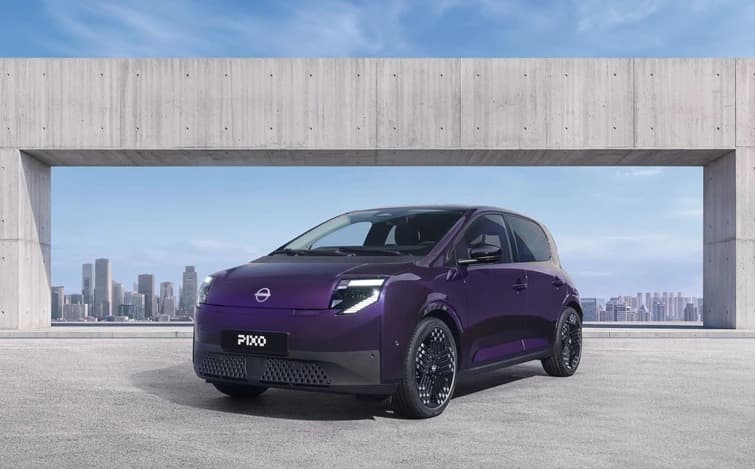
Nissan revealed the all-new PIXO on September 23, 2026, bringing a familiar nameplate back to Europe as a brand-new, purpose-built battery-electric city car. Positioned below the Micra in Nissan's European BEV line-up, the PIXO is an A-segment hatchback built specifically for tight city streets, developed jointly with Renault under the companies' long-running Alliance. It rides on Renault's AmpR Small (RG-EV Small) platform, the same underpinnings as the Renault Twingo E-Tech and Dacia Spring, and is assembled at Renault's Novo Mesto plant in Slovenia. Nissan has not announced pricing yet, with full details due from December 2026, but the car itself is fully revealed: a 27.5 kWh lithium-iron-phosphate (LFP) battery, up to 259 km of WLTP range, and a four-seat cabin engineered to punch above its tiny footprint. Customer deliveries are scheduled to begin in early 2027.
Performance & Specs
The PIXO uses a single front-mounted electric motor producing 60 kW (82 PS / 80 hp) and 175 Nm (129 lb-ft) of torque, driving the front wheels only. Nissan quotes a 0-100 km/h time of 11.9 seconds, marginally quicker than the mechanically related Renault Twingo E-Tech and Dacia Spring, which Nissan lists at 12.1 seconds for the same sprint. Top speed is capped at 130 km/h (81 mph), in line with the car's city-and-suburb design brief rather than any pretence of motorway performance. The 27.5 kWh LFP pack is the first lithium-iron-phosphate battery ever fitted to a Nissan model sold in Europe, chosen for its lower cost and greater tolerance of frequent fast-charging compared with the nickel-based chemistries used in Nissan's larger EVs. Nissan has not published an official kerb weight, but early reporting puts the PIXO close to 1,285 kg, broadly in line with its Twingo E-Tech sibling.

| Powertrain | Single-motor FWD BEV |
|---|---|
| Power | 60 kW (82 PS / 80 hp) |
| Torque | 175 Nm |
| 0–100 km/h | 11.9 s |
| Battery | 27.5 kWh LFP |
| Range | 259 km WLTP |
| POWERTRAIN TYPE | Single-motor FWD BEV |
|---|---|
| HORSEPOWER | 80 hp (82 PS / 60 kW) |
| TORQUE | 175 Nm |
| ACCELERATION | 11.9 s (0-100 km/h) |
| TOP SPEED | 130 km/h (81 mph) |
| DRIVETRAIN | FWD |
| BATTERY | 27.5 kWh LFP |
| ELECTRIC RANGE | 259 km (161 mi) WLTP |
Dimensions & Practicality

| Length | 3,796 mm |
|---|---|
| Width | 1,790 mm |
| Height | 1,512 mm |
| Wheelbase | 2,492 mm |
| Ground clearance | 140 mm |
At 3,796 mm long, the PIXO is a genuine A-segment city car, shorter than a Renault Clio and closer in size to a Fiat Panda. Nissan caps seating at four adults rather than five, using the space savings to fit two independent rear seats that slide and fold separately, letting owners trade rear legroom for cargo space seat by seat rather than as an all-or-nothing bench. That flexibility pays off in the boot: 356 litres with all seats in place (50 litres of which is a dedicated charging-cable compartment), expanding to 1,221 litres with the rear seats folded down. There is no front trunk. A 9.9 m turning circle and 140 mm of ground clearance round out a package tuned specifically for narrow European streets and multi-storey car parks rather than long-distance touring.
| LENGTH | 3,796 mm |
|---|---|
| WIDTH | 1,790 mm (1,953 mm with mirrors) |
| HEIGHT | 1,512 mm |
| WHEELBASE | 2,492 mm |
| CARGO VOLUME | 356 L (1,221 L seats folded) |
| FRUNK | None |
Charging & Battery
Every PIXO grade gets a 50 kW DC fast charger as standard, unusually generous for a car this small and this early in its price bracket — Nissan quotes a 15-80% charge in around 28 minutes. Home and workplace charging runs through an 11 kW onboard AC charger, and Nissan specifies it as bidirectional, meaning the PIXO can in principle discharge power back out rather than just draw it in, useful for running small appliances or backing up a home during an outage. The 27.5 kWh LFP battery trades outright energy density for a chemistry that tolerates heavy daily fast-charging cycles better than the nickel-manganese-cobalt packs Nissan uses in the Ariya and Leaf, which suits a car aimed at drivers who plug in constantly rather than road-trip occasionally.
| BATTERY | 27.5 kWh LFP |
|---|---|
| AC CHARGING | 11 kW (bidirectional) |
| DC FAST CHARGING | 50 kW |
| DC 15-80% TIME | ≈28 min |
Design & Interior
Nissan's designers gave the PIXO a boxy, upright silhouette with a pixel-inspired lighting signature front and rear, a deliberate visual link to the nameplate's name and to Nissan's small-car heritage rather than a scaled-down version of the larger Ariya. The launch car was shown in a deep aubergine-purple finish with contrasting black lower cladding and a body-colour PIXO badge across the nose, a look aimed squarely at younger, style-conscious city buyers rather than fleet or budget shoppers. Inside, the dashboard is dominated by the twin-screen layout shared conceptually with other recent Nissan and Alliance products, with physical climate controls kept separate from the touchscreen to avoid burying frequently used functions in menus. Nissan has also fitted facial-recognition driver profiles, letting the car automatically load a driver's preferred seat position, display layout and infotainment settings without a manual login step. Material quality is pitched at what Nissan calls an accessible level for the segment, with durable, easy-to-clean surfaces prioritised over soft-touch trim given the car's city-runabout mission.
Technology & Features
The cabin centres on a 7-inch digital driver display paired with a 10-inch central touchscreen running Google built-in, giving the PIXO native Google Maps navigation and Google Assistant-style voice control without needing a paired phone. New for this generation is a built-in Gemini AI assistant, which Nissan says will support 16 languages at launch and is intended to handle more conversational requests than a traditional voice-command system, from rerouting around traffic to answering general questions while driving. The MyNissan smartphone app extends that connectivity remotely, covering functions like charge-status checks and remote climate pre-conditioning that are increasingly expected even on entry-level EVs.
Safety & ADAS
Nissan fits a Level 2 driver-assistance suite as standard across the PIXO range rather than reserving it for higher grades, reflecting how central these features have become to even the cheapest new EVs sold in Europe. The package includes automated emergency braking, a lane-keeping system, adaptive cruise control and hands-free automated parking, alongside Nissan's e-Pedal one-pedal driving mode, which lets the driver do almost all everyday accelerating and braking through the accelerator alone. Full independent crash-test results were not yet available at the time of the September 23 reveal.
| ADAS LEVEL | L2 (standard on all grades) |
|---|---|
| ADAS FEATURES | AEB, adaptive cruise control, lane-keeping assist, hands-free parking, e-Pedal one-pedal driving |
Available Versions
| VERSION | POWER | TORQUE | 0-100 | TOP SPEED | DRIVETRAIN | BATTERY | EV RANGE | COMBINED RANGE | PRICE | KEY DIFFERENCES |
|---|---|---|---|---|---|---|---|---|---|---|
| PIXO (launch powertrain) | 80 hp | 175 Nm | 11.9 s | 130 km/h | FWD | 27.5 kWh | 259 km | — | TBA | Only powertrain and battery confirmed at reveal; full grade walk and pricing due closer to on-sale |
Pricing & Availability
Nissan has not announced PIXO pricing. The global reveal on September 23, 2026 confirmed the car, its specs and its Slovenia build location, but the company says full market-by-market line-ups and prices will follow from December 2026, with Nissan's UK operation specifically pointing to March 2027 for its own confirmed range and pricing. Several outlets have floated a sub-€20,000 starting point, reasoning that Nissan would price the PIXO close to its platform-sibling Renault Twingo E-Tech (which starts at €19,990 in France) and UK estimates near £18,000, but none of this is an official Nissan figure and should be treated as informed speculation rather than a confirmed price. What is confirmed is the timeline: customer deliveries begin in early 2027, with the car built for and initially sold into European markets from Renault's Novo Mesto plant in Slovenia.
How It Compares
The PIXO's direct real-world rivals are its own platform siblings, the Renault Twingo E-Tech and Dacia Spring, which share its battery, motor and Slovenian factory almost line for line — Nissan's job here is to differentiate on design, tech and dealer experience rather than on hardware. Against freshmotors' own catalog of budget city EVs, the comparison is more of a value contrast than a same-segment cross-shop: the BYD Seagull undercuts the PIXO's likely price while offering more WLTP-equivalent range from a larger battery, and the Geely EX2 is cheaper still, if with a smaller boot and simpler tech. What the PIXO offers that neither Chinese rival matches is a 50 kW DC charger as standard, a bidirectional 11 kW AC charger, and Google built-in with Gemini — a tech package well ahead of typical A-segment EVs at this price point, assuming Nissan's pricing lands where the market expects.
- 259 km WLTP range and a durable LFP battery are strong numbers for a car this small and this early in the segment
- 50 kW DC fast charging and a bidirectional 11 kW AC charger are unusually generous standard equipment for an entry-level EV
- Independently sliding, folding rear seats stretch a tiny footprint into genuinely flexible cargo space, up to 1,221 litres
- Seats only four, not five, a real practicality trade-off against some rivals in the same price bracket
- Pricing, final trim structure and full European market rollout are all still unconfirmed months ahead of the early-2027 delivery start
The 2027 Nissan PIXO is a well-judged reveal: it takes proven, already-homologated Renault Alliance hardware and wraps it in a distinct Nissan design and a genuinely generous charging and tech package for the A-segment. The 259 km range and 50 kW DC charging comfortably cover city and suburban duty, and the LFP battery is the right chemistry choice for a car that will spend its life on fast chargers. The four-seat-only layout and the total absence of confirmed pricing keep this from being an easy recommendation today, but if Nissan prices it close to the Twingo E-Tech as expected, the PIXO shapes up as one of the more compelling small EVs coming to Europe in 2027. Worth watching closely once real pricing lands.