
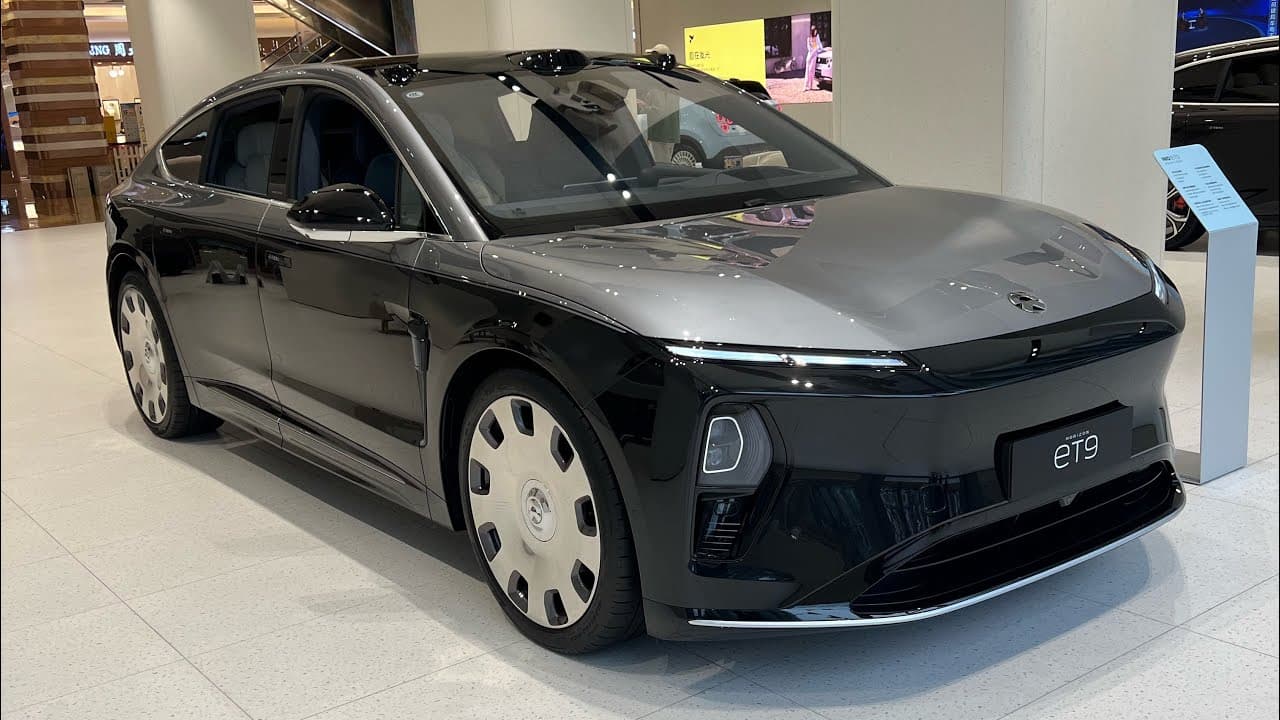
The 2026 NIO ET9 is the flagship of the Chinese electric-car maker: a four-seat executive sedan more than 5.3 metres long, with a 520 kW (707 PS / 697 hp) dual-motor all-wheel-drive system, a 102 kWh battery on a 900-volt architecture and the first steer-by-wire steering approved for mass production in China. The standard ET9 lists at CNY 768,000 (about $113,600) with the battery, or CNY 660,000 (about $97,600) when the battery is rented under NIO's Battery-as-a-Service plan for CNY 1,128 a month. Range is rated at up to 650 km on the CLTC cycle, peak DC charging reaches 600 kW, and a fourth-generation NIO swap station can exchange the pack in 144 seconds. The car was launched at Nio Day 2024 on December 21, 2024, and customer deliveries began in late March 2025. The car in this walkaround is the ET9 Horizon Edition, a two-tone version with 23-inch wheels and a dual-screen rear cabin that lists at CNY 818,000 (about $121,000).
Performance & Specs
Two motors drive all four wheels: a 180 kW asynchronous (induction) motor on the front axle and a 340 kW permanent-magnet synchronous motor on the rear axle. Together they deliver 520 kW, which is 707 PS or about 697 hp, and 700 Nm of torque (300 Nm from the front motor, 400 Nm from the rear). NIO quotes 0-100 km/h in 4.3 seconds, and the listed top speed is 220 km/h. That is quick rather than extreme for a car that weighs about 2,700 kg, and it matches the brief: the ET9 is built around ride quality, silence and rear-seat comfort, not lap times. The drag coefficient is 0.243, and the SkyRide chassis combines a fully active hydraulic suspension, which NIO calls the world's first integrated design of its kind and which adjusts stiffness, damping and height at each wheel, with steer-by-wire and rear-wheel steering of up to 8.3 degrees. The rear steering shrinks the turning circle to 10.9 metres despite a 3,250 mm wheelbase.

| Powertrain | Dual-motor AWD BEV (front induction + rear PMSM) |
|---|---|
| Power | 520 kW (707 PS / 697 hp) |
| Torque | 700 Nm |
| 0–100 km/h | 4.3 s |
| Battery | 102 kWh NCM |
| Range | 650 km CLTC (22-inch wheels) |
| POWERTRAIN TYPE | Dual-motor BEV (180 kW induction front, 340 kW permanent-magnet rear) |
|---|---|
| HORSEPOWER | 520 kW (707 PS / 697 hp) |
| TORQUE | 700 Nm |
| ACCELERATION | 0-100 km/h in 4.3 s (NIO figure) |
| TOP SPEED | 220 km/h |
| DRIVETRAIN | AWD |
| BATTERY | 102 kWh NCM |
| ELECTRIC RANGE | 650 km CLTC (22-inch wheels) / 620 km (23-inch wheels) |
Dimensions & Practicality

| Length | 5,325 mm |
|---|---|
| Width | 2,017 mm |
| Height | 1,621 mm |
| Wheelbase | 3,250 mm |
| Ground clearance | 200 mm |
At 5,325 mm long, 2,017 mm wide and 1,621 mm tall on a 3,250 mm wheelbase, the ET9 is a full-size flagship, and NIO configures it strictly as a four-seater. Two individual seats sit in the rear, separated by a centre console NIO calls the Executive Bridge, which houses a refrigerator, a safe box and an adjustable table. NIO quotes a 582 mm-wide seat cushion, heating across nearly two square metres of seat surface and a 16-point hot-stone massage function. The reviewer states a 544-litre boot on camera, which matches the figure in China's Autohome and Geeknev spec databases, and the car adds a 105-litre powered front trunk, a first for a NIO-badged model. Ground clearance is 200 mm, wading depth is listed at 630 mm and curb weight is 2,700 kg.
| LENGTH | 5,325 mm |
|---|---|
| WIDTH | 2,017 mm |
| HEIGHT | 1,621 mm |
| WHEELBASE | 3,250 mm |
| CARGO VOLUME | 544 L (rear boot) |
| FRUNK | 105 L |
| CURB WEIGHT | 2,700 kg |
Charging & Battery
The whole electrical system runs at up to 925 V, which NIO markets as a full-domain 900V architecture, and it accepts DC chargers from 500 V to 1,000 V. Peak charging power is 600 kW (5C), and NIO claims roughly 255 km of CLTC range can be added in five minutes on a compatible charger. The 102 kWh pack uses NIO-designed 46105 large cylindrical cells supplied by CATL. Consumption is listed at 16.2 kWh/100 km on the 22-inch wheels and 17.0 kWh/100 km on the 23-inch wheels, which lines up with the 650 km and 620 km CLTC ratings (102 kWh divided by 16.2 kWh per 100 km is about 630 km). The ET9 also supports NIO's battery-swap network, and the reviewer shows the charging flap on the left rear fender. Under the BaaS plan the buyer pays for the car without the battery and rents the 102 kWh pack for CNY 1,128 a month.
| BATTERY | 102 kWh NCM, 46105 cylindrical cells |
|---|---|
| SYSTEM VOLTAGE | 900V architecture, up to 925 V |
| DC FAST CHARGING | 600 kW peak (5C) |
| CHARGING CLAIM | About 255 km of range in 5 min (NIO) |
| BATTERY SWAP | 144 s at a fourth-generation station |
| CONSUMPTION | 16.2 kWh/100 km (22-inch) / 17.0 kWh/100 km (23-inch) |
Design & Interior
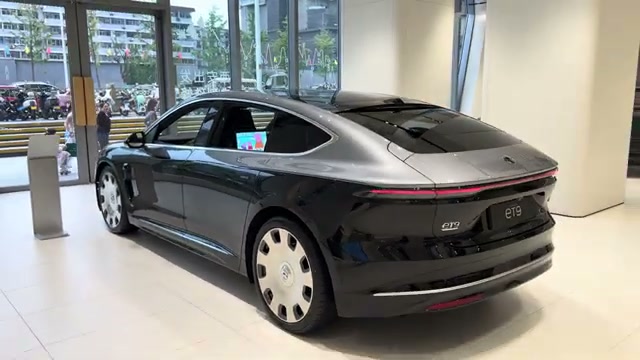
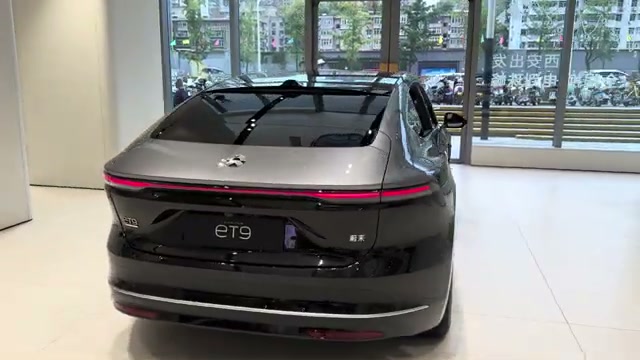
The exterior follows NIO's Landjet design language: a long, low three-box sedan with a fastback-style roofline, a slim light blade across the nose and a thin red LED strip spanning the tail. The Horizon Edition in the video adds a two-tone finish, dark lower body with a grey bonnet, roof and boot lid, plus an exclusive wheel design and Horizon badging. The showroom car rides on 23-inch wheels with silver aero covers and Pirelli P Zero tyres in 265/40 R23, the size the reviewer reads out on camera. Inside, the quilted blue-grey leather seats contrast with ivory door cards and a rose-toned ambient light strip that runs across the dashboard. The steering wheel is a rectangular two-spoke design, and a small NOMI assistant orb sits on top of the dash. The rear cabin is the real showpiece, with a pair of 14.5-inch seat-back screens, a flip-up control panel, a pull-out tray table and a large glass roof with a powered sunshade that the reviewer opens and closes from an overhead control.
Technology & Features
The centre stage is a 15.6-inch display with a 2,880 x 1,800 resolution, running NIO's Cedar system on top of the SkyOS vehicle operating system with a Qualcomm Snapdragon 8295P chip and 16 GB of RAM. Rear passengers get either an 8-inch control screen (standard on the base car) or the twin 14.5-inch screens fitted to the Signature and Horizon versions. The NIO LYRA 8.2.4.8 audio system uses 35 speakers and 2,800 W of amplification. The reviewer's showroom car carries the official English interface, and he walks through the settings menu, including the system-language switch, and calls up the NOMI voice assistant by name. Steer-by-wire itself received a UNECE E-Mark from the Spanish test house Applus IDIADA in May 2025, which NIO describes as the only steer-by-wire system certified in both China and Europe.
Safety & ADAS
The ET9 carries NIO's Aquila sensing suite: three LiDARs (roof plus two side units), 11 exterior cameras, 5 millimetre-wave radars and 12 ultrasonic sensors, 31 sensors in total. Processing comes from two of NIO's 5 nm Shenji NX9031 chips, and NIO has not published a TOPS figure, saying only that each is equivalent to four mainstream driving chips. At the launch event NIO showed a video of CEO William Li driving at 160 km/h through a tyre blowout without losing control, and the car carries a 3,100 kg maximum laden weight rating.
| ADAS LEVEL | L2+ assisted driving on the Aquila hardware suite |
|---|---|
| ADAS FEATURES | 3 LiDARs, 11 cameras, 5 mmWave radars, 12 ultrasonic sensors, dual Shenji NX9031 chips, steer-by-wire, rear-wheel steering |
Available Versions
| VERSION | POWER | TORQUE | 0-100 | TOP SPEED | DRIVETRAIN | BATTERY | EV RANGE | COMBINED RANGE | PRICE | KEY DIFFERENCES |
|---|---|---|---|---|---|---|---|---|---|---|
| Standard | 697 hp | 700 Nm | 4.3s | 220 km/h | AWD | 102 kWh | 650 km | — | $113,600 | 22-inch wheels, 8-inch rear control screen (dual 14.5-inch rear screens optional); BaaS from CNY 660,000 (about $97,600) |
| Signature | 697 hp | 700 Nm | 4.3s | 220 km/h | AWD | 102 kWh | 620 km | — | $116,500 | 23-inch wheels, dual 14.5-inch rear executive screens standard; BaaS from CNY 680,000 (about $100,600) |
| Horizon Edition | 697 hp | 700 Nm | 4.3s | 220 km/h | AWD | 102 kWh | 620 km | — | $121,000 | Two-tone paint, exclusive wheels and badging, upgraded interior materials; BaaS from CNY 710,000 (about $105,000) |
Pricing & Availability
NIO showed the ET9 at Nio Day 2023 with a pre-sale price of CNY 800,000, then launched it on December 21, 2024 at CNY 788,000 with the battery or CNY 660,000 on BaaS, alongside a 999-unit First Edition at CNY 818,000. Deliveries started on March 29, 2025. On August 19, 2025 NIO cut the price of its 100 kWh pack by CNY 20,000, which took the standard ET9 to CNY 768,000 (about $113,600 at CNY 6.76 per dollar) while the BaaS price and the CNY 1,128 monthly fee stayed the same. The Horizon Edition followed at Nio Day on September 20, 2025 at CNY 818,000, and NIO has since released themed Horizon runs, including two 99-unit editions in June 2026 at CNY 838,000 (BaaS CNY 730,000). The video's $110,500 headline price and the $110,000 to $115,000 the reviewer quotes on camera are export-dealer (FOB) figures for China-sourced cars, not NIO list prices. The ET9 is sold in China, where NIO had delivered 3,077 units through May 2026. Outside China, NIO's first Uzbekistan store, which opened in Tashkent on January 31, 2026, lists the ET9 among its announced models. As of September 2026, NIO has not publicly announced an ET9 launch in Europe or North America.
How It Compares
The Huawei-backed Maextro S800 is the closest China-market rival: a 5,480 mm-long flagship sedan on a 3,370 mm wheelbase, offered as a range-extender hybrid (with a pure-electric version also available) with up to 851 hp from three motors and about 1,200 km of total range in that form, at prices that start near the ET9's. It is longer and its range extender removes range planning, while the ET9 is a pure EV with a swappable pack and steer-by-wire. The Lotus Emeya 900 goes the other way, with 905 hp and a far sportier brief, but it manages 530 km on China's CLTC cycle (485 km on the stricter WLTP cycle used in Europe), well short of the ET9's 650 km. Against both, the ET9's case rests on cabin luxury, swap-and-fast-charge flexibility and chassis technology rather than outright power, and only the Maextro's range extender clearly beats it on range.
- 900V architecture with 600 kW peak charging, plus a 144-second battery swap and a BaaS option from CNY 660,000
- SkyRide chassis with active suspension, rear-wheel steering and China's first mass-production steer-by-wire
- Four-seat executive cabin with 582 mm seat cushions, dual 14.5-inch rear screens and a 544 L boot plus 105 L frunk
- Three LiDARs, 31 sensors and two in-house NX9031 chips give the car headroom for future driving-assist updates
- Only four seats and a 2,700 kg curb weight, with 620-650 km of CLTC range from 102 kWh
- 0-100 km/h in 4.3 s and 697 hp trail rivals such as the 905 hp Lotus Emeya on pure performance
- Mainly a China car: outside it NIO has announced the ET9 only for Uzbekistan, and no European or North American launch has been announced as of September 2026
The 2026 NIO ET9 is a technology showcase wrapped in an executive lounge: steer-by-wire, a fully active suspension, 600 kW charging and a rear cabin designed for executives, for about $113,600 with the battery or $97,600 on BaaS. It nails comfort, charging flexibility and hardware ambition, while the trade-offs are a heavy body, only four seats, modest CLTC range for a 102 kWh pack and no announced launch in Europe or North America. It suits a China-based buyer who is chauffeured or wants a quiet, high-tech flagship, and the BaaS route makes the entry price far friendlier. Take the Signature or Horizon Edition if the twin rear screens matter to you.