
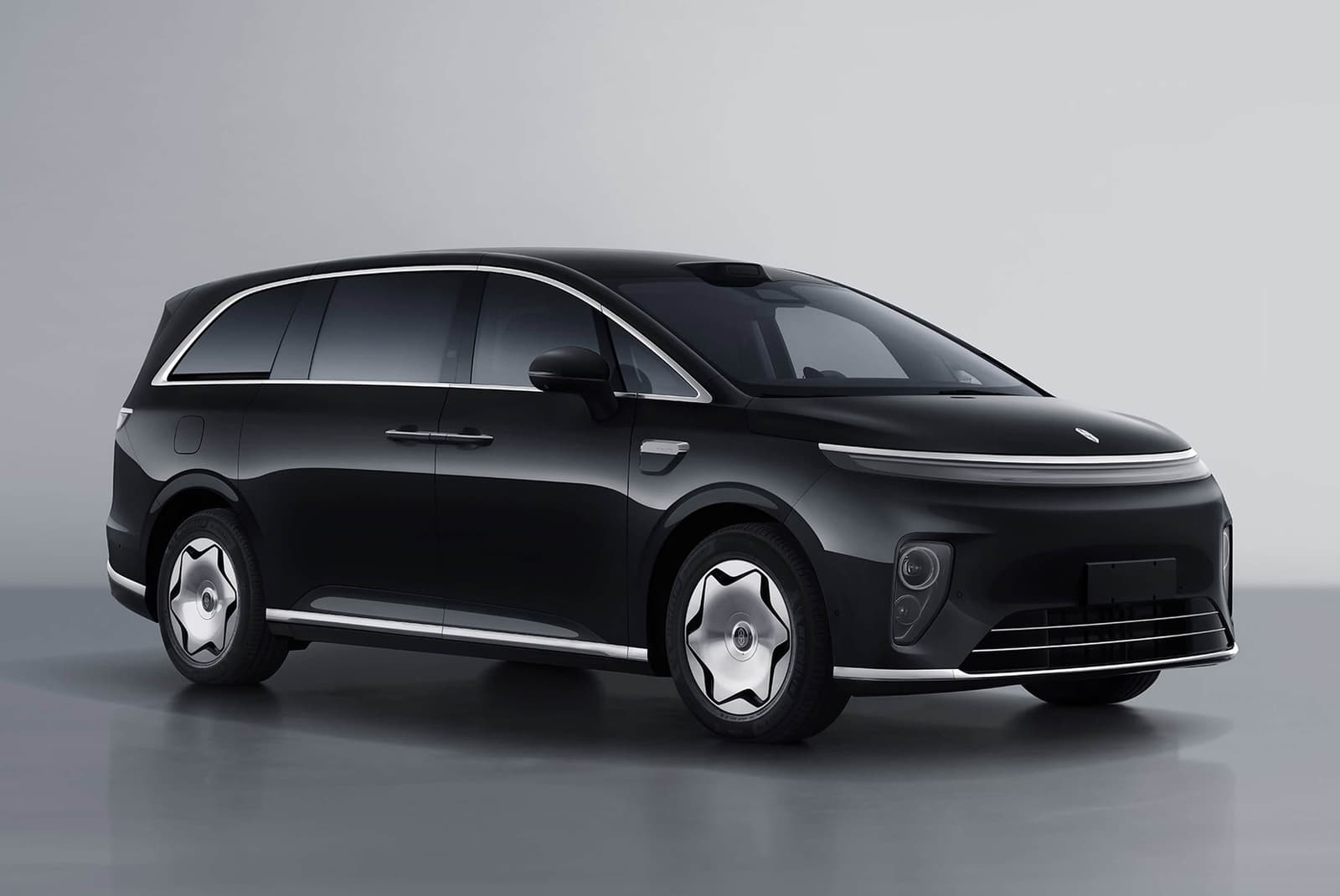
Stelato, the electric brand that Huawei and BAIC build together inside Huawei's HIMA alliance, has opened pre-sales of the V8, its first MPV, in China. Known locally as the Xiangjie V8, the seven-seater started taking orders on September 28, 2026 at a pre-sale price of RMB 329,800 (about $49,190 at RMB 6.7048 per US dollar) for the cheapest extended-range trim. The battery-electric versions start at RMB 369,800 (about $55,150), and the range tops out at RMB 449,800 (about $67,090). The V8 is 5,335 mm long, rides on an 800V platform and carries Huawei's ADS 5 driver-assistance system, backed by a four-LiDAR sensor suite on the top-spec cars. It comes as a 120 kWh battery-electric car rated at up to 830 km on the CLTC cycle, or as a range-extender model rated at up to 1,465 km combined. It joins the S9 sedan, S9T wagon and G9 off-road SUV in the Stelato line-up and aims at the Denza D9, the XPeng X9 and the Luxeed V9. All prices here are pre-sale figures: the final launch price and the delivery schedule have not yet been announced.
Performance & Specs
Stelato sells the V8 with two kinds of powertrain. The battery-electric version uses a single rear motor with 227 kW (309 PS / 304 hp) in rear-wheel-drive form, or two motors with a combined 387 kW (526 PS / 519 hp) in all-wheel-drive form. According to the type-approval filing that China's Ministry of Industry and Information Technology published on July 10, the dual-motor layout is a 160 kW (218 PS / 215 hp) front motor plus the same 227 kW rear motor, which adds up to the 387 kW quoted at the pre-sale event. The extended-range version pairs a 1.5-litre turbocharged range extender rated at a maximum of 118 kW (160 PS / 158 hp) with the same motors, in single-motor and dual-motor layouts. Stelato has not published torque or a 0–100 km/h time. The same filing lists a top speed of 215 km/h for the battery-electric versions and for the dual-motor range-extender versions, 203 km/h for the single-motor range-extender, and curb weights of 2,760 kg (single-motor battery-electric), 2,870 kg (dual-motor battery-electric), 2,810 kg (single-motor range-extender) and 2,895 kg (dual-motor range-extender). What Stelato does state is a drag coefficient of 0.226 Cd, which it says was measured by the China Automotive Engineering Research Institute (CAERI) at 120 km/h, and a chassis with dual-chamber air springs, dual-valve continuously variable dampers and standard rear-wheel steering of up to 12 degrees, which gives a turning radius of 5.09 m on a 5.3-metre car.

| Powertrain | EREV, 1.5T range extender, 118 kW (160 PS / 158 hp) |
|---|---|
| Motors | 227 kW (309 PS / 304 hp) single-motor RWD, or 387 kW (526 PS / 519 hp) dual-motor AWD |
| Battery | 56 kWh or 75.4 kWh |
| EV range | 330 km or 430 km (CLTC) |
| Combined range | 1,365 km or 1,465 km (CLTC) |
| Top speed / curb weight | 203–215 km/h / 2,810–2,895 kg (type-approval filing) |
| 0–100 km/h | Not published |
| POWERTRAIN TYPE | Extended-range (EREV, 1.5T, 118 kW) or battery electric (BEV) |
|---|---|
| HORSEPOWER | 227 kW (309 PS / 304 hp) single motor; 387 kW (526 PS / 519 hp) dual motor |
| ACCELERATION | Not published |
| TOP SPEED | 215 km/h (203 km/h single-motor range-extender), per type-approval filing |
| CURB WEIGHT | 2,760–2,895 kg (type-approval filing) |
| DRIVETRAIN | RWD or AWD |
| BATTERY | BEV 120 kWh; EREV 56 kWh or 75.4 kWh |
| ELECTRIC RANGE | BEV 830 km (RWD) / 775 km (AWD); EREV 330 km / 430 km (CLTC) |
| COMBINED RANGE | EREV 1,365 km / 1,465 km (CLTC) |
| DRAG COEFFICIENT | 0.226 Cd |
Dimensions & Practicality

| Length | 5,335 mm |
|---|---|
| Width | 2,005 mm |
| Height | 1,805 mm (1,825 mm on some versions) |
| Wheelbase | 3,250 mm |
| Turning radius | 5.09 m |
The V8 is a big van: 5,335 mm long, 2,005 mm wide and 1,805 mm tall on a 3,250 mm wheelbase, with some versions listed at 1,825 mm in height. Every version seats seven in a 2+2+3 layout, and Stelato says the third row is a proper seat rather than a small bench. The two front seats and the two second-row seats are zero-gravity seats, and the second-row seats rotate electrically by 45, 90 or 180 degrees. Stelato claims a space-utilisation figure of 69.3 percent and a cabin space of 3,697 mm. The boot holds 674 L with all seven seats in use and grows to 1,552 L with the third row folded. Stelato says that is enough for ten 20-inch suitcases with a full load of passengers, or for an unfolded baby stroller. The side doors slide electrically.
| LENGTH | 5,335 mm |
|---|---|
| WIDTH | 2,005 mm |
| HEIGHT | 1,805 mm (1,825 mm on some versions) |
| WHEELBASE | 3,250 mm |
| SEATS | 7 (2+2+3) |
| CARGO VOLUME | 674 L (1,552 L with third row folded) |
Charging & Battery
All versions use an 800V high-voltage architecture. The battery-electric cars carry a 120 kWh pack rated at 830 km CLTC in rear-wheel-drive form and 775 km in all-wheel-drive form. The range-extender cars use a 56 kWh pack rated at 330 km on battery alone and 1,365 km combined, or a 75.4 kWh pack rated at 430 km and 1,465 km. As a sanity check, 120 kWh over 830 km works out to about 14.5 kWh per 100 km on the CLTC cycle, and 15.5 kWh per 100 km for the 775 km car. The range-extender packs give roughly 17 to 17.5 kWh per 100 km on battery alone, which is plausible for a large seven-seater. The July type-approval filing lists lower battery-only figures of 275 km (single motor) and 260 km (dual motor) for the 56 kWh pack and 339 km for the 75.4 kWh pack, without naming the test cycle, so treat the CLTC numbers as a best case. The filing also shows lithium iron phosphate cells in the 56 kWh range-extender cars and ternary lithium cells in the 75.4 kWh and battery-electric cars. Stelato has not published a peak DC charging power or an AC charging power.
| BATTERY (BEV) | 120 kWh |
|---|---|
| BATTERY (EREV) | 56 kWh or 75.4 kWh |
| ARCHITECTURE | 800V |
| DC FAST CHARGING | Peak power not published |
Design & Interior
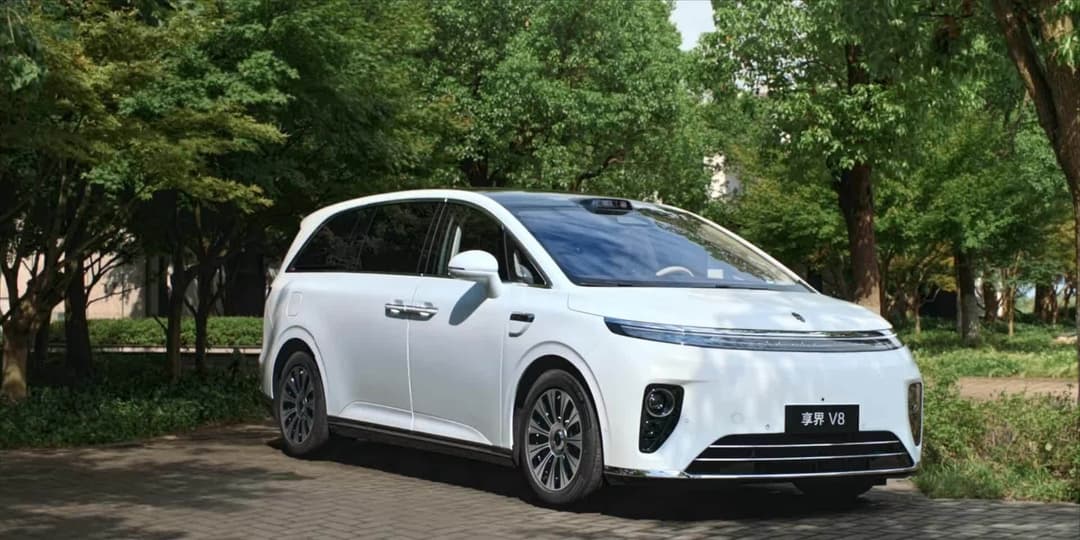
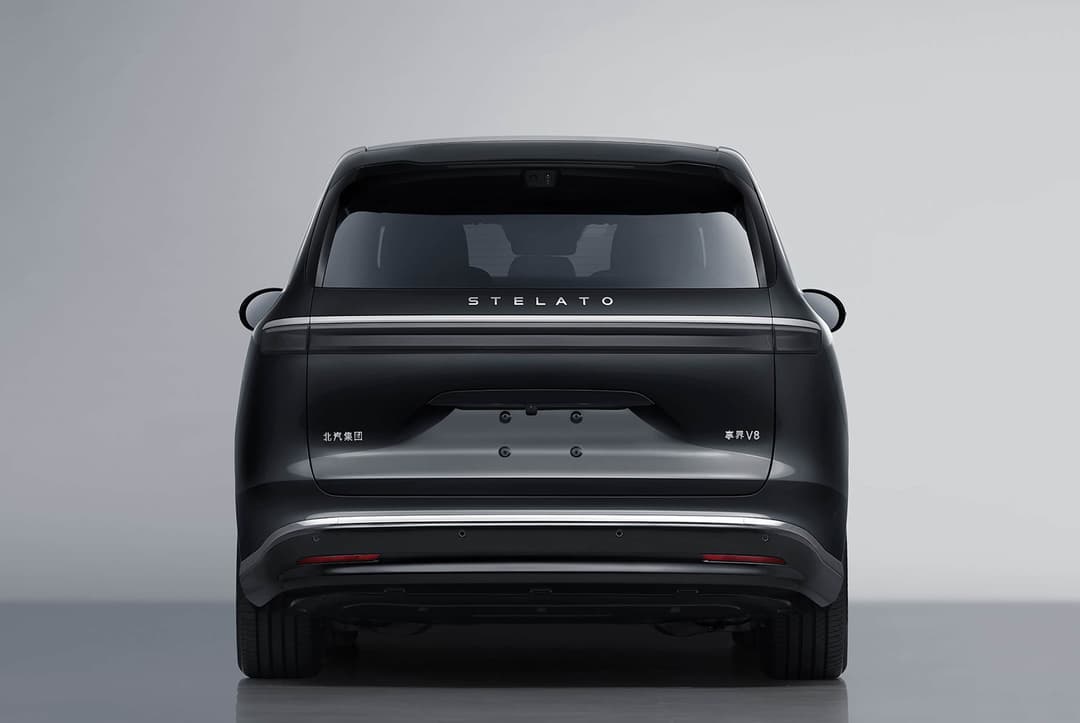
The V8 breaks with the boxy, chauffeur-car look of older MPVs. The front is closed off, with a continuous light bar running nearly two metres across the nose above a trapezoidal lower air intake, and the roofline is shaped for low drag. At the back, a full-width light strip carries the STELATO lettering. A LiDAR sits at the front edge of the roof, and the type-approval filing lists several wheel designs and red brake calipers as options. Inside, the cabin uses Huawei's family design language: a minimalist dashboard with almost no physical buttons, a three-spoke steering wheel with rollers and buttons, a wireless phone charging pad and built-in cup holders on the centre island. The rear cabin is where Stelato spends its effort. There is a 21.4-inch soft-light ceiling screen, switchable privacy glass, which the type-approval filing lists as an option on every version, and a Huawei audio system with 25 speakers.
Technology & Features
The cockpit runs Huawei's Harmony software and is built around a triple-screen layout that, according to Chinese reports of the launch, combines a 12.3-inch instrument cluster with a 17.2-inch central screen and a 17.2-inch passenger screen. The rear cabin adds the 21.4-inch ceiling display. Beyond the cabin, Stelato lists Huawei's Tuling chassis platform, Huawei's battery platform and the ADS 5 driver-assistance system as standard equipment on every trim. Pre-sale coverage does not itemise every equipment difference between Max, Max+, Ultra and Ultra+, so check the final configuration sheet once it is published.
Safety & ADAS
Stelato says the V8 carries 38 sensors, including four LiDARs: one 896-line unit on the roof and three solid-state units. Huawei's ADS 5 is standard, and the car is built on an architecture designed for Level 3 autonomous driving. That wording matters: it describes the hardware and the safety redundancy, not a Level 3 feature that owners can switch on today, so the car should be treated as a Level 2+ vehicle until a regulator approves more. Stelato also markets a Xuanwu body structure and a three-row, five-layer safety concept. It has not published an airbag count, crash-test results or the exact steel grades in the material we checked. Launch coverage lists four LiDARs for the car without a trim breakdown, while some Chinese price tables tie the 896-line unit to the Ultra trim and one to Ultra and Ultra+, so treat the four-LiDAR headline as the top-spec configuration until the configuration sheet appears.
| ADAS LEVEL | L2+ (Huawei ADS 5), architecture designed for L3 |
|---|---|
| ADAS FEATURES | 4 LiDARs (one 896-line, three solid-state), 38 sensors, rear-wheel steering, air suspension with continuously variable dampers |
Available Versions
| VERSION | POWER | TORQUE | 0-100 | TOP SPEED | DRIVETRAIN | BATTERY | EV RANGE | COMBINED RANGE | PRICE | KEY DIFFERENCES |
|---|---|---|---|---|---|---|---|---|---|---|
| BEV RWD | 304 hp | — | — | 215 km/h | RWD | 120 kWh | 830 km | — | — | Single 227 kW rear motor, 2,760 kg curb weight (type-approval filing); BEV pre-sale prices run $55,150–$67,090 across Max, Ultra and Ultra+ |
| BEV AWD | 519 hp | — | — | 215 km/h | AWD | 120 kWh | 775 km | — | — | 160 kW front + 227 kW rear motors, 387 kW combined; 2,870 kg curb weight (type-approval filing) |
| EREV 56 kWh | 304 hp (RWD), 519 hp (AWD) | — | — | 203 km/h (RWD), 215 km/h (AWD) | RWD / AWD | 56 kWh | 330 km | 1,365 km | — | 1.5T range extender (118 kW); 2,810 kg (single motor) or 2,895 kg (dual motor) curb weight per the type-approval filing; EREV pre-sale prices run $49,190–$61,120 across Max, Max+, Ultra and Ultra+ |
| EREV 75.4 kWh | 519 hp | — | — | 215 km/h | AWD | 75.4 kWh | 430 km | 1,465 km | — | The type-approval filing lists this pack only with the dual-motor layout; 100 km more battery-only range than the 56 kWh version |
Pricing & Availability
Stelato lists seven pre-sale prices across four equipment levels. The extended-range versions cost RMB 329,800 (about $49,190) for the Max, RMB 359,800 (about $53,660) for the Max+, RMB 369,800 (about $55,150) for the Ultra and RMB 409,800 (about $61,120) for the Ultra+. The battery-electric versions are RMB 369,800 (about $55,150) for the Max, RMB 409,800 (about $61,120) for the Ultra and RMB 449,800 (about $67,090) for the Ultra+, so at the same equipment level the battery-electric car costs RMB 40,000 (about $5,970) more than the extended-range one. There is no battery-electric Max+. The sources we checked do not say which battery size and drive layout go with each price, so the table above lists the powertrains and this paragraph lists the prices. Customers who place an order now receive benefits worth RMB 6,000: a RMB 2,000 deposit that counts as RMB 5,000 toward the final payment, a limited-time 50 percent discount on optional wheels and priority delivery. Showroom cars have started to arrive at HIMA stores, and Huawei's Yu Chengdong said on Weibo on October 1 that pre-sale orders had passed 8,200 units in the first 72 hours. The V8 first surfaced in China's type-approval filings on July 10, made its show debut at the Chengdu auto show in August, and opened pre-sales on September 28, 2026, alongside the Luxeed RX. As of late October 2026, no final launch date or delivery start has been announced. A Chinese blogger citing dealer sources told IT Home on October 26 that the launch is expected in early November, but that is an unconfirmed rumour.
How It Compares
The rival figures in the cards above come from our catalog, except the XPeng X9 price, which is recalculated from RMB 309,800 at RMB 6.7048 per US dollar because the catalog entry uses an older exchange rate. The Denza D9 and XPeng X9 are the cars that CnEVPost names as the V8's main competition. The V8's entry price of $49,190 is about $980 below the D9's $50,172, but about $3,000 above the X9 EREV's $46,200 (RMB 329,800 against RMB 309,800). Its combined range of up to 1,465 km beats the D9's 1,040 km but falls short of the X9 EREV's 1,602 km. On power the V8's single-motor layout, at 304 hp, sits a shade under the D9's 308 hp but above the X9's 282 hp, while the dual-motor layout reaches 519 hp. On the battery-electric side, the ArcFox Wendao V9 is in the same price bracket as the V8's BEV versions (from about $55,150) and makes 530 hp, but its 550 km range trails the V8's 775 to 830 km CLTC ratings by more than 200 km. These are catalog figures with different model years and test cycles, so treat the comparison as a guide to value rather than a like-for-like test.
- Competitive pre-sale price: from RMB 329,800 (about $49,190) for a 5,335 mm seven-seater with an 800V platform and Huawei ADS 5
- Two powertrains to choose from, with up to 830 km CLTC on the battery-electric car and up to 1,465 km combined on the range-extender
- Family-first packaging: 674 L boot with all seven seats in use, rotating second-row zero-gravity seats and 12-degree rear-wheel steering
- Peak charging power, 0–100 km/h time and torque have not been published, and final launch pricing is still to come
- The headline 1,465 km needs the larger 75.4 kWh range-extender pack; the 56 kWh version is rated at 330 km on battery and 1,365 km combined
The Stelato V8 is an ambitious family MPV that puts flagship-style hardware, from an 800V platform to a four-LiDAR sensor suite and rotating second-row seats, into a package that starts under $50,000 on pre-sale pricing. Buyers who need seven proper seats and a big boot will find the range-extender version especially compelling, while the 830 km battery-electric version suits those who can charge at home. The gaps are the unpublished charging speed, acceleration and torque figures, and the fact that the prices are still pre-sale numbers. If the final pricing holds and the missing numbers are respectable, the V8 will be one of the strongest cases in China's growing premium MPV segment.